
Past exam of the mathematics course of the University of Cambridge 2006 ib Paper 4 17B c Solution Created 2026-09-24 Updated 2026-10-14
Choose the barn entrance as , its exit as , and the positive direction as the javelin's motion. Put at the trailing end entering the barn. Write and in metres. In the javelin frame let the trailing end have , the leading end , and use the same origin event. The Lorentz transformation isIn the barn frame, the four world lines areIn the javelin frame they areThe two spacetime diagrams below use vertical time coordinates and horizontal spatial coordinates. Event labels refer to the same physical events in both panels; dashed lines show light-ray directions.
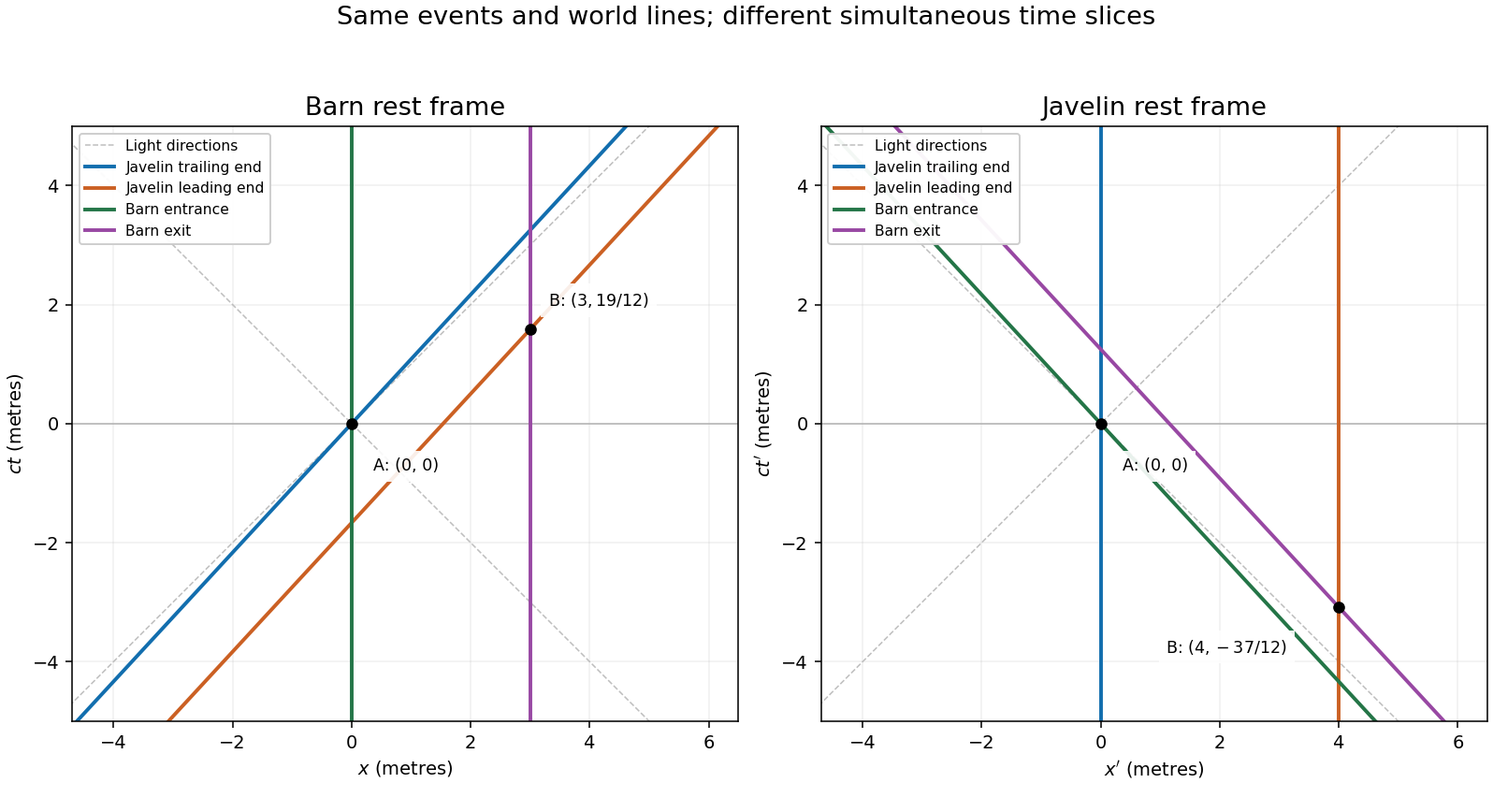
Javelin and barn world lines in the barn and javelin rest frames, with entry event A and exit event B
. Details. 
Past exam of the mathematics course of the University of Cambridge 2006 ib Paper 4 17B b Solution Created 2026-09-24 Updated 2026-10-14
In the javelin's rest frame, the barn moves at speed . Applying length contraction to its proper length givesThe lengths in the two frames use different pairs of simultaneous endpoint events.
Past exam of the mathematics course of the University of Cambridge 2006 ib Paper 4 17B a Solution Created 2026-09-24 Updated 2026-10-14
The Lorentz factor for isThe javelin's length at simultaneous barn-frame times follows from length contraction:Its proper length remains four metres.
Past exam of the mathematics course of the University of Cambridge 2006 ib Paper 4 15D b Solution Created 2026-09-24 Updated 2026-10-14
Integrating the interval indicator givesThe convolution is the length of overlap of two intervals of length one whose centres differ by . Thus for , and zero otherwise. The convolution theorem givesFor this Fourier transform normalization, the Parseval identity says . Sincewe have . Substituting givesThe quotient at zero is understood by its continuous limit.
Past exam of the mathematics course of the University of Cambridge 2006 ib Paper 4 15D a Solution Created 2026-09-24 Updated 2026-10-14
For example, it suffices to assume . Indeed the absolute double integral isThus Fubini's theorem permits interchange in the Fourier transform of the convolution. With ,Hence the convolution theorem in this normalization isThere is no extra in this formula; that factor belongs to the inverse transform and Parseval identity for the convention being used.
Past exam of the mathematics course of the University of Cambridge 2006 ib Paper 4 14F b Solution Created 2026-09-24 Updated 2026-10-14
The nearest-point assertion requires . If , there is no possible point , so the literal assertion for every closed subset has that exception.
For a nonempty closed subset of a compact metric space, is itself compact. The function is continuous, since by the triangle inequality. The extreme value theorem therefore gives a minimizer , with
Past exam of the mathematics course of the University of Cambridge 2006 ib Paper 4 14F a Solution Created 2026-09-24 Updated 2026-10-14
Let be a compact subset of a Hausdorff space, and take . For each , the definition of a Hausdorff space supplies disjoint open neighbourhoods of and of . Compactness gives finitely many covering . Their corresponding intersection is open, contains , and misses . Therefore every point of the complement has an open neighbourhood contained in the complement, so is closed. The empty compact set is closed as well.
Past exam of the mathematics course of the University of Cambridge 2006 ib Paper 4 11E b Solution Created 2026-09-24 Updated 2026-10-14
A finite basis is a generating set, so the preceding determinant trick applies with and . If , the map sending to is a ring homomorphism. Since a determinant is a polynomial expression in its entries, it sends to . ThusWith the more usual monic characteristic polynomial , this reads , the Cayley-Hamilton theorem. If the matrix convention uses column coordinates instead of the row convention above, transpose ; its characteristic polynomial is unchanged.
Past exam of the mathematics course of the University of Cambridge 2006 ib Paper 4 11E a Solution Created 2026-09-24 Updated 2026-10-14
Let be the commutative subring of endomorphisms generated by scalar multiplication and . Commutativity follows because the scalar maps commute with the -linear map , and every element of is a polynomial in with scalar coefficients. Thus determinants and the adjugate identity apply to matrices over .
With the convention for the coefficients in the question, the column of generators satisfiesMultiply by over . Since , the endomorphism kills every generator . It therefore kills every element of the module, by -linearity. Hence it is the zero endomorphism, andThe argument does not require the generating set to be a basis; relations among the generators cause no difficulty. This is the determinant trick.
Past exam of the mathematics course of the University of Cambridge 2006 ib Paper 3 8C b Solution Created 2026-09-24 Updated 2026-10-14
Use the Pearson chi-squared test of homogeneity for two multinomial samples. Under equal preference distributions, estimate the common probabilities from pooled counts, giving . With row totals forty and sixty, the expected table isThe Pearson chi-squared statistic for contingency tables isThere are degrees of freedom, after fitting the common category probabilities. All expected counts exceed five. ThusAt five percent, do not reject the common preference distribution. These data are consistent with that hypothesis; failure to reject does not prove equality. This conclusion differs from part a because a common nonuniform distribution, especially an overall preference for chocolate, is allowed here.
Past exam of the mathematics course of the University of Cambridge 2006 ib Paper 3 8C a Solution Created 2026-09-24 Updated 2026-10-14
Under the null hypothesis the three preference probabilities for girls are each . Conditional on their total of sixty, the counts have a multinomial distribution, giving expected counts . The Pearson chi-squared goodness-of-fit test statistic isNo probabilities have been fitted, so the asymptotic null distribution is chi-squared distribution with degrees of freedom. All expected counts are comfortably large for this approximation. For two degrees of freedom its upper-tail probability is , soAt the conventional five-percent or one-percent significance level, reject equal attractiveness: there is substantial evidence against the null distribution. No level was specified, so reporting the p-value makes the decision rule explicit. The test assumes independent responses and a sampling interpretation appropriate to the children surveyed.
Past exam of the mathematics course of the University of Cambridge 2006 ib Paper 3 4F ii Solution Created 2026-09-24 Updated 2026-10-14
If an open set contains an even integer, invariance under every even translation makes it contain all even integers. Similarly, containing an odd integer makes it contain all odd integers. Conversely each parity class is invariant under those translations. Thus the proposed open sets are exactlyThey form a partition topology. Both the empty and whole sets are included, and any union or finite intersection is again a union of parity classes. Hence this is a topological space. It is not the discrete topology: no singleton is open.
Past exam of the mathematics course of the University of Cambridge 2006 ib Paper 3 4F i Solution Created 2026-09-24 Updated 2026-10-14
This does not define a topology on . Every singleton is declared open, but their union over is , an infinite proper subset. It is therefore not declared open, violating closure under arbitrary unions. This is the example that finite subsets do not define a topology on an infinite set. The empty set, whole space and finite-intersection requirements do hold, but they do not compensate for the failed union axiom. This is different from the cofinite topology, which uses finite complements rather than finite sets.
Past exam of the mathematics course of the University of Cambridge 2006 ib Paper 3 1E ii Solution Created 2026-09-24 Updated 2026-10-14
Use the standard convention that an integral domain has . Since , the sign of a nonzero makes no difference. For prime, every nonzero residue has an inverse by Bézout's identity, so the quotient ring is a field and hence an integral domain. If is composite with , the nonzero classes of and multiply to zero, giving zero divisors. For , the quotient is the zero ring, excluded by the convention above. Finally, gives , an integral domain. ThusIf a convention restricts this notation to positive moduli, the answer is simply the positive primes.
Past exam of the mathematics course of the University of Cambridge 2006 ib Paper 3 1E i Solution Created 2026-09-24 Updated 2026-10-14
Take the integral domain , embedded in . It exhibits failure of unique factorization in the ring of integers generated by square root of minus five:Here is why these are genuinely distinct factorizations into irreducible elements. The multiplicative algebraic norm is a nonnegative integer and equals one only for , which are therefore the only units. Neither two nor three is a value of : if the value is at least five, and if it is a square. A factorization of into nonunits would require norms two and two; one of would require norms three and three; one of would require norms two and three. All are impossible. Thus all four factors are irreducible. The factors of norms four and nine cannot be associate elements of those of norm six, and and are not related by a sign. Therefore is an integral domain which is not a unique factorization domain.
Past exam of the mathematics course of the University of Cambridge 2006 ib Paper 3 19D c Solution Created 2026-09-24 Updated 2026-10-14
The first column is with length three. Choose , so . Its Householder reflection isDirect multiplication givesTo eliminate the remaining third-row entry in the second column, reflect the last two coordinates using . ThenandBoth steps are Householder reflections; the second happens to exchange two coordinates. Solve the leading triangular equations and to obtainFor an independent check, , whose squared norm is nine and which is orthogonal to both columns of . Thus , confirming the least-squares minimizer.
Past exam of the mathematics course of the University of Cambridge 2006 ib Paper 3 19D b Solution Created 2026-09-24 Updated 2026-10-14
For a nonzero real vector , its Householder reflection isLet . Then and , soThus is an orthogonal matrix, and it is also symmetric with . It sends to and fixes every vector perpendicular to , explaining the reflection in the hyperplane . For a target reduction of a vector to , choose when this vector is nonzero; an alternative sign avoids cancellation in numerical implementations.
Past exam of the mathematics course of the University of Cambridge 2006 ib Paper 3 19D a Solution Created 2026-09-24 Updated 2026-10-14
A full QR decomposition of a real by matrix with writeswhere is an orthogonal by matrix and is upper triangular by . In the full-column-rank case is invertible. Equivalently the reduced factorization is with . Householder transformations can construct the full factorization.
Let with . Since orthogonal transformations preserve the Euclidean norm,Therefore the linear least-squares problem has the full-rank solutionBack substitution solves this triangular system without forming . If the matrix is rank deficient, use a rank-revealing pivoted factorization and minimize over its independent columns; the minimizer need not be unique. The original PDF minimizes over ; the converted TeX's minimization over is a transcription error.
Past exam of the mathematics course of the University of Cambridge 2006 ib Paper 3 15G b Solution Created 2026-09-24 Updated 2026-10-14
Set , the Dirichlet gauge transform for constant drift. Direct differentiation givesThe homogeneous endpoint conditions on become . Thus the eigenvalue equation is . To exclude other branches without assuming the eigenvalue real, multiply by and integrate by parts:for a nonzero eigenfunction. Therefore with . The boundary conditions in give and , . HenceEquivalently, is the Sturm-Liouville form , with positive weight . Its orthogonality relation isIt is the weighted inner product, not the unweighted one, that makes these eigenfunctions orthogonal.
Expand with the coefficients from part a. Completeness and the nonzero eigenvalues give the Sturm-Liouville eigenfunction expansionThe coefficients are , so the function series converges uniformly and vanishes at both endpoints. Its first derivative also converges uniformly. Applying the transformed operator in the square-integrable sense gives the part-a expansion of ; equivalently on the interior. Integrating this continuous right-hand side gives the classical twice-differentiable solution there. No nonzero homogeneous solution satisfies both endpoints, so this solution is unique. The mismatch of the forcing's sine series at a single endpoint does not affect the interior equation or these boundary conditions.
Past exam of the mathematics course of the University of Cambridge 2006 ib Paper 3 15G a Solution Created 2026-09-24 Updated 2026-10-14
For the Fourier sine series on , orthogonality givesThereforeThe series is that of the odd, two-periodic extension. At its value is zero, agreeing with ; at every summand is zero and the series converges to zero, the average of the two one-sided extension limits. Thus it represents the function in the interior and in the square-integrable sense, not the prescribed value one at the endpoint . This endpoint issue matters when using sine expansions with homogeneous boundary conditions.
There are unlisted articles, also show them or only show them.