
Past exam of the mathematics course of the University of Cambridge 2003 ia Paper 4 2C ii Created 2026-09-24 Updated 2026-09-24
Past exam of the mathematics course of the University of Cambridge 2003 ia Paper 4 2C i Created 2026-09-24 Updated 2026-10-14
Past exam of the mathematics course of the University of Cambridge 2003 ia Paper 4 1C ii Created 2026-09-24 Updated 2026-09-24
Past exam of the mathematics course of the University of Cambridge 2003 ia Paper 4 1C i Created 2026-09-24 Updated 2026-09-24
Past exam of the mathematics course of the University of Cambridge 2003 ia Paper 4 12E Solution Created 2026-09-24 Updated 2026-10-14
The unit vectors of plane polar coordinates obey and , as follows by differentiating their Cartesian sine/cosine components. Since ,At a regular point of nonzero speed, rotating this velocity vector through a right angle produces a normal vector. Thus, up to its orientation,Its scalar product with gives the distance from the origin to the tangent line:Where is a differentiable function of and , substitute to obtainA choice of principal normal is undefined on a locally straight segment, but the perpendicular normal line and the tangent-distance formula remain meaningful.
For a central force, the torque vanishes. Use physical signed angular momentum , with . The preceding geometric formula implies , where . Conservation of energy gives . Eliminate to obtain the pedal equation for a central-force orbit:Equivalently the radial energy equation isOn an outward radial branch, divide by and integrate:On an inward radial branch the integrand acquires a minus sign. At a turning point the two branches must be joined; the quoted positive-root integral is a local branch representation, not a single global time-parametrized orbit.
For with , defineA finite moving orbit has . In the radial integral, set . Because , the outward integral, measured from the radial minimum, isJoining the inward and outward branches givesThe orientation in time is determined by the sign of . The repulsive inverse-square potential generates force , an outward inverse-cube central force, not an inverse-square force. The orbit approaches infinity along two asymptotic directions, turns once at and escapes again. The total polar-angle sweep is , and the repulsive scattering deflection isThe effective potential decreases strictly to zero, so it admits no finite circular or bounded orbit. The sketch shows this scattering in a repulsive inverse-square potential. In the radial case , the formulas dividing by are inapplicable; the direction is fixed, the turning radius is and the particle reverses on the same ray.
Past exam of the mathematics course of the University of Cambridge 2003 ia Paper 4 11E Solution Created 2026-09-24 Updated 2026-10-14
The parallel axis theorem states for two parallel axes, one through the centre of mass and the other a perpendicular distance away. To see this, expand the squared distance to the translated axis in the mass integral; its mixed term vanishes because the centroidal first moment is zero.
For a uniform solid hemisphere, the moment about a diameter in its flat face is half the corresponding full-sphere moment. With full-sphere mass , it is . The original PDF gives the centroidal displacement ; the TeX's is incorrect. Moving the diameter axis to its parallel centroidal axis therefore yieldsThis is the moment of inertia of a uniform solid hemisphere, not that of a thin hemispherical shell.
Take a cross-section perpendicular to the rotation axis. Let be the underlying sphere centre, the centre of mass and the contact point. During rounded-surface contact, vertically and points toward the curved face, with downward component . ThereforeFor rolling without slipping, is instantaneously at rest and the body rotates about it with angular speed . Thus the centroid speed is . Translation and rotation contributeThe initial vertical base has and , so conserved energy is . Equating the later to this value givesOn the initial roll toward the lowest centroid position, . Static contact friction does no work because the contacting material point is at rest; its coefficient must be large enough for the assumed no-slip motion. The formula describes the rounded-contact phase of the rolling uniform solid hemisphere and should not be continued through a change of contact geometry without another model.
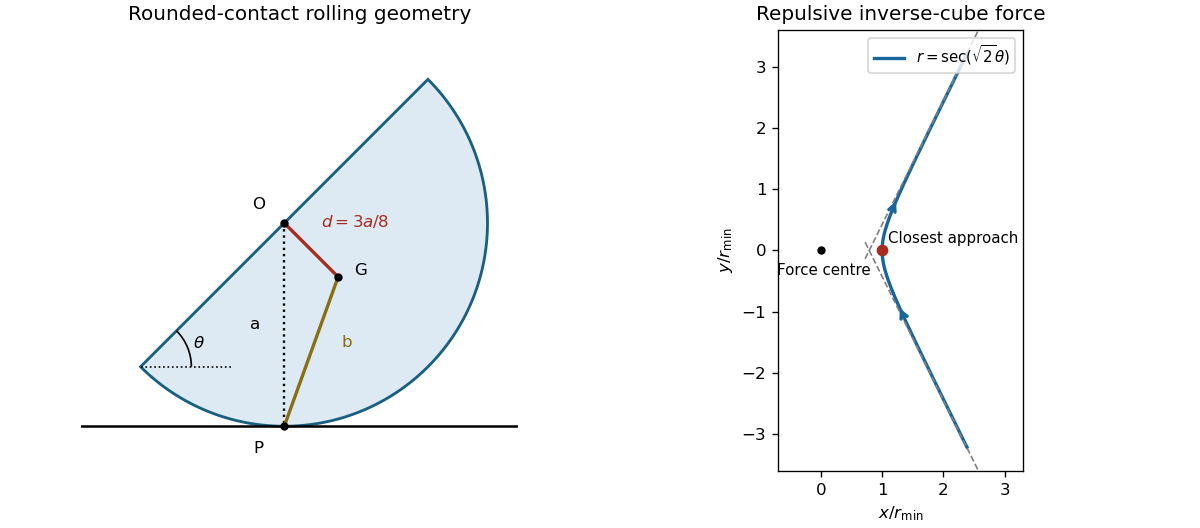
Rolling hemisphere centroid and contact geometry, and scattering under a repulsive inverse-cube force
. Details. Past exam of the mathematics course of the University of Cambridge 2003 ia Paper 4 10E Solution Created 2026-09-24 Updated 2026-10-14
For positive masses and distinct positions, Newtonian gravitational field givesInsert with . The separation numerator contributes a factor and the denominator , soHence the time-dependent equations are satisfied wheneverThe fixed-shape condition is a Newtonian central configuration, and the resulting motion is a homothetic gravitational motion. It applies away from the collision scale ; a negative scale would require absolute values in the force scaling rather than the same positive-scale formula.
In the pair potentialdifferentiating a pair with respect to produces . Every pair incident on contributes exactly once, so . Moreover for . Differentiating with respect to at one proves the relevant Euler homogeneous function theorem identity directly:Dot each fixed-shape equation with and sum to obtainFor a nontrivial collision-free configuration with at least two positive masses, and , and therefore . Positivity requires an interacting pair; an isolated one-particle system is the degenerate zero-force exception rather than a positive- gravitational configuration. Pairwise cancellation also gives , so the nondegenerate configuration has : its scaling origin is the centre of mass.
Finally, the system's kinetic energy is and its potential energy is . ConsequentlyThis establishes the energy relation for every fixed configuration satisfying the algebraic condition, without assuming any particular particle arrangement.
Past exam of the mathematics course of the University of Cambridge 2003 ia Paper 3 9A Solution Created 2026-09-24 Updated 2026-10-14
Orient the triangular boundary from to to and back to . This orientation corresponds to the positive normal vector . The cyclic coordinate rotation sends the three directed edges to one another and transforms the vector field by the same rotation. Since rotations preserve dot products, the three edge contributions to the line integral are equal.
For a sufficiently smooth vector field on an oriented piecewise smooth surface , with induced boundary orientation on , the Stokes theorem statesTherefore the requested surface integral, with all normal components positive, is also .
To verify it directly, parametrize the triangle by on , , . Its two tangent vectors are and , giving the vector area elementDifferentiation of the vector field gives . On the triangle , so its dot product with is . Consequentlyconfirming both the magnitude and the orientation sign.
Past exam of the mathematics course of the University of Cambridge 2003 ia Paper 3 8B b Created 2026-09-24 Updated 2026-09-24
Past exam of the mathematics course of the University of Cambridge 2003 ia Paper 3 8B a Created 2026-09-24 Updated 2026-09-24
Past exam of the mathematics course of the University of Cambridge 2003 ia Paper 3 7B ii Created 2026-09-24 Updated 2026-09-24
Past exam of the mathematics course of the University of Cambridge 2003 ia Paper 3 7B i Created 2026-09-24 Updated 2026-09-24
Past exam of the mathematics course of the University of Cambridge 2003 ia Paper 3 6E Solution Created 2026-09-24 Updated 2026-10-14
Write the row components as . Expanding the cross product in components,equals the alternating six-term expansion of the determinant of . Therefore .
Geometrically, is the area of the parallelogram spanned by , and its direction is perpendicular to that plane. A nonzero scalar triple product means both that this area is nonzero and that has a nonzero component normal to the plane. Thus the vectors are linearly independent and form a basis of , without needing to be orthogonal. Equivalently, their parallelepiped has nonzero volume.
The entries of are , so the required duality is exactly . Since is invertible, this has the unique solutionIts determinant is , so its rows are again a basis. Put . The cross product is perpendicular to , and its dot product with is . Consequently the reciprocal basis isThese vectors have precisely the required dot products, so uniqueness identifies them with the rows of .
For the final request, an orthonormal basis of rows gives . If instead the reciprocal rows are orthonormal, then and substitution of gives , again implying . Thus in either case is an orthogonal matrix and .
The further printed claim that must be a rotation matrix is false without an orientation assumption. The matrix has orthonormal rows and is its own reciprocal basis matrix, but : it is a reflection. By the orientation of an orthonormal reciprocal basis, the corrected conclusion isA right-handed original ordered basis supplies exactly this missing condition.
Past exam of the mathematics course of the University of Cambridge 2003 ia Paper 3 5E b Created 2026-09-24 Updated 2026-09-24
Past exam of the mathematics course of the University of Cambridge 2003 ia Paper 3 5E a Created 2026-09-24 Updated 2026-09-24
Past exam of the mathematics course of the University of Cambridge 2003 ia Paper 3 4A Solution Created 2026-09-24 Updated 2026-10-14
Suppose are two sufficiently regular solutions with the same Dirichlet boundary condition, and put . Then in and on its boundary. Apply the divergence theorem to :Thus throughout , so is constant on each connected component. Its zero boundary values force every such constant to be zero. This proves uniqueness of the Dirichlet solution, without assuming its existence.
For a prescribed Neumann boundary condition, the difference instead has . The same energy argument still gives , but does not fix the constant. Consequently the solution is unique up to an additive constant on each connected component. A value at one point, or the integral mean, fixes the constant on a connected region. There is also a necessary compatibility condition: if on , the divergence theorem givesIt is required on each component if the region is disconnected. Data failing this condition admit no harmonic solution. This is the homogeneous-source instance of the Neumann Poisson problem.
Past exam of the mathematics course of the University of Cambridge 2003 ia Paper 3 3A Solution Created 2026-09-24 Updated 2026-10-14
The curve is a hyperbola with two branches, vertices and , and asymptotes . It is symmetric under reflection in either coordinate axis. The requested sketch marks both vertices:
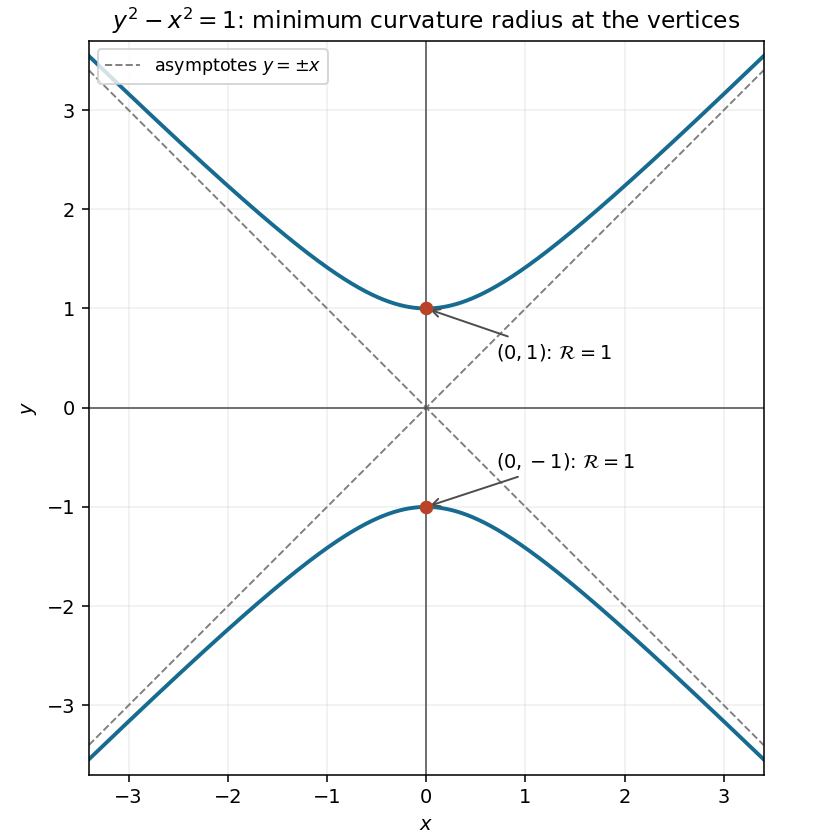


Parametrize the branches by , , for . The squared speed is , and . The reciprocal of the curvature of a plane curve is thereforeSince , with equality only at , the least radius is , attained at and .
Past exam of the mathematics course of the University of Cambridge 2003 ia Paper 3 2B Solution Created 2026-09-24 Updated 2026-10-14
Let be the normal subgroups of orders . Their intersection is a subgroup of both, so Lagrange's theorem makes its order divide both and ; hence . For and , normality shows that belongs to both and . It must be the identity, so . This proves the needed instance of normal subgroups of coprime order commute.
Choose nonidentity and . Their orders are and , since these orders divide the respective prime subgroup orders. If , commutativity gives , so and . Conversely . Thus the product of commuting elements of coprime order gives an element of order .
For the counterexample, take the dihedral group of symmetries of a regular pentagon:Its ten elements are and , . Nonidentity rotations have order , and , so all reflections have order . There is no element of order .
Past exam of the mathematics course of the University of Cambridge 2003 ia Paper 3 1A Solution Created 2026-09-24 Updated 2026-10-14
Use the standard ordered basis for both maps. The reflection in a hyperplane interchanges the second and third coordinates, so its matrix isOrient the rotation axis along and use the right-hand convention. The rotation matrix for angle sends to , to , and to . For example, the Rodrigues rotation formula givesMultiplying the rotation matrix by the dilation factor givesDirect multiplication gives , and . Hence . If the opposite axis orientation is chosen, also has cube . Independently of coordinates, two applications of the reflection give the identity, while three applications of the rotation-dilation give a full turn and dilation by . Every basis represents these resulting maps by and . Thus the equality even holds when the two matrices are expressed in different bases.
Past exam of the mathematics course of the University of Cambridge 2003 ia Paper 3 12A Solution Created 2026-09-24 Updated 2026-10-14
For a sufficiently regular vector field on a bounded region with piecewise smooth boundary , the divergence theorem stateswhere is the outward unit normal vector. Apply it to for an arbitrary constant vector . Since , it givesEquality for every constant proves the vector gradient form of the divergence theorem:
Applying the same divergence theorem directly to , with , proves the flux lawThis is the Gauss flux law for the prescribed source density, obtained directly from the divergence theorem. For the piecewise source in this problem the divergence relation is understood away from the interface, or almost everywhere; applying the theorem separately to the two sides gives the same law because the normal field is continuous across the interface and the internal boundary fluxes cancel.
For the radial field, its normal component on a sphere of radius is the constant , so its total flux is . For the enclosed source is ; for it is . Thus the origin-regular spherical Poisson flux law givesThe value at is the continuous value zero. A singular inverse-square radial addition is excluded by the source equation throughout space, including the origin: it would add a point source there.
Since , radial integration gives inside and outside. The decay condition fixes the exterior constant, giving for . Integrating inside gives , and matching at yields . Hence the potential of a uniform spherical source isBoth and its radial derivative are continuous at ; there is no surface source hidden in the matching.
For any ball centred at the origin, the gradient is odd under , so its volume integral vanishes by symmetry. On the bounding sphere, is constant and outward normals at antipodal points are opposite, so as well. Both sides of the vector gradient identity are therefore zero, for radii below, above, or equal to .
There are unlisted articles, also show them or only show them.