
Past exam of the mathematics course of the University of Cambridge 2002 ib Paper 3 20D c Created 2026-09-24 Updated 2026-09-24
Past exam of the mathematics course of the University of Cambridge 2002 ib Paper 3 20D b Created 2026-09-24 Updated 2026-09-24
Past exam of the mathematics course of the University of Cambridge 2002 ib Paper 3 20D a Created 2026-09-24 Updated 2026-09-24
Past exam of the mathematics course of the University of Cambridge 2002 ib Paper 3 1E Solution Created 2026-09-24 Updated 2026-10-14
For , ordinary differentiation of the two smooth components givesAt zero, use the definition of the derivative in the Euclidean norm:Thus has differentiability everywhere and . The two vectors and are orthogonal unit vectors, so the squared norm of the displayed derivative is . ConsequentlyThis discontinuous derivative of a differentiable plane curve also shows why componentwise scalar mean value theorem conclusions do not supply a single intermediate point reproducing an entire vector-valued difference quotient.
Past exam of the mathematics course of the University of Cambridge 2002 ib Paper 3 19F Solution Created 2026-09-24 Updated 2026-10-14
Use the standard reduced-form convention , with when or . To reduce a positive definite integral binary quadratic form, choose a primitive integer vector at which the positive integer value is least. Complete that vector to a unimodular basis; it makes the leading coefficient that least value. A shear of the second basis vector by an integer multiple of the first replaces by , allowing . The new is the value at another primitive vector, hence . If , a shear makes without changing ; if and , the determinant-one swap reverses its sign. Thus every form is properly equivalent to a reduced positive definite binary quadratic form. This argument also gives the reduction algorithm for a positive definite binary quadratic form by successively decreasing its positive leading coefficient.
For a negative integral discriminant or , a prime is represented by some integral form of discriminant exactly whenIndeed a representing vector is primitive, since a common divisor of its coordinates would have its square divide . A unimodular change takes it to the first basis vector, giving a form and . Conversely a solution gives the positive definite form , which represents at . For odd this is the discriminant criterion for prime representation by a binary quadratic form: must be a square modulo , with parity chosen to satisfy the modulo-four condition.
For and odd , the Legendre symbol is . The supplementary laws make it positive exactly for . The prime also works directly, since has discriminant and represents . ThereforeThe class here consists only of the prime .
For a reduced form, , so . The integer checks yield the reduced forms of discriminant minus thirty-two:If one omits the boundary sign convention, also appears, but is properly equivalent to . The middle form is imprimitive and represents no odd integer. An odd integer represented by has odd and is . For to be odd, one of must be odd and the other even; substitution modulo eight gives in either case. If both are odd or both even, the value is even. Thus a prime represented by the last form is necessarily .
Conversely, a prime is represented by some discriminant- form, which reduces to one of the three displayed forms without changing its represented integers. The first and second cannot represent it, so the third must. ConsequentlyThe prime is not an exception for this particular form: its minimum positive value is , as also follows from .
Past exam of the mathematics course of the University of Cambridge 2002 ib Paper 3 18C Solution Created 2026-09-24 Updated 2026-10-14
For steady uniform-density inviscid flow with no body force, the Euler equations read . Dotting with givesThus the Bernoulli equation states that is constant along each streamline; the constants need not be the same on unrelated streamlines.
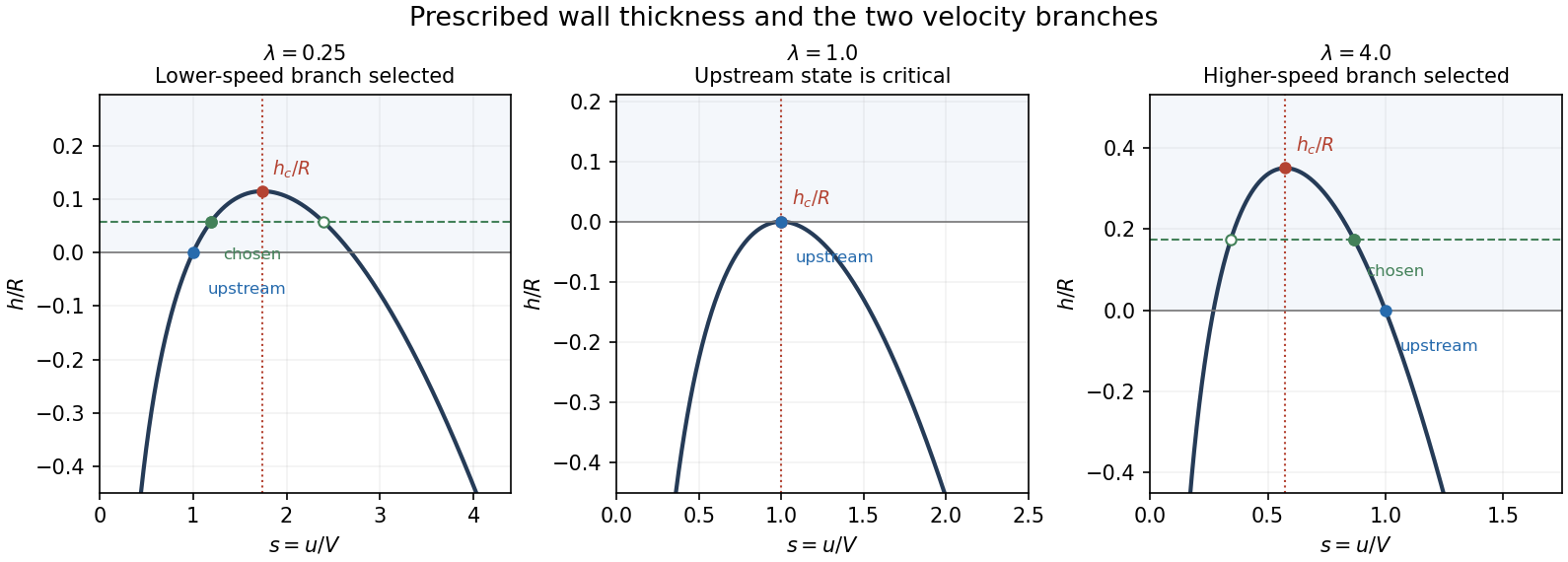
In the slowly varying tube approximation, mass conservation gives , so . The upstream Bernoulli constant and the wall pressure law giveSubtracting the internal radius obtainsThis is choking by wall thickness in an elastic tube. The function tends to as either or , and . Its derivative isIt is positive before and negative afterwards, so the unique maximum isThe maximum is nonnegative because the arithmetic-geometric mean inequality gives ; it is zero only at . If any prescribed thickness exceeds , no positive velocity can satisfy the mass/Bernoulli conditions there, so no flow of this assumed form is possible. Equality is the double-root critical case.
For each , strict monotonicity on and , together with the two negative-infinite limits, gives exactly two positive roots. The upstream condition is as . ThereforeFor , the upstream value lies on the rising branch; for , it lies on the falling branch. Smooth continuation preserves this choice because the branches meet only at , which is excluded by the strict bound. At the upstream state is already critical: , so the requirement cannot hold, and any positive wall thickness is incompatible with the approximation. With the critical root is .

Past exam of the mathematics course of the University of Cambridge 2002 ib Paper 3 17F Solution Created 2026-09-24 Updated 2026-10-14
Over a commutative field, define the determinant by the signed permutation sumIt is linear in each row separately. Swapping two rows reindexes the permutations by a transposition and reverses the sign; thus a matrix with two equal rows has determinant zero. Adding times row to a different row consequently givesThese are immediate consequences of the definition, not assumptions about elementary row operations.
For the block upper-triangular matrix, a nonzero permutation term must assign every bottom row to one of the last columns, because its first entries are zero. Those rows use all the last columns; the top rows must use all the first columns. The sign and products factor into two independent -permutations, givingIn particular has determinant . For each bottom row , subtract times top row for . The top rows remain unchanged, so these additions producewithout changing the determinant. Exchange its first and last blocks of columns; the permutation has sign and gives . HenceSince and have the same parity, . Combining the two evaluations provesNo invertibility of or was used, so the proof includes singular matrices.
Past exam of the mathematics course of the University of Cambridge 2002 ib Paper 3 16B b Created 2026-09-24 Updated 2026-09-24
Past exam of the mathematics course of the University of Cambridge 2002 ib Paper 3 16B a Created 2026-09-24 Updated 2026-09-24
Past exam of the mathematics course of the University of Cambridge 2002 ib Paper 3 15H Solution Created 2026-09-24 Updated 2026-10-14
Introduce surplus variables , slack , and artificial variables , all nonnegative. The two-phase simplex standard-form equations arePhase I maximizes . An initial basic feasible solution has basic variables and all others zero. Its simplex dictionary isLet enter. The simplex ratio test gives from the row and from the row, so leaves. After this pivot,Choose to enter; the limiting ratios are and , so leaves. The resulting dictionary isThus , attained at with . Since for every feasible Phase I point, this proves feasibility and completes Phase I.
Delete the artificial variables and restore the original objective . The resulting Phase II dictionary isLet enter; only decreases, and it reaches zero at . Pivoting givesAn optimal simplex tableau, with each row recording its equality, isBoth reduced costs in the maximization dictionary are negative. Setting nonbasic therefore givesAs a direct optimality check, implies ; the displayed point attains both equalities.
Past exam of the mathematics course of the University of Cambridge 2002 ib Paper 3 14E Solution Created 2026-09-24 Updated 2026-10-14
Let and . Distance preservation and polarization give . The vectors form an orthonormal basis, and . Hence for an orthogonal matrix . Every Euclidean isometry is therefore .
To decompose , if reflect in the origin plane normal to . This reflection sends to . The remaining orthogonal transformation fixes and acts on its two-dimensional orthogonal complement; repeat with , and then on the last one-dimensional complement. At most three plane reflections are needed. A translation is itself a product of two reflections in parallel planes: for , reflecting first in and then in gives that translation. Thus every isometry is a finite composition of plane reflections, the finite reflection decomposition of a Euclidean isometry.
For an isometry fixing zero, the preceding construction gives . A plane reflection's linear part has . The identity implies that a product of such linear parts has rank of at most , even if the reflecting planes are affine. For central inversion , this rank is three. The reflection length of a Euclidean orthogonal map therefore gives
For the regular tetrahedron, center it at zero. Every permutation of its four vertices determines an isometry, and the orientation-reversing ones correspond to odd permutations in : six transpositions and six four-cycles. Each transposition is a plane reflection fixing the two unswapped vertices; its plane contains their edge and the midpoint of the opposite edge. These give six distinct mirror planes.
The other six are rotoreflections: rotate by or about an axis through the midpoints of a pair of opposite edges, and then reflect in the plane through the center perpendicular to that axis. There are three axes and two senses. For vertices , the map is one such four-cycle; the other axes and inverse rotations give all six. Hence the complete orientation-reversing tetrahedral symmetry list is six mirror reflections and six quarter-turn rotoreflections.
Past exam of the mathematics course of the University of Cambridge 2002 ib Paper 3 13G c Created 2026-09-24 Updated 2026-09-24
Past exam of the mathematics course of the University of Cambridge 2002 ib Paper 3 13G b Created 2026-09-24 Updated 2026-09-24
Past exam of the mathematics course of the University of Cambridge 2002 ib Paper 3 13G a Created 2026-09-24 Updated 2026-09-24
Past exam of the mathematics course of the University of Cambridge 2002 ib Paper 3 12A Solution Created 2026-09-24 Updated 2026-10-14
Use the weighted inner product . For real eigenfunctions, integration by parts with the zero endpoint values givesThus . The regular separated Sturm-Liouville problem has simple eigenvalues: for a fixed eigenvalue, prescribing leaves only the initial flux free, so uniqueness of the associated first-order system makes any two eigenfunctions proportional. Distinct eigenfunctions are therefore orthogonal, and choosing their signs and scales so that givesThe positive energy form realizes as a positive self-adjoint operator in this weighted space, with compact inverse on the bounded interval. The spectral theorem for compact self-adjoint operators supplies a complete eigenbasis. This is the standard regular Sturm-Liouville eigenfunction expansion, also valid with continuous by working with the continuous flux .
For a source , expand a zero-endpoint solution of in that basis. Multiplication by and unweighted integration giveSince is not an eigenvalue, every coefficient is determined. The spectral Green function of a regular Sturm-Liouville problem is consequentlyWeighted completeness means as a distribution, so applying to this series produces the required delta source. The source integration is with , explaining the absence of an additional factor in the stated kernel.
For the subsequent operator the sign is explicitly reversed: and . To cover every real non-eigenvalue , define the homogeneous solutionIt satisfies , and . Matching the two endpoint solutions continuously at with derivative jump yieldsThe denominator is nonzero precisely off the Dirichlet eigenvalues . In particular . At , its spectral expansion givesThis odd reciprocal-square sum from a Dirichlet Green function proves .
Past exam of the mathematics course of the University of Cambridge 2002 ib Paper 3 11E Solution Created 2026-09-24 Updated 2026-10-14
The function increases for , andThus implies . Applying this to the triangle inequality for a metric proves the triangle inequality for the bounded metric transform . Symmetry and nonnegativity are immediate, and exactly when , so .
Each is compact and lies inside , so the supremum norm is finite for continuous . Every summand of lies between zero and , giving absolute convergence and . Symmetry is inherited from these norms. If , all the nonnegative summands vanish, hence on every ; their union is , so everywhere. Finallyand the subadditivity already proved give the triangle inequality term by term and then after summation. Therefore . This is a weighted metric for local uniform convergence, representing the compact-open topology.
The geometric-series sum is and its remainder is . Writing , the triangle inequality givesEquality occurs at the positive real point . ThusFor every integer , split the defining sum into a finite head and its tail. Since and ,Given , choose with . For that fixed , each of the finitely many displayed norms tends to zero, so their sum is below for sufficiently large . Hence , even though convergence is not uniform on the whole open disk.
Past exam of the mathematics course of the University of Cambridge 2002 ib Paper 3 10D Solution Created 2026-09-24 Updated 2026-10-14
For a primed inertial frame moving at speed along the positive direction relative to the unprimed frame, a Lorentz transformation isThe inverse has the opposite velocity. To avoid confusing the train speed with the ball speed, now use the primed frame for the train and write the inverse boost with train speed :The ball has on the train, so differentiation along its worldline gives the velocity-addition formulaThe time transformation is essential; simply adding the two speeds uses the Galilean rather than Lorentz relation. For positive subluminal , the result remains below , since .
Past exam of the mathematics course of the University of Cambridge 2002 ib Paper 2 9D Solution Created 2026-09-24 Updated 2026-10-14
Use the position-space momentum operator and set . Direct differentiation givesTo compute the squared orbital angular momentum, write , , , so . Expanding the products, including derivatives of their variable coefficients, givesFor example ; summing the three cyclic expressions proves the identity.
Here and , so . ThereforeThis is the angular momentum of a homogeneous harmonic polynomial, with angular quantum numbers . The polynomial is a nonzero angular eigenfunction; by itself it is not a normalizable full-space wavefunction.
Past exam of the mathematics course of the University of Cambridge 2002 ib Paper 2 8F Solution Created 2026-09-24 Updated 2026-10-14
Use the convention that a sesquilinear form is linear in its first argument and conjugate-linear in its second: for complex scalars ,No symmetry or positivity is assumed. Put . Its diagonal vanishes. Expansion at giveswhile expansion at givesThese two equations force . This is the polarization argument for a vanishing quadratic form, and proves on every pair of vectors.
For the final deduction, the linear map makes another sesquilinear form. Its diagonal agrees with that of , so the result just proved gives
Past exam of the mathematics course of the University of Cambridge 2002 ib Paper 2 7B Solution Created 2026-09-24 Updated 2026-10-14
Write the holomorphic function as , with . If then . If , differentiating the constant modulus with respect to both coordinates, and using the Cauchy-Riemann equations , , givesThe coefficient matrix has determinant , so . The Cauchy-Riemann equations then also give . Along a straight segment inside the disk, both real components have zero derivative and hence are constant. Thus is constant throughout the disk.
There are unlisted articles, also show them or only show them.