
Work-energy theorem Created 2026-09-24 Updated 2026-10-14
For a point mass of constant mass observed in an inertial frame, the net work along its actual path equals its change in kinetic energy:The middle expression is a line integral; the dot product selects the component of force along the displacement. Positive net work increases speed, negative net work decreases it, and zero net work leaves the endpoint speeds equal. Equal endpoint speeds do not imply equal velocities: a perpendicular force can continually change direction while doing zero work. [ref]
https://ocw.mit.edu/courses/8-01sc-classical-mechanics-fall-2016/mit8_01scs22_chapter13.pdf. MIT mechanics, Chapter 13, section 13.11
The bridge to Newton's second law is short: take the dot product of with velocity. The chain rule gives , equating the rate of change of kinetic energy to instantaneous power. Integrating gives the theorem. No conservative force assumption entered this argument; friction also contributes to the net work.
For the harmonic oscillator with spring stiffness , release a mass from rest at . The spring exerts . Its work before the first passage through isThus gives speed there. The velocity is negative on this passage because the position is decreasing. The energy calculation alone determines its magnitude, so the direction still requires information about the motion.
For a time-independent potential energy , the conservative force contributes work . Separating all other work as gives . Consequently conservation of mechanical energy requires zero net other work; the work-energy theorem itself does not require that conservation. With damping, mechanical energy decreases even though the theorem remains valid. [ref]
https://ocw.mit.edu/courses/8-01sc-classical-mechanics-fall-2016/mit8_01scs22_chapter14.pdf. MIT mechanics, Chapter 14: mechanical energy and nonconservative work
Two-turning-point WKB quantization condition Created 2026-09-24 Updated 2026-10-14
Winding number of a continuous closed path Created 2026-09-24 Updated 2026-09-24
If is continuous and closed, choose a continuous lift such thatThen . This agrees with the contour-integral definition when the path is piecewise smooth.
Weyl tensor of a conformally flat metric Created 2026-09-24 Updated 2026-09-24
Every conformally flat metric in dimension at least four has identically zero Weyl tensor. The Weyl tensor is the obstruction to local conformal flatness in dimensions at least four.
Trace-free property of the Weyl tensor Created 2026-09-24 Updated 2026-10-06
Every contraction of the Weyl tensor vanishes. Contracting its first and third indices directly cancels the Ricci and scalar-curvature terms; antisymmetry in each pair and symmetry under exchanging the two pairs reduce all other contractions to this one or make them vanish immediately.
Supersymmetric cancellation of quadratic divergences Created 2026-09-24 Updated 2026-10-05
Supersymmetry fixes scalar and fermion couplings so that bosonic and fermionic loop contributions to scalar masses have equal quadratic ultraviolet parts with opposite signs.
Divisor class group Created 2026-09-24 Updated 2026-09-24
The divisor class group is the group of Weil divisors modulo principal divisors of rational functions.
Prime Weil divisor Created 2026-09-24 Updated 2026-10-06
A prime Weil divisor is one integral codimension-one closed subscheme. At its generic point, regularity in codimension one supplies a discrete valuation and hence an order of vanishing.
Pitt theorem Created 2026-09-24 Updated 2026-10-14
Pitt's theorem implies in particular that every bounded operator is compact. Thus two nonreflexive Banach spaces can have only weakly compact operators between them.
Operator ideal of weakly compact operators Created 2026-09-24 Updated 2026-09-24
Weakly compact operators form a norm-closed vector subspace of and have the ideal property: bounded compositions on either side of a weakly compact operator remain weakly compact.
Gantmacher theorem Created 2026-09-24 Updated 2026-10-06
For Banach spaces and bounded , the following are equivalent: is weakly compact; ; and is weakly compact.
Weakly compact set Created 2026-09-24 Updated 2026-10-14
A subset of a Banach space is weakly compact when it is compact in the weak topology; it is relatively weakly compact when its weak closure is weakly compact.
Weak-star topology Created 2026-09-24 Updated 2026-10-03
The weak-star topology is pointwise convergence of functionals on . If is nonreflexive, it is strictly weaker than the weak topology on .
Weak closure of the unit sphere Created 2026-09-24 Updated 2026-09-24
In an infinite-dimensional normed space, the weak closure of the unit sphere is the closed unit ball. Every basic weak neighbourhood imposes only finitely many linear conditions, whose common kernel contains a nonzero direction that can move any interior point onto the sphere.
Weakly Cauchy sequence Created 2026-09-24 Updated 2026-09-24
A sequence is weakly Cauchy when is a Cauchy sequence for every continuous linear functional . Its consecutive differences form a weakly null sequence.
Weakly null sequence Created 2026-09-24 Updated 2026-09-24
A sequence is weakly null when for every member of the continuous dual space. It may remain bounded away from zero in norm.
Weak closure Created 2026-09-24 Updated 2026-09-29
The weak closure of is its closure in the weak topology. Thus exactly when every weak neighbourhood of meets .
Weak energy condition for a quadratic scalar stress-energy ansatz Created 2026-09-24 Updated 2026-10-25
For the general scalar ansatz in Conserved Klein-Gordon scalar stress-energy ansatz, work in a unit timelike frame. ThenThe weak energy condition for arbitrary local field data is therefore equivalent to
Klein-Gordon equation Created 2026-09-24 Updated 2026-09-24
Dispersion relation Created 2026-09-24 Updated 2026-10-14
A dispersion relation specifies which angular frequencies and wavevectors a linear wave model admits. Fix the plane wave conventionHere is a constant complex amplitude, is the wavevector, and is the angular frequency. Substitution into a constant-coefficient linear partial differential equation replaces by and by , turning the wave problem into an algebraic condition. A system can have several roots; means one chosen branch, rather than a promise that the full dispersion relation is single-valued. For real , means temporal growth in this convention, while means damping. The real-branch discussion of phase velocity and group velocity below assumes negligible loss.
For the one-dimensional wave equation , the dispersion relation is . The branch carries right-moving travelling waves for ; both its phase velocity and group velocity are . One may instead use the positive-angular frequency branch , with right-moving components at and left-moving components at . A real wave pairs each with ; that conjugate pair represents the same travelling pattern. Branch and sign choices therefore matter when interpreting a dispersion diagram.
A particularly tangible dispersive example is a small-amplitude surface gravity wave on still water of uniform depth . Neglect surface tension and viscosity, assume incompressible flow and irrotational flow, and impose a flat impermeable bottom. With and positive angular frequency,Here is gravitational acceleration and is the hyperbolic tangent. Deep water means : and longer wavelengths have larger phase speed. Shallow water means : , an approximately nondispersive wave. Thus depth relative to wavelength, rather than depth alone, determines whether crests and wave packets travel together.[ref]
The dispersion diagram below also includes the ideal deep-water capillary wave limit , where is surface tension and is mass density. This limit requires the surface tension restoring term to dominate gravity; it reverses the trend of the surface gravity wave, giving larger phase speed at shorter wavelength. The combined gravity-capillary wave has .[ref]
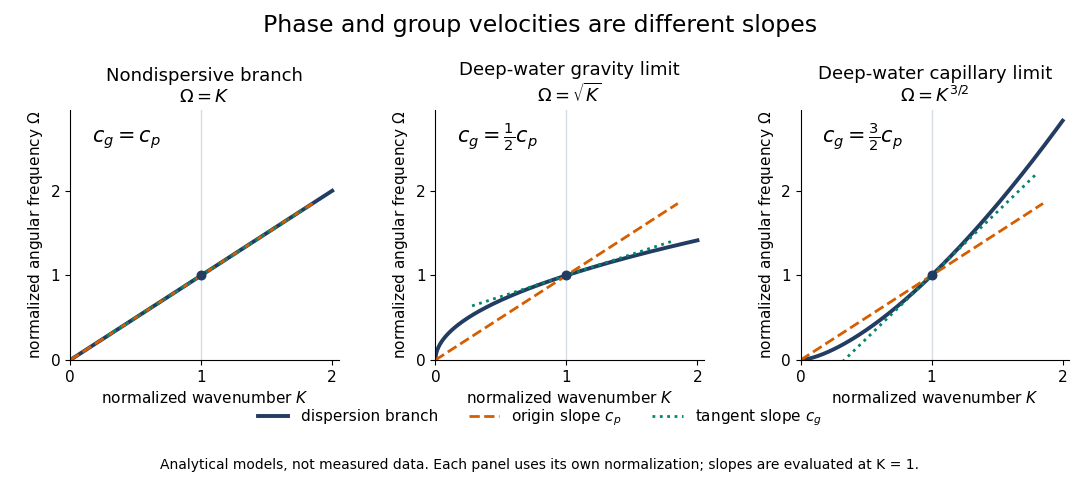
Analytical dispersion diagrams: origin-to-point slope gives phase velocity, tangent slope gives group velocity
. Details. 
The curves use dimensionless normalizations chosen separately for each model; they are analytical diagrams, not experimental data. Their beauty is that a single dispersion relation encodes several observable behaviours: its value gives the angular frequency, its origin-to-point slope gives the one-dimensional phase velocity, its tangent slope gives the group velocity, and variation of that tangent slope predicts distortion of a wave packet. A straight line through the origin describes a nondispersive wave; an affine branch with has constant group velocity but phase velocity , so those properties must be distinguished.
There are unlisted articles, also show them or only show them.