
Person-time at risk Created 2026-09-24 Updated 2026-09-24
Person-time at risk sums durations during which individuals are observed and susceptible to the event.
Capillary wave Created 2026-09-24 Updated 2026-10-14
A capillary wave is a wave along a fluid interface whose restoring stress is predominantly supplied by surface tension. A curved free surface requires a pressure jump by the Young–Laplace equation; increasing its corrugation also costs surface energy. In the ideal limit, inertia carries the interface through its flat position and the resulting oscillation propagates. When gravity also contributes appreciably, use the combined gravity-capillary wave model. Within the capillary wave regime, shortening a ripple makes it travel faster. [ref]
https://davidtong.org/pdfs/teaching/fluid-mechanics/fluids3.pdf. David Tong, Fluid Mechanics, §4.1.3: the capillary restoring pressure
The laser-diffraction measurement of capillary waves below turns this mechanism into a test: set the frequency, measure the wavelength independently with light, and ask whether the dispersion relation follows. The theory is useful both for predicting how ripple wave packets separate and for inferring surface tension from their motion.
Dynamic meniscus Created 2026-09-24 Updated 2026-09-24
Capillary length Created 2026-09-24 Updated 2026-10-14
The capillary length measures when gravity and surface tension are comparably important in shaping a liquid interface. For a liquid of uniform mass density , beneath a gas whose mass density is negligible, with uniform gravitational acceleration and constant surface tension ,A deformation of height and horizontal length scale has hydrostatic pressure variation of order and small-slope capillary pressure of order . Equating these gives : surface tension smooths small features, whereas gravity matters for broad ones. For two resting fluids, replace by their positive mass density difference in this static balance. This change alone does not give the two-fluid wave dynamics, because both fluids can have inertia. [ref]
https://ocw.mit.edu/courses/18-357-interfacial-phenomena-fall-2010/04759cfc15c79928ca9f72a18b3864dd_MIT18_357F10_lec_all.pdf. John W. M. Bush, Interfacial Phenomena, chapters 5–6: curvature and hydrostatic pressure
With the stipulated illustrative parameters , , and , the capillary length is . These parameters define the ideal calculations below; they are not a measurement of a particular sample.
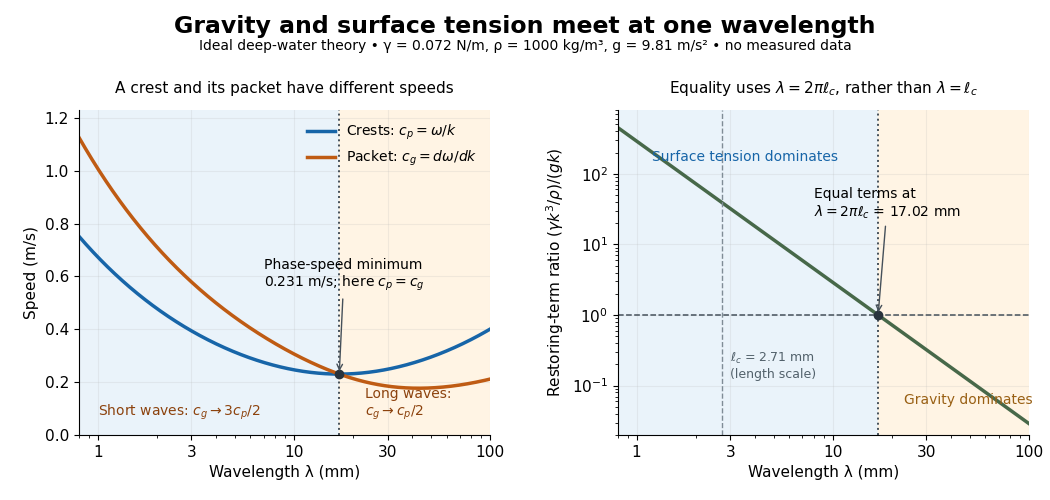

For a sinusoid with wavenumber , the relevant horizontal scale is , while its wavelength is . Thus the Bond number for this scale and the reciprocal restoring-term ratio areEquality is at , hence for these parameters. Using instead produces a different numerical Bond number; state the length convention. The capillary length itself is not the equality wavelength. This distinction helps choose whether a measured ripple should be modeled as a surface gravity wave, a nearly pure capillary wave, or a gravity-capillary wave. [ref]
https://davidtong.org/pdfs/teaching/fluid-mechanics/fluids3.pdf. David Tong, Fluid Mechanics, §4.1.3, equations (4.23)–(4.24) and the wavelength factor
Young–Laplace equation Created 2026-09-24 Updated 2026-10-14
The Young–Laplace equation relates the pressure jump across a stationary interface to its curvature and surface tension. Choose a unit normal vector pointing from the inside region to the outside region, and define to be positive for a convex sphere. In mechanical equilibrium, with constant surface tension and no additional normal viscous stresses,Here are the signed principal curvatures in this convention. Their sum is twice the corresponding signed mean curvature; stating the convention prevents a factor-of-two ambiguity. The Young–Laplace equation is a local normal stress balance for one interface. [ref]
https://arxiv.org/html/2011.11403v2. Tomas Bohr and Bernhard Scheichl, Surface Tension and Energy Conservation in a Moving Fluid, equations (8)–(9)
A spherical liquid droplet of radius in a gas has one interface, with . An ideal thin soap bubble has two liquid–gas interfaces. Adding their pressure jumps givesFor the soap bubble, now means the inner gas pressure minus the outer gas pressure. The second formula assumes equal surface tensions on both faces and film thickness negligible relative to , so their radii can be identified. Retaining distinct radii gives . A gas bubble inside bulk liquid has only one interface and therefore uses . [ref]
With the assumed constant toy surface tension , a droplet with has excess pressure ; at it has . A thin soap bubble assigned the same and has excess pressure . These are differences from the surrounding pressure, rather than absolute pressures. Halving the radius doubles the capillary pressure; doubling the interface count also doubles it at fixed radius and surface tension.
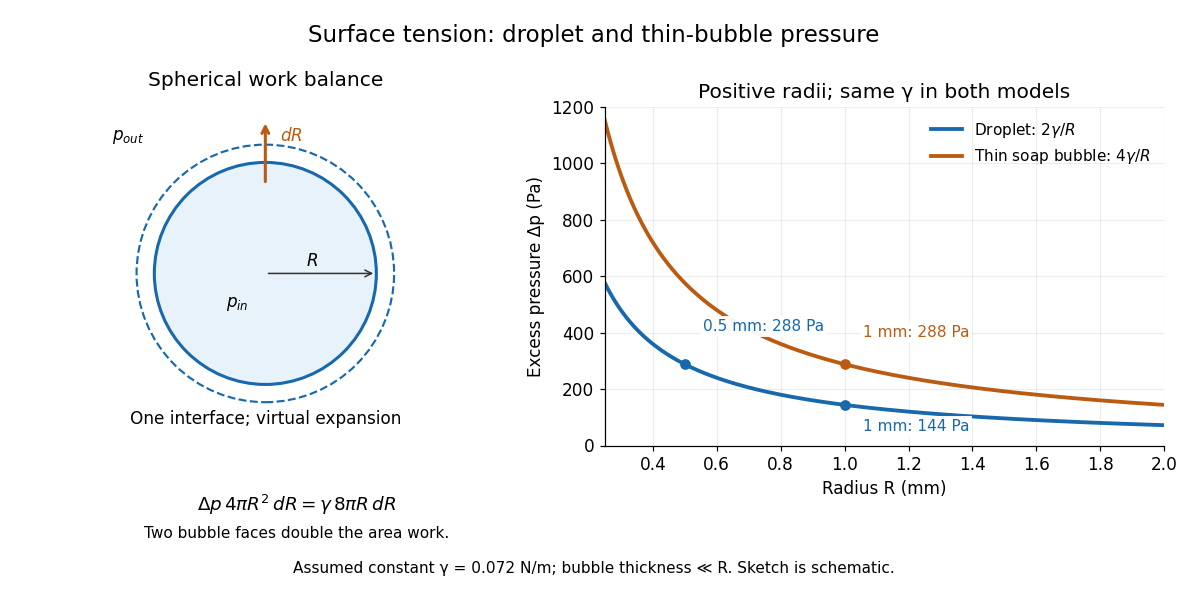
Smaller droplets need larger excess pressure; two bubble interfaces double it
. Left: a virtual outward displacement of a sphere balances pressure work against increased surface energy. Right: excess pressure in pascals versus positive radius in millimetres for one and two interfaces, using the assumed constant toy . Details.
The spherical case has a short work argument. A virtual increase in radius gives and . At mechanical equilibrium, the net pressure work balances the increase in surface energy:For a thin soap bubble, both interfaces gain approximately the same surface area, doubling the right-hand side and giving . This is a virtual work balance between neighboring spherical configurations, rather than an assumption that a fixed-volume droplet actually expands. The general Young–Laplace equation replaces the spherical area-to-volume ratio by local curvature, making geometry directly measurable through pressure.
Pöschl-Teller potential Created 2026-09-24 Updated 2026-11-05
A Pöschl-Teller potential is a solvable one-dimensional potential built from . The attractive memberis reflectionless when is a positive integer.
Partner Hamiltonians Created 2026-09-24 Updated 2026-11-05
Partner Hamiltonians in one-dimensional supersymmetric quantum mechanics are and . For with real and compatible domains, they have the differential expressionsIf with and , then is a normalized partner eigenstate of at the same energy. Applying reverses the map. The normalization follows from .
At this construction is unavailable, and one partner can have a normalizable zero mode that the other lacks. Domain compatibility is part of the statement: matching formal differential expressions alone does not prove identical spectra for arbitrary boundary conditions.
Supergravity F-term potential Created 2026-09-24 Updated 2026-11-05
Fisher-Neyman factorization theorem Created 2026-09-24 Updated 2026-10-14
Assume the full-data sample space and the range of the statistic are standard Borel spaces, is a measurable function, and the statistical model is dominated by one common sigma-finite measure . Write for its densities. Then is a sufficient statistic if and only if there exist nonnegative measurable functions and , with independent of , such thatThe statistical parameter can enter only through and the observed . [ref]
Sufficiency (Stat 210a, Fall 2025) by Will Fithian. Sufficiency, Will Fithian, “Factorization theorem”: common dominating measure and almost-everywhere factorization
For discrete data, take counting measure; for ordinary continuous data, take Lebesgue measure. Independence, identical sampling laws, smooth dependence on , and a fixed positive support of a probability distribution are not requirements of this theorem. Parameter-dependent support must nevertheless be included in , usually through an indicator function, and must fit the displayed factorization. The sufficient statistic for a symmetric uniform sample illustrates exactly this: its indicator function depends on the unknown scale through the observed absolute maximum. The null sets in the theorem concern versions of densities; the factors are not generally themselves normalized probability distributions.
For a discrete sample space, the cancellation behind the theorem is particularly transparent. On a group with positive probability, factorization givesConversely, multiply a common conditional probability mass function by to obtain the required factorization. For continuous data, a sum over a group is not a density integral over the original Lebesgue measure: the group may have measure zero. Use the regular conditional distribution formulation and the Fisher-Neyman factorization theorem instead of that discrete calculation.
Minimal sufficient statistic Created 2026-09-24 Updated 2026-11-05
A Sufficient statistic is minimal sufficient when it is a function of every other Sufficient statistic, up to null sets. Its level sets form the coarsest sufficient partition of the sample space.
Normal sample sum with known variance Created 2026-09-24 Updated 2026-11-05
For independent observations with known variance, is minimal sufficient for . Factorization proves sufficiency, while the Likelihood ratio for two samples is independent of exactly when their sums agree.
Self-adjoint differential operator Created 2026-09-24 Updated 2026-11-05
A self-adjoint differential operator is a densely defined differential operator on a Hilbert space that equals its adjoint operator, including its domain:Integration by parts can show that is a symmetric operator, meaning on , but that gives only ; equality of domains is a further requirement. Formal self-adjointness describes the interior differential expression, while a self-adjoint operator also depends on endpoint or other domain restrictions.
For example, on with domain is symmetric. The constant function one belongs to but not to , so this realization is not self-adjoint. The Dirichlet realization with domain is self-adjoint instead. The same differential formula can consequently define different operators and spectra.
Sturm-Liouville problem Created 2026-09-24 Updated 2026-11-05
A regular Sturm-Liouville problem specifies a differential equation, a positive weight, and boundary conditions together. In one standard sign convention,For example, take real continuous , continuously differentiable , and on the closed bounded interval. Separated homogeneous self-adjoint endpoint conditions can be written and , with each real coefficient pair nonzero. The parameter values admitting nonzero solutions are its eigenvalues; the solutions are its Sturm-Liouville eigenfunctions. The boundary conditions are essential: the differential equation alone is not an eigenvalue problem.[ref]
For , and zero endpoint values on , the eigenvalues are and eigenfunctions are , . Replacing the endpoints by derivative-zero conditions admits the constant eigenfunction at eigenvalue zero. Thus changing the boundary conditions changes the spectrum without changing the interior equation.
Dominant energy condition Created 2026-09-24 Updated 2026-09-28
The dominant energy condition requires the energy flux measured by every future-directed timelike observer to be future-directed and causal. Equivalently, for every pair of future-directed causal vectors and under the convention.
Weak energy condition Created 2026-09-24 Updated 2026-09-28
The weak energy condition requiresfor every timelike vector , so every observer measures nonnegative energy density.
Conserved Klein-Gordon scalar stress-energy ansatz Created 2026-09-24 Updated 2026-09-24
Null energy condition Created 2026-09-24 Updated 2026-11-05
The null energy condition requires the stress-energy tensor to satisfyfor every null vector . It is an assumption about matter, not an assertion that every tensor component or every possible quantum state has positive energy.
With the Einstein field equations in units ,contracting twice with a null vector removes both terms proportional to the metric tensor, since . ConsequentlyThus the null energy condition is equivalent to the null convergence condition for these field equations even with a cosmological constant. A modified gravitational field equation need not give the same equivalence.
For a perfect fluid with signature , normalized four-velocity and energy density , one has . The null contraction is , so the condition reduces to . Positive-density pressureless matter satisfies it, while a vacuum contribution with saturates it. This contraction is the matter term relevant to the Null Raychaudhuri equation, motivating its role in classical focusing and black-hole area arguments under their additional geometric hypotheses.
Streamline classification of a planar linear saddle or centre Created 2026-09-24 Updated 2026-10-06
For , the stream function gives hyperbolic streamlines and a saddle when , while gives elliptical streamlines and a centre.
Binary star Created 2026-09-24 Updated 2026-11-05
A binary star consists of two stars bound by gravity and moving around their shared astronomical barycenter. In a sufficiently isolated pair, a Kepler orbit approximates their relative motion. Combining the orbital period and relative semi-major axis gives the total mass through Kepler's third law, .
A resolved orbit supplies angular information; a spectroscopic binary supplies line-of-sight velocities; an eclipsing binary supplies geometric information through its light curve. Combining these can determine individual masses and stellar radii. Close pairs also exchange matter through binary mass transfer, altering their subsequent stellar evolution and sometimes reversing which component is more massive.
Stellar evolution Created 2026-09-24 Updated 2026-11-05
Stellar evolution is the change of a star's composition, structure and observable properties over time. Nuclear fusion changes the core's composition and available fuel; gravity, energy transport and mass loss then alter the stellar radius, luminosity and effective temperature. The initial mass strongly influences the sequence, but composition, rotation and binary mass transfer also matter.
The evolution of a solar-mass star connects the main sequence to giant phases and eventually a white dwarf. More massive stars can reach stellar core collapse. An evolutionary track in the Hertzsprung-Russell diagram makes these changes visible, while comparisons with coeval stellar populations test the predicted lifetimes. Two stars with similar present appearance can have different prior histories, especially after binary interaction.
There are unlisted articles, also show them or only show them.