
Small oscillation Created 2026-09-24 Updated 2026-10-14
Kinetic energy from Cartesian position vectors Created 2026-09-24 Updated 2026-09-24
For point masses with generalized coordinates, kinetic energy follows by differentiating their Cartesian position vectors and summing .
Double pendulum Created 2026-09-24 Updated 2026-10-18
A double pendulum consists of two pendula coupled because the second pivot moves with the first mass. It has two degrees of freedom: even when the upper pivot is fixed, moving the upper arm carries the lower pivot along. This makes the double pendulum a compact example of how mechanical constraints couple motion, and how Lagrangian mechanics converts geometry into dynamics.
Use two equal point masses and two massless rigid rods of equal length , with joints that allow free rotation in one vertical plane. The upper pivot is fixed; gravity is uniform, with gravitational acceleration . Neglect joint friction and drag force. Both angles are measured from the downward vertical, positive toward the right, in radians. In particular, is an absolute angle, not the bend between the rods: that bend is .
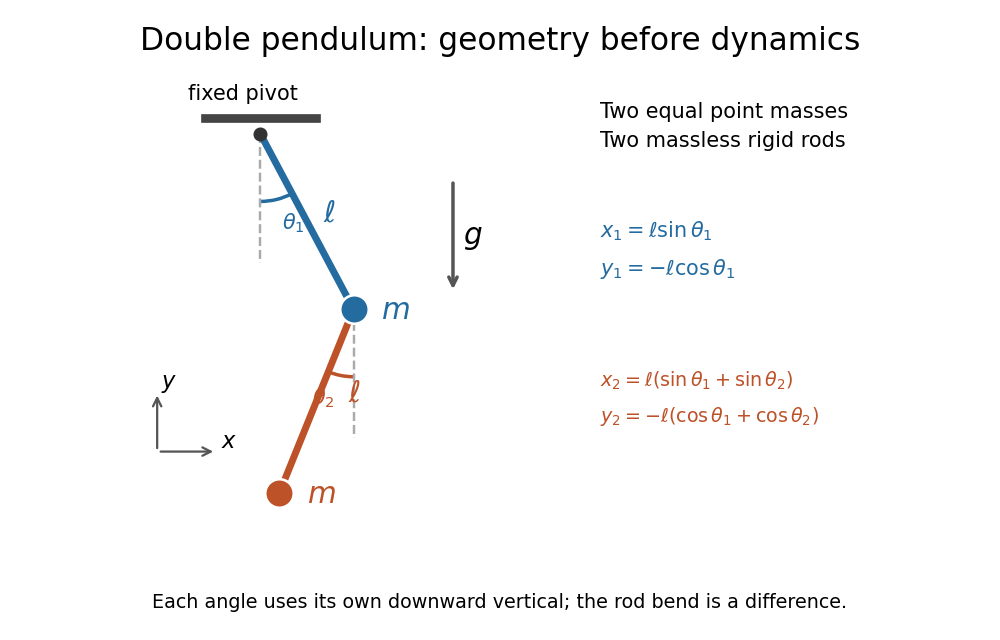
Equal point masses and massless rods: both angles are measured from the downward vertical
. Original diagram of the ideal double pendulum. Dashed vertical lines are the separate references for and ; the lower position vector is the sum of the two rod vectors. The drawn angles illustrate geometry, rather than the small-angle approximation. Details.
The double pendulum Lagrangian below gives the exact dynamics of this ideal model. Near the downward stable equilibrium, normal modes of a double pendulum replace the coupled motion with two independent harmonic oscillators. Their fixed amplitude ratios explain which releases make the rods swing together and which make them swing in opposite directions.
Axially symmetric isotropic-mass Lagrangian Created 2026-09-24 Updated 2026-09-24
If and depends only on and , then rotations about the axis leave invariant. The quantity supplied by Noether theorem is the axial angular momentumIf also has no explicit time dependence, the energy is conserved independently.
Conserved quantities from cyclic coordinates Created 2026-09-24 Updated 2026-10-03
If a Lagrangian is independent of a coordinate, the conjugate momentum to that coordinate is conserved by the Euler--Lagrange equations.
Generalized momentum Created 2026-09-24 Updated 2026-10-14
In Lagrangian mechanics, the coordinate variable describes the configuration; its conjugate momentum need not equal the Cartesian mechanical momentum.
Charged-particle electromagnetic Lagrangian Created 2026-09-24 Updated 2026-09-24
For electromagnetic scalar and vector potentials and ,Withthe Euler--Lagrange equations give the Lorentz force , while the canonical momentum is .
Total-time-derivative invariance of a Lagrangian Created 2026-09-24 Updated 2026-09-24
Replacing a Lagrangian byadds only the endpoint term to the action. Fixed-endpoint variations therefore give the same Euler--Lagrange equations.
Action Created 2026-09-24 Updated 2026-10-14
The action of a path is the time integral of its Lagrangian. The principle of stationary action requires its first variation to vanish for every admissible fixed-endpoint variation.
Weighted open-box minimization Created 2026-09-24 Updated 2026-11-05
Let be the dimensions of a lidless rectangular parallelepiped, fix positive volume , and take positive face weights . Minimize the weighted face cost . The three summands have fixed productThe arithmetic-geometric mean inequality therefore gives , with equality exactly when . These conditions are attainable: if , takeTheir product is , so this is the unique positive global minimizer. For , corresponding to a base and four unweighted side faces, the dimensions obey . The positivity and fixed-volume assumptions are essential parts of the minimization statement.
Derivative of a constrained value function Created 2026-09-24 Updated 2026-10-06
Kramers-Moyal master equation Created 2026-09-24 Updated 2026-11-05
For a jump process with rate from state to , probability balance givesThe first term is inflow from and the second is outflow from .
Constant-birth pair-annihilation process Created 2026-09-24 Updated 2026-11-05
A count-valued Markov jump process with constant single-particle births and pair annihilation must preserve . Choose the ratesThe second rate vanishes at , where there is no pair to remove; the factor for unordered pairs has been absorbed into .
In the Kramers-Moyal expansion, the first two coefficients are the rate-weighted first and second jump moments:Here is the noise variance per unit time in the local diffusion approximation. The positive drift root isThis is the stable fixed point of the drift equation, rather than an exact formula for the mean of the stochastic population.
For , fluctuations far from the count boundary are approximately an Ornstein-Uhlenbeck process. Its stationary variance isAt leading large-count order one may replace by and by , recovering the simpler approximation. A rate proportional to used literally at would allow a negative population, so that replacement is an interior asymptotic approximation rather than the exact count model.
Soliton Created 2026-09-24 Updated 2026-09-24
KdV Schrodinger spectral problem Created 2026-09-24 Updated 2026-10-14
The inverse-scattering spectral problem associated with this KdV convention isFordifferentiation gives the Wronskian identity
Colored link Created 2026-09-24 Updated 2026-10-03
Link Created 2026-09-24 Updated 2026-09-24
A link is a smooth embedding of a finite disjoint union of circles in , considered up to ambient isotopy. A one-component link is a knot.
Seifert longitude Created 2026-09-24 Updated 2026-10-14
The Seifert longitude is the zero-linking parallel of a knot on the boundary of its tubular neighborhood. It is the framing induced by a Seifert surface.
Stevedore knot Created 2026-09-24 Updated 2026-10-14
Surface knot Created 2026-09-24 Updated 2026-10-14
A surface knot is a smooth embedding of a closed connected surface in a four-manifold. In the narrow standard usage, a 2-knot is an embedded two-sphere in .
It extends the embedding viewpoint of knot theory to two-dimensional domains.
There are unlisted articles, also show them or only show them.