
Mathematical physics Created 2026-09-24 Updated 2026-11-05
Mathematical physics develops mathematical descriptions of physical systems and studies what follows from their assumptions. A differential equation can model motion, an linear operator can represent an observable in quantum mechanics, and a symmetry can produce a conservation law. The mathematical structure matters because it reveals which predictions share a common mechanism and which depend on a particular idealization.
A central force illustrates the connection. Its vanishing torque conserves angular momentum, confining a classical particle's motion to a plane and reducing its radial dynamics to an effective potential. One vector equation becomes a one-dimensional energy problem. The reduction also identifies its own limits: a noncentral perturbation can produce a torque and invalidate the conserved quantity. Mathematical clarity is useful precisely because the physical assumptions remain visible.
Area of mathematics Created 2026-09-24 Updated 2026-11-05
An area of mathematics groups related concepts and methods. The glossary of areas of mathematics collects terminology for these fields.
Zero divisor Created 2026-09-24 Updated 2026-11-05
A nonzero element of a commutative ring is a zero divisor if some nonzero satisfies . In a noncommutative ring, left and right zero divisors must be distinguished. The nonzero requirement on both factors is part of the usual convention.
In , the classes of two and three are zero divisors because their product is zero. A commutative ring with identity, , and no zero divisors is an integral domain. Cancellation by a nonzero factor is valid in an integral domain but can fail in a ring with zero divisors: modulo six, although .
Thomae function Created 2026-09-24 Updated 2026-11-05
The Thomae function on the real line is at irrational and for a rational written in lowest terms with . It is continuous at every irrational point and discontinuous at every rational point.
To see continuity at an irrational , choose . In any bounded neighborhood there are only finitely many reduced rationals with denominator at most ; avoid them with a smaller neighborhood of . All remaining values are less than . At rational , irrational points approaching it have value zero instead of . Despite these dense discontinuities, the function is Riemann integrable on every closed finite interval, with integral zero.
Termwise integration Created 2026-09-24 Updated 2026-11-05
Termwise integration interchanges an integral with an infinite series:One sufficient hypothesis is uniform convergence of the partial sums on a finite interval, with every term Riemann integrable. The error in the integral is at most times the uniform error. In Lebesgue integration, dominated convergence or a summable sequence of absolute integrals supplies other sufficient conditions.
For , the geometric series converges uniformly on . Integrating gives . A pointwise identity alone would not justify the interchange.
Spectral mapping theorem Created 2026-09-24 Updated 2026-11-05
A spectral mapping theorem relates the spectrum of an operator to the spectrum after applying a function to it. For a bounded linear operator on a complex Banach space and a polynomial ,Factor over the complex numbers. If no root lies in , every factor is invertible, so their product is invertible. Conversely a product of commuting factors can be invertible only if each factor is invertible, giving the reverse inclusion.
For a matrix with eigenvalues one and three, has eigenvalues two and ten. More general functions require a specified functional calculus; an unrestricted substitution rule for unbounded operators is not automatic.
Simultaneous diagonalization Created 2026-09-24 Updated 2026-09-24
A finite family of pairwise commuting diagonalizable operators on a finite-dimensional complex vector space is simultaneously diagonalizable. In particular, commuting Hermitian operators admit an orthonormal common eigenbasis.
Run of successes Created 2026-09-24 Updated 2026-11-05
A run of successes is a consecutive block of successful trials in a binary observation sequence. For independent trials with success probability , the waiting time until the first run of successes has meanLet be the remaining mean after consecutive successes. For , , while . Solving backward gives the formula. At , , the mean is six, agreeing with the HH pattern waiting time. A run requires consecutive successes, unlike merely collecting successes in total.
Rodrigues rotation formula Created 2026-09-24 Updated 2026-10-20
For a real angle and a unit vector , the rotation about sendsThe vector triple product identity gives the equivalent expression . To see why it is a rotation, decompose into its parallel and perpendicular components relative to . The parallel component is fixed, while the perpendicular component becomes , the usual plane rotation. It is also the matrix exponential of the linear operator : the identity reduces its exponential series to these three terms.
Rational root theorem Created 2026-09-24 Updated 2026-09-24
If a primitive polynomialhas a rational root in lowest terms, then and . In particular, a monic integer polynomial can have only integer rational roots dividing its constant term.
Quasi-steady approximation Created 2026-09-24 Updated 2026-10-03
A quasi-steady approximation neglects a field's time derivative because that field relaxes much faster than the variables that drive it. The rapidly adjusting field then satisfies a steady equation with the slow variables treated as instantaneous parameters.
Period of a function Created 2026-09-24 Updated 2026-10-07
Pattern waiting time Created 2026-09-24 Updated 2026-11-05
A pattern waiting time is the number of observations required until a specified finite pattern first occurs in a stochastic process. Overlaps between possible occurrences affect the answer; treating sliding windows as independent generally gives the wrong mean.
For independent fair coin tosses, let be the expected additional tosses to first see HH with no current matching prefix, and the expectation after one H. Then and , giving . For HT, the analogous equations give four. The patterns have the same probability in a fixed two-toss window, but different self-overlap structure.
Nilradical Created 2026-09-24 Updated 2026-10-06
The nilradical of a commutative ring is its ideal of nilpotent elements, equivalently the radical of an ideal applied to its zero ideal.
Nakayama lemma Created 2026-09-24 Updated 2026-11-05
One form of the Nakayama lemma says: if is a finitely generated module over a commutative unital ring , lies in the Jacobson radical, and , then .
For a local ring with maximal ideal , this implies that elements generating lift to generators of : apply the lemma to their quotient module. The finite-generation hypothesis is essential.
For the determinant proof, choose generators and write with . Multiplying by its adjugate gives . This determinant is modulo , hence is a unit because lies in the Jacobson radical. Therefore .
Metrizable space Created 2026-09-24 Updated 2026-11-05
A topological space is a metrizable space if some metric on its set generates exactly its given topology. The choice of metric need not be unique. For example, and generate the same topology on the real numbers even though one is unbounded and the other bounded.
Metrizability lets one use metric balls and sequential arguments to study the space. Every metric topology is Hausdorff and first countable, so a topology lacking either property is not metrizable. Conversely those two properties alone are not a complete metrization criterion; additional hypotheses occur in the standard metrization theorems.
Method of images Created 2026-09-24 Updated 2026-11-05
The method of images solves a linear boundary problem by replacing a boundary with fictitious sources chosen so their combined field obeys its conditions. The constructed solution is then justified by a uniqueness of Poisson equation, not by treating the fictitious sources as physically present.
For a charge at height above a grounded conducting plane , place an image charge at height . In the upper half-space,is zero on the plane and satisfies the required source equation. Dirichlet uniqueness for the Poisson equation identifies it as the physical potential above the conductor. The construction exploits symmetry; arbitrary boundaries need not have a finite set of image sources.
Cycle decomposition of a permutation Created 2026-09-24 Updated 2026-11-05
The cycle decomposition of a permutation partitions a finite set into orbits under repeated application of the permutation. Writing one cycle means and . Disjoint cycles commute, and the decomposition is unique up to their order and cyclic rotation within each cycle.
Conjugacy class Created 2026-09-24 Updated 2026-10-14
For an element of a group , its conjugacy class is its orbit of a group action under the conjugation action:Thus conjugate group elements describe the same operation after a change of labels. In a symmetric group, conjugation renames the entries of every permutation cycle:For example, with and the transposition , this gives . Products use function composition of permutations, with the rightmost factor applied first. The complete six-element example is conjugacy classes of the symmetric group on three letters.
The conjugacy classes form a partition of a set of , since conjugacy is an equivalence relation. In a symmetric group, two permutations lie in the same conjugacy class precisely when they have the same cycle type: renaming preserves the lengths of permutation cycles, and matching equal-length permutation cycles constructs a renaming in the other direction. This compresses many labelled permutations into a few structural types. See McKernan, Conjugation in Sn, lemma 6.2 and proposition 6.6.
The stabilizer subgroup of under the conjugation action is its centralizer . Consequently the orbit-stabilizer theorem givesThe counting mechanism is the bijection from left cosets onto the conjugacy class: two choices of give the same result exactly when they differ on the right by an element of the centralizer. A large centralizer means many choices of labels leave the operation unchanged, hence a small conjugacy class. A conjugacy class has size one precisely when its element belongs to the center of a group. The class equation counts these orbits of a group action together.
Chinese remainder theorem Created 2026-09-24 Updated 2026-10-20
The Chinese remainder theorem says that remainders modulo pairwise coprime positive integers can be specified independently. For pairwise coprime and , every prescribed list determines one congruence class modulo satisfying for all . It determines a class, rather than one unrestricted integer: adding a multiple of preserves every remainder.
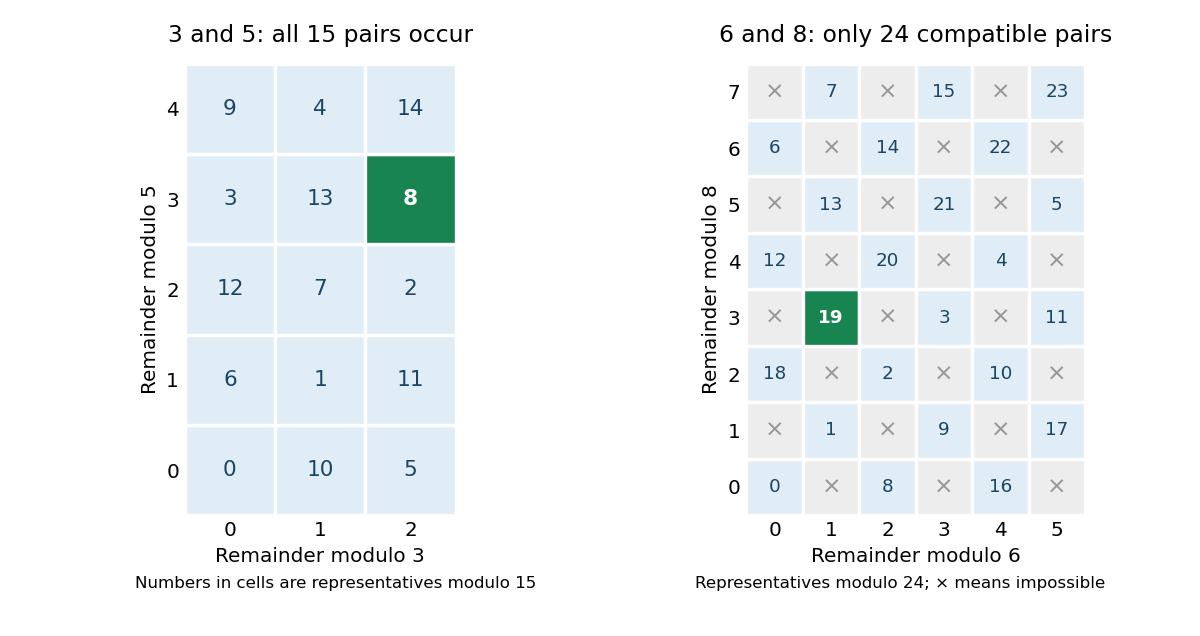
For example, combine and . Write from the first condition. The second becomes . Since three has modular inverse two modulo five, , giving . The integers , and all work. The fifteen possibilities modulo fifteen correspond to the fifteen pairs in a three-by-five grid.

The theorem also preserves arithmetic: reducing an addition or a multiplication modulo each gives the same tuple as performing that operation on the corresponding congruence classes. In the language of quotient rings, reduction is a ring isomorphismOne large residue is thus an exact encoding of several smaller residues. This is useful for splitting arithmetic into smaller calculations and then reconstructing the result; MIT's modular arithmetic notes develop both the reconstruction and the product representation. [ref]
https://ocw.mit.edu/courses/18-200-principles-of-discrete-applied-mathematics-spring-2024/mit18_200_s24_lec15.pdf. Moitra, MIT 18.200, Lecture 15, section 4, Chinese remainder theorem
For a concrete multiplication, corresponds to and to modulo . Their componentwise product is , which reconstructs to , agreeing with .A constructive formula explains the independence. For , put and choose with , using a modular multiplicative inverse. Then is one modulo and zero modulo every other . Thereforehas the desired remainders. A modulus equal to one imposes no restriction and can be omitted. Uniqueness follows because a difference divisible by every is divisible by their product when they are pairwise coprime. This short construction gives a reusable algorithm as well as an existence statement.
The coprime hypothesis explains why every cell in the left grid is attainable. With integer moduli six and eight, a pair must agree modulo their greatest common divisor, two. There are twenty-four compatible pairs, rather than forty-eight arbitrary pairs; each corresponds to a class modulo the least common multiple, twenty-four. The Chinese remainder theorem for noncoprime moduli states the resulting compatibility rule.
There are unlisted articles, also show them or only show them.