
Principal convex lattice subgroup 2026-10-14
For in a lattice-ordered group, the displayed set is the smallest convex lattice subgroup containing . Products of two such bounds are bounded by a larger power of ; inversion and the lattice operations preserve the bounds. This gives an explicit test for membership.
Lattice of convex lattice subgroups 2026-10-14
The convex lattice subgroups of a lattice-ordered group form a distributive lattice, with intersection as meet and the convex lattice subgroup generated by a union as join. A positive element of a join is bounded by a finite product of positive elements from the generating subgroups. Riesz decomposition in a lattice-ordered group splits such an element into positive factors from those subgroups. If the original element belongs to another convex subgroup , every factor does too. Consequently .
The displayed relation makes the right cosets into a lattice, with and . Antisymmetry uses convexity: and give , hence . A prime convex lattice subgroup makes this order total even if the subgroup is not normal.
Assume for all in a lattice-ordered group. For a convex lattice subgroup and , the displayed bounds allow with and integers . To prove the first set is a subgroup, use . Products and inverse products are both bounded because and . Taking the larger exponent and a join of the two bounds in bounds their absolute value in a lattice-ordered group. Inversion preserves that absolute value; common bounds using prove lattice closure and convexity. The set contains and , and any convex lattice subgroup containing them contains the entire set. The second equality follows by applying the proof to the opposite group, where the required inequality is the original one with the variables interchanged.
James's theorem 2026-10-14
James's theorem says that a Banach space is reflexive exactly when every continuous linear functional attains its supremum on the closed unit ball. Its separation proof also yields the equivalent convex-block criterion: nonreflexivity produces a bounded sequence whose initial and tail convex hulls remain uniformly separated.
For convective contraction with power-law opacity at fixed stellar mass and opacity normalization, and . Eliminating gives . Thus a larger mean molecular weight moves the track to larger effective temperature at a given luminosity, with . Contraction decreases both temperature and luminosity for this particular opacity exponent.
Match an stellar polytrope to the grey-atmosphere convection onset with seventeenth-power opacity. At each instant the convective entropy coefficient obeys , at fixed composition, while the boundary gives . Thus and the first displayed luminosity law follows. The stellar virial theorem for a monatomic gas gives total energy , so Kelvin-Helmholtz contraction has . Integrating at fixed mass gives . The second displayed relation holds after the initial-radius term is negligible. The entropy coefficient is spatially constant but changes during contraction.
For a fixed-mass, fully convective monatomic gas protostar, write and . Matching the photosphere to with gives . The Stefan–Boltzmann law gives . The stellar virial theorem gives total energy , so . Integrating proves . This holds before stellar nuclear fusion, changing opacity or electron degeneracy pressure invalidates the assumed contraction law.
Coalescing random walks 2026-10-14
Particles perform independent continuous-time random walks until they meet, after which they share one path. A finite initial particle set remains finite and its cardinality cannot increase. They arise as the common ancestors of sites in a voter model. On the square lattice every pair eventually coalesces, because the difference walk is recurrent Markov chain.
If is a continuous local martingale and , then finite variation of forces . The Itô formula and the quadratic variation of a stochastic integral give . The occupation-times formula implies that almost everywhere where . On the zero set of , its derivative vanishes almost everywhere: zeros at which are isolated and hence countable. Thus . Both terms in the Itô formula vanish.
Every nonempty open subset of an irreducible space is connected. A locally constant function into a fixed abelian group is therefore constant on that open set. Restrictions between nonempty opens identify with the identity of , and restrictions to the empty set are surjective onto zero. Thus the constant sheaf is flasque, with global sections and zero higher sheaf cohomology on a nonempty irreducible space. For an integral scheme its constant function-field sheaf has its natural structure-sheaf action by regular functions viewed in the function field.
Under the same box-model assumptions, is initial particle mass and is final deposited mass per downstream length. Integrate the vertical particle deposition flux across the instantaneous triangular-valley width from arrival of the front at until settling is complete. This gives the displayed profile on and zero beyond the runout. Its integral is , verifying particle mass conservation. Areal deposit density also depends on the lateral coordinate because the wetted valley width changes as the current thins.
// Target: geophysics.bigb
With specific heating , the constant-opacity radiative-zero giant envelope has and . Therefore the shell power is proportional to . Integrating from the core radius gives . The steep radial dependence justifies a thin-shell estimate dominated by the base. Using the outer radiative profile throughout the emitting layer is an approximation; a resolved shell can change the numerical coefficient. Also , so retaining radiation pressure makes the relation implicit in luminosity.
Antiderivatives on disconnected domains 2026-10-14
Let be an open subset of the real line, and let be antiderivatives of the same function on . Each connected component is an open interval. On that component, , so the mean value theorem gives . The constants on different components are independent: there is no subinterval inside joining them. Conversely, adding any chosen constant on each component preserves the derivative everywhere on .
For example, the domain of is . Every antiderivative on this domain has the formwith arbitrary real . The logarithm of the absolute value differentiates to on each side. The function with and is therefore a valid antiderivative, although it cannot be written as with one global constant.
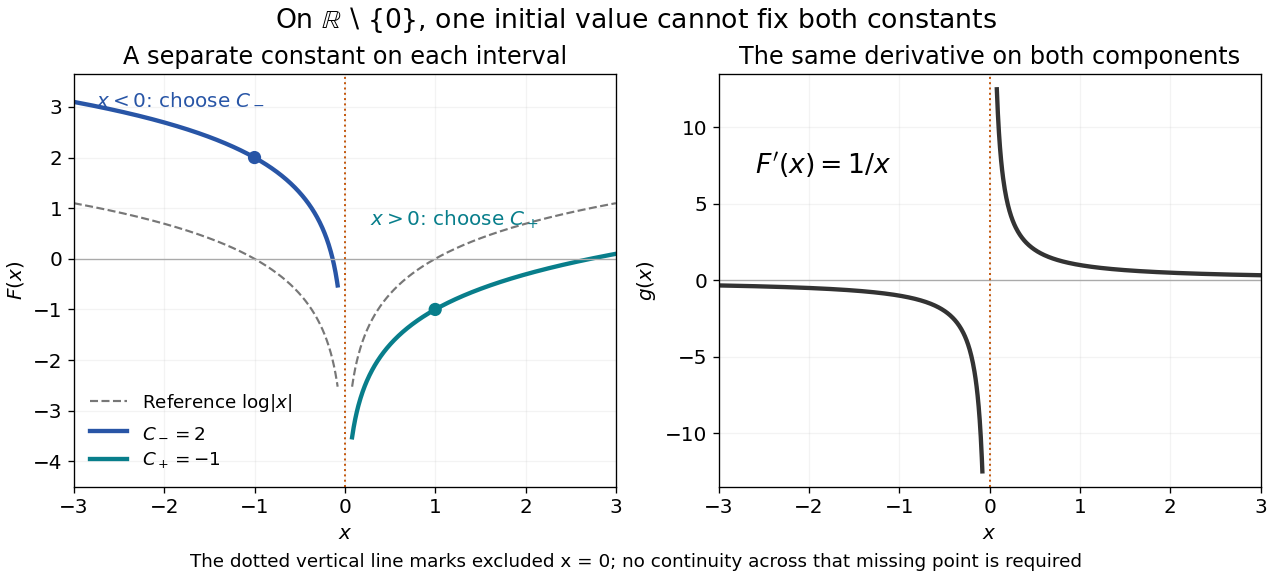
Two disconnected intervals allow independent constants while the derivative stays the same
. Details. 
An initial condition at fixes and leaves free. Fixing both constants requires one reference value in each connected component, or additional conditions that couple the components. The locally constant function captures this remaining freedom.
Adjoints to constant presheaves on open sets 2026-10-14
For a topological space , let be the constant presheaf of sets on its open-set category, with identity restriction maps, including the value at the empty open set. A natural transformation is determined by its map ; its component at composes with . A transformation is determined by ; its component at restricts sections from . These two bijections prove the displayed adjunctions. This concerns presheaves, so no sheafification is involved.
If is a conservative vector field, equality of the mixed derivatives of its potential gives . Expanding proves the displayed necessary equation. For continuously differentiable data on the whole plane, the vanishing planar curl is also sufficient for a potential. A useful integrating factor is nonzero on the region under consideration.
One-sided Fourier spectrum excludes jumps 2026-10-14
Let an integrable function have finite one-sided limits at zero. Oddness gives . Also . Thus : make the near-zero error in arbitrarily small and bound the remaining integral uniformly. When negative Fourier coefficients vanish, the conjugate-kernel identity makes this convolution bounded because tends to . Therefore . A removable discontinuity caused solely by altering a point value is not excluded.
Conjugate permutation 2026-10-14
Two permutations in the same symmetric group are conjugate if for some permutation . Conjugation relabels every permutation cycle, so it preserves cycle type. Conversely, equal cycle types permit a relabelling between corresponding cycles, establishing conjugacy.
For the modified Helmholtz equation with identical oriented outward Neumann boundary data on all sides of an equilateral triangle, uniqueness forces rotation invariance. Put , , and . At , paired global relations giveFor one may choose ; both denominator factors are nonzero. The derivation retains the tangential-derivative term in each side spectrum. Its endpoint contribution vanishes at these samples because rotation invariance makes all vertex values equal. For the data must have zero total flux and an additive constant remains; negative parameters at Neumann Laplacian eigenvalues require the Fredholm solvability condition and allow homogeneous additions.
Let the base be a smooth algebraic curve, the total surface be smooth, and the field be algebraically closed of characteristic different from two. At a rank-two singular fibre with kernel vector , the fibre derivatives vanish at . Smoothness requires . The adjugate matrix is a nonzero multiple of , so the determinant has a simple zero. At rank at most one, the projective kernel contains a line and the quadratic has a zero on it; that point would make the total surface singular. Thus every singular fibre is a pair of distinct projective lines and its discriminant zero is simple.
There are unlisted articles, also show them or only show them.