
Spherical elastic ray invariant 2026-10-14
For an isotropic radial wave speed , the elastic ray equations imply conservation of , where is the slowness vector. Indeed, its derivative is . Thus each nonradial elastic ray lies in a fixed plane through the centre and is constant. The angle is measured from the radial direction; tangential slowness continuity preserves across spherical interfaces.
For a mode with positive downwards, the reduced traction is . Its mean vertical acoustic energy flux is the displayed expression. Propagating modes are downgoing for positive flux and upgoing for negative flux; phase-slowness sign need not agree in anisotropy. Depth-decaying evanescent modes have . At grazing or repeated roots use limiting radiation modes.
For nonnegative strictly increasing link delays and nonempty routes, let and . The inverse demand tends to infinity as flow decreases to , so increasing flow slightly there gains more utility than the bounded link-cost increment. At the inverse demand is zero, whereas a used route has positive delay, so reducing flow improves the objective. A minimizer consequently has and satisfies the ordinary interior Wardrop equilibrium conditions. Lower-semicontinuous endpoint extensions permit minimization on the compact demand interval even when utility diverges at .
Weight-sixteen Eisenstein congruence 2026-10-14
The weight-sixteen cusp form space is spanned by . Its leading coefficient and the Fourier expansion of a normalized Eisenstein series give . The coefficient multiplier is congruent to modulo , and is invertible there. Coefficient comparison gives the displayed modular congruence. Integrality of follows from the modular discriminant product.
Every eigenvalue of this nonnormal matrix is , but . Applied to the second coordinate unit vector, its norm at is at least . Thus negative eigenvalues give no mesh-uniform semigroup bound by themselves. Normal matrices, uniformly conditioned eigenvector bases, or a direct dissipative energy estimate supply the missing control.
Stability of the partial differential equation requires a bound uniform over refining meshes and time steps on every fixed physical time interval. This is distinct from demanding an all-time bound for one fixed matrix. A fixed matrix is power bounded exactly when all eigenvalues are in the closed unit disk and its unit-modulus Jordan blocks have size one. A time-step family can nevertheless have harmless polynomial physical-time growth: with gives , uniformly bounded for despite its nontrivial unit-modulus Jordan block. Mesh dependence and the scaling of the step must therefore be kept in an eigenvalue argument.
Quadratic posterior deviance moments 2026-10-14
Suppose the Bayesian deviance is locally with positive-definite , and the posterior is normal with mean and covariance . Writing , expectation and variance of the quadratic form giveConsequently the usual effective parameter count in DIC is , whereas half the deviance variance is . A locally flat prior gives and , so both counts equal the parameter dimension. Informative priors generally destroy their equality. The expectation formula requires only the first two moments; normality is used for the variance formula.
Untruncated Eddington inversion 2026-10-14
If the galactic distribution function is not restricted to positive relative energy, isotropic velocity integration gives . The same Abel transform argument as Eddington inversion yields the displayed formula, with lower limit . For , substitution gives . An escape-energy truncation changes both the density law and the velocity tails.
Algebraic alpha quenching 2026-10-14
Algebraic alpha quenching prescribes a field-dependent alpha effect as a closure for nonlinear mean-field dynamo feedback. The polynomial law with decreases alpha, so it can saturate positive alpha but makes negative alpha more negative. It therefore differs importantly from the sign-preserving rational law . Its solutions must satisfy nonnegative squared-amplitude conditions; an assertion based only on large need not hold for both signs.
Define a finite colouring of the positive integers by . No increasing infinite sequence has all the numbers , , in one colour class.
Write . If is unbounded on the sequence, fix a term and choose a later term with . With , the numbers and lie respectively in the adjacent dyadic intervals and , so their colours differ. If is bounded by on the sequence, choose and then . Now lies in , whereas lies in . Their colours again differ. The finite colouring therefore excludes the symmetric weighted-pair configuration.
The Conditional Fatou lemma gives for the dyadic density martingale. Integration first on dyadic sets, then extension by the Monotone class theorem, makes a nonnegative measure. Its finite-level density is , which tends to zero almost everywhere for Lebesgue measure. The density level sets separate a singular measure argument shows that this zero-limit set has -measure zero. Thus and are mutually singular measures, obtaining the decomposition without assuming it to identify the martingale limit.
Einstein solid 2026-10-14
The Einstein model of a solid represents the vibrations of chemical atoms by independent one-dimensional quantum harmonic oscillators, all with the same positive angular frequency . Equivalently, each chemical atom has three independent oscillator directions. The common angular frequency is a simplifying model assumption, not a claim about every vibration of a real solid. Hold the volume, and fixed. Define the characteristic temperature and the dimensionless ratio . The vibrational internal energy isThe first term is the zero-point energy . It is constant at fixed , so it contributes no heat capacity at constant volume. The temperature-dependent term givesThis is the vibrational heat capacity at constant volume of the model, with no expansion or other contributions included. [ref]
https://ocw.mit.edu/courses/3-012-fundamentals-of-materials-science-fall-2005/d3fa883afa8df7cf7aa0432fcaadde8f_lec22t.pdf. MIT 3.012, Lecture 22, pages 9–13: Einstein-solid partition function, energy and heat capacity
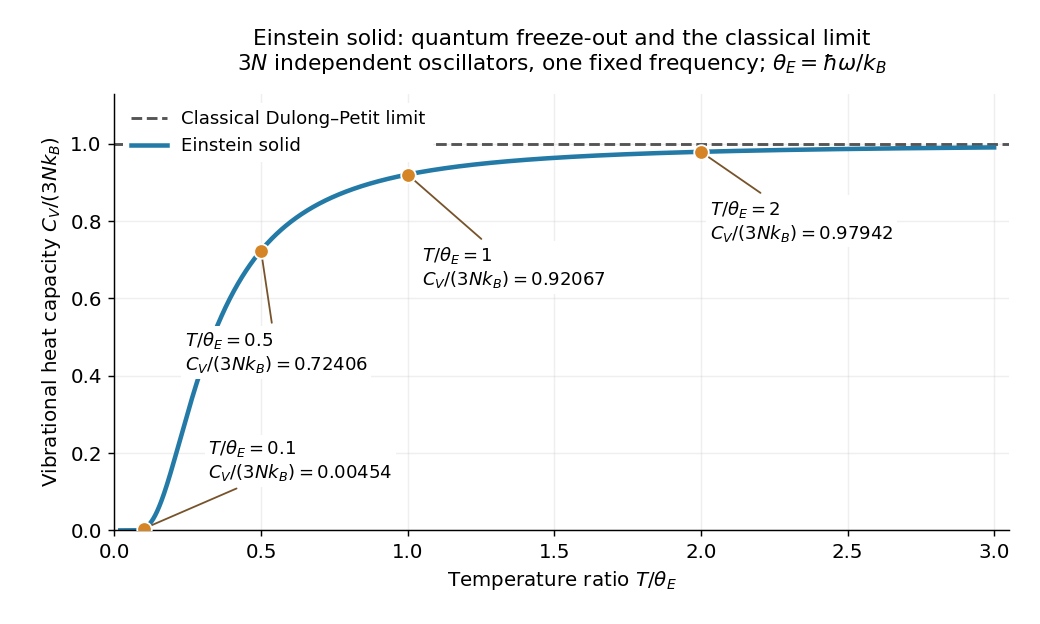
For a worked comparison, choose the model parameter . The normalized heat capacity at constant volume depends only on :
| Temperature in | ||
|---|---|---|
At , one mole of chemical atoms therefore has vibrational heat capacity at constant volume , using the unrounded model value. Even at twice the characteristic temperature, the model remains about below the Dulong-Petit law limit. These are calculations for the ideal Einstein solid, not material measurements.

A short derivation uses the thermal partition function of a quantum harmonic oscillator. The energy eigenvalues and their Boltzmann factors form a geometric series, giving the one-oscillator canonical partition function . The mean occupation is , hence the displayed after summing over independent quantum harmonic oscillators. Taking its derivative with gives the displayed heat capacity at constant volume. [ref]
https://davidtong.org/pdfs/teaching/statistical-physics/omg1.pdf. David Tong, Statistical Physics, Example Sheet 1 (January 2012), problem 5: oscillator energy, the Einstein model and its limits
The two limits explain the shape. At high temperature, a Taylor series in small givesAt low temperature, , soThe zero-point energy remains even when the thermal response is tiny: freeze-out means that changing temperature scarcely changes the occupations, not that the chemical atoms have zero energy. This is the useful lesson of the Einstein model of a solid: the classical counting rule reappears when many levels are accessible, while discrete excitation spacings explain its failure upon cooling.
The exponential low-temperature decay is also the model's limitation. Real three-dimensional crystalline solids have acoustic phonon branches with arbitrarily small angular frequencies in the bulk limit. The Debye model includes these collective normal modes and predicts a low-temperature vibrational contribution , which the single-frequency Einstein solid cannot reproduce. This qualification concerns the vibrational contribution; additional excitations can change a material's total heat capacity. [ref]
https://davidtong.org/teaching/statistical-physics/statmechhtml/S3#S3.SS3. David Tong, Statistical Physics, section 3.3: acoustic phonons and the Debye low-temperature law
Einstein introduced the quantum treatment of solid vibrations in his 1907 paper Die Plancksche Theorie der Strahlung und die Theorie der spezifischen Wärme. Its historical importance is that quantum excitation energies explained why the classical Dulong-Petit law could fail; the modern quantum harmonic oscillator formulation above includes the zero-point energy explicitly. [ref]
https://onlinelibrary.wiley.com/doi/10.1002/andp.19063270110. A. Einstein, Annalen der Physik 327, 180–190 (1907), original-paper publication metadata
Face duality for polyhedral cones 2026-10-14
For a closed polyhedral cone , the maps and give inverse order-reversing bijections on faces. Choose a exposing functional in the relative interior of the dual face. The bipolar identity and an exposing functional for the original face show that applying the maps twice returns that face.
// Target: geometry-and-topology.bigb
Weil pairing for an abelian variety 2026-10-14
For an abelian variety and an integer invertible in the base field, a torsion line bundle has trivial pullback by . Choose a trivialization. The descent action of the kernel on that trivial line bundle acts through a character . Define . This is independent of rescaling the trivialization and bilinear under translation and tensor product. A trivial character descends the trivial bundle, so is trivial. Since both groups have order , the character map is an isomorphism and the Weil pairing for an abelian variety is perfect. The theta autoduality of a Jacobian turns it into a pairing on two copies of the Jacobian variety's torsion group.
For initial spot in the Black-Scholes model, put and . A down-and-in claim with terminal payoff has the same initial price as the terminal claim . Reflection of the log-price endpoint above the lower barrier changes its normal probability density to , where . Substitution gives the payoff identity. This is price equality, not pathwise equality of payments.
For strike , write for the ordinary European call option value. Before activation the down-and-in claim is , where . Consequently its left-limit option delta at the barrier is , whereas after activation it is . Their difference is strictly positive for : differentiating the killed normal transition density at its boundary gives the integral of a strictly positive function against the positive call payoff. The value is continuous, so changing the bank holding finances the stock rebalance.
Two-coordinate stochastic averaging 2026-10-14
This doubly stochastic matrix replaces two values by and , preserving their sum. It fixes all other coordinates when embedded in a larger matrix. A finite product of such averaging matrices and permutation matrices is again doubly stochastic.
Double-couple radiation pattern 2026-10-14
For the seismic moment tensor , source differentiation of the outgoing elastodynamic Green tensor gives and . In the plane the signed radial P wave and tangential S wave factors are and . The full S wave magnitude squared is .
Suppose a chordal SLE trace stays in the open complex upper half-plane at every positive time almost surely. For every deterministic rational time , the domain Markov property of a chordal Loewner chain makes its mapped and centered future a fresh SLE, so its positive-time future stays in the open half-plane as well. The inverse mapping-out function then places that future outside the entire old hull. Intersecting these probability-one events over rational rules out every self-intersection: if two times shared a trace point, choose rational strictly between them. This proves simplicity using the allowed boundary-avoidance assertion for .
There are unlisted articles, also show them or only show them.