
For constant buoyancy frequency, density forcing gives two frequencies . The quasi-geostrophic streamfunction satisfies and . With zero streamfunction at the bottom, a positive selects the decaying solution . For , the westward branch propagates vertically when ; a radiation condition selects positive vertical group velocity, not merely bounded amplitude. Coincident exponential exponents are handled by the finite limit .
Proper base change for sheaves 2026-10-14
For a proper map of locally compact spaces and a constructible complex , the derived stalk satisfies . In particular . Properness is what prevents fibre cohomology from missing nearby sections.
For fixed and , uniform convergence of normalized finite differences to , uniform continuity of , and imply uniformly. Positivity and partition of unity make Bernstein polynomials contractions in the supremum norm. Consequently . The differentiability assumption is essential; continuity alone does not define the target derivative.
Smooth convergence on a compact interval 2026-10-14
Smooth convergence on a compact interval requires uniform convergence of the functions and of their derivatives of every order separately, as measured by the derivative seminorms. The need for several scales is visible inFor , because lies in . The derivative has supremum norm one for every , already at . Thus converges uniformly to zero, but fails the test for smooth convergence to zero. Andreas Buttenschoen, Applied Functional Analysis, spaces of continuous and differentiable functions discusses this example and the family of smoothness measurements.
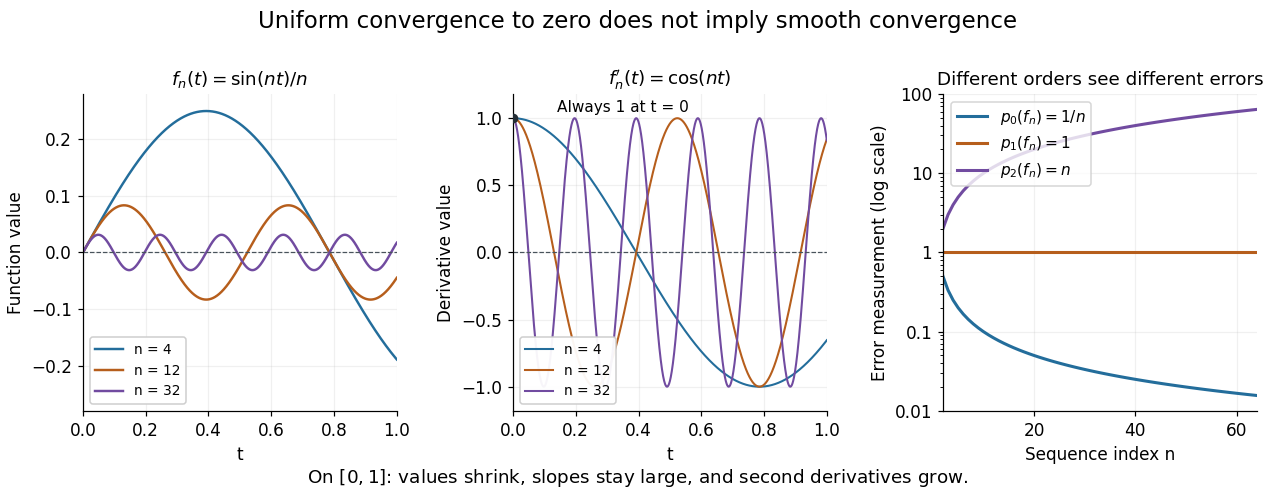

More generally, for any fixed , has but for . If a norm induced the smooth topology, its continuity would give for some finite , while continuity of for would give . Substituting contradicts these two bounds. Smooth convergence therefore cannot be reduced to one norm. Its beauty is that every finite order can be controlled without fixing a final order in advance.
For bound Kepler orbits with gravitational parameter , integrating the Delaunay variables over , and their three full angle periods gives the displayed population. A globally defined thermal eccentricity distribution requires this integral to converge, or an explicit finite action range. Merely having finite at every energy does not suffice: yields an infinite integral at large . At each fixed energy, or on every finite normalized action band, the cumulative eccentricity fraction remains .
In the completed natural Brownian filtration, suppose with , and let , . For an affordable nonnegative terminal claim , represent the conditional-expectation martingale as . Then and the displayed dollar amount in the stock replicate . The Itô product rule gives , proving the formula; share holdings are .
Prime-ball exchange lemma 2026-10-14
In a complete decomposing sphere system for a knot, a disk inside a prime-factor ball that meets the knotted arc once cuts its factor into a connected sum of knots. One side must be an unknot. Replacing the ball by the side carrying the prime factor therefore preserves the unordered factor list. A disk missing the arc cuts off an empty ball and gives the same conclusion. After a small transverse perturbation, such a replacement removes an innermost intersection circle with another sphere system. If a chosen innermost disk contains both marked points, another innermost disk, or its complementary disk when it is the only intersection, contains neither. Iterating produces a prime-factor ball disjoint from both systems. The replacement changes only the location of a joining arc in the intervening punctured ball; capping the other boundaries still recovers the same oriented factors.
Let a uniformly random bit be copied into a three-state classical register with probability , and otherwise replaced in by a flagged erasure independent of . Then bits. Projecting onto its two nonerased states and conditioning on success gives a perfectly correlated bit pair with mutual information one. The postselection branch is completely positive and trace decreasing, but renormalization after conditioning is not a deterministic quantum channel. This does not contradict data processing for quantum mutual information, which applies to trace-preserving operations or an unconditioned instrument including its outcome flag.
For canonical Kähler potential, set , , . The supplied supergravity F-term potential is . Adding with , and gives a supersymmetric vacuum at , . The branch has positive energy , D-term breaking and a flat direction of a scalar potential in . Its charged squared masses are , so it is a local minimum valley only when both are positive. For negative , exchange the charged fields. These are branches rather than two isolated minima; a conventional constant Fayet–Iliopoulos term additionally needs a consistent supergravity gauge completion.
Single charged-field D-term breaking 2026-10-14
For one charged chiral superfield, canonical kinetic terms, no nonconstant gauge-invariant superpotential, and , the sign of selects the vacuum. If , the minimum has , positive vacuum energy, unbroken internal gauge symmetry and a gaugino Goldstino; the scalar squared mass is while its chiral fermion is massless. If , a scalar condensate cancels the auxiliary field, preserving supersymmetry while Higgsing the gauge group. These are classical statements; a consistent quantum charged spectrum must cancel its gauge anomalies.
Root-of-unity Euler system 2026-10-14
Fix a finite excluded set containing two, and let contain the roots of unity of orders coprime to every prime in . A root-of-unity Euler system is a nonzero algebraic-valued function on that is even and Galois equivariant, satisfies for , and satisfies when the order of is prime to , for every prime over . Values are required to be locally integral units where the congruence is used. These distribution and congruence properties provide auxiliary cyclotomic extensions, beyond a single norm-compatible p-power sequence.
The cyclic quotient surface singularity is the only singular point of a complete four-ray toric surface exactly under the displayed condition. Normalize the three smooth cones to the consecutive rays . The singular cone has determinant , so . In the basis , its other generator is , giving quotient parameter . Thus for a positive divisor of . Conversely these rays construct the surface. Exchanging the two axes replaces by ; replacing a factor by its complementary factor preserves the criterion under this equivalence.
Transposition changes the cycle count by one 2026-10-14
Left multiplication of a permutation by a transposition swaps the two target labels . If they occur in different cycles, becomes the single cycle . If they occur in the same cycle, that formula reverses and splits the cycle in two. All other cycles are unchanged, so the total number of cycles, including fixed points, decreases or increases by exactly one. Empty intermediate lists yield one-cycles and require no exceptional case.
Permutation conjugate to its square 2026-10-14
Squaring an odd-length permutation cycle retains its length, whereas an even-length cycle splits into two cycles of half its length. Thus if any even cycle is present, the number of cycles strictly increases, so the cycle type changes. Since conjugate permutations in a symmetric group have the same cycle type, a permutation is conjugate to its square precisely when all its cycle lengths are odd, equivalently when its order of a group element is odd.
Conjugation preserves order of a group element, because , and preserves the sign of a permutation, because sign is a group homomorphism into . These invariants do not determine cycle type. In , and both have order three and positive sign, but have three and zero fixed points respectively. Conjugation relabels cycles, so these permutations are not conjugate.
The Lorentz force per unit area on an ideal current sheet is computed using the mean of its limiting magnetic fields. The sheet's own local magnetic field is equal and opposite on its two sides and cancels in this mean. Equivalently, integrate the Lorentz force density through a thin regularized layer: its self-field contribution averages to zero, leaving the external field acting on the surface current density.
Curl of a gradient 2026-10-14
For a twice continuously differentiable function, the curl of its gradient vanishes. In components, because the second derivatives are symmetric in while the Levi-Civita symbol is antisymmetric. Thus adding a gradient to a vector potential preserves the represented curl. No topological assumption is needed for this identity, unlike the converse assertion that every curl-free vector field has a global potential.
For distinct ordered observations , let be their natural cubic spline interpolant with values . Its roughness is a quadratic form, , where is positive semidefinite and its nullspace consists of vectors sampled from affine functions. Minimizing penalized least squares gives . Thus the smoothing matrix is and its effective degrees of freedom are . As the fit approaches interpolation and the trace approaches ; as it approaches the least-squares affine line and the trace approaches .
Jarzynski equality 2026-10-14
Integrating the Crooks fluctuation theorem over work and using normalization of the reverse probability distribution givesConsequently Jensen's inequality gives . Some realizations may nevertheless have . This is a work relation with equilibrium endpoint preparations, while the integral fluctuation theorem for total entropy production uses the actual final forward distribution. [ref]
The Entropy Production Fluctuation Theorem and the Nonequilibrium Work Relation for Free Energy Differences by Gavin E. Crooks. Crooks, 1999, Eq. (3) and derivation from Eqs. (10)–(11)
Wave trough 2026-10-14
There are unlisted articles, also show them or only show them.