
In the classically scale-invariant case from solution, use , and . Dividing the supplied Noether current expression by givesSince , this isThe first term in this dilatation current comes from the intrinsic weight of the scalar field, while the second comes from moving its spacetime argument. Using the canonical energy-momentum tensor alone without the first term would not give the stated conserved current.
Under the finite dilatation, , and . Keeping the couplings fixed givesThus the full finite change isFor invariance for arbitrary fields and all constant , the fixed nonzero kinetic term requires . Then the mass term requires , and every nonzero coupling must have . Henceincluding the free choice . At the canonical mass dimension is and , so only the quartic interaction has a dimensionless coupling. A mass introduces a scale. This recovers the same result from solution.
The fixed field weight in the question matters: if it were replaced by the general canonical weight , the kinetic term could be invariant in other dimensions, and a nonzero monomial interaction would require for . That is a different transformation from the one specified here. The result above is classical; quantum running generally breaks the quartic theory's scale invariance.
The finite passive dilatation is , . To compare at the same argument, invert the coordinate change:Consequently the fixed-argument infinitesimal variation isThis also follows from and . The plus sign on the derivative term is a consequence of this specified contraction of coordinates.
Put . The Euler-Lagrange equation for the scalar field is , or explicitlyThe derivative of is ; all interaction terms therefore enter with the displayed plus sign for the chosen Minkowski metric.
The real scalar field action has spacetime translations and Lorentz invariance, together giving Poincaré symmetry. With a real scalar transformation law it also has parity and time reversal. A generic polynomial potential has no continuous internal symmetry. The additional field reversal is a symmetry precisely when every nonzero odd-power coupling vanishes. The free massless special case also admits a constant shift of ; generic interactions remove it.
In mass units, and the dimensionless action requires . Normalizing the kinetic term fixes the classical mass dimension of the scalar field:For each interaction, , soThese are classical or engineering scaling dimensions; quantum corrections can change the scaling of operators and couplings. The scale transformation prescribed later has field weight one, which equals this canonical weight only at .
Write , and . The Fourier expansion in the source is compatible with the oscillator canonical commutation relationsFor the free real scalar field, andSubstitution of the Fourier expansion produces spatial Dirac delta functions. Terms with two annihilation operators or two creation operators cancel: in their coefficient is , and in their integral is odd under . The two mixed terms combine, with normal ordering removing the vacuum constant, to giveIn particular, contains the lower component in this Minkowski metric convention.
To check commutativity without manipulating a square of a Dirac delta function, define . The oscillator algebra gives and . Thus and . Taking , provesThese identities hold on the usual dense domain of finite-particle states, or can first be proved in a finite box and then continued to the continuum.
For the spatial momenta, integration by parts givesTheir Poisson bracket is thereforeFor the mixed case, and the spatial generator acts on both canonical fields by differentiation: , . Hence, for a translation-invariant local Hamiltonian density,Finally by antisymmetry. Together these proveThe proof requires commuting derivatives and no surviving boundary terms. It expresses the Abelian translation subgroup of Poincaré symmetry at the level of its canonical generators.
Past exam of the theoretical physics major option course of the University of Oxford 2022 5 d Solution Created 2026-10-25 Updated 2026-11-05
For a first-derivative Lagrangian density with no explicit spacetime dependence, introduce the canonical energy-momentum tensorDirect differentiation giveson solutions of the Euler-Lagrange equations. The four Noether currents are the four columns of this tensor, whereas their spatial integrals are the conserved four-momentum components:For this is the Hamiltonian; for a spatial lower index it is . Under the paper's passive-translation convention, the corresponding generator is . Conservation of the integrated quantities also uses the stated vanishing boundary flux.
For the Noether charge is , with the Hamiltonian density and . Invertibility of the momentum-velocity relation allows . When taking a functional derivative at fixed , the implicit dependence of cancels in the Legendre transform:It follows thatThis proves the same generator relation for time translations. In a constrained theory the assumed inversion fails, so the appropriate reduced variables or Dirac brackets are needed instead. That is precisely the issue encountered for the Proca field in Question 4.
A scalar field has for a pure change of spacetime argument. With and , its variation at a fixed argument is . The supplied Noether charge becomesSince , solution and antisymmetry of the Poisson bracket giveCanonical quantization replaces the Poisson bracket by a commutator divided by :With this sign convention one may use and . Because , the negative shift of the field argument follows with the required sign.
At fixed time, the coordinate field and the canonical momentum are independent variables. Their functional derivatives satisfyPutting , in the Poisson bracket definition therefore givesThe superscript on the species label in the printed denominator has no spacetime-metric significance; with the ordinary species Kronecker metric it is the same expression.
Set , so . Expanding the minimally coupled Lagrangian density givesThus there is a derivative cubic interaction vertex of order , and a quartic interaction vertex of order . There is no pure contact term in this minimal coupling theory, nor an Abelian three-photon interaction vertex.
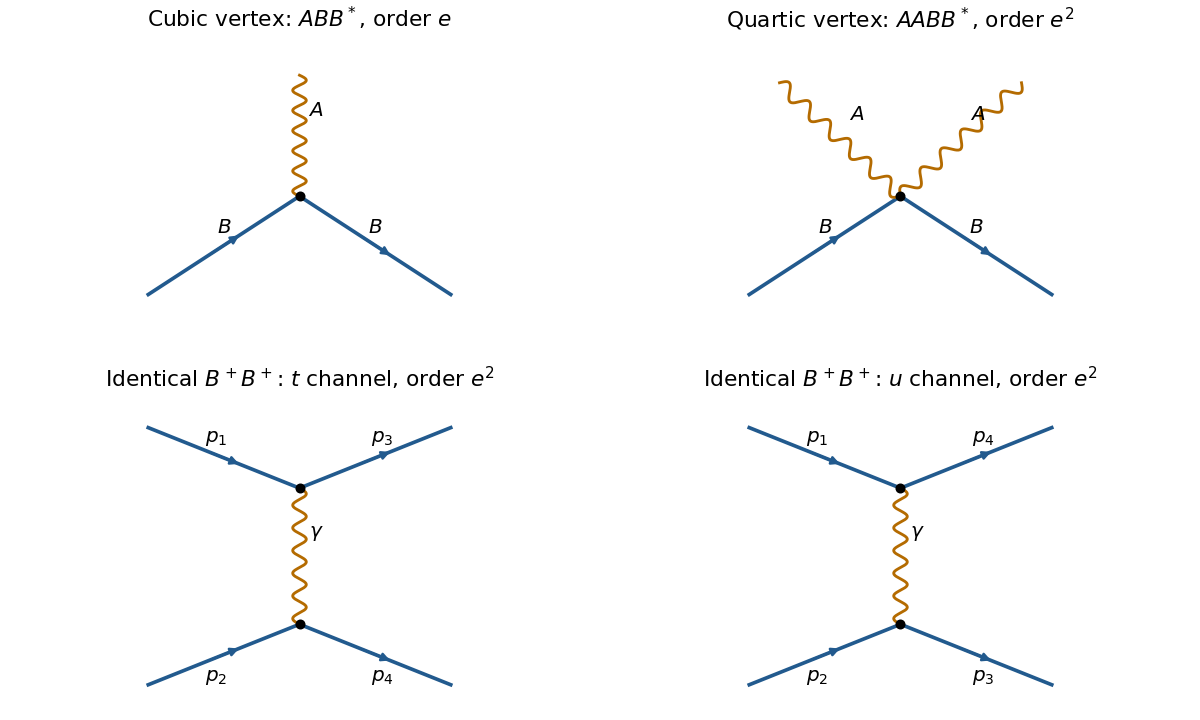
Cubic and quartic charged-vector vertices, and the two photon-exchange channels for identical charged vector bosons
. Details. 
The straight arrowed lines in the original schematic denote charged massive vector bosons; the wavy lines denote photons. For two identical positively charged vector bosons, the leading scattering amplitude has the order- -channel photon-exchange Feynman diagram, together with its -channel interchange required by identical bosons. A quartic interaction vertex cannot directly attach four external massive vector bosons. For a particle-antiparticle incoming pair, the leading channels instead are -channel exchange and -channel photon annihilation. The shown arrows track charge flow; an outgoing charged particle corresponds to the conjugate field at a vertex.
Introduce the electromagnetic electromagnetic field tensor and the charged vector field strength , with . Minimal coupling givesUnder and ,Consequently the required relation isThen , its complex conjugate transforms oppositely, the mass bilinear is invariant, and . Each term in the total Lagrangian density is therefore invariant under the electromagnetic U(1) gauge symmetry. This phase gauge symmetry does not reinstate the broken gradient-shift gauge symmetry of the massive field itself.
The naive equal-time canonical commutation relations would bewith all coordinate-coordinate, momentum-momentum and mixed conjugate-sector commutators zero before enforcing constraints. But the relation contradicts as an operator identity: its left side would vanish and its right side would not.
The primary zero-momentum constraints and the secondary massive Gauss laws form second-class constraints; their Poisson bracket matrix contains nonzero terms proportional to . They must be eliminated, or treated using a Dirac bracket, before quantization. In a reduced description the three complex spatial coordinates and their momenta are canonical, whileare dependent operators. Substituting them in the integrated Hamiltonian gives the positive density, up to a surface term,Thus the problem is a constrained choice of canonical variables, not an absence of a consistent free quantum field theory.
Preserve the primary constraints using the corrected Hamiltonian from solution. After a spatial integration by parts, the terms in its density are . Hamilton's equations giveWith the definitions of in the paper, the actual massive Gauss law is thereforeThis is also the component of the Proca equation. The zero right-hand sides printed in the source apply only to the massless theory or to special configurations with .
For a concrete counterexample, take , , and the longitudinal on-shell plane waveIt satisfies , but and . Imposing the printed zero-divergence condition would incorrectly remove the physical longitudinal particle polarization.
Use the upper-index coordinates specified in the paper. Differentiation of the Lagrangian density gives the canonical momentaIn particular, and . No time derivative of appears, so the zero momenta are primary constraints, not invertible equations for .
For spatial indices, , so , with the conjugate relation for . AlsoThe Legendre transform for the complex Proca Hamiltonian, therefore givesRepeated spatial indices in the positive product denote an ordinary three-component sum. A total Hamiltonian additionally includes multipliers for .
The Hamiltonian printed in the source cannot follow from the given complex Lagrangian density: its missing conjugations, mass coefficients and spatial mass sign are inconsistent. A concrete check is spatially uniform initial data , , with all canonical momenta zero. The correct Hamiltonian density is , while the printed expression gives . These data satisfy the initial constraints and evolve as a spatially uniform massive oscillator. Thus the discrepancy is not a harmless surface term or a different complex-field normalization.
Treat and as independent variables in the Euler-Lagrange equation. Varying gives the Proca equationThe divergence of its first term vanishes by antisymmetry and commuting partial derivatives. Since , it follows that . Substitution into the original equation givesThe complex-conjugate variation gives , hence and .
For an on-shell plane wave , the Lorenz constraint in Proca theory is . In the rest frame it sets , leaving three complex particle polarizations. Thus the complex Proca field has three independent complex dynamical components, or six real ones; its quantized particle and antiparticle each have three physical particle polarizations. The conjugate field is not another unrelated classical field.
The free complex Proca field has Poincaré symmetry, with transforming as a spacetime four-vector, and the global internal U(1) symmetryThe free theory is also invariant under charge conjugation and the usual parity and time reversal transformations of a vector field. The internal real-field description consists of two equal-mass real Proca fields, with an symmetry containing the phase rotations and charge conjugation.
A gradient shift of leaves unchanged, because partial derivatives commute. It changes the mass term byThis is generally nonzero: for example, and real produce . Thus a massive Proca field has no such gauge symmetry. The massless kinetic term alone would have it.
For set and . The master equation becomesUsing and givesInitially the molecule occupies , so and . The characteristic roots are ; the constant particular solution is . ConsequentlywhenceIt has the required initial slope , tends to the stationary uncharged probability , and remains nonnegative. As a further check, and are nonnegative and sum with to one. If , no jump occurs and , also obtained directly from the boxed expression.
Count net transmitted charges per unit time, taking left-to-right as positive. The contact on the left, the internal bond, and the contact on the right give respectivelyThe backward rate must be subtracted in the internal count. Substitution of solution yieldsThe equalities also follow directly from and : there can be no stationary accumulation of electric charge. If each carrier has charge , the electric current is . During a stationary interval of duration , the expected net number crossing any one bond is . In particular, counting both directions of internal hopping as positive would count traffic, not transmitted charge.
There are unlisted articles, also show them or only show them.