
With no pairing, the Hamiltonian is diagonal in the fermionic occupation numbers. The Pauli exclusion principle allows each momentum mode to be either empty or occupied once. Without a fixed fermion number constraint, occupying a mode lowers the energy precisely when its single-particle energy is negative. Therefore, with the Fock vacuum, a ground state isChoose a fixed ordering of the fermionic creation operators; changing it alters only the overall phase. Any zero-energy modes may be occupied or empty without changing the ground-state energy.
To identify the occupied modes, complete the square:Here is the dispersion parameter, not inverse temperature. If , every mode has positive energy and the unique ground state is the Fock vacuum, with . If , there are still no negative-energy modes, but have zero energy if they lie on the allowed momentum grid. Each such mode doubles the ground-state degeneracy.
For , defineBoth are positive, and the occupied Fermi sea consists of the two intervals . With , the requested finite-size ground-state energy is explicitlyThe factor two counts opposite momenta. Endpoints are excluded from this sum because they have zero energy; when an endpoint is allowed, its optional occupation adds ground-state degeneracy. A narrow negative-energy interval can contain no allowed finite-size momenta, in which case the sum is empty. The zero-momentum mode is always empty since .
For low temperature, factor out the largest Boltzmann factor from the dominant eigenvalue:Thus the Helmholtz free energy per site has the expansionDifferentiate at fixed , remembering that . The entropy per site isThe nonzero residual entropy comes from an exponentially large ground-state degeneracy, generated by geometrical frustration. A triangle with antiferromagnetic energy has minimum energy : if , the apex must have the opposite sign; if , either apex sign is permitted. The two all-equal configurations instead have energy . Thus exactly one of a minimum-energy triangle's bonds is frustrated. The bridge can simultaneously minimize its energy at by requiring , where is the next cell's first base spin.
For fixed and , the number of allowed apex choices is therefore two when and one when . The zero-temperature counting transfer matrix on successive first base spins isThe eigenvalues of are and . Dividing by the sites and taking the thermodynamic limit gives , independently confirming the derivative calculation. This does not assert a unique ordered ground state: the extensive choice of frustrated bonds is precisely what leaves entropy at zero temperature. At high temperature, all Ising spins become independent and per site.
Let , so that the total number of Ising spins is . Write and group each triangle's two base spins and its apex into one cell. The Ising chain with alternating triangular decorations has a triangle bond followed by an undecorated connecting bond. Summing an apex Ising spin first gives a decorated-bond Boltzmann weightThe undecorated bridge has Boltzmann weight . In the basis ,Each cell contributes , so periodic boundary conditions giveThe two matrices have common normalized eigenvectors and , expressing spin inversion symmetry. Their respective eigenvalues areConsequently the cell transfer matrix has eigenvaluesand the finite-size partition function isFor , and , so only survives in the thermodynamic limit. Divide the Helmholtz free energy by , the number of sites rather than the number of cells or base spins:As a counting check, gives , , hence , exactly the number of independent Ising spin configurations. This model has separated decorated bonds and should not be confused with the corner-sharing sawtooth Ising chain, which has a different site count.
For an open chain there are bonds, with both endpoint Ising spins independently summed. Retain the same spin-chain transfer matrix, but replace the trace by endpoint vectors. With ,This follows directly by expanding the product of Boltzmann factors. If are orthonormal eigenvectors of the symmetric matrix , the equivalent spectral decomposition isFixed endpoint Ising spins replace the corresponding by a basis vector; extra endpoint energies replace its entries by the corresponding Boltzmann factors. The leading bulk Helmholtz free energy per spin agrees with the periodic result, because the boundary changes only subextensive terms. In particular, gives , as required for one free Ising spin.
Let and use the two spin values as row and column labels. Define the spin-chain transfer matrixIt is a real symmetric matrix because ; every entry is strictly positive for finite bond energies at . The Boltzmann factor of a spin configuration factorizes into the product . Summing the intermediate spin labels is exactly matrix multiplication, and the final closure imposes periodic boundary conditions. ThusWriting , its eigenvalues areA positive-entry matrix need not have two positive eigenvalues; can be negative. The Perron–Frobenius theorem ensures here. Therefore the Helmholtz free energy is , and its value per spin in the thermodynamic limit is .
The massless two-body kinematics gives . The scalar scattering amplitude therefore has constant magnitude . Use and the identical-particle factor from part d:For the photons, the two-photon vertex of a scalar field-strength interaction following from is, up to an irrelevant overall phase,Vertex qualification: the source prints same-index polarization contractions in the second product, whereas the contractions must be crossed as above. The printed expression fails the Ward identity. For a concrete counterexample take , and . This is a transverse unit spacelike photon polarization vector, since and . Replacing by in the printed expression leaves instead of zero. The corrected crossed expression vanishes under either such replacement.
Choose physical spatial transverse photon polarizations along and in the parent rest frame. Then both crossed products vanish; the two equal-polarization combinations have and the two orthogonal combinations give zero. There is no initial-spin average for a spin-zero parent. HenceThe calculation in this spatial transverse gauge also yields the intended result from the misprinted expression, but only the corrected vertex makes its gauge invariance explicit. For equal-magnitude couplings, the photon decay width is twice the two-scalar decay width because of its two nonzero polarization combinations.
Work in the parent rest frame, . For massless daughters, the spatial Dirac delta fixes and . The Lorentz invariance two-body Lorentz-invariant phase-space measure becomesThe factor in the last step is the Jacobian of the energy-conservation Dirac delta. Consequently the labelled two-body decay width isFor two identical final particles, the full angular integral counts each unordered final state twice, so the physical decay width includes an additional factor . This factor is needed for both channels in part e; it is separate from any vertex combinatorics already included in the Feynman rule.
Every interaction contains an even number of fields, so the exact discrete symmetry forbids to every perturbative order. There is no such prohibition for .
The latter decay channel is absent at tree level in the displayed interactions, but contracting two legs at a vertex produces a tadpole diagram with two external legs. For example, contracting the undifferentiated pair leaves the local operator multiplied by an integral proportional to . Contracting the differentiated pair instead gives a local contribution. Both are allowed effective field theory operators. With a ultraviolet cutoff, these local terms generically carry quadratic or quartic cutoff dependence and require matching coefficients or counterterms.
There is a relevant qualification to a claim that the one-loop decay width must be nonzero. Since is exactly massless here, the one-vertex tadpole integrals have no external scale and are scaleless integrals. They vanish in dimensional regularization. Thus the correct conclusion is allowed, and generically generated by quantum corrections or matching, not a regulator-independent nonzero one-loop prediction from alone. No exact symmetry protects the two- channel; its numerical rate requires the renormalized coefficients of the allowed operators.
The action is dimensionless and , so . A canonical scalar kinetic term then requires , and the electromagnetic kinetic term requires . ThusThe brackets here denote mass dimension. The Lagrangian has no explicit coordinate dependence, and all indices are contracted as Lorentz scalars. Its continuous spacetime symmetry is the Poincaré group. Noether's theorem gives conserved four-momentum from translations and conserved angular momentum, including the boost generators, from Lorentz transformations. The nonzero mass and dimensionful couplings prevent a dilation symmetry.
Sign qualification: the printed electromagnetic kinetic term has the opposite healthy relative sign to the scalar kinetic terms. With the stated mostly-minus Minkowski metric, a physical Maxwell Lagrangian is . The printed plus sign instead gives photon Hamiltonian density ; a nonzero purely electric configuration already has negative energy, unbounded below as its amplitude grows. The physical decay widths below use the healthy Maxwell sign with the given interaction normalization. The dimensional and spacetime-symmetry conclusions themselves do not depend on this sign correction.
The light states have the counting . This suggests approximate chiral symmetry breakingwith a nonzero quark chiral condensate for the three light flavours . The three pions, four kaons and predominantly octet eta meson are the resulting pseudo-Goldstone bosons. Their small nonzero masses reflect explicit chiral symmetry breaking by the light-quark masses; for example, is proportional to at leading order. The larger strange-quark mass makes the kaons and octet eta meson heavier than the pions, while electromagnetic interactions help split charged and neutral partners.[ref]
Gauge Theory by David Tong. Chapter 5, chiral symmetry breaking and section 5.3 on adding quark masses
Although the massless strong-interaction terms admit independent rotations of all six flavours, the charm, bottom and top masses are too large to treat six-flavour chiral symmetry as a small explicit breaking at the light-hadron scale. Full approximate breaking would suggest 35 light modes, rather than this octet. The classical axial is also broken by the chiral anomaly, so it does not supply a ninth equally light Goldstone boson.
The breaking of the internal global symmetry in field theory to removes generators. The relativistic Goldstone theorem therefore requiresOther states fall into multiplets of the unbroken special unitary group, but their masses are not fixed by this counting. For the usual diagonal embedding , the Goldstone bosons form its adjoint multiplet.
If small explicit symmetry-breaking terms are added, the broken-generator directions generally acquire small curvature, producing light pseudo-Goldstone bosons rather than exactly massless states. Their squared masses tend to zero with those breaking parameters. Small breaking can also split multiplet degeneracies. These claims concern a small perturbation of the broken phase; approximate symmetry alone does not establish which vacuum is selected.
Assume . At zero source, the vacuum manifold is the sphere of radius . The source tilts the scalar potential by . Its force should be small compared with the radial restoring-force scale , so a useful quantitative condition isFor nonzero , the exact global symmetry in field theory of the Lagrangian is , rotating . The global vacuum aligns with the source:This vacuum preserves the entire remaining symmetry. There is therefore no exact Goldstone boson for . Expanding the scalar potential to quadratic order givesThus there are degenerate light pseudo-Goldstone bosons and one heavy radial scalar. The small-source condition makes their squared masses parametrically smaller than the radial squared mass. Sending to zero restores the original massless modes.
Both the canonical kinetic term and are invariant under the orthogonal group . The stated nonzero vacuum expectation value has length . Its stabilizer is the orthogonal group acting on the perpendicular subspace. HenceThe two nonzero coordinates of this particular vacuum do not break more generators than an axis-aligned vacuum: the two choices are related by a common orthogonal transformation.
Explicitly, with ,stationary point at nonzero requires . The transverse eigenvalues vanish, while the radial squared mass is . If this curvature also vanishes, there is an additional accidental massless radial mode; the number of symmetry-protected Goldstone bosons remains . If , the symmetry is unbroken and none is required.
Past exam of the theoretical physics major option course of the University of Oxford 2018 2 a Solution Created 2026-10-25 Updated 2026-11-05
Goldstone's theorem states that a spontaneously broken continuous internal global symmetry in field theory of a local relativistic quantum field theory produces massless Goldstone bosons. For a Lorentz invariance vacuum breaking to its stabilizer , there are independent symmetry-required massless directions. Additional accidentally massless modes are possible. A gauge redundancy does not obey this physical-state counting, and nonrelativistic systems need not have one independent mode per broken generator.
For the classical proof, consider real scalar fields with a positive canonical kinetic term and an invariant smooth scalar potential . An infinitesimal generator satisfiesLet be a stationary vacuum and differentiate this identity with respect to . At , the term proportional to vanishes, leavingThe Hessian matrix is the scalar mass matrix. An unbroken generator has ; broken generators span the tangent space of the vacuum manifold . Each independent nonzero tangent vector is a zero eigenvector of . The quadratic Euler-Lagrange equations in these directions are , giving the massless dispersion relation . This proves the classical result and explains why the Goldstone bosons describe motion along the degenerate minima rather than against a restoring curvature.
Use one common ultraviolet cutoff for all physical degrees of freedom, with positive sign for each bosonic degree of freedom and negative sign for each fermionic degree of freedom. For the mass-moment cancellation of vacuum energy divergences, define the weighted supertrace . The large-momentum expansion isAfter multiplication by the radial measure , these three terms produce quartic, quadratic and logarithmic ultraviolet divergences. Therefore the necessary and sufficient cancellations for the displayed unsubtracted finite-species vacuum energy areThey respectively mean equal numbers of bosonic and fermionic physical degrees of freedom, equal sums of squared masses, and equal sums of fourth powers of masses. Once they hold, the remaining radial integrand falls as and is integrable at infinity. Nonnegative masses introduce no lower-end divergence.
Pairing every bosonic degree of freedom with a fermionic one of the same mass, as in an unbroken supersymmetric spectrum, is sufficient and cancels the entire expression. It is stronger than these three moment conditions. For a concrete non-paired example, take bosonic squared masses and fermionic squared masses . Both have three degrees of freedom, squared-mass sum and fourth-power-mass sum , but their spectra differ. If a vacuum energy counterterm is instead permitted, a renormalized finite answer need not satisfy them; that is a different prescription from finiteness of the source's bare sum.
A spherical three-momentum ultraviolet cutoff givesFor and , the asymptotic expansion isIn particular, the leading ultraviolet divergence is quartic. For , exactly.
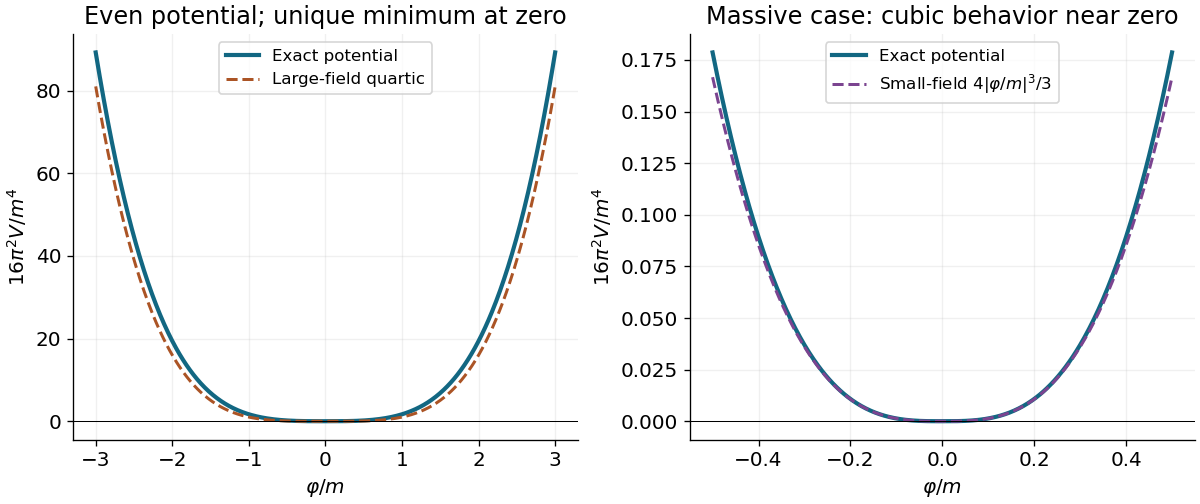
Write . Under the proposed identification, the scalar potential from a field-dependent momentum cutoff is . It is even and nonnegative, and its derivative with respect to is away from zero. Consequently its only global minimum is at : this contribution alone does not cause spontaneous symmetry breaking. At large it grows quartically. At small with fixed positive , however,Thus the quartic sketch is an asymptotic shape, not the exact small-field behavior for a massive original field. Identifying a regulator with a new field is an additional modeling prescription; an actual effective potential also depends on the new field's dynamics and any other allowed terms.

Promote the mode expansion of a free field coefficients to annihilation operators and creation operators, replacing by . The canonical commutation relations areTogether with the normalization in part a, they give and vanishing equal-time commutators between two fields or two conjugate momenta.
Insert the mode expansion of a free field in the Hamiltonian. The spatial integral produces . The and coefficients cancel because . The remaining terms giveThis is a continuum of quantum harmonic oscillators. In a finite periodic volume , . The Fock vacuum satisfies , so its vacuum energy density isNormal ordering would subtract this constant; here it must be retained because it is the quantity being calculated.[ref]
Quantum Field Theory by David Tong. Section 2, canonical quantization of the real scalar field and its zero-point Hamiltonian
The Euler-Lagrange equation for the real scalar field givesThus the conjugate momentum and Hamiltonian density areThe spatial Fourier transform reduces the Klein-Gordon equation to , with positive frequency . Hence a general real solution is the mode expansion of a free fieldThe two coefficients are complex conjugates because the field is real. Each pair of initial data fixes these coefficients. The normalization anticipates canonical quantization and the relativistic normalization of one-particle states.
There are unlisted articles, also show them or only show them.