
Functional monotone-class theorem 2026-10-14
A vector space of bounded functions containing constants and indicators of a generating pi-system, and closed under uniformly bounded monotone pointwise limits, contains all bounded functions measurable for the generated sigma-algebra. This function version extends identities established on elementary integrands to every bounded measurable integrand.
// Target: probability-and-statistics.bigb
Upward-closed subsets of , including the empty subset, form a well-quasi-ordering by reverse inclusion. For , tails correspond to the well-order . Inductively slice in the last coordinate. The slices increase and eventually stabilize: their union has a finite minimal basis by the Dickson lemma, all of which has appeared in one finite slice. Encode an upset by the word of its pre-stabilization slices and its final slice. The Higman lemma and finite product closure of well-quasi-orderings compare these encodings in the reverse-inclusion slice order. A subsequence map has , so containment of the matched later slice implies containment of the slice at ; the final-slice comparison handles the tail. The entire earlier upset therefore contains the later upset.
Taketa's theorem 2026-10-14
Every finite monomial group is a solvable group. Thus expressing every irreducible character as induction from a linear character imposes a group-theoretic solvability condition.
Dade's embedding theorem for monomial groups 2026-10-14
Every finite solvable group is isomorphic to a subgroup of a finite monomial group. This is an embedding assertion and does not assert that every solvable group is monomial, nor that the embedding is normal.
In a finite monomial group, the displayed intersection is a normal subgroup. Every irreducible character is induced from a linear character of a subgroup containing . On restriction to , all conjugate inducing lines remain invariant, so lies in every irreducible character kernel. The intersection of those kernels is trivial, proving that is Abelian.
Along one path, analytic continuation is a chain of function elements on overlapping open discs, each agreeing with the preceding germ of a holomorphic function near the crossing point. The identity theorem makes this chain unique along that fixed path. Equality at a crossing means equality on a neighbourhood, not just equality of a single value.
For the deformation step, fix one intermediate path and its continuation. By compactness of , choose a finite chain of representative open discs and subdivide the parameter so that each subarc fits in its assigned open disc, with consecutive junctions in overlap neighbourhoods where the representatives agree. Joint continuity of ensures that every sufficiently nearby intermediate path uses that same chain and those same overlaps. The endpoints stay fixed, so the terminal germ of a holomorphic function stays unchanged. Existence along every intermediate path supplies this argument at each ; local constancy and connectedness of give equality at and . This proves the monodromy theorem without assuming that every analytic germ projection is a covering map.
The monodromy theorem gives equality of continuations that exist under its hypothesis. It does not assert that every holomorphic function admits analytic continuation everywhere, even within a simply connected domain.
For an explicit obstruction, take near and attempt to apply the theorem on . The path ends at , where no terminal germ of a holomorphic function exists. If a holomorphic representative near continued , then the identity theorem would extend to that neighbourhood. Substituting would give . Thus the pole prevents the existence hypothesis, although is a simply connected domain. The analytic continuation article explains why the same rational function does continue throughout .
Existence at an endpoint by some route is also weaker than existence along every path from the base point. Along the real segment from towards , a holomorphic square root of tends to , yet cannot continue holomorphically through : a local representative would satisfy by the identity theorem, and differentiating at would give with . A finite limiting value therefore does not remove a branch point. More severe obstructions appear at a natural boundary of a holomorphic function.
Start at with complex logarithm germ of a holomorphic function and holomorphic square root germ of a holomorphic function . On the punctured plane , both admit analytic continuation along every path. To construct it locally, for any choose a small open disc avoiding , select a holomorphic logarithm there, and select its additive multiple of to agree with the arriving germ of a holomorphic function; exponentiating half this logarithm supplies the arriving holomorphic square root. A finite chain of these open discs follows any given path.
Compare two paths from to , parametrized by :The first follows a counterclockwise quarter-circle; the second follows a clockwise three-quarter-circle. Following and then path reversal of makes one positive turn about . Its winding number is , so the two paths cannot be homotopic with endpoints fixed in the punctured plane.
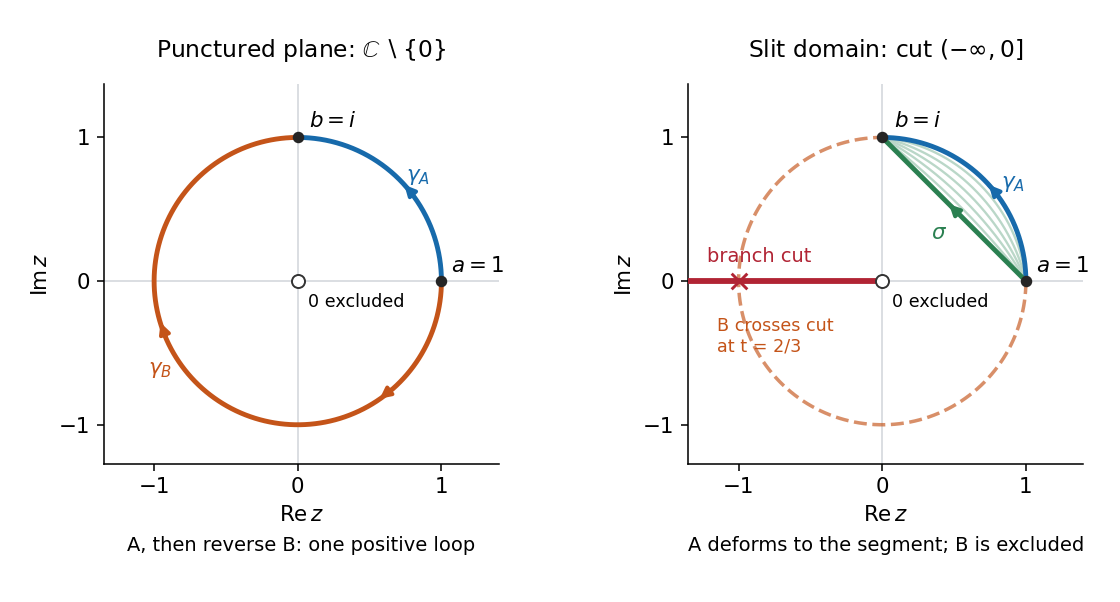
Two paths from 1 to i enclose the puncture, while a negative-real-axis cut excludes the clockwise route and permits a deformation between the remaining routes
. Details. 
The continued values along the chosen paths areAt their common endpoint,Both complex logarithm values exponentiate to , and both holomorphic square root values square to . These give different terminal germ of a holomorphic function representatives, consistently obtained from the same starting germ of a holomorphic function. The monodromy theorem applies, but does not equate these two non-homotopic paths.
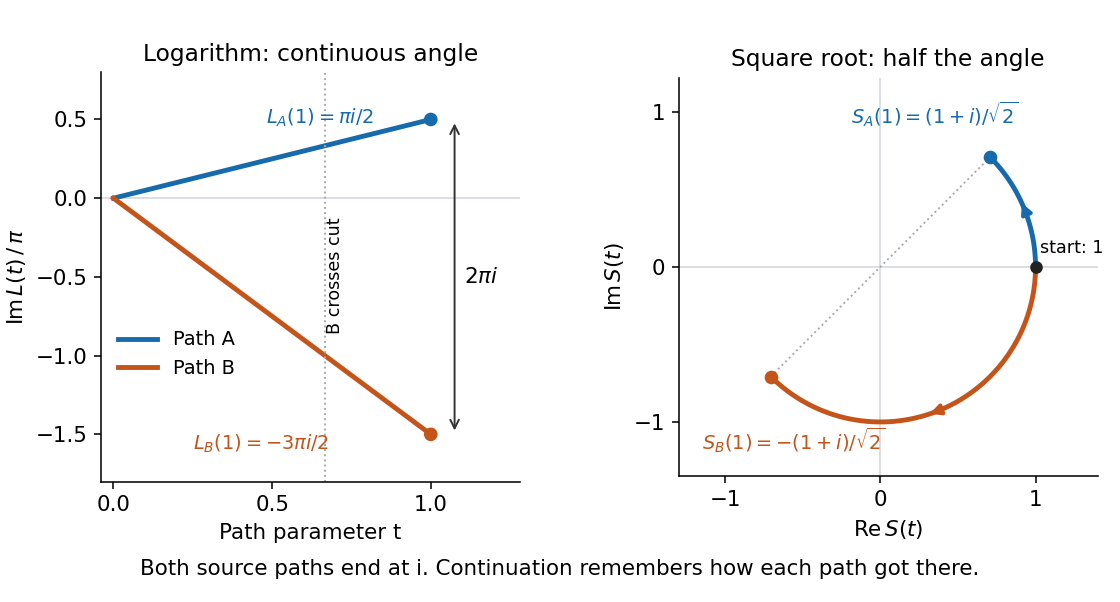
Tracking continuation from 1 to i along a quarter-circle and a clockwise three-quarter-circle gives logarithms separated by 2 pi i and opposite square roots
. Details. 
The closed path instead returns to , with continued values and . One counterclockwise turn changes the complex logarithm by and flips the holomorphic square root from to . Hence neither initial germ of a holomorphic function can come from a global holomorphic logarithm or a global holomorphic square root of on the punctured plane. Repeating a loop of winding number gives the changes and . [ref]
Branch Points and Branch Cuts by Rodolfo R. Rosales. Rosales, Branch Points and Branch Cuts, section 1, printed pp. 3–8, and Example 2.4, printed p. 15
Now restrict to the slit domain . The principal logarithm and realize the same initial germ of a holomorphic function for each expression globally. To see that this is a simply connected domain, polar form identifies this domain with , a convex set; every loop contracts there. The simply connected corollary of the monodromy theorem now forces equality along every pair of paths with matching endpoints. In particular, and the segment both give and . The explicit homotopy stays in the closed first quadrant away from , hence in .
The other route crosses the removed ray at and is no longer admissible. In the punctured plane, that crossing is locally regular: analytic continuation passes through smoothly, although evaluating the principal logarithm would reset its argument. The branch cut changes the allowed domain; it does not create additional branch points or poles. That distinction is the beauty of the obstruction: perfectly compatible local holomorphic functions can fail to make a global choice solely because of the allowed based loops. The branches of a multivalued function article develops how moving the branch cut changes the selected values.
On a simply connected domain , a germ of a holomorphic function admitting analytic continuation along every path from its base point determines a unique holomorphic function with that initial germ of a holomorphic function. [ref]
A Guide to Complex Variables by Steven G. Krantz. Section 9.3.6, printed p. 159: globally defined holomorphic function
Indeed, any two paths with the same endpoints are homotopic with endpoints fixed. Define using the terminal germ of a holomorphic function. The monodromy theorem makes this independent of the path. In a small open disc about , extend the chosen route by a short segment; the same local representative supplies throughout the open disc, proving holomorphy. The identity theorem proves uniqueness. The existence hypothesis of the monodromy theorem must still be checked.
For monic irreducible in , monic division gives an injection : an integer polynomial in the rational ideal has zero integer remainder. The target is a field, so the source is an integral domain. For positive degree , unique remainders make the source a free abelian group on . The nonzero integer is not a unit, since multiplying an integer remainder by two cannot give remainder one. Thus this integral domain is not a field.
Beck's monadicity theorem 2026-10-14
The precise monadicity theorem says that a right adjoint is monadic exactly when it reflects isomorphisms and creates coequalizers of the pairs whose images have split coequalizers.
For scalar metric potentials and positive extrinsic curvature, . The scalar shear terms cancel between its divergence and trace gradient. With , the momentum constraint becomes . Reversing the convention for reverses the geometric left side.
Moment-map equivariance obstruction 2026-10-14
For a weakly Hamiltonian left Lie group action on a connected symplectic manifold, choose . Fundamental vector fields and Hamiltonian vector fields are both antihomomorphisms, so the displayed difference is constant. The Jacobi identity for the Poisson bracket makes it a two-cocycle. Changing by changes the difference by . Thus its class in Lie algebra cohomology obstructs choosing an equivariant moment map. For a connected group, vanishing of this class gives infinitesimal and group equivariance.
On the canonical cotangent bundle , and . The unitary group acts by , preserving both. For a Hermitian , the generator has Hamiltonian . The Poisson bracket satisfies , with no central term. The central generator has moment map ; imaginary antisymmetric matrices give ordinary angular momentum, while real symmetric matrices give quadratic observables mixing position and momentum.
Complex Gaussian exponential moment 2026-10-14
For a centered complex Gaussian variable whose real and imaginary parts are jointly Gaussian, the displayed formula follows by analytic continuation of the real joint moment-generating function. It uses the nonconjugated second moment , not the positive variance . This distinction matters for the coherent mean in the Rytov approximation.
Module endomorphism 2026-10-14
A module endomorphism is a module homomorphism from a module to itself. These maps form the endomorphism ring under pointwise addition and composition. An invertible module endomorphism is a module automorphism.
For a front written in connecting at to nonzero at , one integration gives . The endpoint condition fixes . Setting gives a logistic equation and the displayed profile, with the sign of selected by . The propagation speed in the coordinate is , agreeing with the Rankine-Hugoniot condition for flux .
Poisson moderate deviation principle 2026-10-14
For a Poisson random variable of mean and , the scaled cumulant-generating function is . Its Taylor expansion tends to for every real . The Gärtner–Ellis theorem applies because the limit is finite and differentiable everywhere. Its Legendre-Fenchel transform is the displayed quadratic good rate function.
Frayne embedding lemma 2026-10-14
If , the elementary diagram of is finitely satisfiable by interpreting its finitely many named elements in . Choose those finite realizations as coordinates, extend the filter of diagram cones to an ultrafilter, and use the Łoś theorem to embed elementarily into an ultrapower of . If , work over the named elements of and keep their coordinates constant. The resulting embedding extends the diagonal map of . This relative assertion allows an alternating chain of ultrapowers to keep every previously embedded substructure fixed.
The Frayne embedding lemma embeds into an ultrapower of . Its relative version embeds into an ultrapower of , fixing the diagonal copy of . Continue alternately over the previously fixed elementary substructure. After coherent identifications one has , while each is an ultrapower of along its diagonal map, and similarly for . The two cofinal subsequences have the same elementary union. This proves the ultralimit assertion without the stronger single-ultrapower isomorphism theorem.
There are unlisted articles, also show them or only show them.