
Fréedericksz transition 2026-10-14
The Fréedericksz transition is a field-driven orientational instability of a confined nematic liquid crystal. Elasticity and surface anchoring resist the electric field or magnetic torque; a lowest allowed distortion mode becomes unstable at a finite threshold. Positive dielectric anisotropy of a nematic permits a normal electric field to tilt a planar anchored director.
Twisted nematic field effect 2026-10-14
The twisted nematic field effect switches a nematic liquid crystal between a twisted optically rotating state and a largely field-aligned state. With adiabatic optical following in a twisted nematic and crossed polarizers aligned to the two planar surface directors, a quarter-turn cell passes light at low voltage and suppresses it at high voltage. A rear reflector permits reflective operation with little power expended on light generation.
For independent rate- exponential distribution claims and a zero-based negative binomial distribution count of shape and parameter , the random-sum transform identity gives . This equals the transform of a compound binomial distribution with count and rate- claim sizes. Conditional on its positive count , the total has Erlang distribution, whose survival function is the inner exponential-polynomial sum. Conditioning yields the displayed finite mixture distribution formula for . It replaces an infinite mixture and includes the zero-total atom through the omitted term.
A uniform algebra is natural exactly when functions with no common zero generate the unit ideal. If a generated ideal is proper, it is contained in a maximal ideal. That maximal ideal is closed: the closure of a proper ideal stays proper, since an element within distance less than one of the identity is invertible by the Neumann series. The Gelfand-Mazur theorem identifies the maximal-ideal quotient with the complex numbers, yielding a character of an algebra. Naturality would make that character a common-zero evaluation, a contradiction. Conversely, the asserted unit-ideal property makes the zero sets of every finite collection in a character's kernel intersect. Compactness gives a point common to all these zero sets; applying this to proves . For , one can directly take .
Dinatural transformation 2026-10-14
For , a dinatural transformation has components satisfying, for ,Both composites have domain and codomain . It is the compatibility used for categorical ends and categorical coends, rather than ordinary naturality on just one variance.
Interval dependency problem 2026-10-14
The interval dependency problem is the loss of relationships between repeated occurrences of the same input. For , interval subtraction gives : it permits with independent choices . But the function has actual image of a function . Giving both operands the name does not tell an interval arithmetic calculation to enforce .
For the polynomial on , the natural interval extension isThis allows the impossible combination in the first factor and in the second, producing the spurious upper bound . In the actual function, both occurrences use the same . Completing the square gives , which lies between and on ; every value between these bounds occurs, by continuity and the intermediate value theorem. The maximum occurs at , while either endpoint gives the minimum .
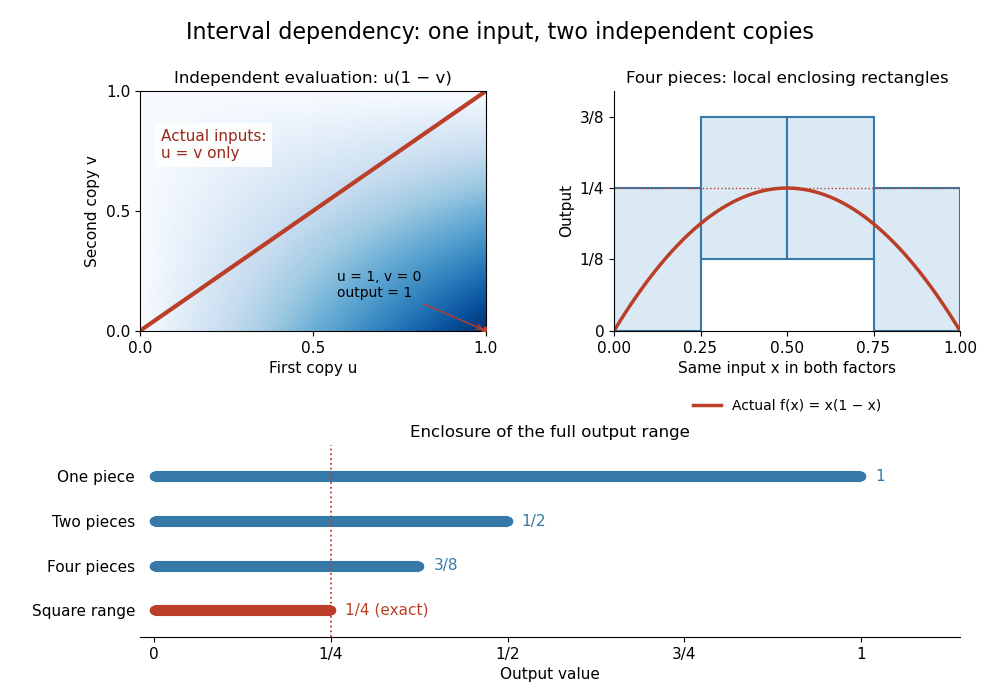
Independent interval inputs lose the diagonal constraint; subdivision tightens the enclosure of x times one minus x
. Left: the Cartesian product permits separate choices , while the actual function uses only . Right: rectangles from four pieces contain the polynomial curve. Below: one, two and four pieces give interval enclosures with upper bounds , and ; the interval square range gives the exact . Details.
Full natural exponential family 2026-10-14
A natural exponential family is full when its parameter set is the entire natural parameter space, with no restrictions on the allowable canonical parameters beyond finiteness of its normalizing integral. Fullness must not be confused with minimality or regularity.
Regular natural exponential family 2026-10-14
A natural exponential family is regular when its parameter space is open. In a full regular family, differentiation under the normalizing integral is justified locally by exponential moments in a neighbourhood. Regularity does not guarantee that every possible data set has a finite maximum-likelihood estimator.
Convex support of an exponential family 2026-10-14
The convex support is the closed convex hull of the canonical sufficient-statistic support. For a minimal exponential family it has nonempty interior. Means at finite interior natural parameters lie in that interior, because a supporting hyperplane at a boundary mean would force the sufficient statistic itself onto that hyperplane.
For each player in a finite bimatrix game, add the positive pure-strategy gains to its current mixed strategy and normalize. This gives a continuous self-map of the product of probability simplices. At a Brouwer fixed-point theorem fixed point, the gain coordinates equal the current strategy times their total gain. If that total were positive, every supported action would beat the current average payoff, contradicting that average. Thus every pure deviation has nonpositive gain for both players, proving a Nash equilibrium.
Define and for . By the Mycielskian chromatic increase and Mycielskian triangle preservation, each is a finite triangle-free graph with chromatic number . The first steps are , the Grötzsch graph, and then a 23-vertex graph needing five colours. The vertex recurrence gives . These explicit examples show how arbitrarily strong graph coloring constraints can accumulate without any three-vertex clique.
Mycielskian triangle preservation 2026-10-14
A finite simple graph is a triangle-free graph if and only if its Mycielskian is a triangle-free graph. No triangle in a graph can contain the Mycielski apex, whose neighbours are an independent set, or two Mycielski shadow vertices. A triangle in a graph containing one shadow and two originals requires all three original edges , hence an original triangle in a graph. Conversely every original triangle in a graph remains. In fact each original triangle in a graph gives four in : itself and the three choices of replacing one of its vertices by its shadow. Thus triangle-freeness is preserved, but a positive triangle count is multiplied by four.
Mycielskian chromatic increase 2026-10-14
For a nonempty finite simple graph, the upper bound copies an optimal proper vertex colouring to its Mycielski shadow vertices and gives the Mycielski apex a fresh colour. For the lower bound, suppose uses colours, with coloured . Shadows avoid . Replace colour at each original by 's colour. Changed originals form an independent set; unchanged neighbours differ because is an edge. This proper vertex colouring of uses colours, contradicting its chromatic number.[ref]
Mycielski graphs and PR proofs by Emre Yolcu and others. §4.1, Proposition 1 and proof, manuscript pp. 6–7
The nonempty condition means , not . An edgeless -vertex graph with has chromatic number one; its Mycielskian is a star graph on together with isolated vertices, and needs two colours. If has no vertices, is a single vertex, so the same formula also holds with the convention .
Mycielski apex 2026-10-14
The Mycielski apex is the added vertex adjacent to every Mycielski shadow vertex and to no original vertex. Its graph neighbourhood is precisely .
Mycielski shadow vertex 2026-10-14
A Mycielski shadow vertex has graph neighbourhood in . Its neighbours other than the Mycielski apex are original vertices. All Mycielski shadow vertices form an independent set.
Grötzsch graph 2026-10-14
The Grötzsch graph is the Mycielskian of the five-vertex cycle graph. Take original edges , with indices interpreted modulo five; add and for every . There are eleven vertices and twenty edges: five original, ten between originals and Mycielski shadow vertices, and five from the Mycielski apex.
Give colours , give each the colour of , and give colour 4. This is a proper vertex colouring. The Mycielskian chromatic increase proves that three colours are impossible, so the chromatic number is exactly four. The Mycielskian triangle preservation proves that this is a triangle-free graph. In particular its clique number is only two, even though its chromatic number is four.
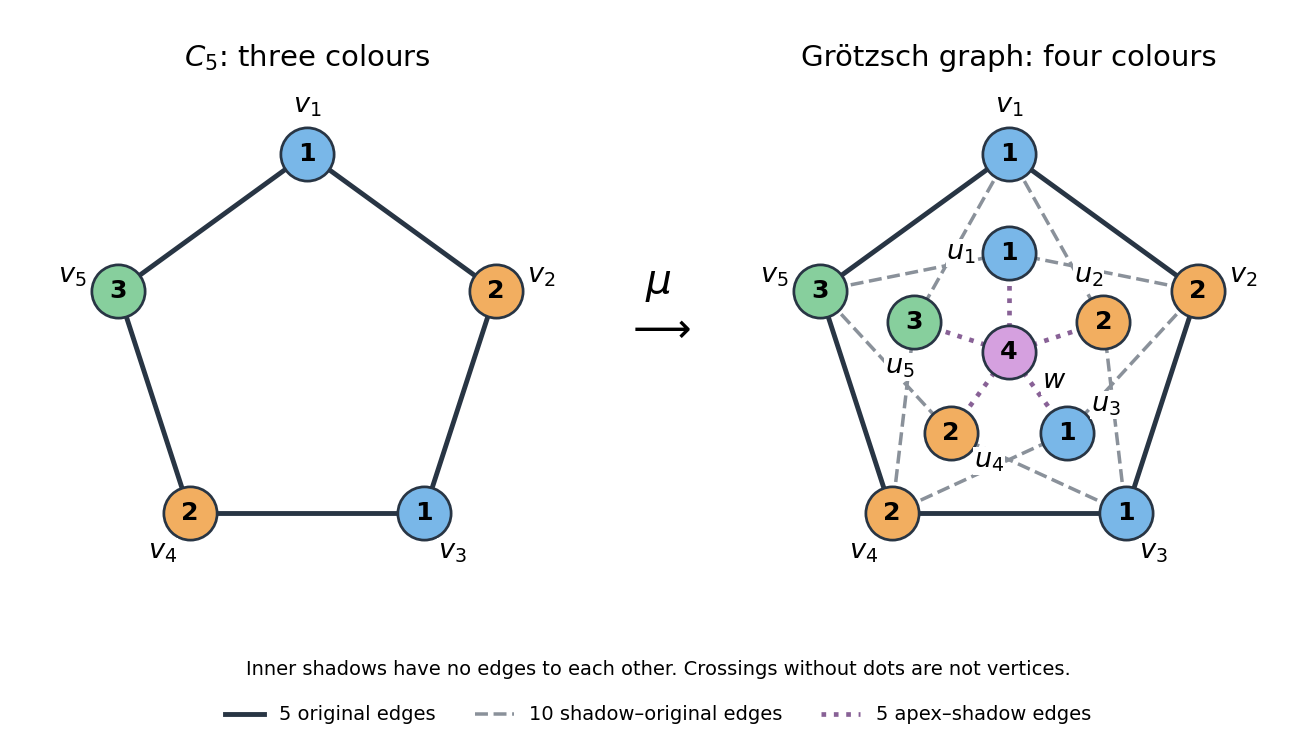

The Mycielski apex has an independent set as its graph neighbourhood, yet all three old colours are needed there in any three-colour proper vertex colouring of the subgraph obtained by deleting it. Thus a locally easy group of mutually nonadjacent neighbours can carry globally incompatible colour requirements. Absence of triangles in a graph alone cannot bound the chromatic number.
Spinlock 2026-10-14
A mechanism that waits for ownership by repeatedly trying while consuming CPU execution time. A spinlock built from test-and-set can enforce mutual exclusion without guaranteeing starvation freedom. Progress also requires the owner to run and release: if a waiting software thread monopolizes the only CPU while the owner is suspended, exclusive entry alone cannot help.[ref]
Muon decay 2026-10-14
A weak charged current decay described at energies much below the W boson mass by a four-fermion interaction with coefficient given by the Fermi constant. At leading order with negligible final-state masses, its width is .
For and vector white noise of covariance matrix , the only nonzero covariance lags are , and . This follows by retaining only matching noise times in . Its spectral matrix, with this lag convention, is . In two dimensions, with , its cross-spectrum is .
Isserlis's theorem 2026-10-14
For centered jointly Gaussian random variables, an odd product has zero expectation, and an even product's expectation is the sum over all pairings of the products of the pair covariances. In particular,For a proof, the moment-generating function is . Differentiating once in each variable at zero leaves precisely products of covariance entries indexed by complete pairings. No independence assumption between the coordinates is needed.
There are unlisted articles, also show them or only show them.