
For , the method of multiple scales gives no first-order phase drift. If is odd, the amplitude obeys the displayed damping law with . If is even, the average is zero and the amplitude is unchanged on the first slow time . The odd case dissipates mechanical energy, whereas the even case is reversible and its force is not damping of both velocity signs.
For and with leading oscillation , , averaging the auxiliary equation gives . Cancellation of resonant forcing in the oscillator gives . With and , and the displayed amplitude follows. Bounded oscillatory corrections repair the instantaneous auxiliary equation; secular terms in a fixed-time expansion show why the slow scale is needed.
For homogeneous Dirichlet endpoints, the centered first-difference matrix is skew-Hermitian and the centered second-difference matrix is negative definite. Thus is contractive in the discrete L2 norm for every real and every mesh width. The displayed identity follows by summation by parts. Nonnegative off-diagonal entries additionally require ; that maximum-principle condition is not necessary for the L2 energy estimate. numerical consistency and Duhamel's formula then give second-order numerical convergence for smooth solutions and compatible initial approximations.
For periodic indexing let be the unitary forward shift. The operator is . A discrete Fourier transform diagonalizes it with eigenvalue and real part . Consequently for every , uniformly in the grid. Equivalently , proving decay of the discrete energy directly. The result is semidiscrete stability; a further time discretization must also have adequate absolute stability.
If initial data are parameterized by and their characteristic invariant is , a solution constant on characteristics requires . At a fold , equal invariant values must have equal data, and must extend continuously if is continuously differentiable. The condition alone is insufficient: for , the data would require a derivative of blowing up at .
Weighted Euler first-order equation 2026-10-14
For , the curves in the method of characteristics are , and . On either component , the invariant is , giving . A coordinate change that includes may be singular on an axis, so smooth continuation there must be checked against the original partial differential equation.
Hysteresis 2026-10-14
Dependence of a system's observed state on the path by which its control parameters were reached. In a first-order phase transition, a metastable local minimum may persist after another phase becomes globally stable, so increasing and decreasing the control parameter give different switching points. Nucleation and sweep rate determine actual switching; a mean-field spinodal point is a local-stability limit, not the equilibrium phase coexistence condition.
Nucleation 2026-10-14
Nucleation forms a sufficiently large region of a new phase within an old metastable phase. In classical nucleation theory, positive surface energy competes with bulk free-energy gain, producing a critical nucleus and a barrier to conversion. The Arrhenius nucleation time depends exponentially on this barrier; boundaries and impurities can alter it. This explains how metastability and hysteresis can persist despite a different globally stable phase.
Metal mass fraction 2026-10-14
The fraction of total mass in chemical elements heavier than helium, so the hydrogen mass fraction, helium mass fraction and metal mass fraction satisfy . Despite the astronomical name, this includes elements such as carbon and oxygen that are not chemical metals.
For steady stellar meridional circulation, and . Thus . In the leading uniformly rotating stellar hydrostatic equilibrium, is constant on an equipotential surface; its total advected flux vanishes because the net mass flux vanishes. Integrating the energy equation then identifies the outward luminosity with enclosed nuclear energy generation, even though local heat advection is nonzero.
Eddington-Sweet circulation 2026-10-14
The thermal imbalance of a slowly rotating radiative star can drive stellar meridional circulation. Its fractional centrifugal distortion is , so balancing an order- fraction of the luminosity by thermal advection estimates , where . Stable composition gradients can further impede the circulation. This radiative thermal estimate is different from rapid torque-driven circulation in a convective envelope.
Finite-thickness Meissner screening 2026-10-14
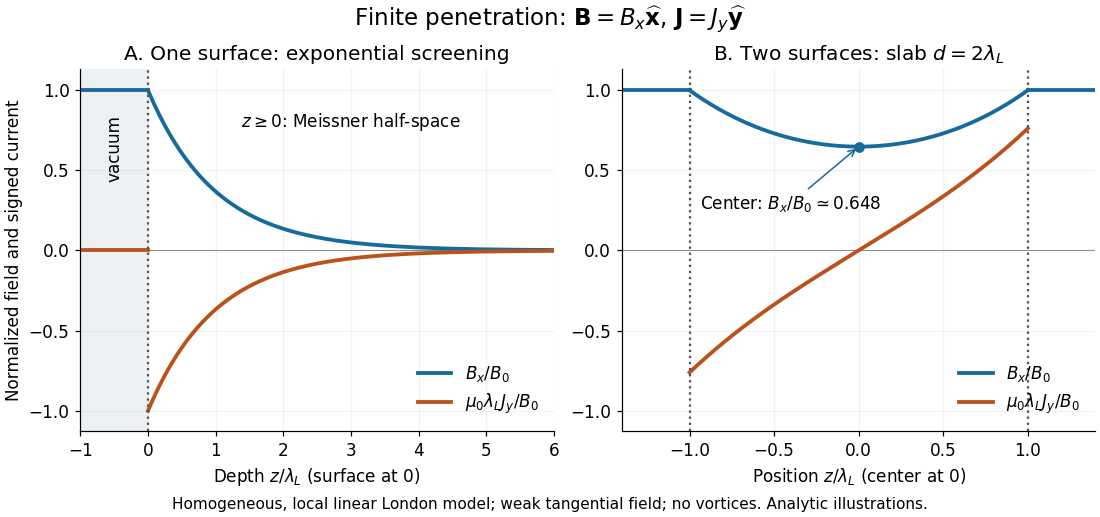
To isolate finite size from quantum vortex penetration, keep the same weak-field London equations but replace the half-space by an infinite slab . Put equal tangential magnetic fields at its two faces. With now at the slab center, the even solution and its signed current density areThe hyperbolic cosine profile has equal boundary values, while the electric currents on the two sides have opposite signs. In particular,For the stipulated thickness , the center retains about and the mean is about , even though this is a Meissner state. For , the center magnetic field is exponentially small and the mean is about , reflecting the two surface layers. For , the mean tends to : little screening is possible across such a short distance. These are analytic model examples, not material measurements. Real finite objects also need their demagnetizing field and edge geometry accounted for; the slab calculation only isolates the effect of thickness.
Planar London screening 2026-10-14
Take a homogeneous material exhibiting superconductivity in the half-space , bounded by vacuum at . Fix the temperature below the superconducting transition temperature, take a constant positive London penetration depth , and assume a local, linear London equation description in a Meissner state. The applied magnetic field is weak enough that it neither nucleates a quantum vortex nor appreciably suppresses the material's superconductivity. Assume translation invariance in , no imposed transport electric current, and a tangential boundary magnetic field . Here is the local surface magnetic flux density, equal to the imposed vacuum magnetic field in this infinite planar geometry; it is not automatically the far-away applied value for a finite object.
For a bounded, decaying interior solution, the London equations, magnetostatic Ampère law and Gauss's law for magnetism giveThe solution isAt one London penetration depth the magnetic field is of its surface value; at five it is . There is no finite depth where this exponential is exactly zero. The differential equation excludes the growing exponential through the deep-interior boundary condition. A constant normal component cannot decay in this geometry: Gauss's law for magnetism would require . A perpendicular applied magnetic field on a finite plate therefore requires a different spatial problem.[ref]
Lecture notes on the electrodynamics of metals and superconductors. §2, p. 13, Eqs. (68)–(74): London screening equation; the planar boundary-value solution here follows directly

Compact semidiscrete nine-point diffusion 2026-10-14
On a square grid, let sum the four axial neighbors and the four diagonal neighbors. With and , the method of lines has fourth-order normalized spatial numerical consistency. Its mass symbol is , and its diffusion symbol is . Every continuous-time mode therefore contracts, and Parseval identity gives mesh-independent discrete L2 stability. No time-step restriction is involved until a time integrator is selected.
Half-sparse median-order embedding 2026-10-14
A graph embedding into an ordered tournament is half-sparse when the displayed inequality holds for every proper final interval . Reserving two extra tournament vertices allows extension at any outward-oriented leaf: the median order of a tournament supplies at least half of the later vertices as outneighbours of the parent's image, while half-sparsity leaves at least one of them unused. Adding one image while extending every old final interval by two preserves the inequality.
Universal measuring coalgebra 2026-10-14
A terminal measuring coalgebra: every measuring map from factors uniquely through its universal measuring map by a coalgebra homomorphism . Composition of universal measurings makes a bialgebra, with the identity map providing its unit.
Ergodicity 2026-10-14
A measure-preserving transformation is ergodic when every set in its invariant sigma-algebra has measure zero or full measure. Equivalently, every integrable invariant function is almost everywhere constant.
Asymptotic mean squared error 2026-10-14
The asymptotic mean squared error is the leading large-sample approximation to the sum of variance and squared bias of an estimator. Minimizing it balances stochastic variation against systematic error; the resulting choice must still satisfy the assumptions used in the approximation.
Paired binary sample size calculation 2026-10-14
For a paired binary difference , set and . Then and . Under equal marginal probabilities the variance is . The McNemar test has approximate upper rejection boundary for the sum of differences. Requiring that the alternative mean exceed this boundary by gives the displayed planning size for a positive alternative, neglecting its very small lower-tail rejection probability. Use for a pre-specified one-sided test. The marginal probabilities alone do not determine : co-occurrence of positive outcomes must be specified or bounded. Discreteness and clustered data can change achieved statistical power.
Let a paired binary table have cells and . The uncorrected McNemar test is , while the ordinary independent-sample chi-squared test on the two marginal allele columns is . For nonzero difference and positive denominators, they coincide exactly when . Such numerical coincidence does not justify discarding pairing; altering concordant counts can change the unpaired statistic while leaving McNemar's statistic unchanged.
// Target: biology.bigb
There are unlisted articles, also show them or only show them.