
This criterion holds even for reducible nonnegative matrices. If a fixed point exists, for gives on its support. Some therefore satisfies , forcing the spectral radius above one by the Perron–Frobenius theorem. Conversely take , , with and . For sufficiently small , . Thus is a subsolution; monotone iteration under gives a positive fixed point below . Strictness of excludes survival at the critical value for this Poisson offspring law.
Odd-integrand cancellation by reflection 2026-10-14
If a region is invariant under one coordinate reflection and an integrable function changes sign under that reflection, its multiple integral is zero. Apply the change of variables formula to the reflection, whose absolute Jacobian determinant is one: the integral equals its negative. This applies to odd coordinate powers in symmetric volumes and to the off-diagonal entries of an inertia tensor when the mass density shares the coordinate-reflection symmetries.
Negative multinomial distribution 2026-10-14
Counts of several categories before a fixed number of stopping-category outcomes have a negative multinomial distribution. For one stopping outcome of probability , the two-count mass function is . Its probability generating function is and its means are and .
For cell means with , the independent Poisson distribution likelihood and the multinomial distribution likelihood with probabilities differ by a parameter-independent factor. Thus a maximum-likelihood estimator for the unrestricted Poisson model whose fitted total is is also an estimator for the constrained multinomial model. Equality of named parameter estimates presumes identifiability and uniqueness; without these, the conclusion concerns the sets of maximizers. A free intercept in a log-linear Poisson model enforces the fitted-total equation.
Multinomial aggregation 2026-10-14
If has a multinomial distribution with trials, group its categories into disjoint nonempty sets covering all categories. The grouped counts in the displayed equation have the multinomial distributionEach original trial belongs to exactly one group, its group probability is the sum of its category probabilities, and grouping preserves independence between trials. This gives the rule without summing the original probability mass function over every possible internal count pattern.
For the four-trial example with probabilities , merge the last two categories. Their total has the binomial distribution , so and . The same variance follows from the variance of a sum:Ignoring the negative covariance would give , although the two counts share a fixed total. Multinomial aggregation lets the resolution of category labels change while retaining a consistent model for the counts.
Galvanometer calibration by half deflection 2026-10-14
NCERT's teaching experiment uses a moving-coil galvanometer, a 0–6 V supply, a 0–10 kΩ series electrical resistance box , a 0–200 Ω parallel electrical resistance box , two switches and a voltmeter. With the parallel path open, close the supply switch and record the pointer deflection. Keep fixed, close the parallel path, and adjust until the deflection halves. The guide requests repeated settings, clean tight contacts and constant supply electromotive force; it introduces high before energizing to protect the winding. [ref]
Experiment 6: Resistance and figure of merit of a galvanometer. Experiment 6, printed pp. 53–58: Figure E 6.1, Procedure 1–5, Precautions and Sources of Errors
Write the winding electrical resistance as , the supply electromotive force as , and assume negligible supply internal electrical resistance. Ohm's law gives the two winding electric currentsIf proportional deflection gives , solving yields , requiring . The shortcut requires ; closing the parallel path generally changes the total supply electric current. For chosen values and , the exact result is , rather than . The manual gives this exact relation and asks how finite supply internal electrical resistance affects it. [ref]
As an additional calibration control, record the supply-off zero, apply several small positive and negative electric currents, and recheck zero after each sequence. With known, calculate each electric current from the measured supply electric potential difference and the total series electrical resistance; plot settled deflection against that electric current. Equal-magnitude reversed readings should lie equally far from a stable zero. A fitted relation separates zero offset from galvanometer current sensitivity. The manual's “figure of merit” is electric current per scale division, not the mechanical torsional spring constant used above. These reversal and zero checks extend the documented procedure; they are proposed controls, not reported measurements.
Galvanometer current sensitivity 2026-10-14
The galvanometer current sensitivity is the change in settled deflection angle per change in electric current. In the linear model its derivative is constant, . The illustrative design has , or per . A chosen full-scale angle corresponds to ; a straight-line extrapolation beyond that range does not establish real instrument behavior.
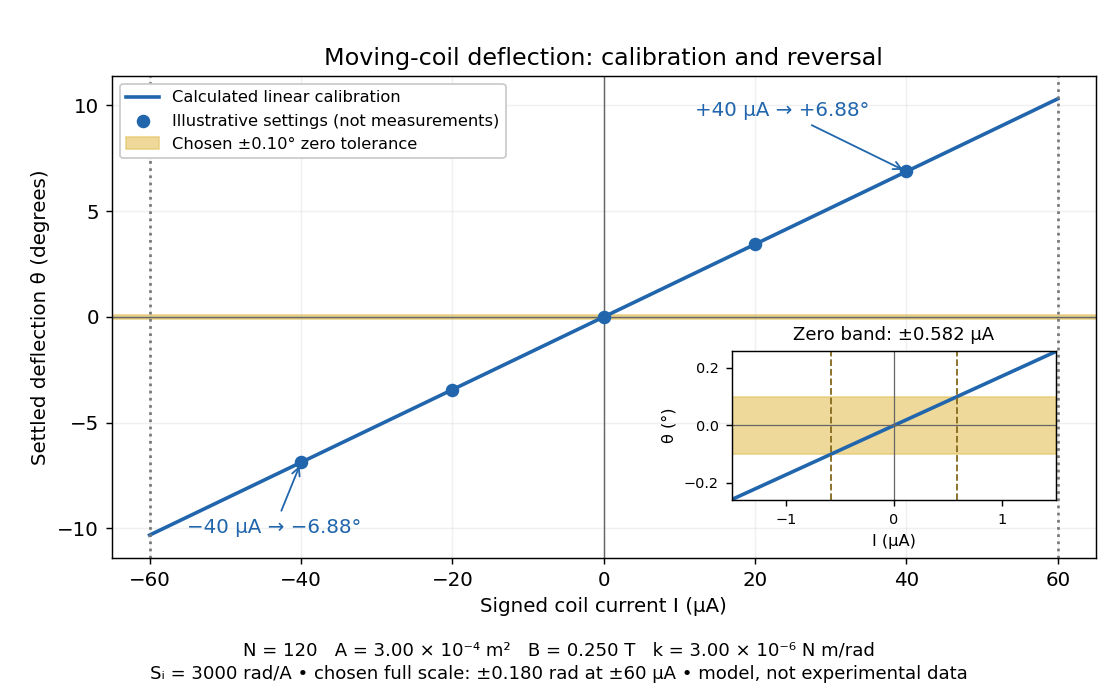
Illustrative moving-coil calibration, current reversal and finite zero resolution
. Calculated deflection for the original design, with selected calibration points and a close view of zero. The shaded band is a stipulated readout tolerance, corresponding to about ; it is not measured noise. Values and points are illustrative model predictions, not observations from a real instrument. Source. Details.
Finite sensitivity and finite readable angle set different limits. Under the stipulated tolerance, a reading indistinguishable from zero means only if the zero is stable and the model applies. More turns can increase galvanometer current sensitivity while also increasing winding electrical resistance; the response to an applied electric potential difference depends on both. Friction, zero drift, departures from the radial magnetic field, and spring nonlinearity can spoil the calibration. Damping sets how long one must wait for a settled reading. A rapidly reversing electric current can produce little mean pointer deflection even when its instantaneous magnitude is large.
Moving-coil galvanometer torque 2026-10-14
For a rectangular winding with turns, active side length , side separation , and per-turn area , the magnetic force on a current-carrying wire gives equal and opposite side forces of magnitude . Their force couple has lever arm . Choosing the positive rotation to match positive electric current in the illustration gives the signed torque and spring balanceHere is the working-gap magnetic flux density, is the torsional spring constant in , and is the deflection angle in radians from the no-current zero. The balance holds after motion has settled, within the radial-field and linear elasticity ranges. Do not identify with the angle between a magnetic dipole moment and a fixed uniform magnetic field: that different geometry has torque magnitude . [ref]
For an original illustrative design, choose , , , and . Then . At , the magnetic torque is and . Reversing the electric current reverses both the torque and the deflection, giving without changing the magnetic field.
Galvanometer radial field 2026-10-14
A galvanometer radial field is approximately radial about the rotation axis within each narrow working gap. Its direction follows the moving sides of the coil over the useful sweep. Here the magnetic field points from the left pole toward the core and from the core toward the right pole; it is not outward everywhere. This geometry keeps the magnetic force on a current-carrying wire tangential, with nearly constant lever arm. A spatially uniform magnetic field in a fixed direction would instead give an angle-dependent torque as the coil turns.
Reynolds equation 2026-10-14
Incompressible mass conservation in a moving gap givesCombined with the local Couette-Poiseuille flux, this is the Reynolds lubrication equation.
For a thin gap with tangential wall velocities , lubrication theory and the no-slip boundary condition give the integrated volume fluxConservation of mass gives . This is the Reynolds equation; it determines the lubrication pressure from wall motion and gap geometry.
Moving-average operator 2026-10-14
The moving-average operator is the finite filter obtained by substituting the backshift operator into the moving-average polynomial. It maps a white noise sequence to its weighted finite sum of present and past values.
Electromagnetic braking of a sliding rod 2026-10-14
A conducting rod sliding on rails separated by in a transverse magnetic field has induced current magnitude when self-inductance is neglected and resistance is . The Lorentz force opposes motion with magnitude , so free motion decays exponentially on the displayed time constant. Joule heating integrates to the rod's lost kinetic energy. Current direction follows the Lenz's law.
Mostowski collapse 2026-10-14
The recursively defined isomorphism from a well-founded extensional set-like relation to membership on a transitive set or class. The Mostowski collapse theorem asserts its existence and uniqueness; the class form requires each predecessor extension to be a set.
Projective quadratic Morse complex 2026-10-14
For distinct ordered , the quotient on Real projective space has one critical point of index . Its descending flow is . The unstable cell at is . Between adjacent critical points there are two trajectories, whose relative orientation is the degree of the antipodal map on . Thus, up to generator orientation, the differential is two in even degrees and zero in odd degrees. This gives the integral cellular homology of real projective space rather than only its mod-two ranks.
Integral Morse complex of the Klein bottle 2026-10-14
On the Klein bottle given by , the Morse function , , has one minimum, two saddles, and one maximum. In its descending Morse-Smale gradient flow, the two branches from either saddle to the minimum cancel. From the maximum to the fiber saddle, reflection of the fiber under the base identification reverses the transverse orientation, making the two contributions add. The contributions to the base saddle cancel. With a choice of generator orientations the displayed Morse chain complex follows. Thus integral homology is , and ; the top attaching word independently gives the coefficient two on the fiber generator.
One-sided kinetic solidification dispersion 2026-10-14
Use undercooling , solidification attachment mobility , velocity scale , length and time . Let be the latent-to-sensible heat ratio, , and . In the one-sided liquid-diffusion model, a travelling planar front has and . For a corrugation , the decaying thermal perturbation is , with and the branch . The displaced kinetic condition gives . The displaced Stefan condition gives . Eliminating proves the displayed dispersion relation. Neglect of solid-side perturbation heat flux is part of this model.
Cokernel sheaf 2026-10-14
For a morphism of sheaves of abelian groups or modules, the cokernel sheaf is the sheafification of the presheaf . Its stalk at is . The presheaf quotient itself need not satisfy the sheaf gluing axiom, which explains why a surjective morphism of sheaves need not be surjective on global sections.
If an integer-valued monotone sequence is nondecreasing and bounded above by , it can increase strictly at most times. Thus its values eventually remain constant. Such sequences are determined by a finite initial list followed by a constant tail, so their collection is a countable set.
Map a binary sequence to the rational partial sums . They are nondecreasing and bounded above by . A first different digit makes the corresponding partial sums different at that index, so the map is injective. Cantor's diagonal argument then makes this family uncountable despite every individual term being rational.
// Target: special-relativity.bigb
Minimum-decrement convergence criterion 2026-10-14
Suppose and the displayed inequality holds with fixed . Then decreases to some . Telescoping shows . If , this bounds , contradicting clipping preserves divergence of a positive series when diverges. Thus divergence of the positive input series forces .
There are unlisted articles, also show them or only show them.