
Continuity correction 2026-10-14
A continuity correction shifts a discrete probability boundary by half a lattice spacing before using a continuous normal approximation. For an upper-tail event on a unit lattice, the approximation is . Lower tails use the boundary . The correction is used in approximate Wilcoxon signed-rank tests and Wilcoxon rank sum tests; tied ranks also require the appropriate variance adjustment.
Tangential and normal acceleration 2026-10-14
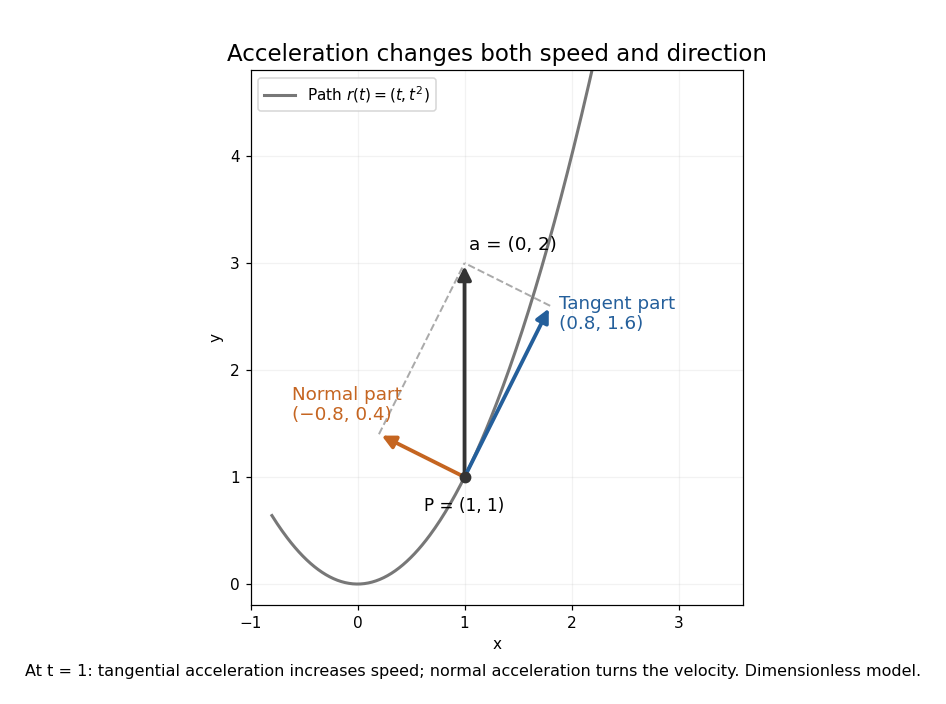
For a twice continuously differentiable regular curve describing motion, let , , and let be the principal normal vector where the curvature is positive. Differentiating the velocity vector givesThe tangential component changes the speed; the normal component changes the direction of the velocity vector. A particle can therefore have nonzero acceleration at constant speed, as in circular motion with constant speed. The formula follows from and the product rule. When , the normal contribution vanishes even though the principal normal vector is undefined there. [ref]
https://ocw.mit.edu/courses/16-07-dynamics-fall-2009/84852a46fa77de9a750245ceb761255a_MIT16_07F09_Lec06.pdf. Widnall and Peraire, MIT 16.07 Lecture 6: intrinsic coordinates, pp. 1–4
In dimensionless coordinates, take . At ,The resulting vector components areBoth increasing speed and turning contribute to the same acceleration.

Pinching map 2026-10-14
For mutually orthogonal projectors summing to the identity, a pinching map discards coherences between their ranges while preserving each diagonal block. It is a quantum channel with Kraus operators , and a unital quantum channel. A state is fixed by pinching exactly when it commutes with every projector.
In Synchronous gauge in cosmology with coordinates comoving with cold dark matter, the linearized Einstein field equations and matter conservation give the displayed density equation. Primes denote conformal time derivatives. The radiation term contains its pressure contribution and cannot be dropped on superhorizon scales merely because radiation oscillates after cosmological horizon entry.
Diagonalize two density operators with eigenvalues , and put . This overlap matrix has row and column sums one. The scalar inequality yields in natural units; division by gives bits. Equality forces whenever , so and . Zero eigenvalues use limits, and failure of support inclusion gives infinite quantum relative entropy.
An irreducible Markov chain is recurrent exactly when every nonnegative superharmonic function for a Markov chain is constant. In the recurrent case, absorb the chain at . The inequality and almost-sure hitting give ; exchange . In the transient case, the hitting probability of a state is one there and satisfies the superharmonic inequality, but its one-step average at is the strictly smaller return probability. It is a nonconstant example.
Primitive real-analytic Eisenstein series 2026-10-14
For this Eisenstein series also equals , where consists of translations and their negatives. It is modular invariant. The nonholomorphic Eisenstein series summed over all nonzero integer pairs instead equals : separate each pair into a positive integer times a primitive pair. This normalization matters in Rankin–Selberg unfolding.
Completed nonholomorphic Eisenstein series 2026-10-14
This modular-invariant function, initially defined for , has Fourier expansionwhere is the completed Riemann zeta function, without the entire-xi polynomial factor. Poisson summation and the integral representation of the modified Bessel function of the second kind prove the expansion. It gives meromorphic continuation, , and simple poles at zero and one with residues . Apparent poles at cancel between the two constant terms.
Parametrize one ellipse as and substitute it into the quadratic equation of the other. At a transverse intersection, has a simple zero, so its sign changes. Periodicity makes the number of zeros even. The function is a trigonometric polynomial of degree at most two, so multiplication by , with , gives a nonzero polynomial of degree at most four. Hence there are at most four distinct intersection points. Coincident ellipses are excluded by transversality.
For with , completing the square in its Gaussian representation gives . Integrate the identity and use Tonelli theorem to obtain the displayed reciprocal moment. It is strictly decreasing in , since its positive integrand is strictly decreasing for every . At the integral equals , proving finiteness and the sharp maximum over noncentrality parameters.
If an autoregressive model has white noise of positive variance, a unique weakly stationary process solving its equation on all integer times exists precisely when its autoregressive polynomial has no root on the unit circle. In that case has an absolutely summable Laurent series on an annulus containing the unit circle; its coefficients define a bilateral linear filter of a stationary time series. Applying that inverse also proves uniqueness among bounded second-moment solutions. A root on the unit circle forces the candidate spectral density of a stationary process to have a nonintegrable singularity. The stronger causality root criterion for an autoregressive model requires every root outside the closed unit disk.
The real matrix has both eigenvalues equal to one, whereas for . Hence no universal constant bounds this quotient by the maximum eigenvalue of every real matrix with real eigenvalues.
Extend the interior grid vector by zero. With axial weights and diagonal weights , the negative central coefficient equals the total neighbour weight. Expanding the edge-square sum gives the displayed quadratic form. Equality forces all axial differences to vanish, and connection to the zero exterior forces the vector to be zero. Simultaneous row and column permutations preserve symmetry and negative definiteness.
The Jacobi method has axial neighbour weights and diagonal weights . Interior row sums are one, boundary-adjacent sums are smaller, and the positive-weight graph is connected. If an eigenvalue had modulus one, a maximal-modulus eigenvector component would force all its neighbours to have the same modulus. Propagation reaches a deficient row, a contradiction. This proves strict spectral-radius control even though the infinity norm of the iteration matrix can equal one.
Compact fourth-order Helmholtz stencil 2026-10-14
Let have center weight , axial weights and diagonal weights , and let have center weight and axial weights . Taylor expansion gives and . On a smooth solution of the constant-coefficient Helmholtz equation, the second-order term becomes . Thus the normalized PDE residual is fourth order, while the original unscaled stencil residual is sixth order. This local cancellation alone does not prove uniform global accuracy at or near a resonance.
For the square-grid nine-point finite-difference stencil for the Laplacian,If , both displayed correction terms vanish: the mixed sixth derivatives sum to , and the pure sixth derivatives sum to the negative of that sum. Expanding two orders further yields for a smooth harmonic function. Thus the compact harmonic scheme has sixth-order normalized consistency of a numerical method and, with the discrete maximum principle inverse bound, sixth-order nodal convergence on a square with exact smooth Dirichlet boundary data. For example shows that the sixth-order term need not vanish.
For the Dirichlet discrete Laplacian on a square, let . The standard axial five-point operator is , and the axial-weight , corner-weight nine-point operator additionally contains . Its eigenvalues are therefore strictly larger than the five-point values for the same sine modes. Both lie above the corresponding negative continuum Laplacian eigenvalues, so the five-point operator has smaller spectral error. For fixed mode numbers the leading errors are respectively and .
There are nilpotent matrices of size n over . Every matrix has a unique invariant direct sum on which it is nilpotent and invertible. Counting those ordered decompositions gives . Subtraction at n and n−1 yields . Translation by the identity counts unipotent matrices.
For a real or complex two-by-two matrix , the Cayley-Hamilton theorem reads . Hence exactly when . Conversely, if for any positive integer , every eigenvalue is zero and the same identity gives . Thus a nonzero nilpotent matrix of this size has nilpotency index two.
Nilpotence index of an ideal 2026-10-14
For a nilpotent ideal , its nilpotence index of an ideal is the least positive integer for which . In , with an irreducible polynomial, the unique maximal ideal has index . In a discrete valuation ring with , the maximal ideal of its reduction modulo has the same index. Comparing these indices under a quotient ring isomorphism recovers the ramification exponent in the Kummer-Dedekind theorem.
There are unlisted articles, also show them or only show them.