
Longest element of a Coxeter group 2026-10-14
The longest element is the unique element of maximal Coxeter length in a finite Coxeter group. It is an involution and satisfies .
The finite cyclic group and the Klein four-group are both abelian groups of order four. In , composition is addition modulo four. In , label the elements and add each coordinate modulo two. For example, and .
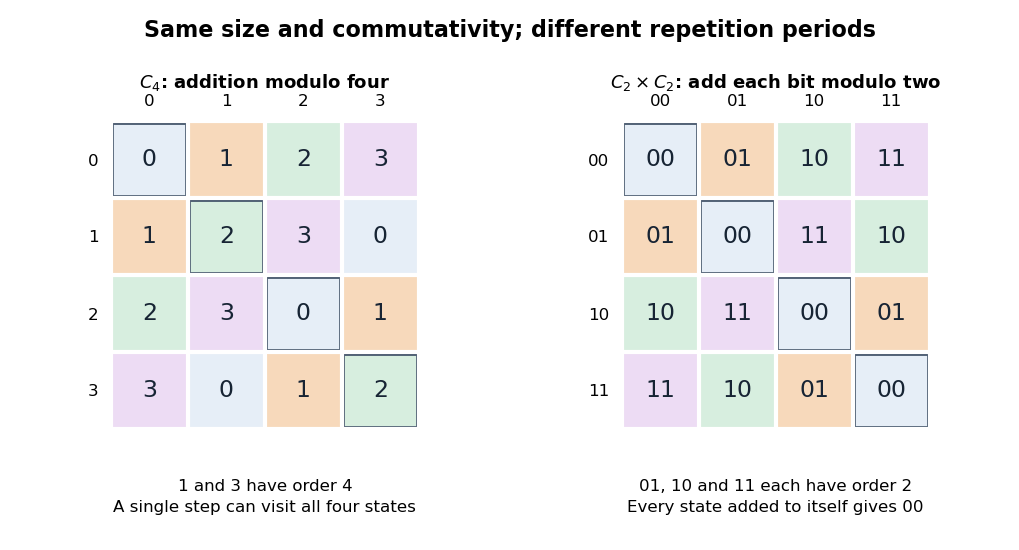
Two abelian groups of order four have different addition tables
. Each cell is the row element plus the column element. Diagonal cells record adding an element to itself. In , only and return to zero after two additions. In the Klein four-group, every diagonal cell is the identity element . The symmetric tables show commutativity, while the different doubling behavior distinguishes the groups. Details.
The order of a group element is preserved by a group isomorphism: an equation holds exactly when its image satisfies the same equation. In , both and have order four. In , each nonidentity element has order two. Hence these groups are not isomorphic, despite having the same order of a finite group. No relabelling can repair this discrepancy.
For a geometric model of , take the symmetries of a non-square rectangle: the identity element, reflection in its horizontal axis, reflection in its vertical axis, and rotation through . The two reflections commute, and their composite is the half-turn. Every nonidentity motion is its own inverse element. This makes the two binary switches concrete: choosing whether to apply each reflection specifies all four motions. The case of abelian groups of prime-square order generalizes this distinction from to any prime .
Normal ultrafilter on small subsets 2026-10-14
An ultrafilter on is normal when each function with on a -large set is constant on a -large subset. This is the small-subset version of normality; together with fineness and kappa-completeness it gives the measure characterization of a supercompact cardinal.
Connected-component presheaf of a functor 2026-10-14
For a functor , precomposition by induces , hence a map of categorical connected components in the opposite direction to . This defines a presheaf on . Its category of elements is the intermediate category in the final-discrete-fibration factorization.
Two factorizations of one functor have a unique connecting functor in each direction, by the orthogonality of final functors and discrete fibrations. Their composites and the identity fill the same lifting square, so uniqueness makes both composites identities. The intermediate categories are therefore canonically isomorphic.
Almost commutative algebra 2026-10-14
An almost commutative algebra over a field is an algebra with an exhaustive increasing nonnegative multiplicative filtration whose associated graded ring is commutative and finitely generated as an algebra over the field. A common presentation uses finitely many degree-one generators, scalar degree-zero part, and commutators that lower degree. The finite-generation requirement is essential: an infinitely generated commutative polynomial ring has commutative associated graded algebra but need not be Noetherian.
Rees ring of a filtered algebra 2026-10-14
For an ascending multiplicative filtration with , its Rees ring contains the central element . The quotient by is the associated graded ring, and the quotient by is the original algebra. If , commutators of lifts are divisible by . Their first-order term defines the Poisson bracket from a central deformation parameter on the associated graded ring.
Fibonacci gcd reduction 2026-10-14
Consecutive Fibonacci numbers are coprime by the Euclidean algorithm. The Fibonacci addition formula writes for . Taking the greatest common divisor with removes the last summand, and multiplication by the coprime factor leaves that gcd unchanged. The case uses . Applying the Euclidean algorithm to the indices yields the strong-divisibility identity for nonnegative indices, with the usual zero conventions.
Mihailova subgroup 2026-10-14
For a finite group presentation , let be the free group on its generators and . The corresponding fiber product of groups is generated by and . Conjugation by the diagonal pairs supplies every pair with in the normal closure of the relators, and proves the generating claim. Membership of is equivalent to in , so this finitely generated subgroup can have undecidable membership even though has soluble word problem.
Local fibre dimension 2026-10-14
The dimension of the fibre of a morphism locally at its source point : the maximum of the dimensions of the fibre's irreducible components through . This differs from the Krull dimension of the local ring at a nonclosed point.
Orthogonal structure on a real vector bundle 2026-10-14
An orthogonal structure is a reduction of the transition functions of a real rank- vector bundle to the orthogonal group. Its orthonormal frames define a fiber metric, independent of the chosen frame because orthogonal transitions preserve the inner product. Conversely a fiber metric gives smooth orthonormal frames by the Gram-Schmidt process, with orthogonal transition matrices. This equivalence does not require the vector bundle to be globally trivial.
Fixed-body retarded acoustic loading formula 2026-10-14
For a fixed impermeable object, the Ffowcs Williams-Hawkings equation has a volume acoustic quadrupole and a surface acoustic dipole, with no mass-injection term. If is the total force exerted on the fluid and the integrated Lighthill stress tensor, the acoustic compact-source approximation in the acoustic far field gives the displayed pressure at retarded time. A force convention directed onto the body reverses the loading sign. The retarded acoustic Green function carries when the wave operator is .
For normalized triplets and , let the raising matrix have ones in entries and . Its commutator with its adjoint is . Neutral mixing in leaves this result unchanged because . With current normalization using , fermionic bilinear charge algebra gives the displayed proportionality to the leptonic electric charge . Other current normalizations change the numerical prefactor, not closure. Equal-time algebra does not itself imply conservation of a fermionic weak charge in a symmetry-broken theory.
For a fixed pants decomposition of a closed genus- hyperbolic surface, its cuff lengths determine all its Y-pieces. Two suitably chosen transverse simple closed curves at each cuff, one obtained from the other by a Dehn twist, determine the corresponding twist: hyperbolic seam identities express their lengths through shifted hyperbolic cosines of that twist, removing the sign ambiguity of just one transversal. Thus finitely many marked lengths determine the Fenchel–Nielsen coordinates. The unmarked length spectrum lacks these labels, which is why this fact alone does not imply global spectral uniqueness.
Fenchel–Nielsen twist 2026-10-14
After cutting a hyperbolic surface along a simple closed geodesic, reglue its two boundary copies after an arclength displacement . The boundary length remains fixed, while the Riemannian metric varies. In marked Fenchel–Nielsen coordinates, the twist is real-valued; changing it by one boundary length corresponds to a Dehn twist in the marking. This construction also applies to a hyperbolic pair of pants with a fixed cone angle and two geodesic boundaries.
Symmetric Feller semigroup 2026-10-14
A Feller semigroup symmetric in the space associated with an invariant measure has a self-adjoint contraction realization in . Its two-point kernel measure is symmetric. This reversibility expresses its joint energy as an integral of products of increments.
// Target: analysis.bigb
Fejér saturation on a Fourier mode 2026-10-14
For fixed positive integer and , the Fourier coefficient of the Fejér kernel at frequency multiplies the mode by . The displayed error is exact. Consequently the order cannot be replaced by for all twice continuously differentiable periodic functions, even though each fixed Fourier mode is infinitely differentiable.
Fractional-scale Fejér approximation bound 2026-10-14
Fay shock-layer asymptotics 2026-10-14
For and , the Fay solution becomes . The partial-fraction identity for the hyperbolic tangent sums this to the displayed smooth shock layer. It resolves the odd transition from to on angular thickness ; at both sides vanish and the comparison is read through their derivatives.
For the standard fundamental sequences of limit ordinals below epsilon zero, the index order corresponds to eventual, rather than necessarily pointwise, growth. For example, under and successor iteration times, whereas . Limit stages are diagonal choices, so a larger index can give a smaller value at small arguments.
There are unlisted articles, also show them or only show them.