
Euler characteristic and holes 2026-10-14
For a finite CW complex, counts connected components: its connected components are its path components, as recorded by the zeroth homology group. For a finite graph regarded as a one-dimensional CW complex, no higher homology groups occur, so counts independent graph cycles, and . For a connected planar surface obtained by removing disjoint open disks from the interior of a closed disk, and ; the annulus is .
The word "hole" needs its dimension. A two-sphere encloses a cavity but has and . A closed orientable surface of genus instead has and : increasing the genus by one adds two independent one-dimensional homology classes. In higher dimensions, further homology groups enter with alternating signs; there is no universal "components minus handles" rule.
A homeomorphism preserves every homology group, hence the Euler characteristic wherever the finite rational Betti number sum is defined. In fact, homotopy invariance of homology makes Euler characteristic invariant under homotopy equivalence. Thus different finite CW complex structures on the same space have equal alternating cell counts.[ref]
Algebraic Topology by Allen Hatcher. Algebraic Topology, §2.2, p. 146, homotopy-type independence immediately before Theorem 2.44
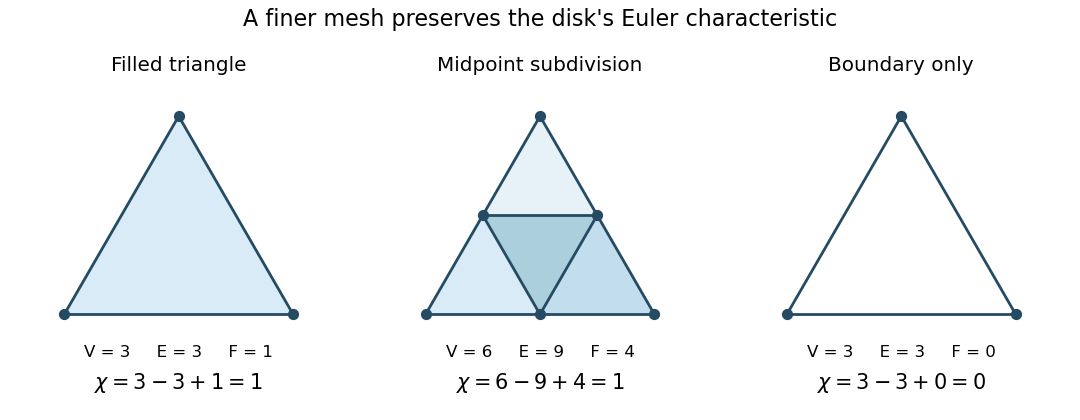
In the illustrated simplicial subdivision, inserting the three edge midpoints turns one filled triangle into four. The counts change from to , but . Splitting a single edge adds one vertex and one edge, so its net contribution is . Adding a diagonal inside a polygonal face adds one edge and one face, giving .
These local accounts explain common refinements. For arbitrary finite simplicial subdivisions, including barycentric subdivision in any dimension, the underlying geometric realization is unchanged. The topological invariance of Euler characteristic therefore guarantees the same alternating count, even when the individual counts change substantially.
Euler characteristic of a torus 2026-10-14
Identify opposite sides of a square by translations to obtain a torus. All four corners become one vertex; the horizontal sides give one topological cell and the vertical sides one topological cell . The open square supplies one two-dimensional topological cell. Thus and . The cellular boundary of each one-dimensional topological cell is zero because its endpoints agree. Traversing the face boundary gives the group commutator , whose signed counts of both and vanish. Hence its cellular boundary is also zero, and .[ref]
A Concise Course in Algebraic Topology by J. P. May. A Concise Course in Algebraic Topology, Chapter 13, §5, p. 103, Example (i), the torus cellular chains and integral homology
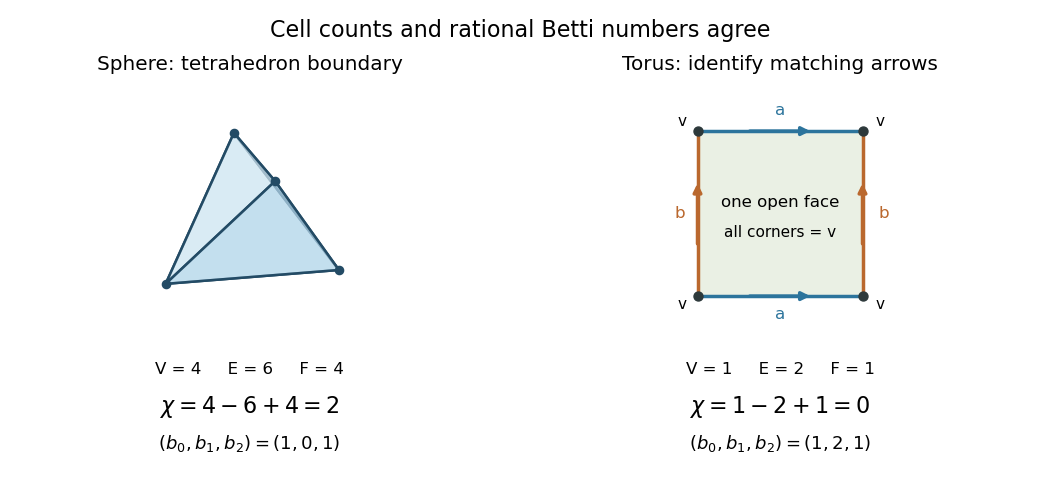
The tetrahedral sphere and the square presentation of a torus have different alternating cell counts
. Details. The boundary of a tetrahedron is a two-sphere, with four vertices, six edges and four triangular topological cells: . Its rational Betti numbers are by homology of a sphere. The torus's two independent one-dimensional homology classes cancel its degree-zero and degree-two contributions. The torus and annulus both have Euler characteristic zero, yet different homology groups; one integer cannot recover all of homology.
Euler characteristic of an annulus 2026-10-14
Build a closed annulus from two nested -sided polygons, , with radial edges joining corresponding vertices. There are vertices, edges and quadrilateral topological cells, giving . The central missing region and the exterior are not faces of the annulus. A deformation retraction onto a circle gives , agreeing with the cell count. This is a useful reduction: the annulus is two-dimensional, yet its homology is that of a one-dimensional cycle graph.
A filled triangle is a disk with three vertices, three edges and one two-dimensional topological cell, so . Its simplicial homology has : the filled triangle is contractible, and the three-edge chain cycle is the chain boundary of its face. Keeping only the cycle graph on those three vertices gives and , since that chain cycle no longer bounds a face. The surrounding plane's exterior is not part of either simplicial complex; do not add it to .


Cell-count formula for Euler characteristic 2026-10-14
Let be a finite CW complex, with topological cells of dimension and none above . Its Euler characteristic is the displayed alternating sum. For a finite simplicial complex, counts its -dimensional simplexes, each counted once rather than once for each containing simplex. In dimension two this becomes . A topological cell's interior is counted; identified parts of its boundary are counted in their own lower-dimensional topological cells.[ref]
Algebraic Topology by Allen Hatcher. Algebraic Topology, §2.2, p. 146, definition of Euler characteristic and Theorem 2.44
The cellular homology theorem identifies cellular homology with singular homology, so the count equals the alternating rational Betti numbers. These are the free ranks of integral homology; torsion subgroups do not contribute to them. Over any field, the alternating homology dimensions still give the same Euler characteristic, although individual Betti numbers can depend on the field.
Euclidean semigroup growth bounds 2026-10-14
The spectral radius of the matrix exponential gives the lower bound through the spectral abscissa . Differentiating the squared Euclidean norm along and bounding its Hermitian quadratic form gives the upper bound through the Euclidean logarithmic norm . A non-normal matrix can have despite , allowing transient growth before its ultimate decay.
Frieze group 2026-10-14
A discrete subgroup of Euclidean isometries is a frieze group when its translation subgroup is infinite cyclic and has finite index. Translations along a line alone give ; adding perpendicular mirrors gives the infinite dihedral group, while adding a mirror along the translation direction gives . These groups describe patterns periodic in one planar direction.
Translation subgroup 2026-10-14
The translation subgroup of a group of Euclidean isometries consists of its translations. It is a normal subgroup, because conjugation by takes translation by to translation by . Its vectors form an additive subgroup of Euclidean space; for a plane crystallographic group they form a rank-two translation lattice.
Rotation (mathematics) 2026-10-14
In Euclidean geometry, a rotation about the origin is an orientation-preserving orthogonal linear map, represented by an element of the special orthogonal group. About another center , the map has form . In three dimensions a nonidentity rotation fixes an axis.
Rigidity of a scalene triangle 2026-10-14
The vertex set of a triangle with three distinct side lengths has trivial setwise stabilizer subgroup in the plane isometry group. Each vertex is characterized by the unordered pair of lengths of its incident edges, so a setwise-preserving Euclidean isometry fixes every vertex. An isometry fixing three noncollinear plane points is the identity: squared Euclidean distances to them determine every other point, since subtracting two of the Euclidean distance equations gives two independent linear equations. For example, have side lengths .
The ring of integers is a Euclidean domain for . In its lattice choose the nearest row, whose imaginary-coordinate error is at most , then the nearest point on that row, whose real-coordinate error is at most . Every complex number is thus within squared distance of a lattice point, giving Euclidean division. The suborder has the nonprincipal ideal and consequently is not a Euclidean domain for any Euclidean function.
For a Euclidean radial-time metric , assume has a simple horizon zero and is smooth, finite and positive there. A proper radial coordinate puts the leading metric in the form . Smoothness fixes the displayed period independently of . When the Lorentzian time is normalized at infinity, the period is the inverse Hawking temperature in natural units. A conformal factor singular at the horizon need not preserve this argument.
// Target: general-relativity.bigb
For a normalized static metric with a simple outer zero at , set . The Wick rotation and give to leading order, so smoothness fixes period . In an ingoing null chart, on the future horizon; the outgoing chart gives the opposite sign on the past branch. The Hawking temperature is and uses the time generator normalized at infinity.
On the side where V is positive, set . Its radial Euclidean metric becomes the displayed plane in polar coordinates. The would-be singularity is conical unless the angular variable has period exactly . This fixes ; a nontrivial integer multiple still has a cone excess at the tip.
Euclidean unit ball 2026-10-14
The Euclidean unit ball is the closed unit ball of the Euclidean norm, centered at zero. Its radial function is identically , making it a natural reference body for John ellipsoids and volume ratios.
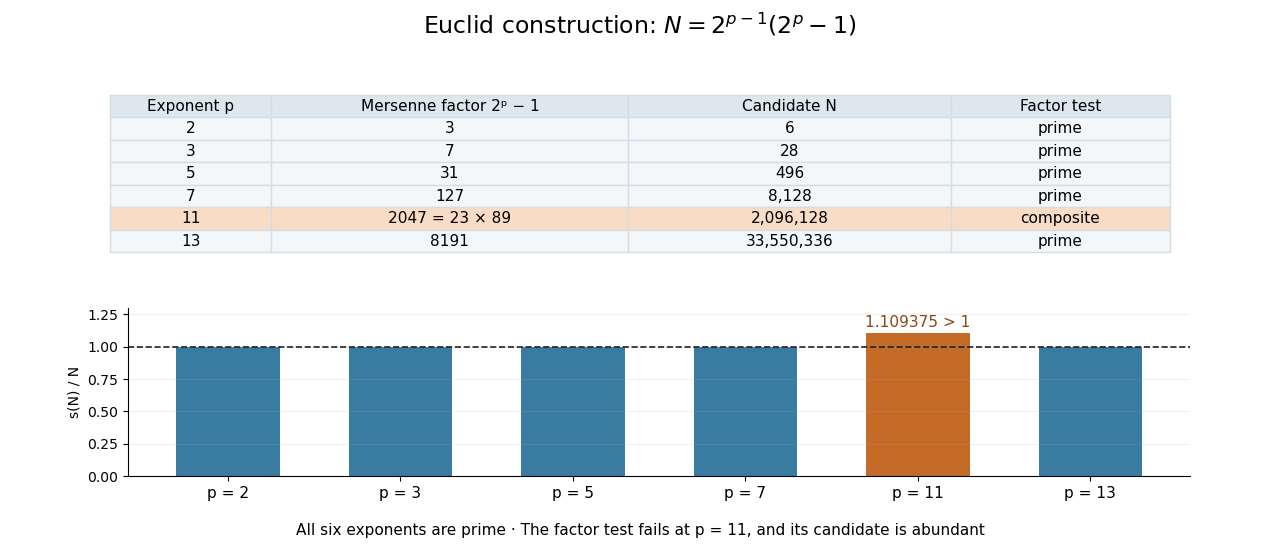
The prime exponents give Mersenne primes and therefore perfect numbers. But gives . The resulting candidate hasso . It is an abundant number, not a perfect number. Checking only that the exponent is prime would miss this obstruction.

Let be a closed operator and let be compact when the domain carries its graph norm. If is closed on the same domain, compact perturbation invariance of Fredholm operators applied to the maps proves invariance of the Fredholm essential spectrum. For self-adjoint operators this is also the essential spectrum obtained by deleting isolated finite-multiplicity eigenvalues. A bounded potential tending to zero at spatial infinity is relatively compact with respect to a second-order constant-coefficient operator: local Rellich-Kondrachov compactness theorem gives compactness on bounded intervals and the small tails give compactness globally.
Essential spectrum in the Calkin algebra 2026-10-14
For a bounded linear operator on an infinite-dimensional complex Hilbert space, define the essential spectrum by failure of the Fredholm property for . The Atkinson theorem identifies it with the spectrum in the Calkin algebra, hence it is compact and nonempty. On a finite-dimensional Hilbert space it is empty. For a bounded real diagonal operator on a separable infinite-dimensional space it equals the subsequential cluster set of the diagonal entries, including values of infinite multiplicity.
There are unlisted articles, also show them or only show them.