
Past exam of the theoretical physics II course of the University of Cambridge 2019 4 e i Solution 2026-10-18
The normalized singlet state has column vector in the specified product basis. Its outer product isIt obeys and has eigenvalues , hence purity of a density operator one. The joint two-atom system is therefore a pure state, even though the quantum entanglement prevents assigning a separate pure spin state to each atom.
The sign can be checked independently by multiplying the equation by . With ,For periodic motion the total-derivative near-field term averages to zero, so positive gives a radiative energy loss, consistent with the slow poles' damping. Negative acts as energy gain in this model.
For the comparison equation as printed, , the response denominator instead is , with exact polesThus ordinary positive damping in that sign convention requires , the opposite sign from slow radiation damping in the third-derivative equation. The word “damped” does not override the explicitly printed minus sign. With the usual equation , positive gives the familiar lower-half-plane poles.
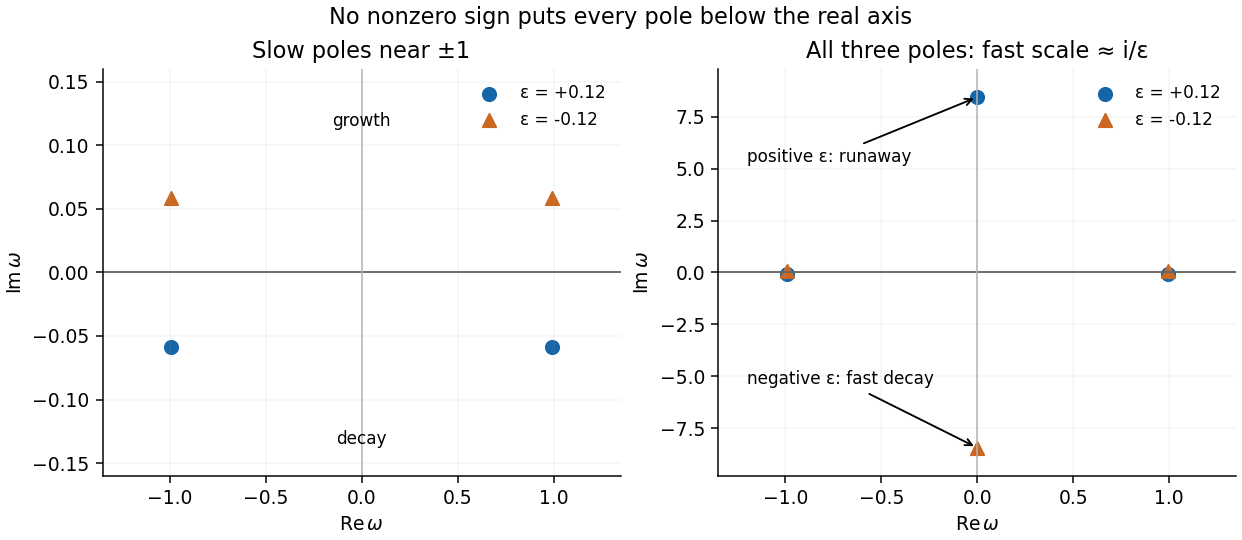
Exact pole locations for small positive and negative radiation-reaction parameters, including the singular fast pole
. Details. 
At the algebraic poles are ; a retarded limiting prescription displaces them infinitesimally below the real axis. Set , with and . The denominator becomesConsequentlyFor positive these two poles move below the real axis, giving slowly damped oscillations. For negative they move above it and the slow oscillations grow. This is only the slow part of the radiation-reaction oscillator pole structure; the third pole must still be examined.
A retarded Green function obeys for andFor a bounded or suitably tempered response represented by the real-axis Fourier integral, analyticity in the upper frequency half-plane is required, with suitable behaviour at infinity. For negative , decays on a large upper semicircle. If that half-plane has no singularities, contour closure gives zero response before the source. Lower-half-plane poles give factors decaying for positive time. Real poles are approached from below for a retarded prescription; at , for example, .
The causality versus stability of a Green function distinction matters: an unstable initial-value problem can still have a strictly causal response that grows exponentially. Such a response has no ordinary real-axis Fourier transform. Its inverse Laplace transform must run on a frequency contour above its growth poles. Thus “upper poles violate causality” is correct only with the stable/tempered real-axis Fourier assumptions, not as an unconditional theorem about differential equations.
For , put . Each derivative gains a factor , so . Changing integration variables to contributes , proving exact invariance of the full-space action.
Set . At fixed coordinates, with . Since the density is quadratic in derivatives,The variation is a divergence, so subtract its boundary term in the Noether current:Thus the dilatation charge of a one-dimensional elastic wave isAn overall sign change would give the same conservation law. Unlike , this charge has units of action, . Its explicit factor of is balanced by transport of the weighted momentum density; an explicitly time-dependent charge can still be conserved.
The transformation leaves both derivatives unchanged, so the Lagrangian density and action are invariant. For infinitesimal unit field variation, the Noether current for a first-derivative scalar field is the shift current of an elastic rod,Its divergence vanishes by the equation of motion. The charge is the total longitudinal mechanical momentum to this order in the displacement field.
Past exam of the relativity course of the University of Cambridge 2022 Section B 6 b v Solution 2026-10-18
Use the specified hyperbolic trajectory. The emitted right-moving photon follows , so its retarded null coordinate is . Interception at astronaut proper time requiresThe astronaut has velocity relative to the star and . The collinear relativistic Doppler effect givesThis is the Doppler shift for a uniformly accelerated receiver. A finite reception time exists precisely when , so the limiting emission time is , approached from below. At the photon lies on the Rindler horizon and never reaches the astronaut. If reception is restricted to , the full emission range is ; for emission after , it is .
Past exam of the relativity course of the University of Cambridge 2022 Section B 6 b iv Solution 2026-10-18
For the stated outward-accelerating hyperbola, take positive signed proper acceleration and an initially stationary spaceship. Then , so and . The initial values are , . Integration givesTaking their half-sum and half-difference yields the hyperbolic motionThe printed position data alone do not specify the initial velocity. If the initial rapidity is an arbitrary , the equally valid positive-acceleration solution isThus the requested special expression implicitly selects .
Past exam of the relativity course of the University of Cambridge 2022 Section B 6 b iii Solution 2026-10-18
The proper time normalization of the astronaut's four-velocity gives . In the light-cone coordinates this isThe four-acceleration has squared norm , because is the constant proper acceleration. The same coordinate change therefore givesEquivalently write , . Their second derivatives give , so the rapidity form of one-dimensional proper acceleration makes , with sign fixing the acceleration direction.
Past exam of the relativity course of the University of Cambridge 2022 Section B 6 b ii Solution 2026-10-18
The Lorentz transformation is , in units . Adding and subtracting givesSince and the other factor is its reciprocal,Here is the boost rapidity. Their product is unchanged, as required by invariance of the Minkowski interval.
Past exam of the relativity course of the University of Cambridge 2022 Section B 6 b i Solution 2026-10-18
The inverse transformation is , . ThusThe metric tensor in these light-cone coordinates is thereforeBoth off-diagonal entries are needed, since the quadratic line element sums over both index orders.
Past exam of the quantum condensed matter course of the University of Cambridge 2008 Section A A4 d ii Solution Created 2026-10-18 Updated 2026-10-20
For the planar good-solvent coil, . The two-dimensional polymer overlap fraction is thereforeThis is a scaling estimate; the monomer geometry and choice of coil radius set order-one numerical factors.
Past exam of the quantum condensed matter course of the University of Cambridge 2008 Section A A4 d i Solution Created 2026-10-18 Updated 2026-10-20
The polymer overlap concentration is reached when the number of chains per coil area is of order one. If is the chain number per unit interfacial area, then . Equivalently, the monomer area fraction is , assuming an occupied monomer area of order . Below this scale coils are mostly separate; above it they interpenetrate.
Past exam of the quantum condensed matter course of the University of Cambridge 2008 Section A A4 a iv Solution Created 2026-10-18 Updated 2026-10-20
A three-dimensional self-avoiding walk has swollen size , with ; the three-dimensional Flory approximation gives the nearby estimate . Isotropic projection gives , preserving this exponent. For the mean distance rather than its root mean square, the orientation average instead gives . Neither prefactor changes its position between the ideal walks and the planar swollen walk.
Past exam of the quantum condensed matter course of the University of Cambridge 2008 Section A A4 a iii Solution Created 2026-10-18 Updated 2026-10-20
For an isotropic three-dimensional ideal walk, each Cartesian component contributes to the mean square. Keeping two components gives . The planar projection of an isotropic random vector therefore has , smaller than the unprojected planar ideal walk by . The corresponding two-dimensional Gaussian mean distance has the same ratio.
Past exam of the quantum condensed matter course of the University of Cambridge 2008 Section A A4 a ii Solution Created 2026-10-18 Updated 2026-10-20
A planar self-avoiding walk cannot revisit its occupied sites. In the good-solvent scaling regime, the two-dimensional Flory approximation gives , larger at large than either ideal walk and the projected three-dimensional self-avoiding walk. This is a scaling statement, with microscopic prefactors dependent on the walk model.
Past exam of the quantum condensed matter course of the University of Cambridge 2008 Section A A4 a i Solution Created 2026-10-18 Updated 2026-10-20
For the planar random walk with independent steps of length , cross terms vanish and . Thus . At large , the planar Gaussian end distribution gives .
Kirchhoff's law of thermal radiation equates spectral absorptivity and spectral emissivity at the same wavelength and direction. A surface that is a poor absorber in the thermal infrared is also a poor emitter there; a coating cannot be assigned its solar absorption independently of its thermal emission spectrum.
(i) All-wavelength black paint. It absorbs the sunlight and also radiates maximally at the spacecraft's own temperature. With the isothermal-sphere assumptions of (d), the limiting black-surface distance isThe spacecraft can operate at in this model. A surface already assumed to be a blackbody is not improved by another black coating; relative to option (ii), however, this paint permits closer operation.
(ii) Black at short wavelengths and grey in the infrared. By Wien's displacement law, changing the black-body radiation temperature from to shifts the wavelength peak from about to about . Most solar power is therefore in the highly absorbing short-wavelength band, whereas most spacecraft emission lies beyond , where the spectral emissivity is reduced. The coating retains most of the heating but suppresses much of the cooling. Under the intended two-band grey body approximation, option (ii) makes the spacecraft hotter at the same distance and requires a larger minimum distance than black paint.
To express the comparison without inventing a grey absorptivity, let be radiometric absorptance averaged over the solar spectrum and be emissivity averaged over the spacecraft's own thermal spectrum. The radiative equilibrium equation becomesAt the failure threshold,For an ideal two-band coating take a constant radiometric absorptance beyond , and unity below it. If is the fraction of the power emitted by a blackbody below , Planck's law givesSince , this model has and hence . The paper supplies neither a numerical value of nor a detailed spectrum, so no unique numerical distance for the grey paint follows. If its long-wavelength absorption is not approximately grey, the spectrum must be integrated explicitly rather than inferred from a peak alone. A coating designed to improve close approach would instead reflect much of the solar radiation while retaining strong thermal infrared emission.
Let the spacecraft radius be , and assume that heat redistribution keeps its whole surface at a common temperature . Neglect background radiation, and let . The Sun's luminosity, from the Stefan–Boltzmann law, isAt distance , the incident irradiance is . The spacecraft intercepts radiation over its projected disc, area , but emits from its whole spherical area . The radiative equilibrium condition is thereforeCancelling the common factors givesThe radius of the spacecraft cancels. The factor follows from the ratio of absorbing projected area to emitting surface area. Uniform surface temperature is the intended additional idealization behind a single equilibrium surface temperature. A poorly conducting spacecraft would have position-dependent temperatures; for example, a locally reradiating patch facing the Sun would instead have , and a different maximum-temperature constraint.
There are unlisted articles, also show them or only show them.