
Past exam of the mathematics course of the year 2 of the natural sciences course of the University of Cambridge 2008 Paper 1 4 a i Solution Created 2026-10-18 Updated 2026-10-20
The even extension is the triangular function for and zero outside. Its Fourier transform is real and even:At zero the removable limiting value is one, also obtained directly by integrating the triangle. This is the Fourier transform of a triangular function.
Past exam of the mathematics course of the year 2 of the natural sciences course of the University of Cambridge 2004 Paper 2 3 c ii Solution Created 2026-10-18 Updated 2026-10-20
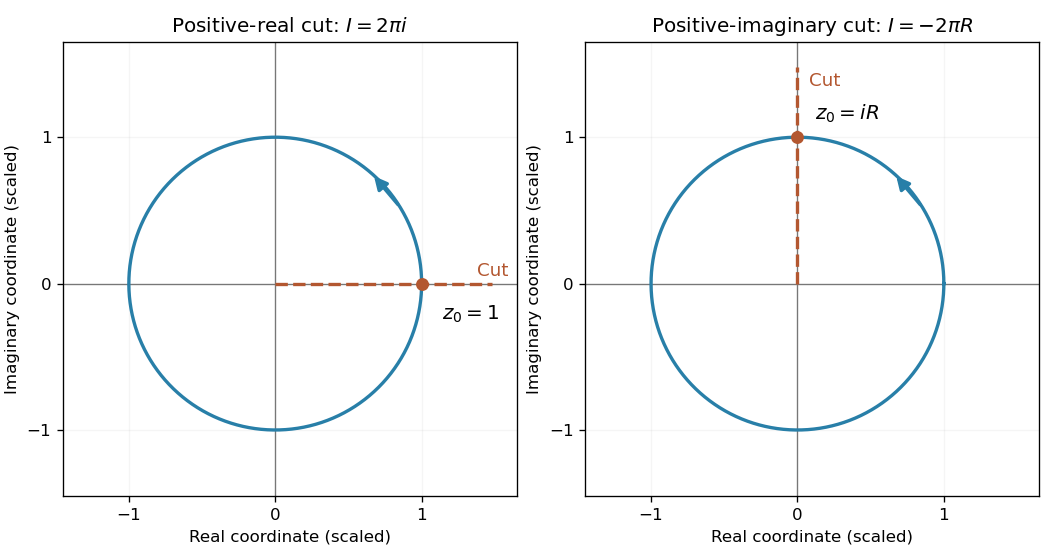
Choose the argument interval , which makes the logarithm real on the positive real axis and puts its cut on the positive imaginary axis. Parametrize . The constant term contributes , leavingEquivalently the cut-crossing point is , so the circle integral of a logarithm with a radial branch cut is . The different cut changes where the discontinuity lies on the circle; it is not merely an additive constant change of branch along the entire contour.
Past exam of the mathematics course of the year 2 of the natural sciences course of the University of Cambridge 2004 Paper 2 3 c i Solution Created 2026-10-18 Updated 2026-10-20
On the unit circle use with . The specified branch has there and . ThereforeThis is the circle integral of a logarithm with a radial branch cut, using the one-sided values at the cut crossing. The logarithm is discontinuous at that crossing, so the Cauchy integral theorem for a function holomorphic around a closed contour does not apply.

The difference quotient at zero isFor , its absolute value is at most . Given , set . Then makes the difference quotient have absolute value below . Thus .
Conversely, along the second sequence the difference quotient is exactly zero. Any finite derivative would consequently have to be zero. Along the first positive sequence, however, the difference quotient equals . It is one for and tends to for . In both cases it stays outside the neighbourhood of zero for arbitrarily small positive increments. Thus no finite derivative exists. We obtainIn particular, gives continuity without differentiability.
For , the fact that sine is a bounded function gives . Given , choose . If , then . This proves continuity directly from its definition.
For , use the first sequence from part (b), for which . When these values are one; when they tend to . In either case, for every neighbourhood of zero contains a sufficiently late with . This contradicts the definition of continuity. Hence
The function is differentiable at if there exists a finite real number such thatThen . The puncture makes the difference quotient defined; requiring a finite real distinguishes an ordinary derivative from an infinite slope.
The function is continuous at ifThe choice of may depend on and , but must work for every in that neighbourhood. This is the epsilon-delta definition of continuity.
Let , so . The even and odd powers in the matrix exponential giveHere the two scalar sums are the Taylor series for cosine and sine. ConsequentlyWith the usual convention that positive angles turn anticlockwise, this rotation matrix rotates by ; the parameter in the form printed in the paper is .
The defining condition for an antisymmetric matrix forcesIts dot product with is zero, and its Euclidean norm is . Thus it combines a right-angle rotation with a uniform dilation by . More precisely, the rotation is clockwise for and anticlockwise for . A direction-independent description is a clockwise right-angle rotation followed by multiplication by the signed scalar .
Choose the unnormalized eigenvectorsTheir linear combination giving the specified vector isApplying the reciprocal eigenvalues of the inverse matrix therefore yieldsIn Cartesian coordinates, this is , and direct matrix multiplication gives .
Since every eigenvalue is nonzero, is an invertible matrix. Multiplying by the inverse matrix givesHence the eigenvectors are unchanged and the corresponding eigenvalues are .
Induction on gives , including . The absolutely convergent matrix exponential series may therefore be applied term by term to each eigenvector:ThusFor a repeated eigenvalue, every nonzero vector in its eigenspace remains an eigenvector. Because the real exponential function is injective, distinct real eigenvalues of do not merge under this transformation.
Take the dot product of the orthogonal basis expansion with . All terms except the th vanish by orthogonality, leavingThereforeThe basis is not assumed normalized, so its squared lengths must remain in the denominators. Applying and using gives
Use the two pieces of the surface integral directly; this avoids introducing an unnecessary second derivative of . On the unit sphere, and . A spherical band between heights and has area , so the curved flux isby the fundamental theorem of calculus. On the horizontal top disk, and the area is . ThusAs usual for these surface integrals, the first derivative is assumed sufficiently integrable for the displayed fundamental theorem of calculus evaluation; a continuous first derivative suffices. Mere pointwise differentiability without such an integrability assumption need not make an ordinary flux integral exist.
Differentiate the flux:On , is strictly increasing. Its limiting endpoint values are and , and . It has horizontal limiting tangents at the endpoints, curves upward for , curves downward for , and has an inflection point at zero.
The derivative graph is a downward-opening parabola, approaching zero at both endpoints and attaining its maximum at .
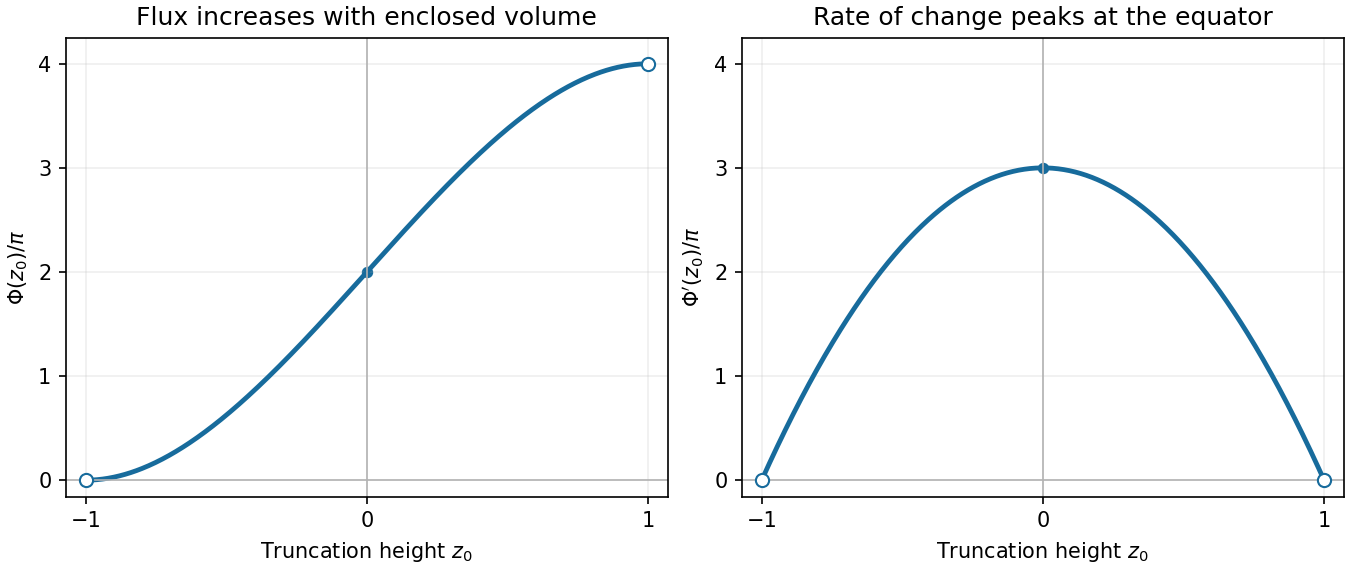

The divergence of the position vector field is . At height , the horizontal cross-section is a disk of area . By the divergence theorem, the outward flux integral is three times the enclosed volume:ThereforeA direct check separates the two pieces of the surface integral. On the unit sphere, the outward unit normal is , so and the curved contribution is . On the top disk, , giving . Their sum is the same flux.
The relevant mixed partial derivatives agree:The vector field is smooth on the entire simply connected plane, so this condition establishes that it is a conservative vector field. We can also construct its vector-field potential explicitly. From , take an antiderivative in :Then requires . HenceThe fundamental theorem for line integrals checks the previous answer: .
Integrating first over multiplies by . Split at to handle the absolute value correctly:Integration by parts gives antiderivatives and for these two inner integrands. Their contributions arerespectively. ThusFor the remaining integrals,andCombining them yieldsThe upper bound is , as in the original PDF; an additional truncated version in the OCR must not be used.
There are unlisted articles, also show them or only show them.