
The plane equation has normal vector . Thus its normal vector is parallel to the cylinder's axis and the plane is perpendicular to that axis. It passes through the origin, so the intersection is a circle of radius centred at the origin in that plane.
Indeed, with the orthonormal basis and of the plane, write . The cylinder equation becomes . Equivalently, the intersection has the parametric equation
The removed vector is the orthogonal projection of onto the line through the origin in direction . The remaining vector measures the perpendicular displacement from that line. Fixing its Euclidean norm at therefore describes an infinite circular cylinder of radius , with axis , .
The dot product with the given unit vector is . Subtracting the corresponding orthogonal projection givesTaking its squared Euclidean norm yields the equivalent Cartesian equation
No. Every vector in the plane can be written asThe two linearly independent vectors in part (ii) therefore form a vector space basis for this vector subspace. Its dimension is , so any three vectors in it have linear dependence.
For example, chooseBoth vectors satisfy the plane equation. They are linearly independent vectors: in , the second coordinate gives and the third gives .
This is a plane through the origin in three-dimensional Euclidean space, with nonzero normal vector :
The standing wave oscillates about the constant level , with time period . Suitable snapshots areThe nonconstant amplitude shrinks to zero at a quarter-period, reverses sign at half a period, and returns after a full period. The nodes of a standing wave of the oscillatory part, , remain at height .
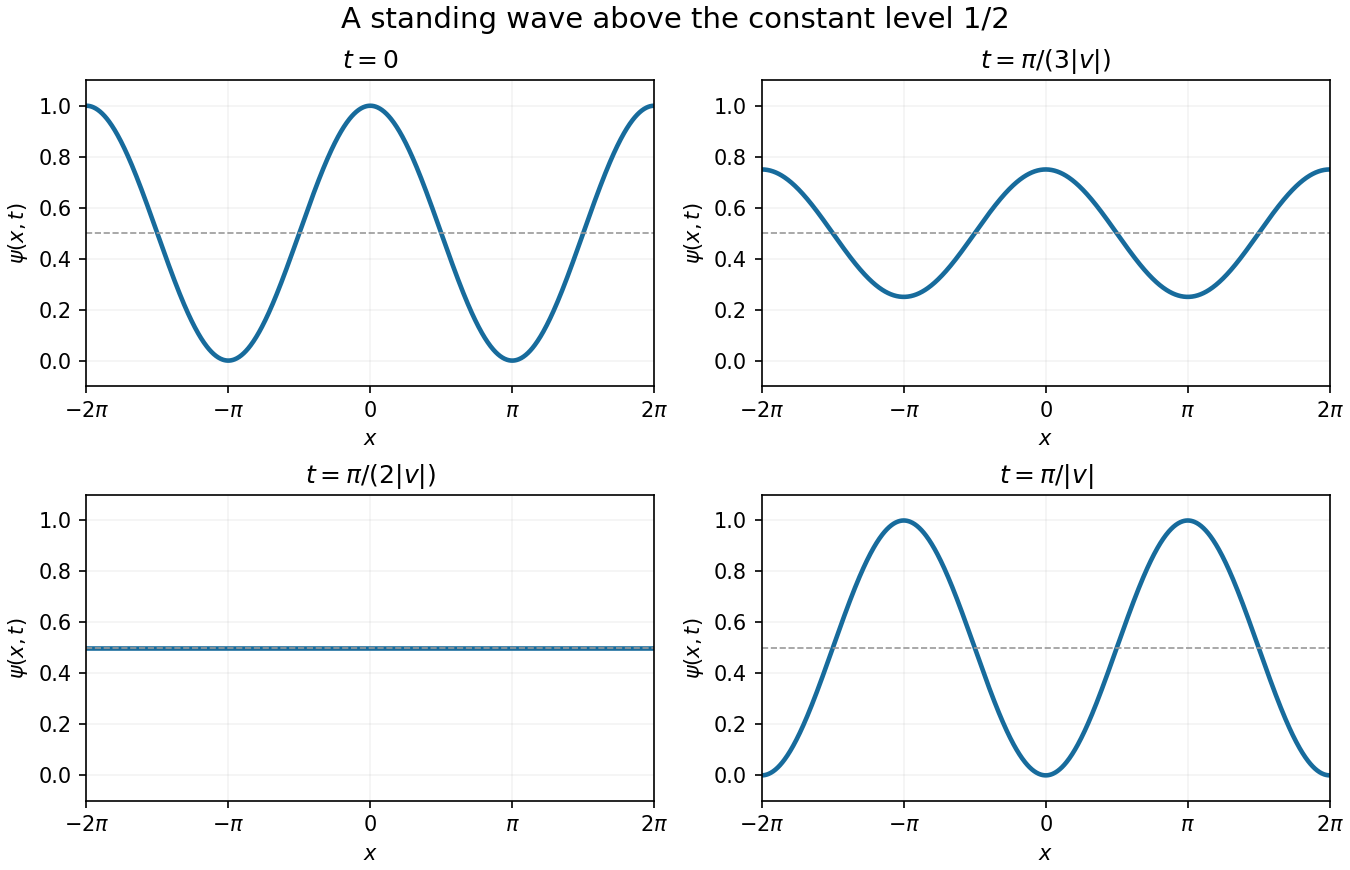
Time evolution of the whole-line Neumann-compatible standing wave
. Snapshots at phases , , and illustrate contraction, flattening and reversal of the cosine profile. A full-period snapshot repeats the initial curve. Details.
For the two travelling profiles, the initial conditions implySince , is constant. One may therefore choosewhere the constants cancel in the sum. The D'Alembert formula then givesThis agrees exactly with the restricted-domain solution from part (b). The whole-line cosine profile already has zero spatial derivative at both and for every time, so its restriction satisfies the Neumann boundary conditions without further modification.
Use the Lagrange multiplier condition for :Neither coordinate can vanish at a constrained stationary point: either would force both to vanish, contradicting the constraint. Substitution therefore gives , so or . In either case , givingEqual signs give the two points attaining the global maximum ; opposite signs give the two global minima with . These exhaust the extrema because the ellipse is compact, its constraint gradient never vanishes on it, and is smooth. The bound can also be checked by setting , : then and , so .
The square is even, and direct integration givesUsing the nonzero Fourier coefficients in Parseval's identity,Hence
The function is an odd function, so . Here , and the Fourier coefficients areWrite . One integration by parts has zero endpoint terms because vanishes at both endpoints:A second integration by parts givesTherefore , zero for even and for odd . The Fourier series isThe coefficients are absolutely summable, and the periodic function is continuous even at the joins , so the displayed Fourier series represents it everywhere.
Let be the Fourier partial sum through frequency . By orthogonality and the coefficient formulas,Expanding the nonnegative squared L2 norm of the error gives the exact finite identityFor in the L2 space, completeness of the Fourier basis makes the left-hand side tend to zero. Dividing the resulting equality by proves Parseval's identity:This argument uses convergence in L2 rather than an unqualified exchange of an infinite sum with the integral of its square. The function in part (c) is continuous and piecewise polynomial, so these hypotheses hold.
The analogous orthogonal projection onto the cosine terms givesFor , this means ; the actual constant in the Fourier series is because the constant function has squared norm .
Take the inner product of the Fourier series with . Fourier orthogonality eliminates the constant, all cosine terms, and all sine terms except the th. The remaining squared norm issoFor a square-integrable function, the calculation is justified by taking inner products of finite Fourier partial sums and passing to their mean-square limit.
Here , so the same elimination forces . The first two linear equations would then require and simultaneously. Thus
There is no solution for any value of .
When , the third linear equation is times the second, so it adds no constraint. Take freely. The remaining linear equations are and . Solving gives the straight line of solutionsThis exists for every real .
Adding three times the second linear equation to the third gives . Since , it follows that . The second linear equation then gives , and the first becomes . Thus the unique solution isThe assumption makes the denominator nonzero; is unrestricted.
On , and the outward unit normal is . Its flux isOn , and the outward unit normal is . HenceOn , write over , , . The oriented surface element is , pointing away from the origin. Here , so . ThusThe unnormalized normal vector in the oriented surface element already incorporates the factor from the surface area; no additional factor is needed.
There are unlisted articles, also show them or only show them.