
Past exam of the mathematics course of the year 2 of the natural sciences course of the University of Cambridge 2009 Paper 2 3 Solution Created 2026-10-18 Updated 2026-10-20
Write . A radial function harmonic away from the source satisfies , hence . Decay at infinity forces . Integrating over a small sphere, the divergence theorem requires flux one:Therefore the fundamental solution in this sign convention isAdding point sources outside the domain changes only a harmonic function inside it. The method of images selects their positions and strengths to cancel boundary values. The sign reverses for the alternative convention .
Past exam of the mathematics course of the year 2 of the natural sciences course of the University of Cambridge 2009 Paper 2 2 Solution Created 2026-10-18 Updated 2026-10-20
Set and multiply the Laplace equation by . Separation of variables givesWith , the angular equation is . Regularity at both poles selects the Legendre polynomials and . The radial Cauchy-Euler equation has solutions . Expanding the angular data in this complete orthogonal system therefore giveswith the usual convergence required of a harmonic expansion on the region considered. Angular Legendre functions singular at the poles are excluded.
For , the outer data have expansion , while the inner data are pure . Thus only degrees zero and two are needed. A radial interpolation matching each pair of boundary values givesThe first term is a linear combination of and takes values at the two radii. The second is a combination of and takes values zero and . These checks establish both boundary conditions; each term is harmonic. The maximum principle for harmonic functions gives uniqueness. This is an example of axisymmetric harmonic interpolation between concentric spheres.
Past exam of the mathematics course of the year 2 of the natural sciences course of the University of Cambridge 2009 Paper 2 1 Solution Created 2026-10-18 Updated 2026-10-20
Use the standard regular self-adjoint assumptions on the Sturm-Liouville problem, including positive weight . The normalized eigenfunctions obey orthogonalityCompleteness means every function in the weighted space has expansion , with convergence in that space. Comparing the action of this kernel on test functions with the Dirac delta gives, in the distributional sense,If zero is not an eigenvalue, divide each term by . Since , application of recovers the displayed delta expansion, provingThe factor is required because the source equation uses an ordinary, unweighted delta. It distinguishes the normalized Sturm-Liouville spectral Green kernel from a kernel integrated against weighted source measure. If there is a zero eigenvalue, an inverse for arbitrary forcing does not exist; the unqualified division by that eigenvalue is invalid.
For with real and zero endpoints on , the weight is one, and . Substitution yieldsThe series is absolutely and uniformly convergent, although applying the differential operator is understood distributionally at its source point.
Past exam of the mathematics course of the year 2 of the natural sciences course of the University of Cambridge 2009 Paper 1 9 Solution Created 2026-10-18 Updated 2026-10-20
Introduce a Lagrange multiplier for the constraint and vary with , where . The first variation isThe fundamental lemma of the calculus of variations gives the Sturm-Liouville equation . Multiplying by , integrating by parts and using the endpoint conditions gives . Therefore the normalization implies . Assume the coefficient and function regularity needed for these variations and integrations; the condition makes the constraint derivative nonzero at a normalized function.
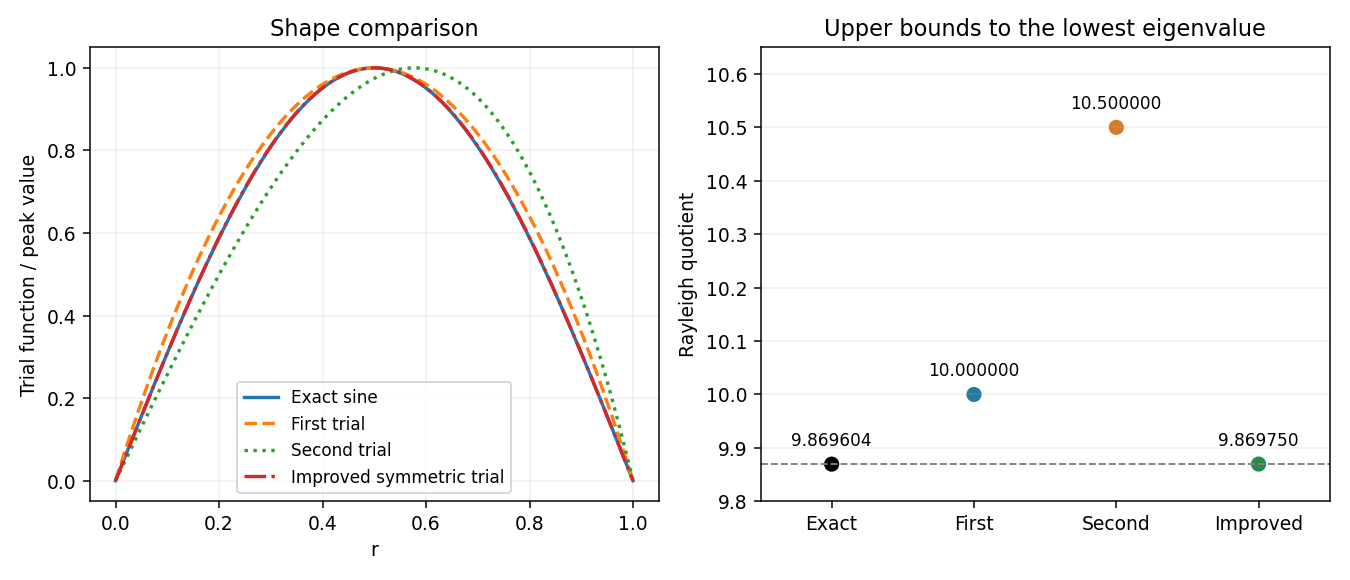
For the radial problem, set . A direct differentiation gives , soFinite supplies the first boundary value. The Rayleigh quotient is . For the two trials, and , the numerator-denominator pairs are and , respectively. HenceThe exact eigenvalues are , so . Both trials give upper bounds by the Rayleigh-Ritz variational principle, and the first estimate is more accurate, since it is smaller. Trial admissibility uses the Dirichlet energy form for ; the first trial's nonzero radial derivative at the origin does not invalidate this variational calculation.
To improve, add independent trial functions and minimize the quotient over their span. Here merely combining the two supplied trials gives no improvement: their two-dimensional stiffness and mass matrices areThe lowest Ritz value is still ten. Instead add the symmetric quartic . On the span of , the generalized eigenvalue problem hasIts determinant is , so the least root givesThis is strictly better than both original estimates. The symmetry obstruction in a polynomial Rayleigh-Ritz trial space explains why the cubic addition failed while the quartic helps. It is also the shifted-interval version of the polynomial Rayleigh-Ritz trial space for a one-dimensional box.
Past exam of the mathematics course of the year 2 of the natural sciences course of the University of Cambridge 2009 Paper 1 6 Solution Created 2026-10-18 Updated 2026-10-20
A square complex matrix is a unitary matrix when , so it preserves the Euclidean norm. If with , then , giving . For a Hermitian matrix and ,because the numerator equals its complex conjugate. Hence no eigenvalue of is zero, proving it is invertible.
For , the Hermitian conjugate is . The factors and their inverses commute, since they are rational functions of . Thus . Its action on the same eigenvectors isThese eigenvalues have modulus one. This is the Cayley transform of a Hermitian matrix in the convention that avoids the unitary eigenvalue one.
For the inverse direction, givesTaking the conjugate transpose of therefore yieldsThe last equality uses commutativity of the two factors. This proves that the inverse Cayley transform of a unitary matrix without eigenvalue one is Hermitian. Solving for gives . An orthonormal eigenbasis of therefore diagonalizes , with diagonal entries .
The result extends even when a unitary matrix has eigenvalue one: choose so that does not. There are only finitely many forbidden phases, since the matrix has finitely many eigenvalues. Diagonalizing also diagonalizes in the same basis. Thus every unitary matrix is unitarily diagonalizable.
Past exam of the mathematics course of the year 2 of the natural sciences course of the University of Cambridge 2009 Paper 1 5 Solution Created 2026-10-18 Updated 2026-10-20
The spectral theorem for real symmetric matrices supplies an orthonormal basis of real eigenvectors. Put these in the columns of , so and . In the question's coordinate convention choose and . Since ,Reorder the eigenvalues with positive, negative and zero. For nonzero eigenvalues set , and retain the remaining coordinates as . This is an invertible real transformation , where is the diagonal rescaling; the combined matrix gives . It giveswith the zero coordinates absent. The general allowed range is . The printed restriction is not valid for every real symmetric matrix: a negative-definite or zero form has no positive square. The invariance of these counts is Sylvester's law of inertia.
Past exam of the mathematics course of the year 2 of the natural sciences course of the University of Cambridge 2009 Paper 1 4 Solution Created 2026-10-18 Updated 2026-10-20
Choose the Fourier transform convention , with inverse . For absolutely integrable , Fubini's theorem permits the substitution in the convolution transform:This proves the convolution theorem in the chosen convention.
Take . Splitting its transform at zero gives . Thus the desired inverse is . For , split the convolution integral at and :The result is even, soDifferent normalization conventions alter the transform prefactors, which is why the convention was stated explicitly.
Past exam of the mathematics course of the year 2 of the natural sciences course of the University of Cambridge 2009 Paper 1 3 Solution Created 2026-10-18 Updated 2026-10-20
The homogeneous Cauchy-Euler equation has solutions and . Choose , which vanishes at zero, and , which vanishes at one. Their Wronskian is . For a Green function integrated against the unweighted measure , continuity at and the jump condition giveIt satisfies for . Therefore the candidate solution isThe leading coefficient vanishes at zero, so the endpoint condition needs care. If extends continuously to , this expression has limit as . Indeed and , while the remaining terms vanish. Thus the continuous zero-endpoint problem in this class requires . With that compatibility condition the formula gives both boundary values and is unique: a difference of two bounded solutions is , whose two endpoint conditions force both constants to vanish. For incompatible forcing such as , the bounded solution with is , which cannot also vanish at zero. Pointwise vanishing of for fixed does not justify interchanging the singular endpoint limit with its integral. This issue is treated in Green kernel and endpoint compatibility for a singular Euler equation.
For the supplied compatible forcing , the integrals are and . Their polynomial pieces cancel, givingDirect differentiation gives , and at zero. Its derivative diverges there, which is allowed because the boundary condition requires the value, not a finite derivative.
Past exam of the mathematics course of the year 2 of the natural sciences course of the University of Cambridge 2009 Paper 1 2 Solution Created 2026-10-18 Updated 2026-10-20
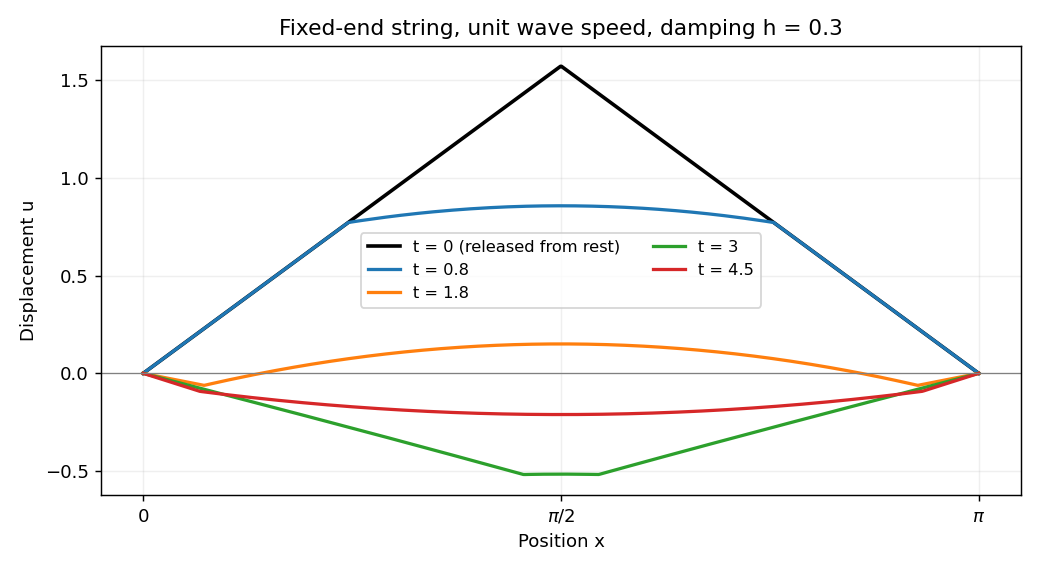
Use separation of variables . The fixed-end Dirichlet boundary conditions select , , and each mode satisfies . In the physical resistance range , all normal modes are underdamped, with . The modal factor normalized by , isConsequently the linearly damped string has solutionThe coefficients are those of the initial Fourier sine series. Differentiating each normalized modal factor at zero confirms that the string starts from rest. Suitable initial data give convergence in the string's energy space; the piecewise linear profile here need not give a twice differentiable solution along every characteristic from its corner.
For the specified tent profile, integrating its two linear pieces by parts givesFor example the first piece gives , and the second gives the opposite cosine term and the same sine term. HenceThe zero even coefficients also follow from reflection symmetry about the midpoint. This is the Fourier sine series of a symmetric tent. If were read without the physical assumption , the same modal solution extends by replacing imaginary-frequency sine and cosine by their hyperbolic counterparts, and taking when .
Past exam of the mathematics course of the year 2 of the natural sciences course of the University of Cambridge 2008 Paper 2 9 Solution Created 2026-10-18 Updated 2026-10-20
The kernel of a group homomorphism is . It is a subgroup, since the identity maps to the identity and for . Alsoso . Applying the same inclusion with gives equality, proving that is a normal subgroup.
The map is well defined, multiplicative and injective, with image . Thus the first isomorphism theorem givesThe quotient is isomorphic to all of precisely when the original homomorphism is surjective.
For the general linear group, the determinant gives a homomorphism , since . Its kernel is the special linear group , so that subgroup is normal. Every nonzero real is the determinant of for , making the map surjective. Thereforewhere the operation on the right is multiplication.
Past exam of the mathematics course of the year 2 of the natural sciences course of the University of Cambridge 2008 Paper 2 8 Solution Created 2026-10-18 Updated 2026-10-20
If , then for both cosets equal . For , neither coset intersects : an intersection would imply . Both have elements, because multiplication by is a bijection. They therefore both equal , proving in this case too. This establishes that an index-two subgroup is normal.
For Lagrange's theorem, left cosets partition . Indeed if , then by multiplying by elements of ; otherwise the cosets are disjoint. Every coset has elements, so if there are cosets,The group order of thus divides the group order of . Normality is not needed for this divisibility statement.
Past exam of the mathematics course of the year 2 of the natural sciences course of the University of Cambridge 2008 Paper 2 7 Solution Created 2026-10-18 Updated 2026-10-20
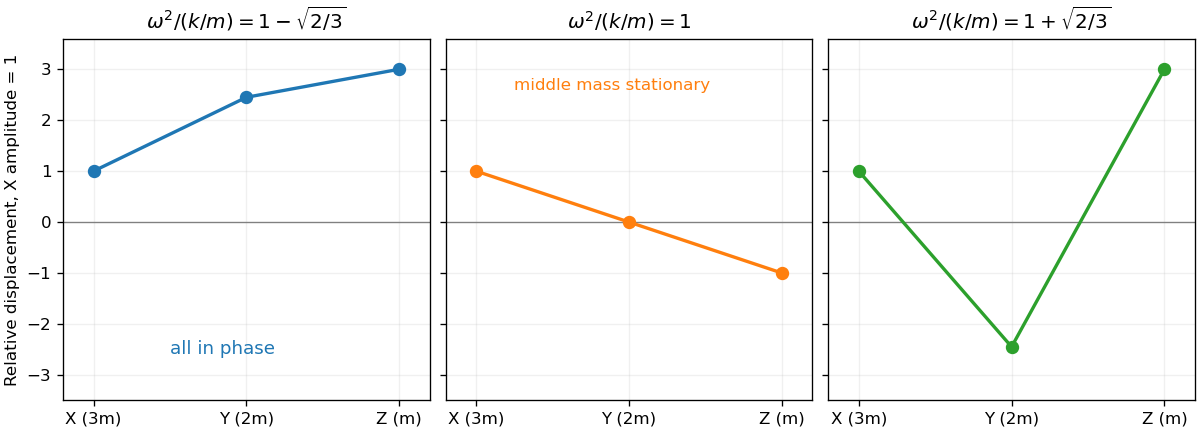
With downward position as the vertical coordinate, the full potential energy isThe equilibrium tensions are , and . On expanding, these relations cancel every term linear in the displacements, leaving . Newton's second law therefore givesFor a normal mode , set . The generalized eigenvalue problem isIts determinant is , so the angular frequencies and mode directions areThe square roots of these positive values give the requested frequencies. Only the lowest mode has all components of the same sign, so all three particles oscillate in phase at the lowest frequency. The mode shapes are shown below.


Past exam of the mathematics course of the year 2 of the natural sciences course of the University of Cambridge 2008 Paper 2 6 Solution Created 2026-10-18 Updated 2026-10-20
Under an orthogonal change of Cartesian coordinates with , a rank- Cartesian tensor transforms as , summing repeated indices. An isotropic tensor is invariant under every rotation. For an isotropic fourth-rank tensor, half-turns about the coordinate axes eliminate components unless each coordinate label occurs an even number of times. Coordinate rotations make the remaining two-pair patterns depend on three constants , , . Invariance after rotating the first axis to gives . HenceThis is a direct proof of the rank-four isotropic decomposition, without assuming any prior interchange symmetry of the four indices. Each displayed delta pairing is itself rotation invariant.
For symmetric strain, contraction gives . Comparing with the Lamé parameters yieldsWrite and , so . Since , the strain energy density becomesThe two terms describe volumetric and shear deformation, respectively. Thus nonnegative isotropic elastic strain energy is equivalent toNecessity also follows by taking a nonzero traceless strain and a pure dilation separately. The combination is the bulk modulus; strict inequalities give positive energy for every nonzero strain.
Past exam of the mathematics course of the year 2 of the natural sciences course of the University of Cambridge 2008 Paper 2 5 Solution Created 2026-10-18 Updated 2026-10-20
Use . Jordan's lemma says that for , if a function has maximum modulus on upper semicircles, then ; a bound is . For use lower semicircles instead. The rational factors here meet this decay condition, so the residue theorem evaluates their inverse transforms.
For , only the upper half-plane contains a pole, at . Its residue after multiplication by is . The lower contour encloses no pole. ThereforeHere is the Heaviside step function, with midpoint value for symmetric Fourier inversion.
For , the upper-pole residue is when , while the clockwise lower contour gives the matching expression for . ThusThe final rational factor has double poles at . At the upper pole,The upper inverse integral is times that residue. The lower contour for negative supplies , and the value at zero is zero. Consequently
There are unlisted articles, also show them or only show them.