
Article by Rüdiger Paschotta in RP Photonics Encyclopedia by Rüdiger Paschotta, hosted by RP Photonics. No article publication or revision date is established.
Online text: www.rp-photonics.com/refractive_index.html
Cited passages: What is a Refractive Index?; Wavelength Dependence and Other Dependencies; Anisotropic Media; Complex Refractive Index; Group Index and Effective Index; Measuring Refractive Indices.
Work by Royal Society 2026-10-18
Work by Royal Institution 2026-10-18
Work by Ross Galbreath 2026-10-18
Work by Rosemary Remacle 2026-10-18
Work by Robert Sanders 2026-10-18
Work by Robert S. Windeler 2026-10-18
Work by Robert E. Ecke Created 2026-10-18 Updated 2026-11-05
Work by RIKEN Created 2026-10-18 Updated 2026-11-05
Narrow resonance and instrumental resolution 2026-10-18
A simple isolated particle resonance model starts with a survival amplitude proportional toIts survival probability is , giving mean rest-frame lifetime . The Fourier transform of this one-sided amplitude is proportional to ; its squared modulus gives a Lorentzian line shape. Write its normalized density asAt the density is half its peak, so its intrinsic full width at half maximum is . This is a local isolated-line approximation, extending the offset coordinate over the real line; physical production thresholds, interference and energy-dependent decay widths can require a richer quantum scattering model.
Now stipulate a centered normal distribution for the measurement response, with standard deviation . A measured coordinate has densityThis convolution describes the smearing of an underlying line, with constant acceptance and no background. For a pair spectrometer the response summarizes invariant-mass resolution; for an idealized collider scan it summarizes incoming center-of-mass energy spread. These are different experimental sources of uncertainty even when the same mathematical response is useful.
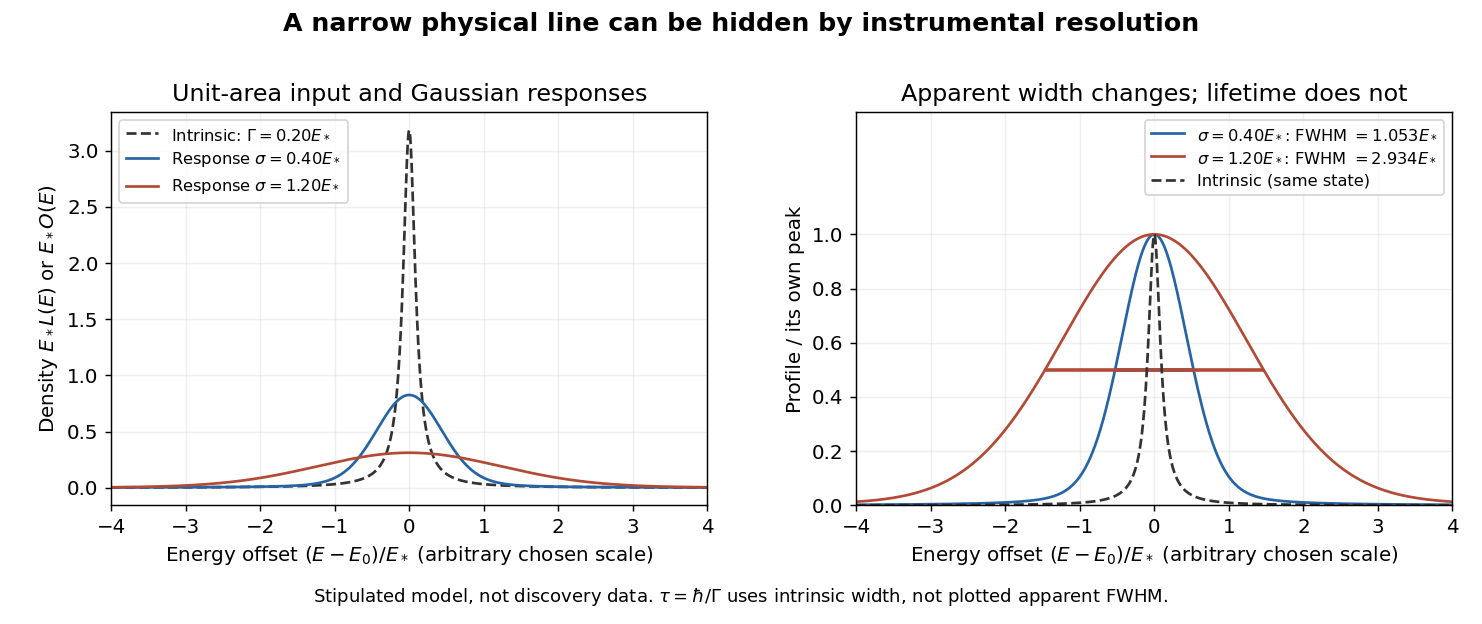
An arbitrary narrow line broadened by two stipulated Gaussian responses
. Original numerical convolution using a Lorentzian with intrinsic width 0.20 times an arbitrary energy scale and Gaussian standard deviations 0.40 and 1.20 times that scale. Left: densities with unit area on the whole line. Right: each profile divided by its own peak. No historical points, cross-section table or published curve were copied or fitted. Details.
Choose an arbitrary scale , intrinsic decay width and response standard deviations and . Numerical integration gives apparent full width at half maximum values of approximately and , respectively. The state and its rest-frame lifetime are identical in both cases. The normal distribution's width alone is ; adding that width to in quadrature is not an exact rule for this convolution.
For a purely illustrative , taking gives . These are invented line parameters, not J/psi meson measurements. Substituting the larger apparent width into would incorrectly shorten the inferred lifetime by nearly a factor of fifteen. An unresolved width can support an upper bound on intrinsic decay width, and consequently a lower bound on lifetime, only after the instrumental response and model assumptions have been assessed.
The discovery peak and its later interpretation answer different questions. The J/psi meson is understood as charmonium, a bound charm quark–charm antiquark system. Richter's 1976 lecture distinguishes the initial discovery from subsequent tests of competing explanations, including the related level structure and later evidence for particles carrying uncancelled charm. A narrow peak alone did not establish all these properties in 1974.[ref]
From the Psi to Charm – The Experiments of 1975 and 1976 by Burton Richter. From the Psi to Charm – The Experiments of 1975 and 1976, introduction and sections 7.4–8: charmonium interpretation and subsequent charm searches
Pair mass versus collision energy Created 2026-10-18 Updated 2026-10-20
For a reconstructed electron–Positron pair, four-momentum conservation givesNeglecting the electron mass compared with the daughter energies, and calling the opening angle , this becomesAs an original example, choose , and . Then , although the pair's laboratory energy is . The pair carries net momentum. Neither its laboratory energy nor the original proton beam energy is its invariant mass; unobserved products carry additional four-momentum.
For equal, oppositely directed incoming beams with equal total energy , their total momentum vanishes. Thus the incoming center-of-mass energy isStipulated beams therefore provide of incoming center-of-mass energy. This identity is exact for the stated equal-beam geometry. Radiation before annihilation can reduce the energy forming the final state; the apparatus also has a distribution of beam energies. A nominal machine setting is therefore not an exact event-by-event final-state invariant mass.
SPEAR psi energy-scan experiment Created 2026-10-18 Updated 2026-10-20
At SPEAR, counterrotating electron and Positron beams collided inside a magnetic particle detector. Finer steps in stored-beam energy resolved a sharp production peak. A magnetometer and measured orbit positions monitored the energy settings; Bhabha scattering normalized the cross sections. The paper attributed the observed width to beam-energy spread and radiation effects, reporting an upper limit on intrinsic width. Its muon identification system was not functioning: the non-electron two-body excess was not conclusively a muon pair.[ref]
Discovery of a Narrow Resonance in e+e- Annihilation by J.-E. Augustin. Discovery of a Narrow Resonance in electron–positron Annihilation, pp. 1406–1408: scan, energy monitoring, normalization, width limit and two-body identification caveat
A scan must compare normalized production rates, since more selected events can result from more beam encounters or different detection efficiency. A proposed diagnostic is to revisit energies on either side of the peak while monitoring the energy calibration and event selection. Such neighboring settings test the local production background; their event totals alone are not an independent measurement of the intrinsic decay width.
Brookhaven J pair-spectrometer experiment Created 2026-10-18 Updated 2026-10-20
Brookhaven's proton beam struck stationary beryllium. A two-arm magnetic pair spectrometer measured electron–Positron momenta and directions. Cherenkov detectors, tracking chambers and shower counters rejected the much larger hadron background. Calibration used an electron beam; timing and track matching rejected accidental coincidences. The pair invariant mass distribution showed a narrow excess. Reducing magnet currents left its reconstructed position unchanged; changing target thickness and reversing spectrometer polarity supplied further checks. The unresolved intrinsic width did not mean a zero decay width.[ref]
Experimental Observation of a Heavy Particle J by J. J. Aubert. Experimental Observation of a Heavy Particle J, pp. 1404–1405, Fig. 1 and checks 1, 2 and 7: target, spectrometer, calibration and stability tests
The logic of the magnet-current check is especially useful. A real state should retain its reconstructed invariant mass when a calibrated change of magnetic field makes its daughters follow different accepted paths. A feature tied to one detector location or one setting need not do so. This checks a possible instrumental origin; it does not by itself determine the state's quark composition.
Work by Richard J. Bantges 2026-10-18
EcoRI 2026-10-18
EcoRI is a restriction enzyme whose usual recognition sequence is GAATTC. Staggered cleavage produces complementary single-stranded ends.
Restriction digest 2026-10-18
A restriction digest is cleavage of DNA using a restriction enzyme. Complete cutting at all specified sites and partial cutting can give different fragment patterns.
Gamboge Created 2026-10-18 Updated 2026-11-05
Gamboge is a yellow gum-resin material obtained from certain plants and historically used as a pigment. It contains a mixture of organic constituents rather than one pure yellow molecule.
Its color and interaction with a binder depend on that composition and on particle dispersion. Distinguishing a natural colorant material from an isolated chemical compound is important when interpreting historical pigment descriptions.
Angular size under a collinear relativistic boost Created 2026-10-18 Updated 2026-10-20
Let an observer move towards the centre of a small distant source with velocity , where is the speed of light. For source-direction angle , the photon arrives with longitudinal momentum . A Lorentz transformation gives and therefore the relativistic aberration lawwhere is the rapidity. For a small angular diameter , the displayed angular-size ratio follows by linearizing at . Two momentarily coincident observers can consequently measure different angular sizes without any change in their observation event. If their diameter ratio is , their relative speed is .
Repeated ideal-stage enrichment 2026-10-18
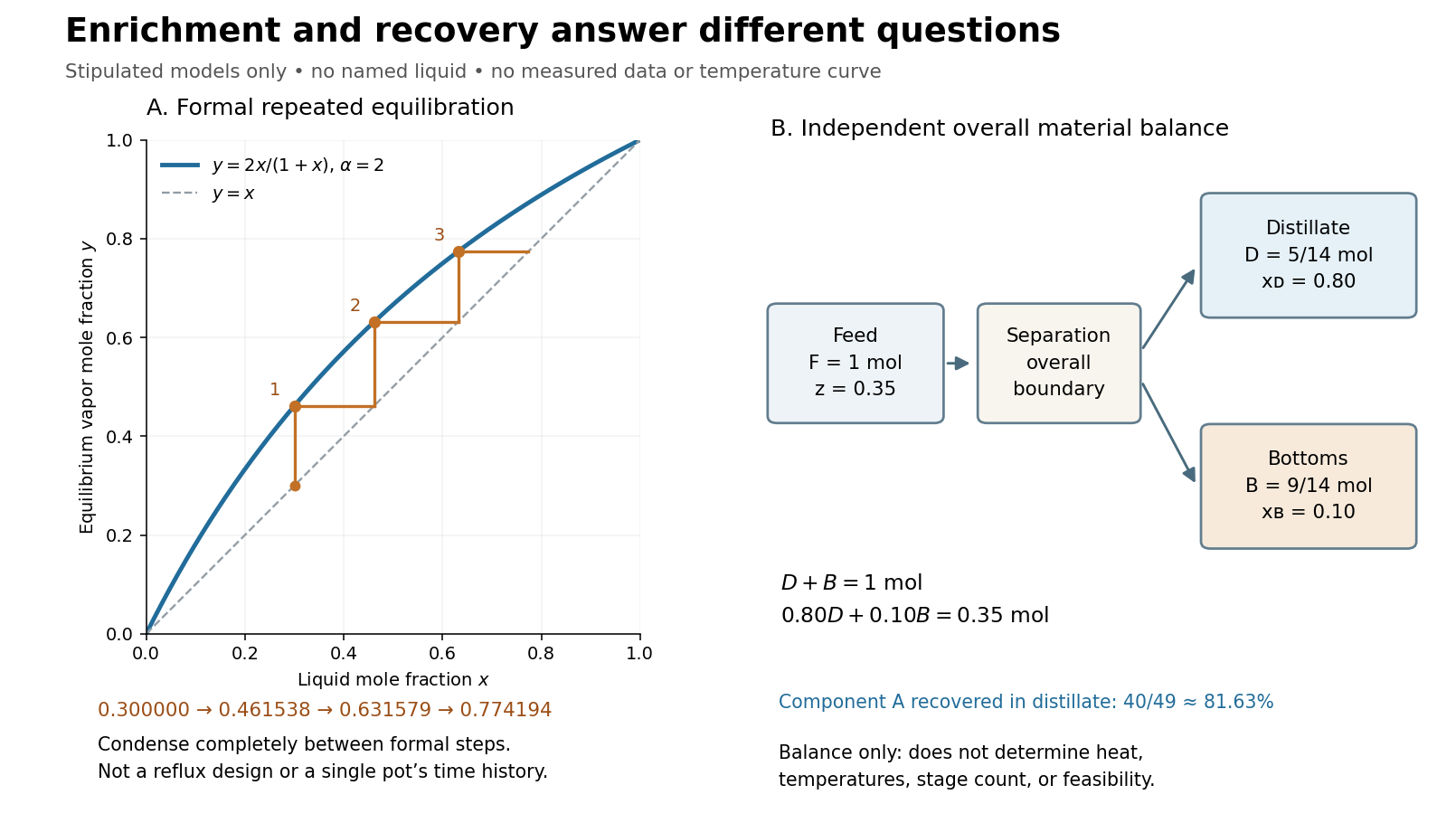
Stipulate a constant relative volatility . The vapor-liquid equilibrium model then becomesAn initial liquid mole fraction gives an equilibrium vapor mole fraction . Now imagine completely condensing a small sample of that vapor and using this condensate as a fresh liquid for another equilibration. Repeating this formal operation givesThese are original model calculations of ideal-stage enrichment. They are not measured compositions, a reflux design, or successive compositions of one pot undergoing simple distillation. That pot loses the more volatile component and becomes depleted; each step here instead starts from the previous enriched condensate. The displayed sequence specifies compositions, not the recoverable amount at each step.

Fictitious force Created 2026-10-18 Updated 2026-10-20
An inertial force is an additional term used to express Newton's second law in an accelerating reference frame. For origin acceleration and axes with angular velocity , the apparent force on a particle isHere and are measured relative to that frame. The rotation terms are the Coriolis force, Euler force and centrifugal force. Their values depend on the frame rather than on an additional physical interaction.
There are unlisted articles, also show them or only show them.