
Substitutional semiconductor doping Created 2026-10-18 Updated 2026-10-20
Substitutional semiconductor doping replaces selected host atoms with impurity atoms on ordinary lattice sites. A shallow donor impurity can supply a mobile conduction electron and remain positively charged; a shallow acceptor impurity can capture an electron and leave a mobile valence hole, remaining negatively charged. In nondegenerate, substantially ionized material, donor-dominated doping raises the chemical potential toward the conduction edge and acceptor-dominated doping lowers it toward the valence edge. Dopants do not create net bulk charge in a neutral sample: fixed impurity charge compensates the mobile carrier charge. Freeze-out, compensation and degeneracy qualify the simplest relation between dopant and carrier densities.
SciPy 1.18.0 documentation Laplace (Double Exponential, Bilateral Exponential) Distribution 2026-10-18
Section of SciPy 1.18.0 documentation. The SciPy community is credited in the copyright footer; no individual section byline or publication or revision date is established. The unversioned URL served the inspected 1.18.0 manual.
Inspected locators: maximum-likelihood location estimator; even-sample median interval; scale estimator.
Potter-Elvehjem homogenizer Created 2026-10-18 Updated 2026-11-05
A Potter-Elvehjem homogenizer disrupts biological tissue between a fitted pestle and a surrounding vessel, often using a rotating drive. Flow and mechanical deformation in the small clearance transfer energy from the drive into the sample. [ref]
WHEATON Safe-Grind Potter-Elvehjem Tissue Grinder by DWK Life Sciences. DWK Life Sciences, Potter-Elvehjem grinder: vessel, pestle and powered operation
For an idealized narrow gap containing a Newtonian fluid, the shear rate scale is , with relative surface speed and clearance ; viscous stress scales as . Actual tissue is more complex, but the relation explains why clearance, motion and dynamic viscosity affect disruption.
Proportional counter 2026-10-18
A gas-filled particle detector using electron avalanche multiplication. Within its proportional operating range, the collected electric charge tracks the initial ionization, allowing more than a yes-or-no count.
Ionization chamber Created 2026-10-18 Updated 2026-11-05
An ionization chamber measures ionizing radiation by collecting the electric charge that it creates in a gas. Two electrodes establish an electric field; liberated electrons and positive ions move toward opposite electrodes. In the chamber's intended operating regime the field collects the initial charge with negligible electron avalanche multiplication, distinguishing it from a proportional counter.
Varying the applied electric potential difference while holding the incident radiation fixed produces a collection curve. Too weak a field allows electron-ion recombination before collection; an approximately flat region indicates near-complete collection under those conditions. Increasing the field far enough can instead cause gas multiplication. A 2013 synchrotron radiation experiment compared free-air chambers with different electrode gaps and chopped the X-ray beam, showing that collection depends on both geometry and the temporal delivery of radiation.[ref]
Current saturation in free-air ionization chambers with chopped synchrotron radiation by Nobuteru Nariyama. abstract and sections 2–3: chamber gaps, chopped irradiation and recombination
For a simple counting model, let each interacting particle create on average electron-ion pairs and let be their collected fraction. An interaction rate then gives mean electric current , where is the elementary charge. This accounting explains why loss of charge can mimic a reduced incident particle flux; converting a current to absorbed dose requires additional information about energy deposition and the irradiated mass.
Microscope Created 2026-10-18 Updated 2026-11-05
A microscope produces an enlarged representation of a small object. An optical microscope forms its image using light and an objective; an electron microscope uses an electron beam and different focusing and detection methods. The useful result depends on image contrast and optical resolution, as well as magnification.
For a compound optical microscope, the objective forms an enlarged intermediate image and an eyepiece can magnify that image further. Increasing this second magnification alone does not reveal finer detail than the objective has transmitted. The objective's numerical aperture and the illumination wavelength constrain diffraction-limited detail, while specimen preparation determines which structures create image contrast. A practical check compares the visibility of two nearby features, rather than judging only their apparent size.[ref]
Oscillograph Created 2026-10-18 Updated 2026-11-05
An oscillograph traces or records an electrical signal against time, making its waveform observable. The signal-to-deflection conversion and the time-axis mechanism require separate calibration.
A historical string design passed electric current through a fine wire in a magnetic field. An illuminated image of the wire and a rotating mirror made its oscillation visible on a screen. [ref]
General Radio type 338 string oscillograph by the Smithsonian Institution. Smithsonian, General Radio type 338 string oscillograph: wire, lamp and rotating-mirror arrangement
Resonance and inertia limit how faithfully such a recorder follows rapid signals; a distorted trace need not reproduce the input waveform. Faraday cup Created 2026-10-18 Updated 2026-11-05
A Faraday cup collects beam electric charge on a conducting electrode and measures the resulting electric current or accumulated electric charge. For complete collection of particles carrying known electric charge , and , providing a direct relation between the electrical signal and particle delivery.
The collector intercepts the beam. Its geometry and applied fields must account for escaping secondary electrons, which alter the net electric charge left on the cup. Background electric currents and incomplete collection also affect the inferred particle number. [ref]
Faraday Cup by the ALPHA experiment. ALPHA experiment: Faraday-cup counting of stored electron and positron plasmas
Telescope Created 2026-10-18 Updated 2026-11-05
A telescope collects electromagnetic radiation from distant objects and forms an image or supplies a signal to a detector. An optical telescope can use lenses or mirrors; instruments for other wavelengths can require different collecting structures. Collection increases the detectable signal, while the aperture and wavelength constrain the angular resolution.
For an ideal unobscured circular aperture of diameter , the Rayleigh criterion gives an angular scale . Increasing the magnification of an already blurred image cannot recover angular detail lost through diffraction, optical aberrations or atmospheric seeing. This makes a double star a useful observing test: a larger apparent image is different from two genuinely resolved intensity peaks.[ref]
Load cell Created 2026-10-18 Updated 2026-11-05
A load cell is a calibrated device for measuring force. In a tensile modulus experiment its output supplies the axial load used to calculate engineering stress.
Work by Science Museum Group 2026-10-18
Work by S. R. Jefferts 2026-10-18
Work by S. Nicklen Created 2026-10-18 Updated 2026-11-05
Work by S. Edyvean 2026-10-18
Thin-foil scattering counts 2026-10-18
Let be the number of projectiles actually incident on the foil during an exposure, its foil areal number density, and the probability of detecting an accepted particle. For a sufficiently small detector patch of area at distance from the scattering point, with its normal at angle to the line of sight,The product is a dimensionless scattering probability in this approximation; is an expected value of counts, so it need not be an integer. The approximation requires a nearly constant differential scattering cross-section and efficiency across the patch and incident beam. For finite acceptance use , including the incident beam's spread if appreciable. A screen facing the foil has .
For an original numerical model, stipulate monoenergetic alpha particles with , , and a gold target with . Use the rounded model constant , where electronvolts and . Thus and . Choose , , , and . For example, facing the foil at gives this small-patch solid angle.
At , and , using barn . The expected signal is counts. At it is four times larger, about counts. Doubling foil areal number density or detector solid angle doubles these expected signals as long as the approximations continue to hold.
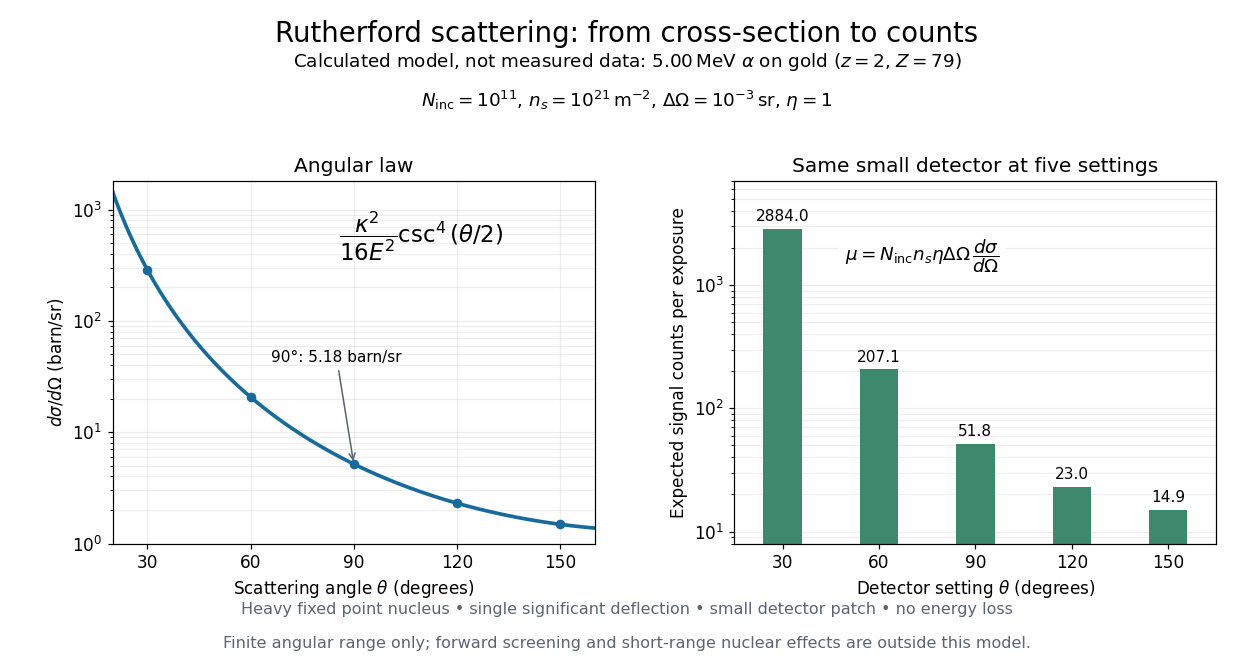
Calculated Rutherford angular cross-section and finite-detector counts
. Original calculation for the stated ideal monoenergetic alpha beam and thin gold foil. The curve is a differential cross-section; the bars are expected counts for the specified small detector solid angle at separate settings. They are not measured 1909 or 1913 data, and do not sum to a total scattering probability. The curve is shown only from 20 to 160 degrees. Details.
An observation also contains backgrounds. For a stable source and matched geometry, an estimator is , where denotes exposure duration. If source activity changes, normalize by incident exposure as well. Background subtraction removes an estimated background; it does not make finite counting fluctuations disappear.
Rutherford differential cross-section 2026-10-18
For an incident beam uniform across its relevant impact parameters, an incident annulus has area . Rotational symmetry maps it to outgoing solid angle . The central-potential classical differential cross-section and the Rutherford impact-parameter relation therefore giveThis is a differential scattering cross-section, with units of area per steradian, conventionally , not a detector count and not an area per degree. It applies for , with a finite limiting value at . Doubling incident kinetic energy divides it by four at fixed angle; doubling either electric charge number multiplies it by four.
Rutherford impact-parameter relation 2026-10-18
Let be the scattering angle between incoming and outgoing velocities, so forward scattering is and exact reversal is . Define the length . ThenFor , this gives ; is the head-on limiting case . Large deflections select small impact parameters, rather than requiring every incident alpha particle to reverse.
A short derivation uses conservation of angular momentum and conservation of energy. Choose the polar angle at closest approach, and write . The Binet equation for the repulsive Coulomb potential givesThe last equality follows by substituting this orbit into . The hyperbola reaches infinity at , with . Its scattering angle is , henceThis proves the relation without assuming that the deflection is small. The symbol here is a dimensionless orbital parameter, distinct from .
For a head-on repulsive Rutherford scattering encounter, relative kinetic energy becomes Coulomb potential energy at closest approach. With projectile charge and target charge , conservation of energy gives the displayed separation. If the Coulomb description remains valid down to that separation, it bounds the target's interaction radius from above, treating the projectile as pointlike. For a stationary target of mass and incident projectile mass , use centre-of-mass energy ; neglecting nuclear recoil amounts to .
Work by Russian Academy of Sciences Created 2026-10-18 Updated 2026-11-05
By Rüdiger Paschotta. No article date is established.
Online text: www.rp-photonics.com/faraday_effect.html
There are unlisted articles, also show them or only show them.