
John P. Perkins Created 2026-10-14 Updated 2026-11-05
A protein kinase is an enzyme that catalyzes phosphorylation of a protein. In receptor tyrosine kinase signaling, ATP supplies the transferred phosphate group.
Donal A. Walsh Created 2026-10-14 Updated 2026-11-05
A protein kinase is an enzyme that catalyzes phosphorylation of a protein. In receptor tyrosine kinase signaling, ATP supplies the transferred phosphate group.
Alfred G. Gilman Created 2026-10-14 Updated 2026-11-05
Alfred G. Gilman coauthored purification and characterization of the regulatory component of adenylate cyclase. The work connects guanine-nucleotide-dependent regulation with production of the second messenger cyclic AMP.
Separating a regulatory component from the catalytic activity helps show how a signal can control an enzyme through another protein, rather than through direct substrate binding alone.[ref]
The regulatory component of adenylate cyclase. Purification and properties by P. C. Sternweis and others. Primary publication: scientific topic and stated experimental result

Portrait of Alfred G. Gilman
. NIH historic image. Public domain (United States government, NIH). Source usage terms, via Wikimedia Commons. Source.
M. D. Smigel Created 2026-10-14 Updated 2026-11-05
M. D. Smigel helped investigate the purified regulatory component of adenylyl cyclase. Connecting its guanine-nucleotide-dependent properties with restored hormone stimulation showed how biochemical separation and reconstitution can identify a signaling component.[ref]
The regulatory component of adenylate cyclase. Purification and properties by P. C. Sternweis and others. 1981, abstract, properties 2–4: purified component and functional reconstitution
J. K. Northup Created 2026-10-14 Updated 2026-11-05
J. K. Northup helped characterize the guanine-nucleotide regulatory component of adenylyl cyclase. Its ability to restore hormone-responsive activity in a reconstituted system provided functional evidence for the purified component's role in signal transduction.[ref]
The regulatory component of adenylate cyclase. Purification and properties by P. C. Sternweis and others. 1981, abstract, properties 2–4: guanine-nucleotide regulation and reconstitution
P. C. Sternweis Created 2026-10-14 Updated 2026-11-05
P. C. Sternweis helped purify the guanine-nucleotide regulatory component of adenylyl cyclase. Reconstitution of hormone-stimulated activity connected an isolated biochemical component with signal transmission from a receptor to an enzyme.[ref]
The regulatory component of adenylate cyclase. Purification and properties by P. C. Sternweis and others. 1981, abstract, properties 2–4: purification and reconstitution
T. Lee Created 2026-10-14 Updated 2026-11-05
T. Lee coauthored work identifying an activating kinase for p34cdc2. Comparisons of phosphorylation-site mutants show that different regulatory sites have different functional effects.
Loss of activity after a mutation must be interpreted alongside partner binding and phosphorylation measurements. The combined observations help distinguish regulation of an assembled complex from failure to form the complex.[ref]
Role of phosphorylation in p34cdc2 activation: identification of an activating kinase by M. J. Solomon and others. Abstract: mapped sites, activating phosphorylation, and cyclin binding
Identity source: pmc.ncbi.nlm.nih.gov/articles/PMC275499/
M. J. Solomon Created 2026-10-14 Updated 2026-11-05
M. J. Solomon coauthored experiments on activating phosphorylation of the cell-cycle kinase p34cdc2. Mutation and activation tests distinguish cyclin binding from phosphorylation needed for kinase activation.
A protein can bind its regulatory partner yet remain inactive. This distinction links a molecular association measurement with a separate test of catalytic function.[ref]
Identity source: pmc.ncbi.nlm.nih.gov/articles/PMC275499/
Work by Leonard C. Maximon 2026-10-14
Work by Léo Ducas 2026-10-14
Magneto-optical trap 2026-10-14
A magneto-optical trap combines laser cooling with a position-dependent magnetic field and suitable beam electromagnetic polarization to produce a restoring force. Its spatial confinement is additional to the velocity damping of uniform optical molasses.
Sub-Doppler cooling 2026-10-14
Real atoms have multiple internal quantum states. Optical pumping and spatially varying electromagnetic polarization can remove kinetic energy by additional mechanisms, producing sub-Doppler cooling below the ideal Doppler cooling limit. In polarization-gradient cooling, state-dependent energy shifts from the Stark effect and delayed optical pumping make atoms repeatedly climb potential energy hills. This mechanism needs the internal-state structure omitted by the independent-beam two-level system above. [ref]
Nobel Lecture: Laser cooling and trapping of neutral atoms by William D. Phillips. William D. Phillips, Nobel Lecture: Laser cooling and trapping of neutral atoms, pp. 733–734 and Fig. 18: multilevel polarization-gradient cooling
.William D. Phillips's team tested unexpectedly cold sodium molasses with time-of-flight atom detection. A probe above the cloud initially saw no atoms; deliberately heating them verified that the detector worked. Moving the probe below the cloud produced arrival signals consistent with temperatures below the Doppler cooling limit. Independent release/recapture checks used sharply apertured beams and included gravity; uncertain cloud and probe geometry still limited the inferred temperature. These controls tested the thermometer as well as the cooling theory. [ref]
Nobel Lecture: Laser cooling and trapping of neutral atoms by William D. Phillips. William D. Phillips, Nobel Lecture: Laser cooling and trapping of neutral atoms, pp. 731–732, Figs. 15–16: probe reversal, deliberate heating, geometric uncertainties and independent thermometry
. Optical molasses 2026-10-14
Optical molasses surrounds slow chemical atoms with opposing red-detuned laser beams, usually three pairs along perpendicular axes. In the elementary Doppler cooling picture, each pair damps one component of velocity. The result resembles viscous drag, even though the atoms are moving through a vacuum rather than a liquid.
Uniform balanced optical molasses supplies velocity damping, without a restoring force towards a chosen position. An atom at rest has zero mean force wherever it sits within the uniform illuminated region. Without noise or external forces, givesThe atom approaches a position determined by its initial condition, not the beam intersection. Recoil-driven diffusion and gravity eventually remove atoms from finite beams. A long residence time in optical molasses is therefore compatible with the absence of position trapping. An optical trap provides spatial confinement by a different force mechanism; a magneto-optical trap adds a position-dependent magnetic field and suitable beam electromagnetic polarization to create a restoring force.
Doppler cooling 2026-10-14
Consider equal opposing laser beams along the axis and an atom with velocity . Let be their angular frequency, the atomic resonance angular frequency, their wavenumber, and the laser detuning. Red detuning means . To first order in , the atom seesFor small positive , the beam travelling towards negative is closer to resonance and causes more photon absorption; its momentum kicks point against . The beam travelling towards positive is further from resonance. Reversing exchanges the roles of the two beams. This is a Doppler effect on the absorption rates, rather than a need to follow each atom with a moving beam.
An absorbed photon gives the atom momentum , where is the reduced Planck constant. Subsequent spontaneous emission gives a recoil opposite to the emitted photon. For an emission pattern symmetric under reversal of direction, that recoil has zero expected value, but nonzero variance. Its mean therefore leaves the directional absorption force intact, while its randomness adds recoil energy. Random absorption times and choices of beam add further momentum fluctuations. Zero mean recoil does not mean zero heating.
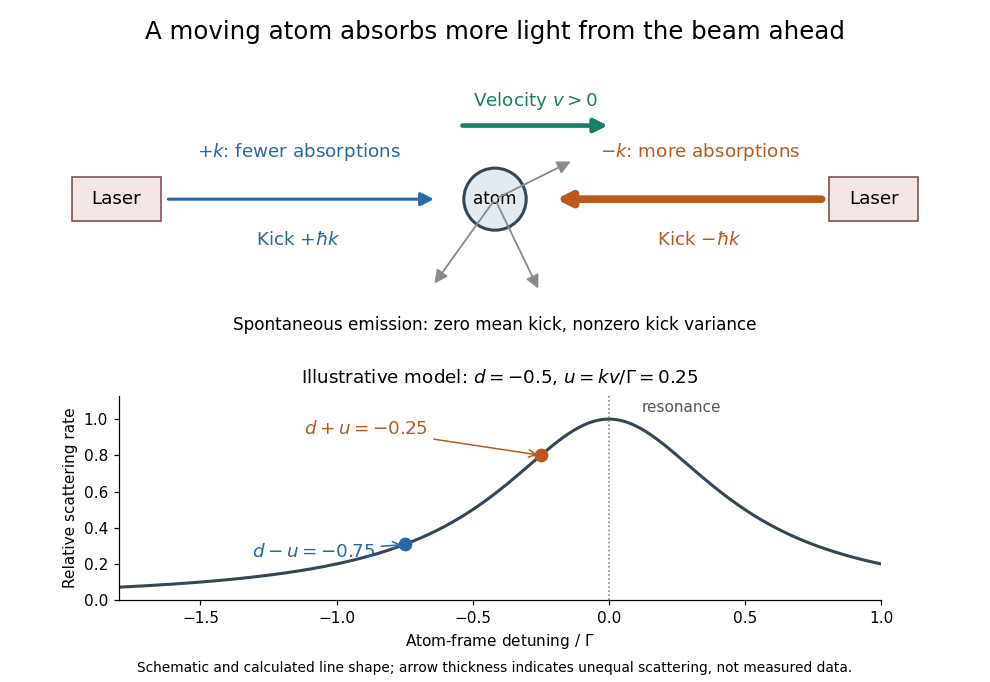
Opposing beams and Doppler-selective photon absorption
. An original schematic for an atom moving right. Both beams have the same red detuning in the laboratory. The calculated weak-field line shape below shows their different atom-frame scattering rates for and ; it is not experimental data. Details.
Helium-neon laser Created 2026-10-14 Updated 2026-11-05
A helium-neon laser uses an electrical discharge in a helium–neon gas mixture to establish optical gain on neon transitions. Excited helium atoms transfer energy in collisions to suitable excited neon states, helping create the required population inversion.
A discharge tube and aligned resonator mirrors form the apparatus; one mirror transmits part of the circulating light as output. The familiar red emission is one selected transition rather than a direct photograph of the entire discharge spectrum. Gas pressure, discharge current and mirror selection affect oscillation, while misalignment can suppress the laser output even when the discharge remains visibly bright.
Laser detuning Created 2026-10-14 Updated 2026-10-18
Laser detuning is the difference between a laser angular frequency and a specified atomic resonance angular frequency. Red detuning has ; blue detuning has . The sign matters in laser cooling: a moving atom can see a red-detuned laser closer to resonance because of the Doppler effect.
Work by Kyle Siegrist 2026-10-14
Shadow price of an inequality constraint 2026-10-14
A shadow price measures the marginal improvement from relaxing an inequality optimization constraint. Use for in a minimization problem. With strong duality and a differentiable optimal value function, .[ref]
Convex Optimization by Stephen Boyd and Lieven Vandenberghe. §5.6.3, printed pp. 251–252, equation (5.58): local sensitivity
In the quadratic minimization with a moving upper bound, direct differentiation givesThe derivative at is zero from both sides, although has different one-sided derivatives there. The value of additional room has faded continuously to zero just as the active constraint stops restricting the optimizer.
At , , and . Raising the bound to lowers the value to : the first-order prediction is a change of , while the exact change is . At , the same relaxation leaves and . At , tightening by costs , a second-order effect despite the zero Lagrange multiplier.
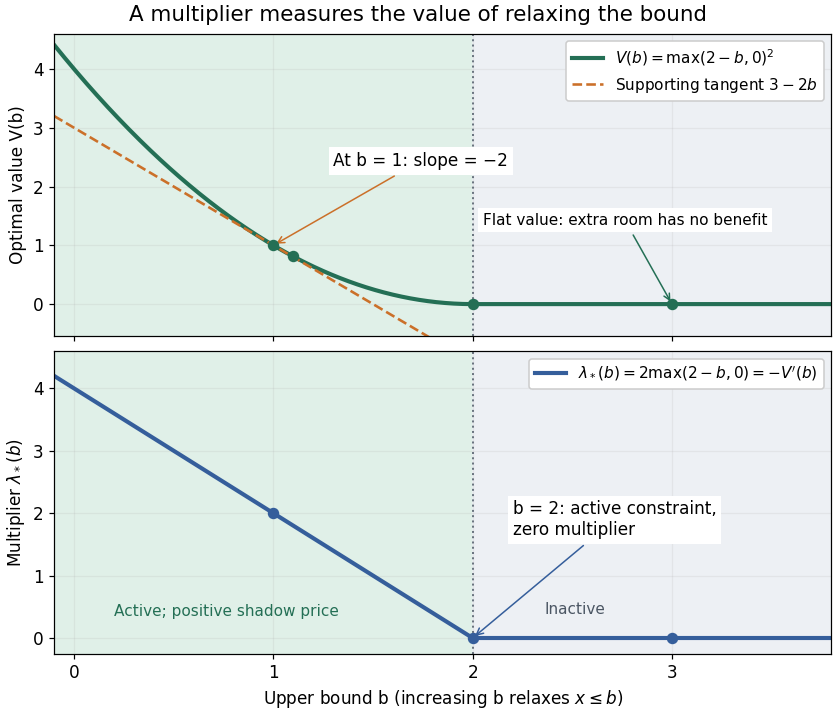
The derivative of the optimal value is the negative inequality multiplier
. Details. 
There is also a global statement in this example. Keeping the Lagrange multiplier at the value associated with , the Lagrange dual function changes by . Weak duality therefore givesAt this is , the supporting tangent shown in the diagram. This bound remains valid for large changes, whereas the derivative predicts only the first-order effect. If the value function is not differentiable, an optimal Lagrange multiplier can instead supply a supporting subgradient, rather than a unique marginal rate. This is the same idea used in sensitivity analysis in convex perturbation duality.
Consider the minimization problemThe objective function is a strictly convex function with its unconstrained optimization minimum at . If , it decreases throughout the feasible set until the bound is reached. If , the feasible set already contains . HenceWith , the optimization Lagrangian and KKT conditions areSubstituting gives the unique inequality Lagrange multiplierFor , the active constraint has . For , there is strict slack and . At , the active constraint has zero Lagrange multiplier: the boundary happens to pass through the unconstrained optimum. Feasibility and complementary slackness must both be checked; solving only would allow infeasible candidates.
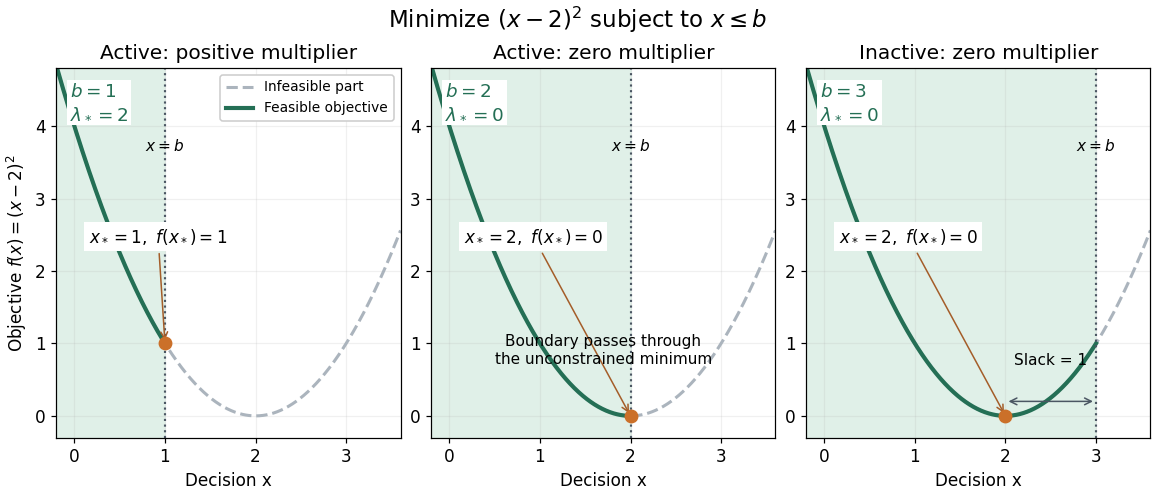
The same quadratic objective with active, just-touching and inactive upper bounds
. Details. 
An independent certificate follows by completing the square:The Lagrange dual function is a concave function of . Its maximum over occurs at and equals . Thus every case has an explicit lower bound attained by a feasible point; the KKT conditions provide a certificate that can be checked without searching all real numbers.
Convex KKT optimality certificate 2026-10-14
For differentiable functions that are convex functions on an open convex set and affine functions , the KKT conditions certify a global minimum. Once Lagrange multipliers satisfy them, no extra Slater condition is needed.[ref]
Convex Optimization by Stephen Boyd and Lieven Vandenberghe. §5.5.3, printed p. 244: sufficiency under convexity and affine equalities
The certificate is a short chain of inequalities. Nonnegative Lagrange multipliers and affine equalities make a convex function. Its zero gradient gives a global minimum at by the first-order optimality condition. For every feasible point ,The first equality uses feasibility and complementary slackness; the last inequality uses and . Equivalently, the Lagrange dual function attains the same value as the primal objective function, proving strong duality. A strictly convex function makes the primal optimum unique, although the Lagrange multipliers need not be unique.
Affine equality optimization constraints matter: an arbitrary signed multiple of a nonlinear equality can destroy convexity of the optimization Lagrangian. For example, minimizing subject to the affine equality gives and for . This equality Lagrange multiplier is positive for , zero at , and negative for . Completing the square gives the certificate for every real number .
Outside convex optimization, KKT stationarity alone does not certify an optimum: minimizing with no optimization constraints gives the stationary candidate , which is a global maximum. The Lagrangian sufficiency theorem remains applicable whenever a global minimum of the optimization Lagrangian can be proved directly.
There are unlisted articles, also show them or only show them.