
KKT regularity at a local minimum Created 2026-10-14 Updated 2026-10-24
At a local minimum of continuously differentiable functions, a suitable constraint qualification guarantees the existence of Lagrange multipliers satisfying the KKT conditions. One sufficient local regularity assumption is that the gradients of the equality optimization constraints and the active constraints are jointly linearly independent. This assumption concerns the description of the feasible set, not just the smoothness of the objective function.[ref]
Lecture 7: Lagrange Multipliers and KKT Conditions. Lecture 7, §L7.1.3, Theorem L7.3, printed p. 4: continuous differentiability and independent active gradients
To see why a hypothesis is needed, minimize subject to . The feasible set is the singleton , so is a global minimum. Yet for every finite Lagrange multiplier . Thus this convex optimization problem has an attained optimum without a KKT multiplier. The zero gradient of the active constraint has hidden the actual restriction from its first-order equation. Rewriting it as the equality yields the unrestricted Lagrange multiplier .
For convex optimization, Slater's condition requires strict inequalities and affine equalities at a point in the relative interior of the common domain of a function. A finite optimum value then gives strong duality and dual attainment. Primal attainment and differentiability yield KKT multipliers. Affine inequalities may be nonstrict in the refined version.[ref]
Slater's condition is sufficient, and need not hold for an optimum to exist. The singular example above also shows that mere primal attainment is not a substitute for a constraint qualification.
Work by Karl Heun 2026-10-14
Work by K. I. Dickson 2026-10-14
Work by Jyrki Piilo Created 2026-10-14 Updated 2026-10-31
Work by Jonas Almström Duregård 2026-10-14
Work by John Watrous Created 2026-10-14 Updated 2026-11-05
Work by John Preskill Created 2026-10-14 Updated 2026-10-31
Work by John M. Lee 2026-10-14
Work by John Edensor Littlewood 2026-10-14
Work by John C. Butcher 2026-10-14
Work by Johann Andreas von Segner 2026-10-14
Work by Jean Gallier 2026-10-14
Work by Jan-Hendrik Evertse 2026-10-14
Work by J. Robert Oppenheimer 2026-10-14
Work by J. Laurie Snell 2026-10-14
Work by J. David McDonald 2026-10-14
Isotopic composition Created 2026-10-14 Updated 2026-10-20
The relative isotopic abundances in a sample.
Linear-gradient isopycnic focusing 2026-10-14
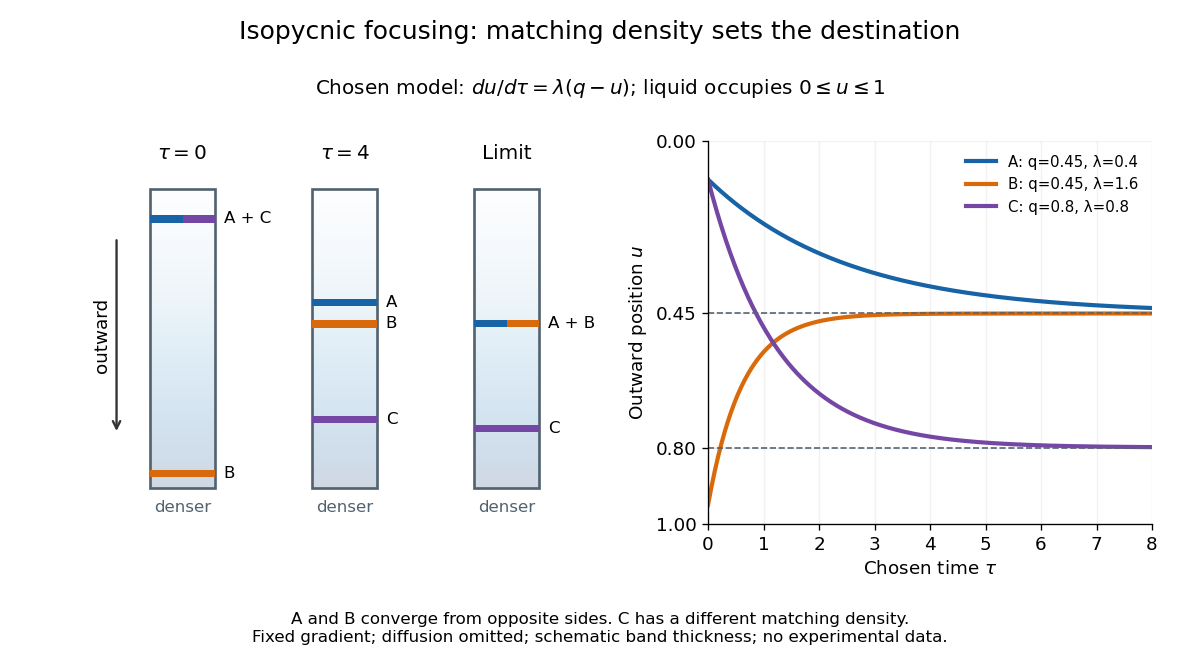
Why does an isopycnic centrifugation band return after displacement? Choose a dilute mathematical model with outward coordinate , constant local centrifugal acceleration , fixed displaced volume , linear friction coefficient , and an imposed liquid density with . Treat the species' buoyant density as constant in this medium. The sedimentation coefficient force balance gives the ordinary differential equationIts exponential function solution is . The sign of the velocity reverses across , proving stable equilibrium when lies inside the liquid. Changing changes the approach time , while depends on buoyant density and the imposed density gradient. A real centrifuge rotor has radially varying centrifugal acceleration; the constant- approximation describes a short radial interval. Here the density gradient is held fixed, rather than modeling its formation.
For an original dimensionless example, let and , where is column length and a chosen time scale. Write and , so . Species A and B have the same but different friction-dependent rates: and . A moves outward and B inward, both toward . Species C has and approaches a separate band at . At , their positions are approximately , and : a finite-time photograph would still show A short of its limiting position.

An equilibrium band has finite width because diffusion opposes focusing. In the same local model, let be concentration and let the constant diffusion coefficient be . Combining the restoring drift with Fick's laws, zero net flux requiresDividing by and integrating proves the Gaussian function profile, whose standard deviation is . This local result assumes that the band is narrow relative to its distance from the boundaries and that , and the density gradient vary negligibly across it. Equal buoyant densities therefore imply coincident centers in this model, not identical widths. A band outside the available density range has no such interior restoring point.
Bytecode Created 2026-10-14 Updated 2026-10-31
An encoded instruction representation for a software execution mechanism. Compilation can produce bytecode that an interpreter executes.
IP3-sensitive calcium store 2026-10-14
An IP3-sensitive calcium store contains releasable calcium behind a membrane bearing functional IP3 receptors. The endoplasmic reticulum is an important example. Pumping calcium into it or exporting calcium across the cell membrane lowers free cytosolic calcium; intracellular redistribution and loss from the whole biological cell are different balances.[ref]
Pathways of Intracellular Signal Transduction. Phospholipids and Ca2+, paragraph accompanying Figure 13.27: calcium pumps across plasma and ER membranes
Finite availability matters: a release pathway cannot deliver more calcium than its accessible store contains unless replenishment occurs. A falling cytosolic calcium response can reflect reduced release, increased removal, or both. Store content, release rate and free cytosolic concentration therefore answer different questions. Binding to proteins can also change the free fraction without changing the total number of calcium ions.
There are unlisted articles, also show them or only show them.