
Chromatic index 2026-10-14
The chromatic index , also called the edge chromatic number, is the least number of labels in a proper edge colouring of a finite undirected graph without self-loops. Equivalently, it is the smallest number of matchings in a graph whose set partition covers all the edges. We take when there are no edges. For an arbitrary edge colouring, one colour always suffices whenever an edge exists, so properness is essential to this definition. The chromatic number instead colours vertices.[ref]
Graph Theory by Reinhard Diestel. Colouring, author-hosted chapter preview, p. 124: chromatic index and line graph
To establish an exact chromatic index, supply both a proper edge colouring and a reason that fewer colours cannot work. Every edge at a fixed vertex must have its own colour, giving the lower bound , where is the maximum degree of a graph. The bound need not be attained: it counts a single resource's workload, while conflicts can also accumulate around a graph cycle.
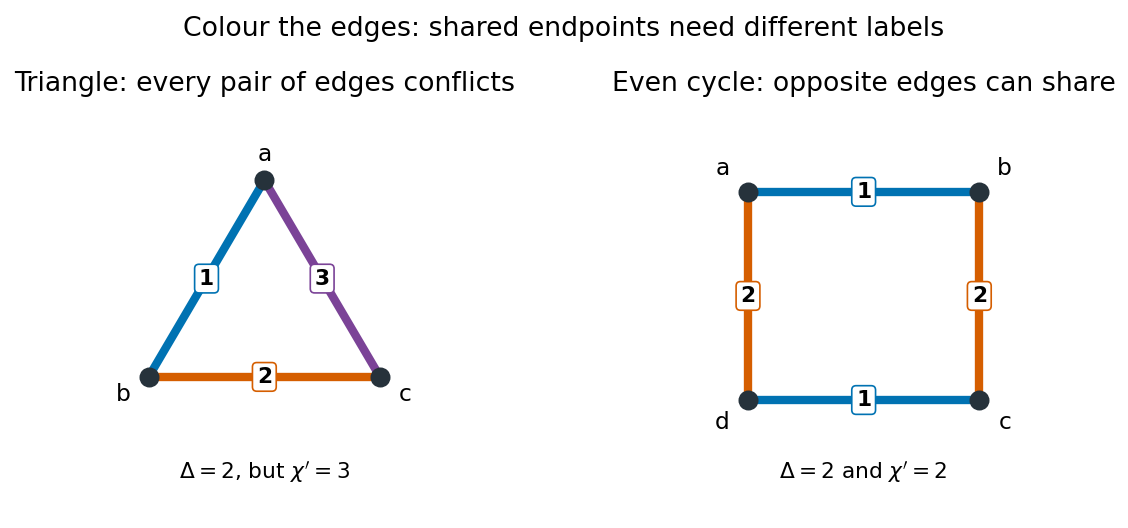
Worked proper edge colourings: a triangle in a graph needs three colours, while an even cycle graph needs two
. Numbers beside edges are colour labels; letters at dots are vertices. Both graphs have maximum degree of a graph two. The triangle in a graph has three pairwise conflicting edges, while opposite edges of the square can share a colour. Details.
For the triangle in a graph with edges , every pair of edges shares a vertex, so all three require different labels. The assignment works, proving although . In its line graph, those three edges become a three-vertex clique. Treating this as three pair-resource jobs makes the obstruction tangible: each resource has only two jobs, but every pair of jobs conflicts, so no slot can contain two jobs.
For the square cycle graph with edges , use and . Each colour class is a matching in a graph, and each vertex has one edge of each colour. Since , this proves . More generally, alternation closes on any even cycle graph , . On an odd cycle , , two-colour alternation would make the last and first edges share a colour at their common vertex; a third colour on the last edge suffices. Thus even cycle graphs have chromatic index two and odd cycle graphs have chromatic index three. These exact examples show why maximum degree of a graph alone does not determine the answer.
List edge coloring 2026-10-14
Each edge has a list of allowed colors; a list edge coloring chooses an allowed color on each edge, giving different colors to incident edges. The list-chromatic index is the uniform list-size threshold guaranteeing success.
Proper edge coloring 2026-10-14
A proper edge colouring gives different labels to any two distinct edges sharing a vertex. We work with finite undirected graphs without self-loops; distinct parallel edges in a multigraph must also have different colours. For a simple graph, whose edges are two-element sets, the condition isEvery colour class is a matching in a graph. Conversely, a set partition of the edges into matchings in a graph supplies a proper edge colouring. Thus minimizing colours means grouping all the edges into as few matchings in a graph as possible.
The line graph makes the relationship with proper vertex colouring explicit: replace each original edge by a vertex, joining two new vertices exactly when their original edges share an endpoint. A proper edge colouring of becomes a proper vertex colouring of its line graph , so . For a multigraph, retain a distinct new vertex for each parallel edge.[ref]
Vizing's theorem Created 2026-10-14 Updated 2026-10-25
Isoperimetric number of a graph 2026-10-14
For a finite graph with at least two vertices, the displayed minimum measures the fewest outgoing edges per vertex in a nonempty set occupying at most half the graph. It uses the edge boundary, rather than the external vertex boundary. For the hypercube graph , , it equals one: edge-isoperimetry gives the lower bound and a coordinate half-cube attains it.
For the affine angular ansatz , the radiative flux is . Setting the inward hemispheric flux to zero gives , but then the formal intensity at is negative when . Exact no-incoming radiation and nonnegative intensity cannot both be represented by a nonzero affine polynomial on all directions. The Eddington surface boundary condition therefore specifies approximate moments, rather than an exact emergent angular radiation field.
Earth's outer core Created 2026-10-14 Updated 2026-10-18
Earth's outer core is a liquid, electrically conducting region whose buoyant motion and rotation sustain the geodynamo. Its magnetic field both responds to the flow through induction and modifies that flow through the Lorentz force. A prescribed-velocity kinematic model describes onset rather than the entire nonlinear core dynamics.
Siegel–Shidlovsky theorem 2026-10-14
Let a vector of E-functions satisfy with . At a nonzero algebraic point which is not a pole of , the transcendence degree of the values over equals the transcendence degree of the functions over . In particular algebraically independent functions give algebraically independent values. The exponential system , for rationally independent algebraic , recovers the Lindemann–Weierstrass theorem by evaluating at one.
Addition closure of Siegel E-functions 2026-10-14
Work in the compositum of the two coefficient fields. Conjugate coefficient bounds add, while multiplying the common denominators clears both coefficient lists. For Siegel's original bounds , use in each denominator estimate. A nonzero linear differential equation for the sum follows because its derivatives lie in the sum of the two finite-dimensional derivative spaces over the rational function field. The stricter exponential arithmetic bounds are preserved as well.
For , suppose a skew-Hermitian Lie algebra becomes all of after adding the scalar identity direction. Scalar matrices commute, so is contained in . If contains any nonzero-trace generator, subtracting its traceless part supplies , and was already all of . This permits using identity-augmented commutator calculations without assuming an additional physical identity control.
Let be a symmetric unitary matrix and every skew-Hermitian control generator obey . The condition is closed under real linear combinations and commutators, and evolution preserves . In a unitary basis where becomes the identity, the generators are real antisymmetric, so the Dynamical Lie algebra is contained in . The state quantity is invariant under the reachable evolution and insensitive to global phase, obstructing unrestricted pure-state controllability. This is a bilinear-form symmetry; it does not assert that commutes with the Hamiltonians.
Let and , with nonzero , distinct positive . The squared adjoint action of has different eigenvalues on the two adjacent skew-Hermitian couplings. Linear combinations of and its double commutator with isolate both couplings. Further commutators give their real antisymmetric partners, two traceless diagonal generators, and both – generators, hence the special unitary Lie algebra . The drift has nonzero trace; subtracting its traceless part supplies , giving the Lie algebra of the unitary group and unitary operator controllability under the usual freely timed real-control assumptions.
For a nonsingular skew-symmetric unitary , if each skew-Hermitian control generator obeys , then so do their real linear combinations and commutators. Differentiating shows that it stays equal to . The reachable group is therefore contained in a unitary conjugate of the compact symplectic group. This is preservation of an alternating bilinear form, not commutation with .
For , let be a Lie subalgebra of with codimension one. With inner product on skew-Hermitian matrices, its orthogonal complement is a line . Invariance of the inner product shows that lies in that line for every ; skew-adjointness of the adjoint action makes orthogonal to , hence zero. A nonscalar skew-Hermitian has a centralizer of dimension at most , by its orthogonal eigenspace decomposition, and cannot centralize all of . Thus is scalar and . This gives density operator controllability and all determinant-one gates, but not the central phase direction needed for unitary operator controllability.
Strongly regular quantum Hamiltonian 2026-10-14
A drift Quantum Hamiltonian is strongly regular when its energy levels are nondegenerate and distinct unordered transitions have distinct absolute nonzero Bohr frequencies. Sometimes regularity is required only on the graph of allowed control transitions. This lets polynomials in the squared drift adjoint action separate different coupling quadratures and permits frequency-selective resonant quantum control. This notion is unrelated to a strongly regular graph.
Let be diagonal and , with every and the adjacent absolute energy gaps distinct and nonzero. The squared drift adjoint action has distinct eigenvalues on these coupling components, so Lagrange interpolation isolates every adjacent symmetric coupling. One more commutator gives its antisymmetric partner. Their mutual brackets produce adjacent traceless diagonals, while brackets along the connected chain give all longer-range matrix units. Thus the special unitary Lie algebra is generated. Any nonzero-trace generator also supplies the central direction, giving all of . This is a sufficient condition in the finite-dimensional freely timed real-control model; connectivity alone does not remove frequency degeneracies.
For a rocket equation with exhaust mass rate and incoming stationary mass rate , mass balance is . A short-interval momentum conservation calculation gives . Constant time rates , give , unlike a constant accretion rate per distance, whose incoming mass rate is proportional to speed. For unequal rates and initial rest, .
Closed-hyperplane proof of Lp duality 2026-10-14
Let and . For a nonzero bounded linear functional on an Lp space, choose with and a closest point in its closed kernel. Put . The variational condition is for every kernel element . Since lies in the kernel, with . Hölder's inequality gives the upper norm bound; testing against gives equality. Thus the representation is an isometric linear isomorphism when the pairing is bilinear.
Quantum dimension 2026-10-14
Closing an identity strand using compatible evaluation morphisms and coevaluation morphisms gives the categorical dimension in a pivotal or ribbon setting. For the standard two-dimensional quantum enveloping algebra of sl2 module, the weighted contraction has diagonal coefficients , giving quantum dimension . The chosen duality and framing conventions matter.
Dual variable 2026-10-14
A dual variable is a multiplier associated with a primal constraint in a dual linear program. In a minimization linear program with equality constraints and nonnegative primal variables, the Lagrangian yields the dual objective and inequalities ; the equality-constraint multipliers are unrestricted in sign. For a transportation problem, row and column dual variables give potentials satisfying . Complementary slackness makes occupied routes attain equality.
There are unlisted articles, also show them or only show them.