
Limited excess of loss reinsurance 2026-10-14
A reinsurance layer with attachment and payment limit pays nothing below , the excess between and , and above that. Its expected recovery is , by the tail integral formula for moments. For continuous claims, conditioning on penetration of the layer divides this expectation by .
Grouped Nelson–Aalen event-count identity 2026-10-14
Suppose everyone enters observation at zero and has one event or censoring time. At distinct recorded time , let observations terminate, of which are events, and use the pre-time risk set size . For the grouped Nelson–Aalen estimator, . Exchanging sums gives . The unweighted sum over distinct times generally does not have this property. Processing each observation separately after breaking ties also restores the corresponding unweighted identity on the resulting artificial time grid.
Limsup of events 2026-10-14
For events in a probability space, the infinitely-often event isIts complement of an event is : after some outcome-dependent index, no more events occur.[ref]
Probability: Theory and Examples (fifth edition) by Rick Durrett. §2.3 opening definition and infinitely-often notation, printed pp. 67–68
Deleting finitely many events leaves the limsup of events unchanged. It is therefore a tail event of the sequence of indicator random variables , whether or not those random variables are independent. For independent events, the Kolmogorov zero-one law restricts its probability to zero or one; the Borel-Cantelli lemmas determine which alternative holds from the series of probabilities. Also precisely when only finitely many events occur, connecting the First Borel-Cantelli lemma to almost sure convergence and the existing complete convergence criterion.
If the bank account is positive and nondecreasing and is a martingale under an equivalent martingale measure , then for the European call price is nondecreasing in . Put . For , and hence . Conditional convexity gives . Taking expectations and multiplying by proves the claim. The result is not generally true for negative strikes: with and , a negative-strike call costs , decreasing in maturity.
Convexity of a European call price in strike Created 2026-10-14 Updated 2026-11-05
For any fixed maturity, a European call option price is convex in its strike because is convex for every terminal stock value . Specifically, for , . Multiplication by the positive discount factor and expectation under the pricing measure preserve this inequality. This also explains why a violation of convexity creates a butterfly-spread arbitrage.
Down-and-out European call 2026-10-14
A down-and-out European call pays the usual European call option payoff only if a lower barrier has not been hit before maturity. In the zero-interest, zero-dividend Black-Scholes model, for , its value is . This follows from reflection of the drifted logarithmic price killed at the barrier.
Volume integral of a homogeneous function 2026-10-14
For a sufficiently regular homogeneous function of degree on a three-dimensional region, Euler theorem for homogeneous functions gives . Hence , and the divergence theorem gives the displayed reduction when . At degree only the zero-flux identity follows, so division by is unavailable. Singular functions additionally require an excision or limiting argument; the surface contribution at a removed singularity must not be silently dropped. On the sloping side of a cone with its apex at zero, is tangent to the side and , so only the cap contributes to this formula.
Euler differential identity characterizes homogeneity Created 2026-10-14 Updated 2026-10-18
On an open domain invariant under positive scaling, implies . Indeed, . The converse follows by differentiating the scaling identity at . Connectedness of the whole domain is unnecessary: the argument works along each positive ray.
Small faces of a spherical polyhedral graph 2026-10-14
For a connected cellular spherical planar graph with vertex degrees at least three and face sizes at least three, degree/face double counting and the Euler formula for a connected planar graph give . The left side is at most , proving the displayed bound. In particular a convex polyhedron has at least four faces of size at most five.
Hierholzer's algorithm 2026-10-14
Hierholzer's algorithm constructs an Euler circuit by growing closed trails along unused edges and splicing them at shared vertices, as in the Euler circuit criterion. Each edge must have a distinct record. An implementation using adjacency lists, a stack, and a used flag for each edge runs in time, including the connectivity and vertex degree checks. Store both incidences of a self-loop, while marking its single edge record used only once.
Standardized Euclidean distance Created 2026-10-14 Updated 2026-10-18
With fixed positive scale estimates , this is Euclidean distance in standardized coordinates. It removes marginal units but ignores correlations. Small estimated variances can greatly amplify measurement noise; a zero scale must be handled separately.
Method of moments (statistics) Created 2026-10-14 Updated 2026-10-31
A method-of-moments estimator equates selected theoretical moments to corresponding empirical moment estimates and solves for the parameter. For a distribution with mean and variance , the first two raw moment equations give and . Existence, uniqueness and consistency require appropriate identifiability and moment assumptions; unbiased empirical moments do not make nonlinear parameter estimates unbiased. This statistical estimation procedure differs from the method of moments in probability for proving convergence in distribution.
For a sphere of radius and uniform mass density , with no surrounding mass and gravitational potential zero at infinity, the spherical shell theorem gives inside. Matching to the exterior point-mass potential gives . Since , the displayed relation follows for . Exterior shells leave the interior circular speed unchanged but deepen the potential and change the escape velocity; a uniform core alone is insufficient to determine escape.
Spacecraft trajectory 2026-10-14
A spacecraft trajectory is the path traced by a spacecraft's position over time. An unpowered exterior arc can approximate a Kepler orbit; other bodies' gravity, radiation pressure, and propulsion can change it.
Operational evidence comes from reconstructing a spacecraft's motion. A ground antenna transmits a coded signal; the spacecraft returns it. Corrected round-trip time constrains distance, while the Doppler effect of a coherent carrier constrains the line-of-sight relative velocity. NASA's navigation account describes calibration of onboard turnaround delays before launch, calibration of ground delays before use, and corrections for the terrestrial atmosphere. Measurements over multiple stations and epochs constrain the orbit; range and Doppler effect alone do not directly give all transverse motion. Navigators compare a fitted spacecraft trajectory with later tracking and remeasure after propulsion to assess the maneuver. The account identifies radiation pressure and imperfect propulsion as disturbances. This provides practical checks of a dynamical model and its corrections, rather than a laboratory measurement of a universal escape speed. The simple inverse-square potential predicts an unpowered exterior arc; accurate navigation includes additional forces and measurement delays.[ref]
Escape speed, circular speed, and propulsion 2026-10-14
For a circular orbit, gravity supplies centripetal acceleration, giving . ThusA body in a circular orbit is bound despite its continuous free fall. At the same , escape needs twice its kinetic energy per unit mass. An instantaneous forward tangential velocity increment from the circular orbit requires , rather than the full escape speed from rest. In the synthetic example this is exactly .[ref]
13.4 Satellite Orbits and Energy. §13.4, “Circular Orbits” and “Energy in Circular Orbits”: centripetal balance and negative total energy
Escape speed is a coasting threshold, not a required continuously maintained speed or a measure of rocket propellant. A powered vehicle can start at rest and acquire energy gradually. The rocket equation relates an ideal velocity increment to rocket exhaust speed and rocket mass ratio; rocket thrust, drag, and the timing and direction of propulsion affect a real ascent. Rotation also changes the relation between surface-relative velocity and the inertial frame used in the calculation.
Reaching another body is a finite-destination spacecraft trajectory problem. In the synthetic radial example, a launch at reaches while remaining bound. A spacecraft can similarly encounter the Moon on a bound geocentric transfer; actual planning must include the Moon's gravity, target motion, arrival velocity, and any propulsion needed for capture. Escaping Earth alone does not imply escaping the Sun, because the relevant reference frame and attracting mass have changed. The isolated formula describes one gravitational well; a full mission requires more than its scalar threshold.
Zero-energy escape takes infinite time 2026-10-14
“Arrives at infinity with zero speed” is an asymptotic statement. For outward radial motion at zero specific orbital energy,Every finite distance takes finite time, but as . There is no instant of rest at an infinitely distant destination. Differentiating the displayed solution gives , independently checking Newton's second law. In the synthetic example, reaching takes exactly . For nonzero specific angular momentum, the Barker equation gives the corresponding infinite-time limit along a parabolic trajectory. Positive-energy escape also takes infinite time to reach infinity; it retains nonzero asymptotic speed.
The same initial distance can lead to strikingly different orbits. Let and launch tangentially in one orbital plane. Then periapsis is the launch point, specific angular momentum is , andwhere is true anomaly. These follow by combining the initial specific orbital energy with the orbital eccentricity relation and the Kepler orbit equation. With and , the initial speeds , , , and give : a circular orbit, an elliptic orbit with apoapsis distance , a parabolic trajectory, and a hyperbolic Kepler orbit. The two open paths have asymptotic speeds zero and respectively. Their different directions at large distance are part of the Kepler orbit, not an extra scalar escape threshold.
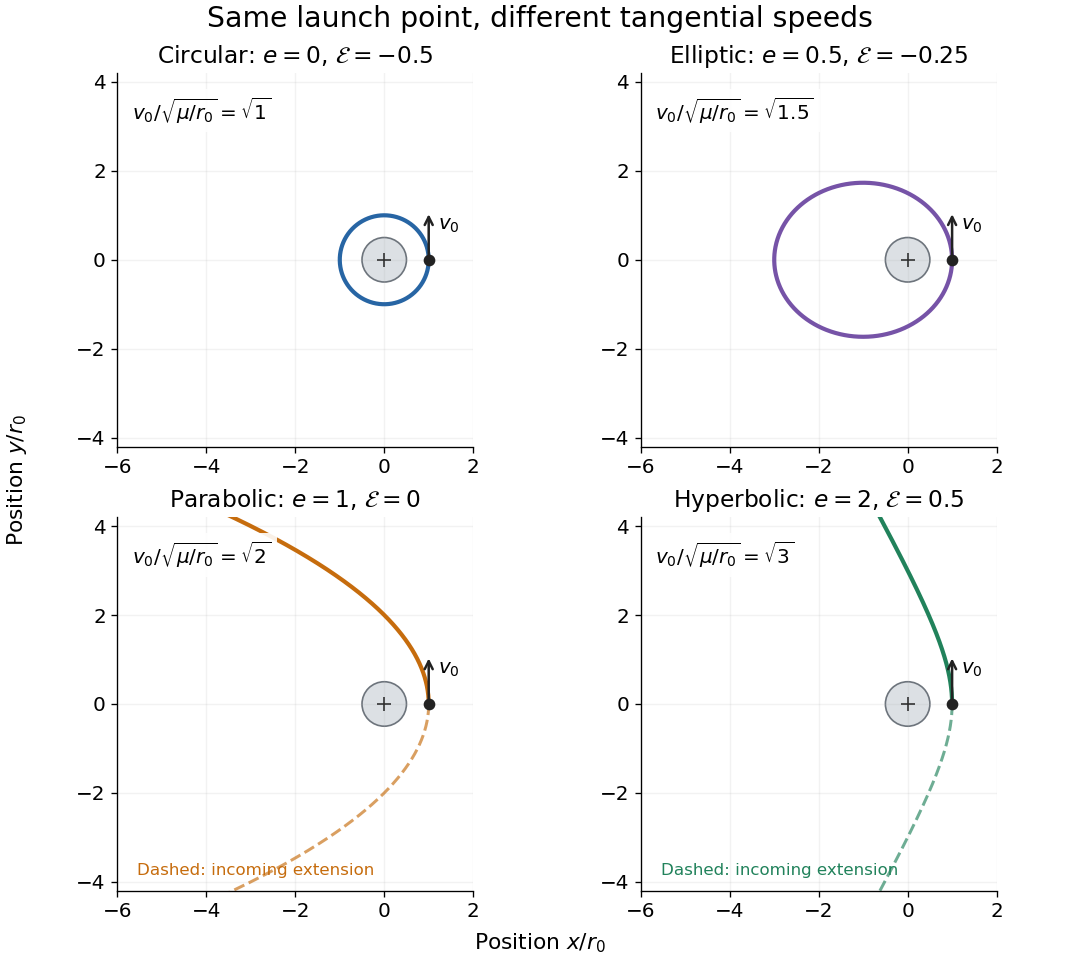
Tangential launches give circular, elliptic, parabolic, and hyperbolic Kepler orbits
. All panels use equal spatial scales, a fixed attracting centre at the origin, a launch point , and an initially upward velocity. The gray body's radius is stipulated as , so all displayed paths remain exterior. Colored solid curves follow motion after launch; dashed curves on the open orbits are their incoming extensions, not an additional part of the launch. Open curves continue beyond the viewing window. The normalized launch speeds and specific orbital energies are computed from the stated isolated model. Details.
Escape-energy balance diagram Created 2026-10-14 Updated 2026-10-20
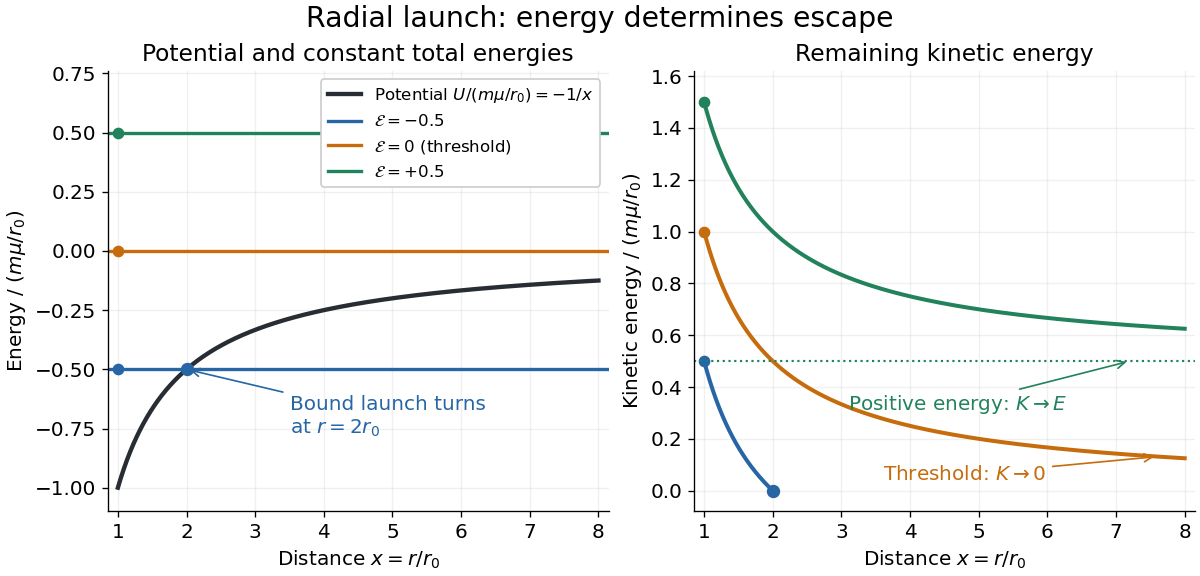
Use the synthetic standard gravitational parameter and launch distance . Then escape speed is . Three outward radial launches give exact comparisons: has specific orbital energy and stops outward at ; has zero specific orbital energy; has specific orbital energy and asymptotic speed . The second case has speed at . Doubling divides escape speed by , whereas doubling at fixed multiplies it by . Changing the test particle's mass changes but cancels from the escape speed.

Ertel's theorem Created 2026-10-14 Updated 2026-11-05
An inviscid fluid with conservative body force, a materially conserved stratifying scalar , and an equation of state making coplanar conserves its Ertel potential vorticity. The stretching of absolute vorticity per unit density cancels the deformation of the scalar gradient; the remaining baroclinic triple product vanishes. In an incompressible density-stratified ideal fluid, choosing the advected density as gives that cancellation directly.
There are unlisted articles, also show them or only show them.