
Divisor summatory asymptotic Created 2026-10-14 Updated 2026-11-05
The Dirichlet hyperbola method gives , where . The harmonic number estimate , with the Euler's constant, yields . Substitution of gives the displayed asymptotic expansion. Comparison of with its integral consequently gives for integer .
The direct divisor summatory function formula evaluates floor divisions. Its balanced Dirichlet hyperbola method formula evaluates floor divisions and reuses their sum for the other strip, followed by doubling and square-overlap subtraction. Thus it uses arithmetic operations, with big O notation, in a model that counts each division, addition and multiplication as one operation. At , the division counts for these two formulas are and .
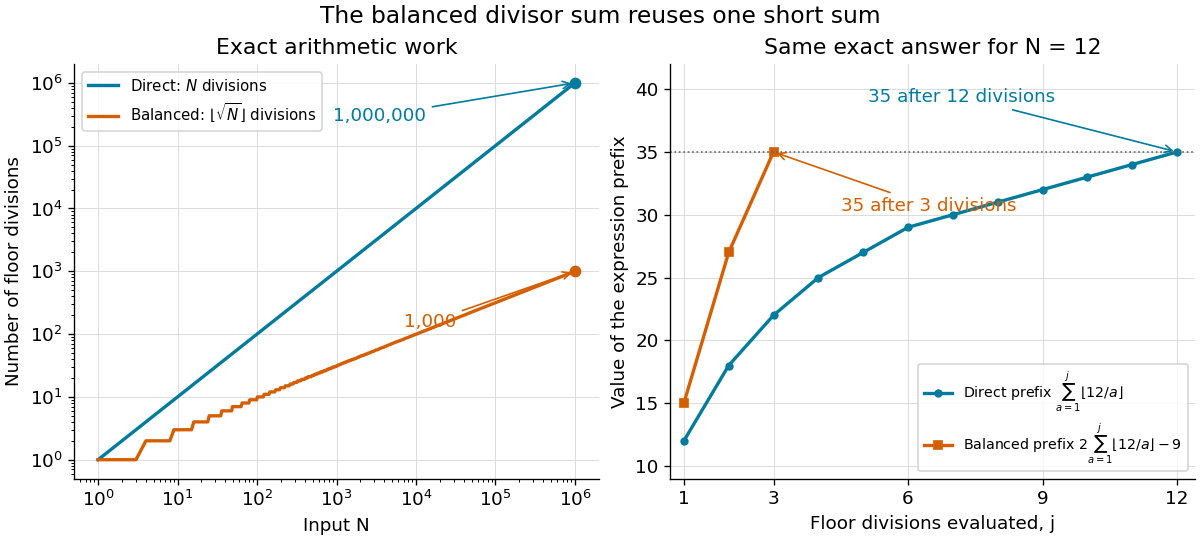
The balanced Dirichlet hyperbola method reduces floor divisions from to ; for , two sequences of partial sums reach the same exact answer 35
. Details. 
For a general Dirichlet convolution, the asymmetric formula has outer terms; evaluating and has an additional cost. Under , equal thresholds minimize , but an asymmetric split can be useful if the two partial sums have different evaluation costs. The balanced divisor summatory function gains the further reuse because its two arithmetic functions are identical.
These are arithmetic operation counts, rather than counts of elementary operations on binary digits: the integers grow with , and division of longer integers costs more in that model of computational complexity theory. Computing also requires an exact integer square root, or checking and correcting a numerical square root until holds.
Asymmetric Dirichlet hyperbola split 2026-10-14
A balanced Dirichlet hyperbola method split takes real thresholds . An asymmetric split takes and . Every lattice point with then has or , and every point in their overlap rectangle is allowed because . For arithmetic functions , define their partial sums by and , always over positive integers. The same inclusion-exclusion principle, now with weight , yieldsNo multiplicativity assumption is needed: this is a finite rearrangement of Dirichlet convolution. The constant-one arithmetic function in both positions recovers the divisor summatory function. For , , givesIt uses two columns and six rows, with a twelve-point overlap.
For general positive real thresholds, is sufficient for coverage, since and would imply . If , however, the overlap can include points above the hyperbola. The correct subtraction is then ; the product is justified only when the whole integer rectangle lies below it. For example, , covers every allowed pair, but its rectangle contains the forbidden pair , so subtracting all sixteen points would give instead of .
Conversely, the balanced integer thresholds have and still cover every allowed pair because . More generally, positive integer thresholds give coverage exactly when , and their overlap is a full rectangle exactly when . These discrete conditions explain why the square-root identity works even when .
Divisor summatory function 2026-10-14
The divisor summatory function adds the divisor function up to a cutoff . It counts all ordered pairs of positive integers whose product is at most . For , the twelve individual divisor function values areCounting columns of lattice points instead gives . The Dirichlet hyperbola method needs only the first three column counts:The arithmetic work of the Dirichlet hyperbola method is much smaller even though the answer is identical.
This is useful for elementary averages: individual divisor function values fluctuate, but their summation has the regular behavior given by the divisor summatory asymptotic. Dividing that estimate by a positive integer giveswhere is the natural logarithm, is the Euler--Mascheroni constant, and uses big O notation. This describes an average, rather than an estimate for every individual divisor function value. [ref]
Consider determinant-one matrices over Gaussian integers with , modulo their common sign. They act on the Poincare disc model by fractional linear maps. Their origin-centered Dirichlet domain isFor a nonidentity matrix set and . The group orbit point is and its bisector inequality is . Since , integrality gives , so the four inequalities defining imply all of them. They are necessary because the matrices with , realize the four combinations . The four sides are arcs of the unit-radius circles centered at , and the ideal vertices are .
For the directly forced cubic amplitude equation, a saddle-node bifurcation requires and . The right side has its unique maximum at , giving a cusp bifurcation at . The stability matrix has trace and determinant . A Hopf bifurcation requires , and . These imply ; equality is a double-zero linear degeneracy rather than an ordinary Hopf bifurcation.
Diffusive steadily pulled equilibrium mush 2026-10-14
For a linear imposed temperature , local liquidus equilibrium gives in the mushy layer. With equal densities, pure solid, pulling velocity , and diffusion only in liquid volume fraction , steady solute flux is . The exterior concentration is . Marginal equilibrium at a mush-liquid boundary gives and hence the displayed thickness. In the mush, , so . A positive thickness requires the thermal interval to exceed the diffusive length .
Finite-inventory directional salt rejection 2026-10-14
For pure solid rejecting all solute, pulling speed , solutal diffusivity and finite solute inventory per unit area , a stationary planar front has in its liquid half-space. The advection-diffusion equation gives this profile, and fixes . A liquidus fixes its position in an imposed temperature gradient. The pure-solid branch requires , where is the eutectic composition.
Frozen-temperature approximation Created 2026-10-14 Updated 2026-10-20
The frozen-temperature approximation prescribes the external thermal field during interface perturbations, rather than solving a perturbation heat equation. An interface displacement samples that prescribed field at its new location. Local liquidus and Gibbs-Thomson effect conditions still apply, and the solute field may retain full time-dependent diffusion.
Survival and susceptibility thresholds for directed percolation Created 2026-10-14 Updated 2026-11-05
For the out-cluster in directed percolation, define and , with value when the relevant set is empty below . The first is a survival threshold; the second is a percolation susceptibility threshold. Both depend on the root in a general directed graph. Exploring a site percolation cluster and using each fresh vertex coin for its first tested incoming bond gives a coupling of probability distributions with bond percolation such that and . Consequently and .
Suppose every vertex of a directed graph has at most incoming bonds. In bond percolation with parameter , open a site whenever at least one incoming bond is open. Incoming bond sets have different heads and hence are disjoint, so these site indicators are independent random variables. Supplement their probabilities to . Every vertex reached by a nontrivial open directed path is now open. Conditioning the root to be open gives , since a simple directed path from the root never uses a bond entering the root. Thus .
Parallel-bond ray with different site and bond thresholds Created 2026-10-14 Updated 2026-11-05
Take a directed graph with vertices and parallel bonds from to . This is a locally finite graph, although the incoming degrees are unbounded. For bond percolation, whenever : the failure probabilities are summable, so the infinite product is positive. For site percolation, survival requires every vertex of the ray to be open, which has probability zero for . Thus the survival and susceptibility thresholds for directed percolation satisfy and .
Oriented bond percolation Created 2026-10-14 Updated 2026-11-05
Independently open the bonds of a directed graph with a common probability , and ask whether an infinite open directed path starts at a specified root. On the oriented square lattice, edges run from to with even. The critical probability is the infimum of parameters with positive survival probability. The incoming-edge coupling of site and bond percolation compares this threshold with that of oriented site percolation.
Oriented site percolation Created 2026-10-14 Updated 2026-11-05
Independently open vertices of a directed graph with common probability , and require every vertex of an infinite directed path to be open, including its root. Conditioning the root to be open changes the survival probability by a factor and does not change the critical probability. This model gives an independent comparison process in the independent oriented-percolation comparison for the contact process.
Spanning circuit family Created 2026-10-14 Updated 2026-10-31
A spanning circuit family is a collection of directed cycles whose union contains every vertex of the directed graph. Different circuits may overlap. This is distinct from a cycle cover of a directed graph, which requires vertex-disjoint cycles.
Common plane for three pairwise complementary subspaces Created 2026-10-14 Updated 2026-10-25
If with nonzero subspaces, choose and write using the first direct sum of vector spaces. Both components are nonzero. The plane spanned by them meets and in their component lines and meets in the line through . Its intersection with cannot be the whole plane, since .
In mostly-minus signature and the Weyl representation, take . The Hermitian matrices and commute and obey . Their positive square roots of a matrix therefore obey . It follows that solves and solves . They multiply and respectively. For normalized two-spinors, . The formula extends by positive-semidefinite square roots to the massless limit.
Massless limit of a transverse canonical-spin label Created 2026-10-14 Updated 2026-11-05
Boost a massive rest Dirac spinor labelled by along the third axis and take its massless limit. In the Weyl representation the result is the displayed equal superposition of helicities, not an eigenvector of the fixed transverse rotation generator . For momentum the positive-energy Hamiltonian is , which anticommutes with . A nonzero positive-energy solution cannot also be a eigenvector. Thus a transported canonical spin label must be distinguished from literal transverse spin at zero mass; longitudinal helicity remains a good quantum number.
Dirac plane waves in the standard representation Created 2026-10-14 Updated 2026-11-05
For and the block-diagonal standard representation of the gamma matrices, write a positive-energy Dirac spinor as . The Dirac equation gives . Choosing two orthonormal two-spinors yields the displayed positive-frequency solutions. Negative-frequency solutions are multiplying . They obey . Both have norm ; their Dirac adjoints give and . Spatial rotations act on each two-spinor with generators , explaining spin one-half.
Mostly-plus Dirac propagator with a real derivative kernel Created 2026-10-14 Updated 2026-11-05
For action , choose gamma matrices with and signature . The Fourier kernel of is . Its algebraic inverse is . The Grassmann Gaussian integral for has covariance , giving the displayed Dirac propagator. Its denominator has positive-energy poles below and negative-energy poles above the real energy axis by the Feynman i-epsilon prescription. Both the metric and the factor of in the derivative kernel must be specified when comparing propagator formulas.
There are unlisted articles, also show them or only show them.