
Lichnerowicz spinor-square formula 2026-10-14
With and spin curvature , the Dirac equation operator squares to the rough Laplacian minus . In the curvature contraction the four-gamma term vanishes by the first Bianchi identity, the two-gamma terms vanish by Ricci symmetry, and the scalar term is . In Riemannian signature is the self-adjoint convention and its square is .
Flat-space Dirac factorization Created 2026-10-14 Updated 2026-10-18
The gamma matrix Clifford algebra and commuting partial derivatives give . Thus every free Dirac equation solution also solves the Klein-Gordon equation componentwise. The converse is false without the first-order spinor constraint: the second-order equation alone allows twice as much independent initial data.
Causal Dirac spinor current 2026-10-14
For a commuting spinor in mostly-plus signature, orient its Dirac current to the future and write , with Hermitian . For every spatial unit vector , implies . Choosing along the spatial current proves . Thus spinor bilinears supply causal vectors suitable for energy-condition estimates. A Grassmann-valued spinor does not have this ordinary positivity interpretation.
Polynomial ring of level-one modular forms Created 2026-10-14 Updated 2026-11-05
Subtract the constant term of a modular form times a same-weight monomial in . The remainder is a cusp form, hence divisible by the modular discriminant. Induction on weight and express every form as a weighted homogeneous polynomial in these two Eisenstein series. The number of monomials of a given weight equals the dimension of level-one modular forms, so they form a basis and the graded ring has no polynomial relation.
For a constant ambient buoyancy frequency, entrained liquid lags the decreasing ambient density by . Balancing this negative buoyancy with expanding-bubble buoyancy gives the displayed fifth-degree equation. The first physically admissible root is the neutral height in the quasi-steady rise-speed model. In a very deep release, bubble expansion is negligible and . Actual momentum can cause overshoot, while bubble slip becomes important as the liquid stops rising.
Thermal dike-widening similarity Created 2026-10-14 Updated 2026-11-05
Consider a two-dimensional dike of full opening width carrying magma upward at mean velocity . Let be the imposed magma volumetric flow rate per unit strike length. Assume equal solid/liquid mass densities , constant specific heat capacity , latent heat , melting temperature , and fixed inlet temperature .
If opening is entirely supplied by wall melting, volume conservation gives . Prescribe the heat transfer to each wall as with constant dimensionless . The two walls and the warming of newly melted material then giveThe second equation is the melt-dilution heat balance in a dike; discarding its sensible-heat dilution term is an additional approximation.
Set , and . The similarity solution ansatzreduces the two equations toThus both opening and vertical similarity length grow as . The fixed-temperature inlet requires and, on the positive-width branch, . The ratio and these boundary data must accompany the shape equations. A finite initial aperture or unequal densities can change the early-time model; the zero-width start is an idealized similarity limit.
Shortest-path predecessor 2026-10-14
A shortest-path predecessor records the previous vertex on a chosen route from source to . When edge relaxation strictly improves through , set . For a multigraph, store the actual directed edge, since two edges with the same endpoints can have different weights. Initialize all vertices, including the source, without a shortest-path predecessor. The authored implementation reconstructs a route by following these incoming edges backwards, then reversing their order.[ref]
https://raw.githubusercontent.com/kevin-wayne/algs4/master/src/main/java/edu/princeton/cs/algs4/DijkstraSP.java. Sedgewick and Wayne, DijkstraSP.java, edgeTo and pathTo
At the end of the edge relaxation trace, , , and . Following them gives , so the forward directed path is , of cost . This makes the distance useful: a number tells us the best cost, whereas the shortest-path predecessors tell us which connections to take. In the Dijkstra algorithm, reconstruct a destination's shortest route after its label becomes permanent. In a label-correcting shortest-path algorithm, wait for convergence and the appropriate negative-cost directed cycle check. During correction, a predecessor's label may have changed since its child's last update: immediately after in the trace, the current chain to costs although still records the earlier discovered route of cost .
Strict improvement is a useful guard against directed cycles in the recorded pointers. Consider and of cost zero, followed by and , also of cost zero. After the first two edge relaxations, both labels are zero and both shortest-path predecessors are . If equality also allows pointer replacement, the last two operations can set and : following pointers loops forever despite correct distance labels. Keeping the old pointer on ties prevents this example; choosing among equal-cost routes requires a separate rule that preserves a route to the source. Strict improvement alone does not protect against reachable negative-cost directed cycles, which can force endless decreases. Equality on recorded edges plus the Bellman inequalities certifies route costs only when the pointer chains actually terminate at the source.
For all-to-one distances to , record a next vertex whenever relaxing improves . Follow these successors forward in the original directed graph to reach . They are shortest-path predecessors when viewed in the reversed directed graph; keeping the direction convention explicit prevents returning a route whose arrows point the wrong way.
Edge relaxation Created 2026-10-14 Updated 2026-10-18
Edge relaxation tests whether extending a recorded route by one directed edge improves a tentative distance. For a single source and an original directed edge of weight , form the candidate . If is finite and , replace by and record the shortest-path predecessor . Otherwise leave both unchanged. The minimum formula in the header gives the resulting label in either case. The authored implementation uses this strict comparison and records the incoming directed edge.[ref]
https://raw.githubusercontent.com/kevin-wayne/algs4/master/src/main/java/edu/princeton/cs/algs4/DijkstraSP.java. Sedgewick and Wayne, DijkstraSP.java, relax method
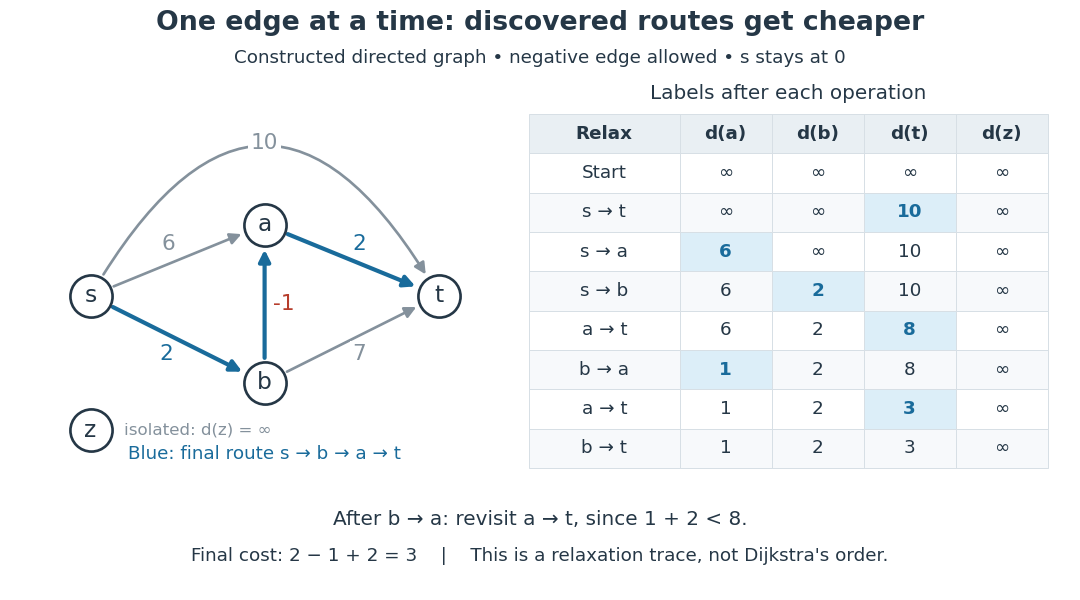

The table lists labels after each specified operation, keeping throughout this constructed acyclic graph. Relaxing first offers . Relaxing then offers , lowering from to ; revisiting now offers . Finally offers , so the label stays. Changing a label can make a previously checked outgoing directed edge worth checking again. This trace illustrates the operation itself, with a deliberately specified order, rather than a run of the Dijkstra algorithm.
A single edge relaxation does not require nonnegative weights: its candidate is the cost of a real extended directed walk, even when the last directed edge has negative weight. Nonnegative weights are needed by the Dijkstra algorithm to make its selected minimum tentative distance permanent. The Bellman-Ford algorithm permits negative weights and revisits labels; its authored implementation also checks for reachable negative-cost directed cycles.[ref]
https://raw.githubusercontent.com/kevin-wayne/algs4/master/src/main/java/edu/princeton/cs/algs4/DijkstraSP.java. Sedgewick and Wayne, DijkstraSP.java, nonnegative-weight precondition
[ref]BellmanFordSP.java. Algorithms, 4th edition by Robert Sedgewick and others; Sedgewick and Wayne, BellmanFordSP.java, signed weights and cycle detection
For the all-to-one convention of the Bellman inequalities, relax the same original directed edge by . This prepends to a discovered route from to , and improves the tail label , not the head label . Skip the operation when . In exact arithmetic, a full pass over all relevant directed edges with no improvement establishes all their Bellman inequalities; combined with the discovered-route upper bounds, this certifies finite distances. One unsuccessful operation establishes only that this particular candidate did not improve its label at that moment.
Tentative distance Created 2026-10-14 Updated 2026-10-31
A tentative distance is the cheapest cost so far recorded by a shortest path problem algorithm. For the single-source convention, initialize and elsewhere. Every finite label is the cost of a discovered route from to , soIt is an upper bound supplied by an actual route, not a guess that might be too low. The loop invariant follows directly from edge relaxation: extending a discovered route to by supplies another discovered route. The usual label initialization and this safety property are stated and proved in the authored MIT notes.[ref]
https://ocw.mit.edu/courses/6-006-introduction-to-algorithms-fall-2011/6277a1f06100c26a7ff21031af6757b5_MIT6_006F11_lec16.pdf. MIT 6.006, Lecture 16, p. 1: relaxation safety
In the trace under edge relaxation, first records the direct directed path . Later records , and finally records . Each label is a usable route cost, but the first two are not shortest. An infinite tentative distance means no route has yet been discovered; only a completed search establishes unreachability. The isolated vertex in that example remains at .
In a directed graph, the discovered route is formally a directed walk, which may repeat vertices; in the pictured acyclic graph it is always a directed path. Negative-cost directed cycles can keep supplying cheaper directed walks without a finite optimum. In the all-to-one convention, the same meaning applies to discovered routes from to . Do not confuse either version with the lower bounds supplied by feasible potentials in the Bellman inequalities: one records something achievable, the other rules out anything cheaper.
If only reflection and common temporal phase remain, the linear complex matrix is . The symmetric and antisymmetric modes have eigenvalues and , generically separating their Hopf thresholds. One-component rotating-wave axes are no longer invariant. Their hyperbolic finite-amplitude periodic solutions can persist as mixed-mode solutions, often through secondary symmetry-breaking bifurcations, while the double primary onset splits into two simple Hopf onsets. Coefficients determine the detailed secondary diagram and stability.
Independent sign changes and interchange of two coordinates in the natural dihedral group action force the displayed cubic normal form. Apart from the origin, its nondegenerate small equilibria lie on coordinate axes or on the diagonals. An axial branch has squared amplitude and eigenvalues . A diagonal branch has component squared amplitude and eigenvalues . Subtracting the two nonzero equilibrium equations gives , excluding other cubic branches when .
Dihedral subgroups of every divisor order 2026-10-14
Write the dihedral group as . If , the cyclic subgroup has order . For an even divisor of , and has rotations and reflections, hence order . An odd divisor of always divides . This proves that the necessary divisibility condition from Lagrange's theorem is also sufficient in a dihedral group, although it is not sufficient in arbitrary finite groups.
Classification of subgroups of a dihedral group Created 2026-10-14 Updated 2026-11-05
Write . A subgroup contained in the rotations is a cyclic subgroup , with . If it contains a reflection, every other reflection differs from a chosen by a member of the rotational intersection, so it is , with specified modulo . These subgroups have orders and respectively. This gives a complete list, including the trivial and whole subgroups; see Peter Cameron's group-theory exercise solutions, question1.
Dihedral splitting when the half-rotation order is odd Created 2026-10-14 Updated 2026-10-18
Let have order with odd, and let , . The subgroup is a dihedral group of order , while is a central cyclic group of order two. Since is odd, and lies in by Bézout's identity. Thus the original group of order is the direct product of groups . This statement specifies group orders and avoids the two competing conventions for dihedral notation.
Numerical aperture 2026-10-14
The numerical aperture is , where is the refractive index of the medium between object and objective, and is the half-angle of the admitted cone of light. Specify object-side or image-side numerical aperture; the microscope convention usually means the object side.[ref]
Electron diffraction Created 2026-10-14 Updated 2026-10-20
Electron diffraction is interference between scattered electron probability amplitudes. It connects the de Broglie wavelength of the incident beam to the arrangement of the scattering material. In elastic scattering from a fixed crystal, , and constructive crystal scattering selects wavevector transfers in the reciprocal lattice. The physical momentum transfer to the electron is in this convention.
Bragg's law expresses the same condition as , where is the spacing of the chosen lattice planes, the diffraction order, and the angle to those planes. The angle between incoming and outgoing propagation directions is for that reflection geometry. In normal-incidence backscattering, a detector's angle from the outward surface normal instead gives ; neither detector colatitude nor angle to the surface normal should silently replace . A finite-row electron diffraction model uses a different spacing, the spacing between sites along a surface row, and makes that distinction explicit.
Entropy power 2026-10-14
The entropy power of an -dimensional random vector with finite differential entropy in bits is the variance per coordinate of an isotropic Gaussian distribution with the same differential entropy. The normalization makes when has covariance matrix .
// Target: probability-and-statistics.bigb
In A Mathematical Theory of Communication by Claude Shannon (1948), section 20 extends the discrete entropy formula to continuous densities. Properties 8–9 explicitly discuss coordinate dependence, possible negative values and linear rescaling. Claude Shannon relates this coordinate convention to the engineering use of entropy differences, rather than treating an isolated continuous entropy as an invariant count of messages.[ref]
A Mathematical Theory of Communication by Claude Shannon. section 20, definition and properties 8–9, reprint pp. 35 and 37–38
Relative entropy and coordinate dependence 2026-10-14
Apply the same invertible differentiable transformation to two probability distributions with densities and . Both transformed densities acquire the same Jacobian determinant factor. Write their transformed densities as and . Their ratio is unchanged, and the integration measure transforms with the numerator density. Consequently their relative entropy is unchanged:The densities describe two alternative laws in the same coordinate, with a nonzero Jacobian determinant on their common domain, and the expression is assumed well defined. This explains why comparing two laws can survive a change of measurement units even though either law's differential entropy changes. Mutual information, formulated as relative entropy from a product of marginals, has the same invariance under invertible changes to either observed coordinate.
Differential entropy is also the entropy term in the evidence lower bound for continuous variational inference. Its coordinate dependence must be combined consistently with that of the model density; changing units does not justify changing only one term of the objective.
Equal-width bin entropy 2026-10-14
Partition into bins of width , and let the discrete random variable record the bin containing . This is a quantization of . Its probability mass function isand its discrete information entropy is . Let be the average probability density within bin . Rearrangement gives the exact finite-bin identityFor a continuous probability density on , uniform continuity makes the bin averages converge uniformly to the density. Since is continuous at zero with the stated convention, the right-hand side converges to . Thus the increasing resolution cost is ; differential entropy is the remaining offset, rather than the entire discrete encoding cost.
For a continuous uniform distribution, every bin has probability , and exactly. For the continuous uniform distribution's squared transformation above, the exact bin probabilities areThe diagram computes these masses directly, including the bin next to the integrable singularity. It compares their corrected information entropy with the analytic differential entropy .
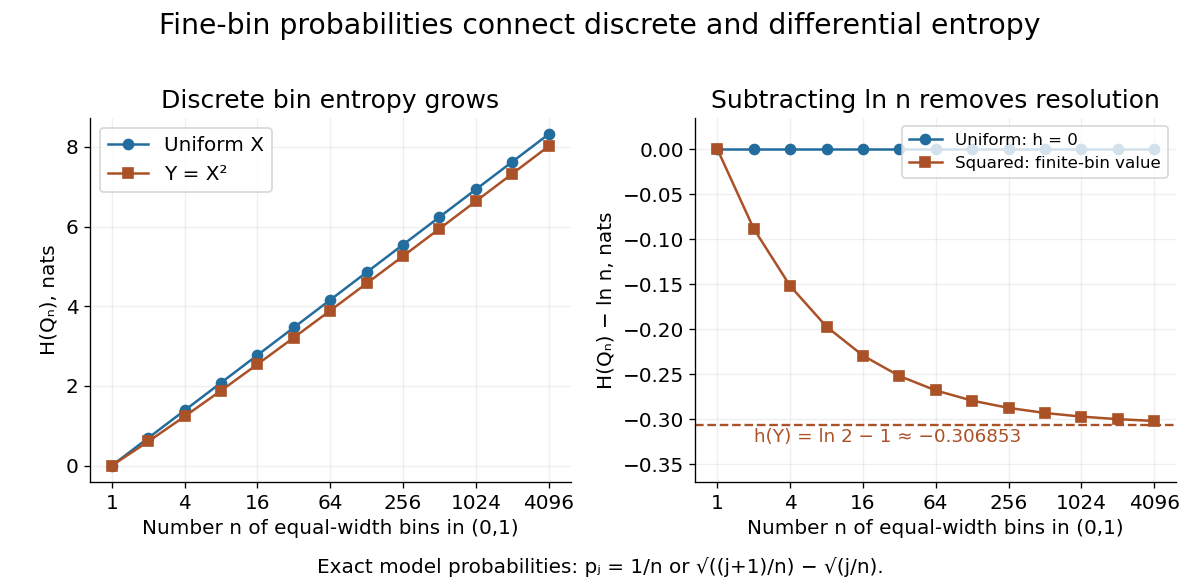
Removing the bin-resolution cost reveals differential entropy
. The left plot shows discrete information entropy increasing with the number of equal-width bins. The right subtracts and compares with the exact differential entropy of a uniform input and its squared transformation. Every plotted point comes from the stated exact probability mass functions; no observations are fitted. Details.
There are unlisted articles, also show them or only show them.