
If a measured cluster baryon fraction represents the cosmic baryon fraction , combining it with the cosmological baryon density inferred from Big Bang nucleosynthesis gives the displayed estimate. Gas and stellar baryons must both be counted, and all distance or Hubble constant dependence must be consistent. Baryon depletion or feedback modifies the identification: with , the corrected answer is . The method measures total matter rather than vacuum or radiation density.
Coriolis deflection of a vertical projectile Created 2026-10-14 Updated 2026-10-18
At colatitude , ignore terms quadratic in Earth angular speed and use uniform vertical gravity. A vertically launched particle has zeroth-order height . Its eastward Coriolis acceleration is , so its horizontal velocity is . Integrating over the flight time gives the westward displacement displayed above. Descent reverses the horizontal acceleration but does not cancel the accumulated displacement.
Failed supernova Created 2026-10-14 Updated 2026-10-18
Core collapse can fail to produce an ordinary successful ejecting supernova, leaving a black hole and retaining much of the processed core. Some envelope material can still escape, depending on the event; failure is not equivalent to a universal zero-yield prescription.
Joint coprimality 2026-10-14
A list of integers , with , has joint coprimality when its greatest common divisor is one; define that greatest common divisor by repeated application of the two-input operation. For positive integers, no prime factor may divide every entry. Thus have joint coprimality but fail pairwise coprimality. For two entries, the conditions coincide.
Pairwise coprimality 2026-10-14
A list of integers , with , has pairwise coprimality when every two entries in distinct positions are coprime. This implies joint coprimality. For positive integers, it means no prime factor occurs in two different entries. For example, satisfy this condition.
Asymmetric coordination example 2026-10-14
Two players independently choose venues or . Meeting at gives the ordered payoff pair ; meeting at gives ; choosing different venues gives . As throughout this article, the row player's payoff comes first:
| Row choice / column choice | ||
|---|---|---|
Against a column player choosing , the row player gets from and from , so is the unique best response. Against , the row player gets from and from , so is the unique best response. The column player likewise prefers to match the row choice. Thus and are pure strategy Nash equilibria, while each mismatched strategy profile has a profitable unilateral deviation.
For mixed strategies, let and be the row and column probabilities of choosing . The pure-choice expected payoffs areThe row player is indifferent when , giving . The column player is indifferent when , giving . The best responses are thereforeThese give exactly three Nash equilibria: . If either player uses both choices, their indifference condition places the other player's probability strictly between zero and one, so both conditions must hold; otherwise both choices are pure and must match. Notice whose equation determines whose probability: the row player's indifference fixes the column player's , and the column player's indifference fixes the row player's .
At the mixed Nash equilibrium, independence givesThus they meet with probability , and each receives expected payoff . Holding fixed, every row deviation gives ; holding fixed, every column deviation gives . This directly verifies the Nash equilibrium inequalities.
Both coordinated pure strategy outcomes strictly improve both players' expected payoffs over : and each do so. The mixed Nash equilibrium therefore fails Pareto efficiency, even though no unilateral deviation helps. Switching together can help when switching alone cannot. Neither coordinated outcome improves both players over the other, and both are Pareto efficient, even when a lottery over joint action profiles is allowed: any positive weight on another outcome reduces the payoff of the player receiving .
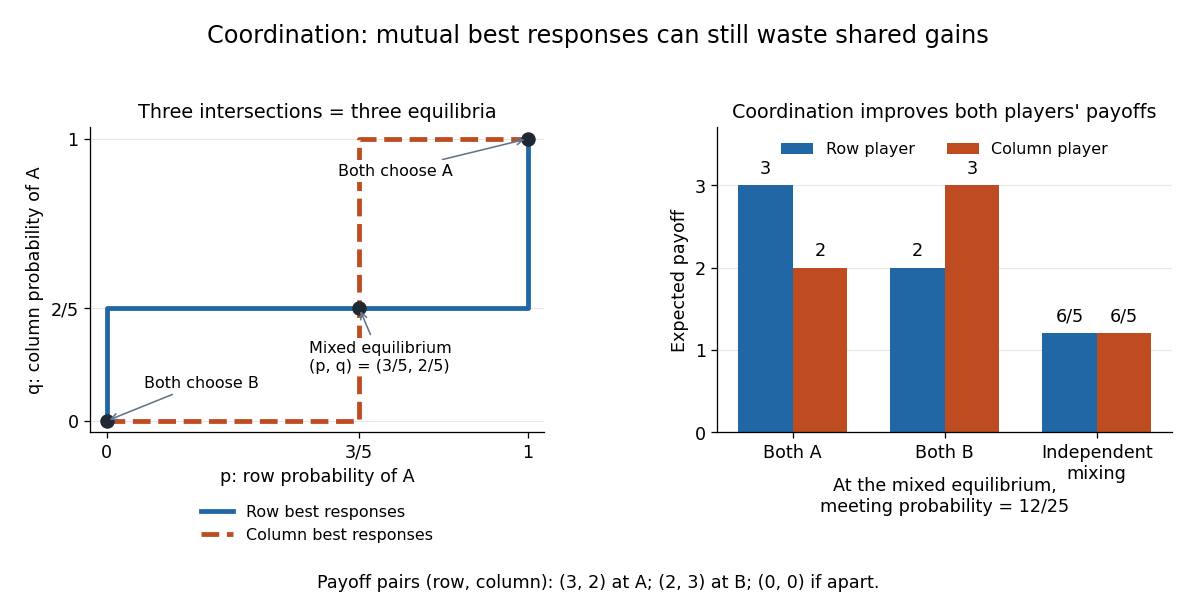
Asymmetric coordination: three best-response intersections and the cost of independent mixing
. Details. 
Exponential kernel convolved with an interval indicator Created 2026-10-14 Updated 2026-10-18
For , the convolution of with the indicator of is outside the interval and inside it. With Fourier convention , their transforms are and . Fourier inversion therefore evaluates as .
If a convex roof extension is non-increasing on average for every pure input to a quantum instrument, then it is non-increasing on average for mixed inputs too. For an input ensemble , let and be its conditional outcome probabilities and states. Linearity of each unnormalized outcome map gives . Convexity gives . Taking the infimum over input ensembles proves the result, even when conditional outputs of pure inputs are mixed, provided the averages are well defined.
Convex chain Created 2026-10-14 Updated 2026-10-14
A convex chain between two fixed points inside a triangle is a finite point set whose union with the endpoints forms the vertices of a convex polygon, with the endpoint segment as one boundary edge. In the triangle , with endpoints and , its ordered lower boundary has strictly increasing segment slopes. Every subset of its intermediate vertices remains a convex chain. This hereditary property lets selected point coordinates certify the existence of a long chain.
Convergence from fixed-length series blocks Created 2026-10-14 Updated 2026-10-18
For a fixed positive integer , if and the series of the displayed block sums converges, then the original series converges to the same limit of a sequence. Its partial sum at a block endpoint is exactly a partial sum of ; the difference at an intermediate endpoint has at most terms, all tending to zero. This justification is essential when block cancellation proves convergence without absolute convergence. It does not apply without further control to blocks whose lengths grow.
Matrix summability method 2026-10-14
A matrix summability method takes the ordinary limit of a sequence of the row sums , whenever every row series converges and the resulting sequence has a finite limit. For rows in the absolutely summable sequence space with uniformly bounded norms, the matrix defines a bounded linear operator from the l-infinity sequence space to itself.
The sequence is bounded and by the mean value theorem. Nevertheless, along the integer parts of its terms tend to one, and along the integer parts of they tend to minus one. The square root rounding error is . Thus a bounded sequence with vanishing successive increments need not be a convergent sequence.
Method of moments (probability theory) Created 2026-10-14 Updated 2026-11-05
If all moments of real random variables converge to those of a moment-determinate limit law, then the variables converge to that law in the sense of convergence in distribution. Moment determinacy is essential; the standard normal distribution meets this condition.
Marginal weak convergence does not control sums Created 2026-10-14 Updated 2026-11-05
Let take values with equal probabilities. Set for every , and for even , for odd . Both marginal laws are constant, but alternates between the law of and a point mass at zero. Thus separate weak convergence of random variables does not determine a joint limit or a sum limit. The obstruction disappears when one marginal limit is constant, as in the Slutsky theorem.
Atoms obstruct a continuous distributional limit Created 2026-10-14 Updated 2026-11-05
If has probability at least p at , with and , every weak limit has probability at least p at z. Apply the closed-set bound of the Portmanteau theorem to arbitrarily small closed intervals containing z and eventually , then decrease their radii. Thus a persistent atom prevents convergence to a continuous law, including a chi-squared law. This provides a direct check when bounded-information estimation fails standard asymptotic-normal theory.
Markov decision process Created 2026-10-14 Updated 2026-10-20
A Markov decision process specifies states, admissible actions, action-dependent transition probabilities and rewards. A policy chooses actions from observed information; a time-homogeneous problem uses transition and reward rules independent of the date. A Bellman equation optimizes current reward plus the conditional value of subsequent decisions. For nonnegative rewards, finite-horizon values increase as the horizon grows, while identification of their limit with the infinite-horizon value requires an approximation argument for admissible policies.
For uniform on , put and . Then , and estimates the standard Cauchy distribution probability above two. Its variance is , minimized by the displayed coefficient. Here and , so the optimal coefficient is negative. A coefficient estimated using a separate pilot can be fixed for a fresh unbiased production sample.
Multivariate control variates 2026-10-14
If is an unbiased estimator and a vector has known mean, then remains unbiased for a deterministic coefficient vector. Its variance is , where and . For invertible , completing the square gives the displayed optimum and minimum variance . With singular , use a generalized inverse on its range. Estimating coefficients from the same simulation can introduce finite-sample bias; fixed pilot coefficients or independent training preserve the elementary unbiasedness assertion.
Control polygon 2026-10-14
A control polygon joins successive control points by line segments. It gives an editable geometric skeleton, not usually the exact curve. An open control polygon has two ends; a closed control polygon also joins the last control point to the first. Store the first control point only once when using cyclic indices, so the closing edge is counted exactly once. Positive partition of unity basis functions place the curve inside the convex hull of its active control points; a convergent subdivision curve rule refines the control polygon toward its limit, with a certified error when an appropriate bound is available.
Control net Created 2026-10-14 Updated 2026-10-14
A mesh connecting a surface's control points according to the representation's indexing topology. A tensor-product surface basis gives a rectangular index grid and quadrilateral cells, even when its points in space are neither planar nor rectangular. The drawn mesh is a geometric skeleton, not generally the exact limit surface or an enclosing solid. Positive partition of unity coefficients give a convex hull bound on the relevant controls.
There are unlisted articles, also show them or only show them.