
Prime decomposition of knots 2026-10-14
Every nontrivial oriented knot is a finite connected sum of knots of prime knots, uniquely up to permutation and oriented link isotopy. Existence follows by induction from additivity of Seifert genus. For uniqueness, compare complete decomposing sphere systems for a knot and remove their intersection circles by the prime-ball exchange lemma. Once a prime ball is disjoint from both systems, its factor can be removed from both; induction then matches all factors.
Source renormalization of a scalar generating functional Created 2026-10-14 Updated 2026-11-05
For , write the bare field as and the renormalized source coupling as . In bare variables this is , with the displayed source. At fixed bare parameters, the source running is . Normalizing the generating functional by its zero-source value cancels source-independent vacuum diagrams and the constant measure factor from field rescaling. It does not remove source-dependent ultraviolet divergences or infrared divergences; the former require the ordinary field, mass and interaction counterterms.
Centered four-point cumulant decomposition 2026-10-14
For a normalized Minkowski source functional with vanishing one-point function, andDifferentiating assigns the four labels to connected blocks. Blocks of size one vanish, leaving one block of four or one of the three pair partitions. Thus in this source convention.
// Target: perturbative-quantum-field-theory.bigb
Connected component of a category 2026-10-14
Two objects of a category lie in the same connected component if a finite zigzag of morphisms, with either orientation allowed, joins them. This is an equivalence relation; its classes give full subcategories, each a connected category. For a small category, the collection of components is a set denoted . A functor induces a function on components. Empty categories have no components.
Conjugates of a proper subgroup do not cover a finite group Created 2026-10-14 Updated 2026-10-31
For a proper subgroup of a finite group , the number of its conjugates is , because its normalizer contains . All conjugates contain the identity, so their union has size at most . Thus some element is not conjugate to any element of . Finiteness is essential to this cardinal counting argument.
Multiplicity of a conjugate point Created 2026-10-14 Updated 2026-10-31
Along a nonconstant affinely parametrized geodesic, the multiplicity of a conjugate point at positive time is the dimension of the space of Jacobi fields vanishing at both endpoints. The tangential component of such a Jacobi field is affine and vanishes at both endpoints, hence is zero. Uniqueness for the Jacobi field equation embeds this space into the -dimensional normal space by . Thus its dimension is at most .
Strict feasibility for conic duality Created 2026-10-14 Updated 2026-10-31
For a proper cone , suppose a point satisfies and is finite. This generalized Slater condition gives strong duality and attainment of the conic dual problem's optimum. It does not by itself assert primal attainment.[ref]
Convex Optimization by Stephen Boyd and Lieven Vandenberghe. §5.9.1, printed p. 265: generalized Slater condition, strong duality and dual attainment
The two worked examples have strict primal points: has slack in the interior of the nonnegative orthant, and has slack in the interior of the second-order cone. Both optima were already certified by explicit feasible pairs. Slater's condition explains why a matching optimal dual variable can be expected under these hypotheses; checking a supplied zero-gap pair needs only weak duality.
Changing cone geometry preserves the bound mechanism. For a positive semidefinite cone, the dual cone pairing is the Frobenius inner product of two matrices. This connects the same certificate idea to semidefinite programming, while the central path uses strictly interior primal and dual points to approach vanishing gap.
In 1995, Lieven Vandenberghe and Stephen Boyd presented a primal-dual interior-point method for convex optimization with matrix inequalities. Their algorithmic study included exploiting problem structure and allowing incomplete conjugate gradient method solves within an iteration. This illustrates how the primal-dual viewpoint guides computation as well as checking a final answer.[ref]
A Primal-Dual Potential Reduction Method for Problems Involving Matrix Inequalities by Lieven Vandenberghe and Stephen Boyd. Publication record and authored abstract: A Primal-Dual Potential Reduction Method for Problems Involving Matrix Inequalities, Mathematical Programming, Series B, 69(1), 205–236 (1995)
Conic primal-dual gap 2026-10-14
For a feasible point and a feasible dual variable , weak duality follows from one identity:The inequality is the defining property of the dual cone. Every feasible pair therefore encloses the optimal objective function value:Both optima are finite when such a pair exists. Consequently,These are absolute cost bounds, rather than bounds on distance to an optimizing vector. Zero gap certifies both optima immediately. A small positive gap bounds the remaining improvement even if no strong duality theorem has been invoked.
For the nonnegative-orthant optimality certificate example, is feasible and costs . Pairing it with gives , so its cost exceeds the optimum by at most . Here the optimum is known to be , and the bound is exact. Pairing the same with the weaker certificate gives : a valid but less informative guarantee.
The identity assumes exact primal and dual feasibility. With a dual linear-system residual , it becomesThe second term has no guaranteed sign. Checking only a small linear-system residual and the cone dot product is insufficient when is large; a separate bound follows from the Cauchy-Schwarz inequality. Approximate cone membership likewise needs a quantified correction before claiming a certificate.
For an exact arithmetic example, minimize subject to . The point is optimal. A proposed multiplier is nonnegative and gives zero cone dot product because the slack is zero, but violates by . Its purported lower bound is , exceeding the optimum. The missing term explains the failure.
Second-order-cone optimality certificate 2026-10-14
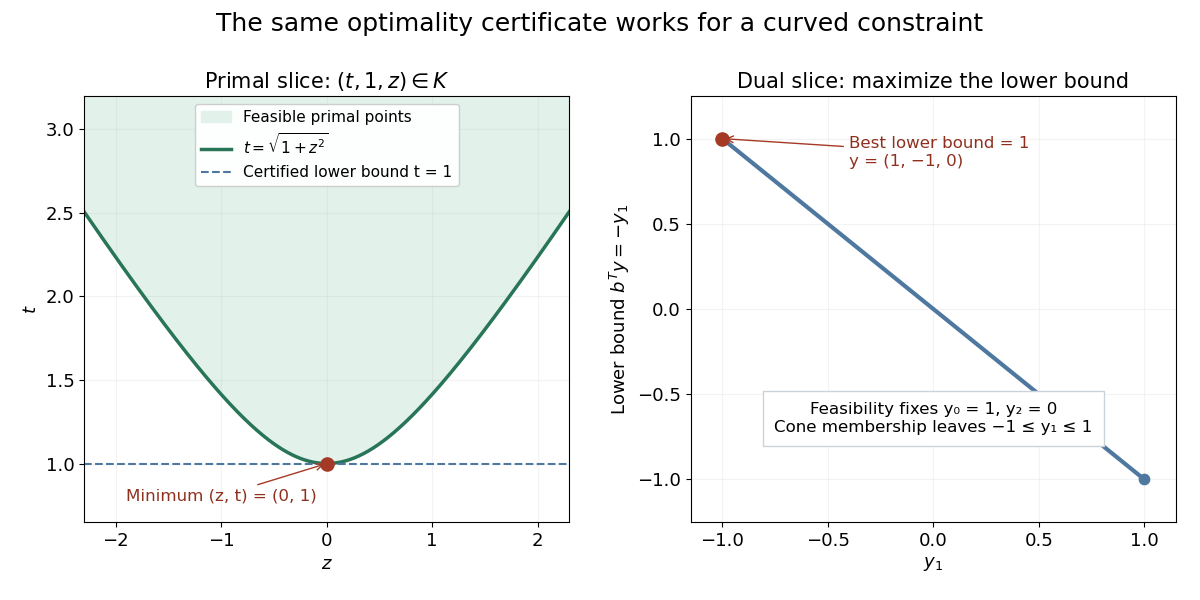
A curved feasible set can have the same certificate structure. ConsiderWrite and use the second-order cone . In this coordinate ordering,Self-duality of a second-order cone makes . The equality forces and , leaving . Its dual objective function is , maximized at . Thus every feasible point satisfies , and attains that bound: .
A curved primal constraint and an interval of dual certificates
. The left panel is the slice of the second-order cone, so its boundary is . The right panel is the dual slice , : admissible form , and reaches at . The optimal slack variable and dual variable lie on different cone boundary rays with zero dot product. Details.
The zero dot product is . Individual coordinate products need not be nonnegative here: the cancellation occurs across coordinates. The valid complementary slackness condition is cone-level orthogonality, rather than the coordinatewise interpretation of the nonnegative orthant.
Nonnegative-orthant optimality certificate 2026-10-14
Consider the original linear programOne unit of costs twice as much as one unit of , so is a plausible answer. To certify it, multiply the three linear inequalities by , respectively, and add:The proposed feasible point attains , so its cost is the global minimum.
In the conic dual problem convention, the data and certificate areDirect matrix multiplication gives and . At , the slack variable is , so . The first linear inequality has positive slack and zero multiplier; the two positively weighted linear inequalities are tight. This is complementary slackness.
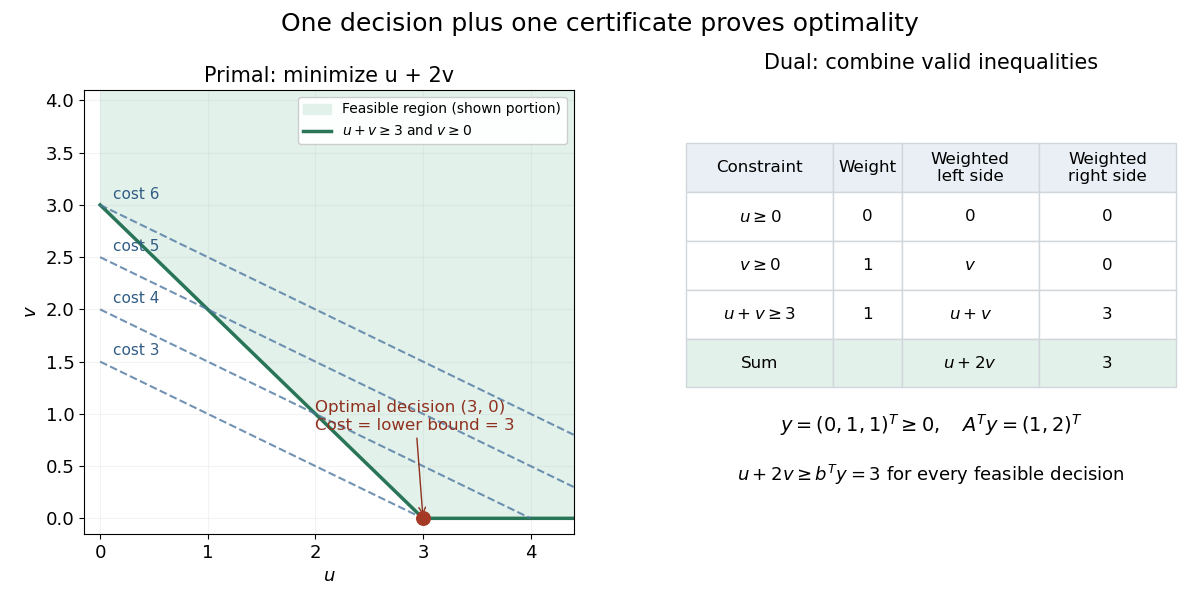

The entire dual feasible set can also be read off: write with . Then and . Maximizing this lower bound gives . A point such as is still a valid certificate of the weaker bound .
The difference of the two Levi-Civita connections is . Along a null geodesic with tangent , the last term vanishes and the remaining acceleration is . It is parallel to the tangent, so changing the affine parameter removes it. Thus a positive conformal factor preserves unparametrized null geodesics, although it generally does not preserve timelike or spacelike geodesics.
For the complete observer in two-dimensional de Sitter spacetime, let be shortest angular distance. An event can signal to the observer exactly when , and can receive its signals exactly when . Equality describes its future and past observer event horizons. Their intersection is the static patch of de Sitter spacetime containing the observer. These are observer-dependent cosmological horizons; constant- circles are Cauchy hypersurfaces, so there are no Cauchy horizons in the full spacetime.
The Projective Minkowski compactification has infinite cyclic fundamental group, while the conformal compactification of Euclidean space is and simply connected. Thus the affine substitution cannot extend to an invertible smooth identification of these real compactifications. Both are real slices of the same complex Klein quadric, which permits local analytic continuation without equating their global real topologies.
In affine cone coordinates with and , the substitution is represented on the complex quadric by the rational map . It preserves the quadric equation but is indeterminate at some infinity points, including . This is a direct algebraic manifestation of the obstruction to a global regular Wick map.
Inverse stereographic projection identifies Euclidean four-space with a sphere minus one point. Multiplying its flat metric by gives the round metric, which extends smoothly over the added point. In the Klein quadric description, the compact space is the projectivized real null cone of signature . It differs topologically from Minkowski conformal compactification.
Conformal boundary 2026-10-14
A boundary obtained by extending the rescaled metric smoothly and nondegenerately to a hypersurface on which vanishes with nonzero derivative. Its causal character is measured using the extended Lorentzian metric, not the divergent physical metric. In signature , a timelike normal makes the boundary spacelike, a spacelike normal makes it timelike, and a null normal makes it null. These cases lead to different causal and initial-value properties. The conformal cylinder of two-dimensional de Sitter spacetime has spacelike past/future boundaries; the conformal strip of two-dimensional anti-de Sitter spacetime has two timelike boundaries.
Confined-plume momentum fold 2026-10-14
For the pressure-neglecting confined plume with compensating return flow, define specific plume momentum flux and area fraction . Then andThe branch issuing from a pure plume reaches a fold at , where plume and ambient have equal areas, opposite velocities and equal specific momentum fluxes. The numerator is nonzero on this branch, so diverges although remain finite. This signals failure of the steady uniform-profile description, not infinite physical velocity.
Half-edge of a graph 2026-10-14
Bounded-degree pairing avoidance estimate 2026-10-14
For bounded vertex degrees, total degree , and a forbidden graph of bounded maximum degree, put and . Count prescribed loop pairs, double-edge pairs, and forbidden-edge pairs in the configuration model. Their means are respectively , , and . A fixed collection of disjoint prescribed pairs occurs with probability . Bounded degrees make intersecting bad configurations contribute to each fixed factorial moment. Thus the total bad-pattern count has factorial moments . The Bonferroni inequalities and uniformly bounded means give the displayed zero-pattern probability, without requiring the parameters to converge.
Kolmogorov-Smirnov confidence band 2026-10-14
For independent observations from a continuous distribution function, the probability integral transform makes the Kolmogorov-Smirnov statistic distribution-free. Choose from its uniform-sample distribution to have probability of not exceeding that critical value. Clipping the empirical distribution plus/minus this value to the unit interval gives simultaneous coverage at every argument. This is a band for the entire distribution, rather than separate pointwise intervals.
// Target: statistical-modelling.bigb
Cone point 2026-10-14
A cone point on a metric surface has total angular measure about its tip. The flat model is , with ; the curvature-minus-one model replaces by . In these models the tip is smooth when . For integer , angle gives a cyclic orbifold point of order . Under a degree- local branched lift, the total angle is multiplied by , and the residual orbifold order, when defined, is .
There are unlisted articles, also show them or only show them.