
Conductor-discriminant formula 2026-10-14
For a finite abelian extension of number fields, its relative discriminant ideal is the product of the finite conductor ideals of the characters of its Galois group, with the trivial character contributing one. In a multiquadratic extension of , the nontrivial characters correspond to its quadratic subfields, and their conductors are the absolute values of the corresponding fundamental discriminants. This gives an efficient discriminant computation and can prove that a compositum is unramified over a quadratic subfield.
Periodic conductivity cell problem 2026-10-14
The periodic zero-mean corrector adjusts a unit imposed gradient so microscopic flux is divergence-free. For bounded uniformly elliptic coefficients, the weak problem has a unique solution modulo constants. The averaged flux is . For symmetric coefficients this also gives a symmetric positive-definite effective tensor.
Polarization field of a conductivity inclusion Created 2026-10-14 Updated 2026-10-31
Conditioning and differential entropy 2026-10-14
With appropriate probability density functions and finite differential entropies, , with equality iff independence. Differential entropy does not reverse the inequality; infinite or undefined quantities cannot justify subtraction.[ref]
Chapter 2: Information Measures: Mutual Information. Theorem 2.4(3), printed p. 24: density and finiteness hypotheses for the differential-entropy identity
However, differential entropy can be negative and depends on the choice of coordinates. For with a uniform distribution on an interval of length , ; in particular gives . Rescaling by a constant adds to both and , whenever they are finite, leaving the mutual information unchanged.[ref]
A Mathematical Theory of Communication by Claude Shannon. pp. 37–38: coordinate dependence, negative entropy, and linear rescaling
If a continuously distributed is revealed exactly, its conditional distribution is a Dirac measure with no ordinary probability density function. The discrete identity has no finite differential entropy counterpart. Mutual information, defined through relative entropy, is infinite here.[ref]
Additional conditioning reduces entropy 2026-10-14
For finite discrete random variables , retaining and also observing givesEquality means conditional independence of and given . Both sides average over reports; the additional observation is retained alongside .[ref]
Chapter 2: Information Measures: Mutual Information. Definition 2.4 and Theorem 2.5(1), printed pp. 26–27
A short proof of the original inequality uses Kullback-Leibler divergence:Gibbs inequality makes each term nonnegative, vanishing exactly when : independence for every possible report. Applying this within each and averaging proves the additional-conditioning inequality.[ref]
Independent revelation of a binary variable 2026-10-14
Let be a Bernoulli random variable with . Independently of , a Bernoulli random variable with decides whether to reveal it:The symbol means “hidden” and is distinct from both binary states. This is a binary erasure channel with erasure probability . The hidden report leaves the posterior distribution equal to the prior distribution, because hiding is independent of the state. Either visible report determines . Weighting these three reports gives the exact conditional entropy and mutual information:For and , bits, while bits. With the report tells us nothing; with it reveals the state completely. If , every positive reveal probability makes the conditioning inequality strict. At or , the state was already known and every value of gives equality.
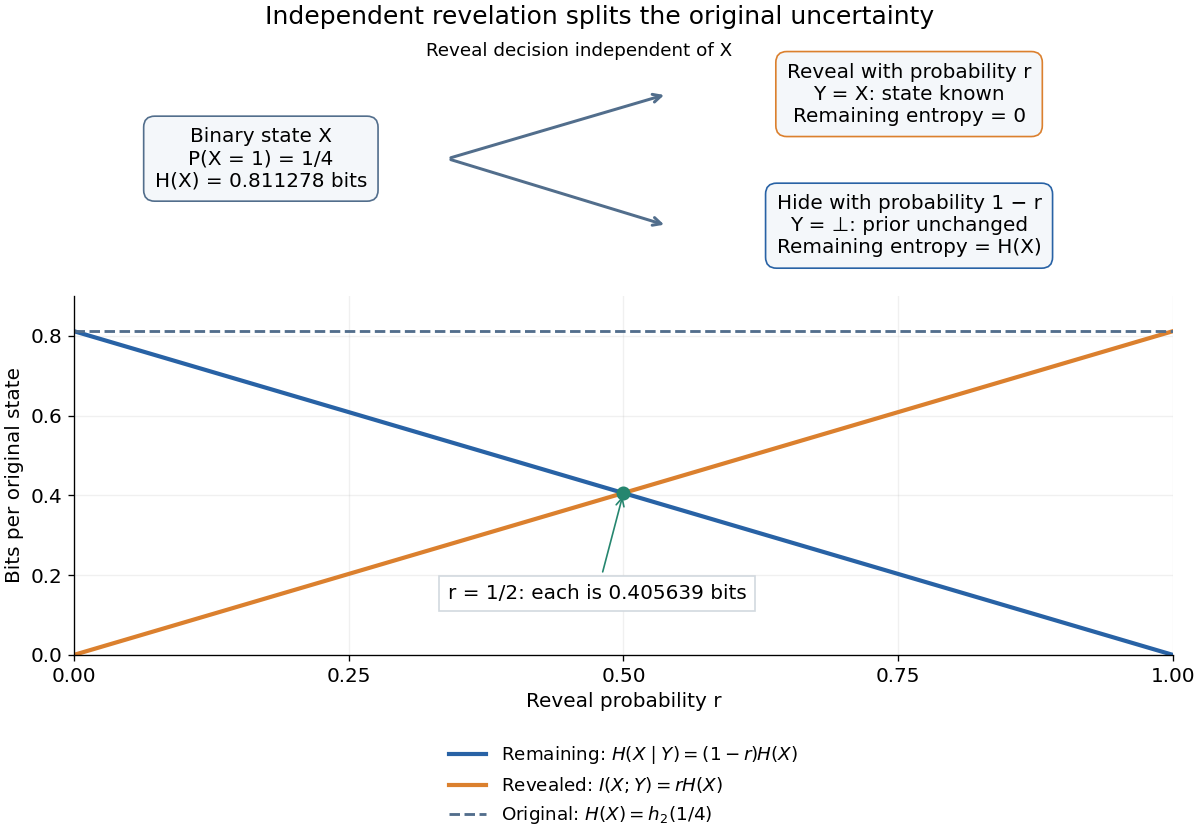
For a Bayesian inference problem, this model distinguishes an uninformative missing report from a decisive observed state. If hiding depended on , even could carry mutual information, and the displayed calculation would change. In lossless source coding, suppose both encoder and decoder already know the reveal pattern for repeated independent and identically distributed pairs. Only the hidden states require descriptions. Applying Shannon's source coding theorem to those states gives an asymptotic average rate bits per original state. A single hidden state need not have a codeword of that fractional length.
The reveal pattern itself has information entropy . If that pattern must also be sent, the chain rule for information entropy gives , since and are independent random variables. Equivalently, and . Thus a saving in the description of given assumes that is already available; it is not a free saving in the description of the whole pair.
An observation can increase entropy 2026-10-14
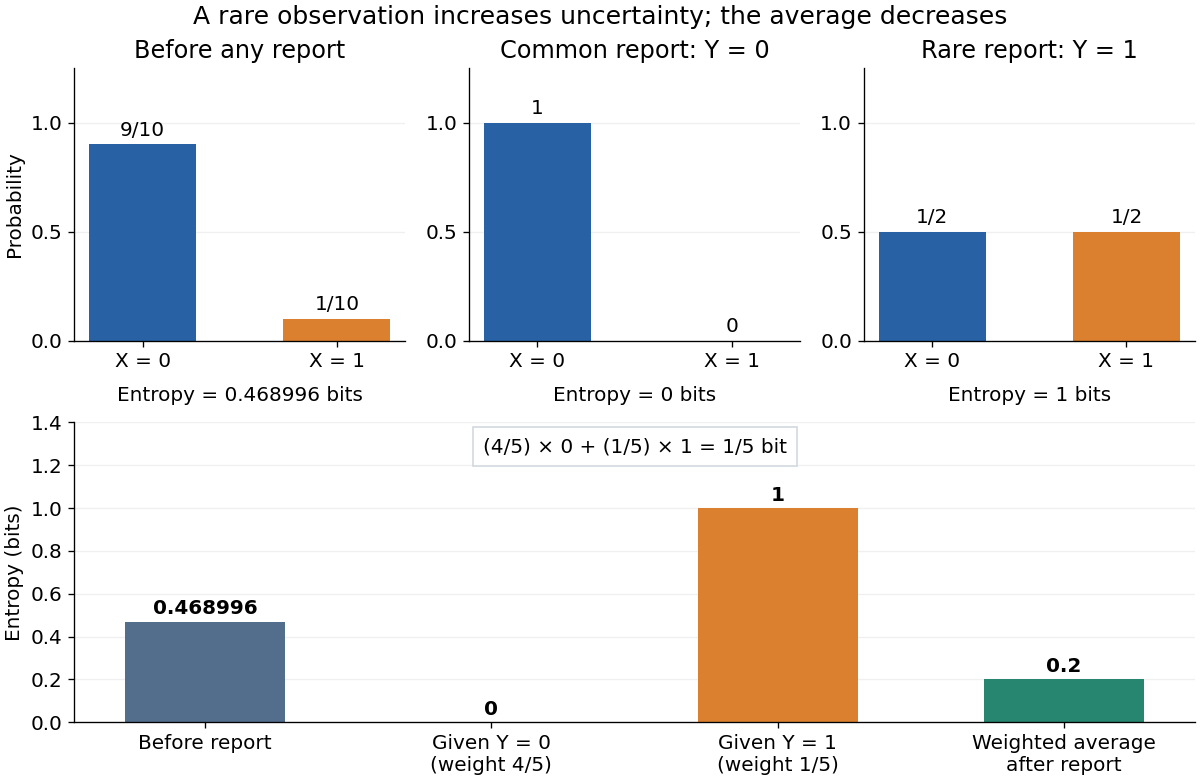
Consider a binary state and a report with the following joint probability mass function:Before the report, is strongly favored: its information entropy is bits, where is binary entropy. A report makes the two states equally likely, so bit, strictly larger than before. This report occurs with probability . The more common report determines , giving . Therefore the averaged conditional entropy isThe resulting mutual information is bits. The rare report increases uncertainty about the state; that increase does not make the report useless. Together the reports remove uncertainty on average. These are stipulated probabilities in an exact model, not measured frequencies.


Symmetrization as conditional expectation 2026-10-14
If a finite group acts by measure-preserving maps on a probability space, let be its invariant sigma-algebra. For an integrable random variable , the displayed group average is -measurable. For , changing variables under each group element gives . The average therefore satisfies the defining integral identity for conditional expectation. For permutations of exchangeable coordinates, averaging a product attached to distinct indices yields the sum over all ordered distinct -tuples divided by the falling factorial .
For an integrable function on , average on each dyadic interval of length . The resulting step function converges to almost everywhere and in the L1 norm. If has the uniform distribution on , then , where rounds down to a dyadic endpoint. Refinement makes these conditional expectations a uniformly integrable martingale. The uniformly integrable martingale convergence theorem gives almost-sure and convergence in L1 to a limit .
Since , the generated limiting sigma-algebra contains up to null sets. For every event in any finite-stage sigma-algebra, convergence in the L1 norm gives . The pi-lambda theorem extends this equality to the limiting sigma-algebra, identifying . The uniform distribution of translates the two convergence conclusions into the assertions for . Choosing a Borel representative of and assigning arbitrary values at the endpoint one makes all random variables well defined without changing either conclusion.
Conditional expectation preserving a distribution Created 2026-10-14 Updated 2026-10-20
For a real integrable random variable , a conditional expectation with the same probability distribution as must equal almost surely. No second moment is needed. For any real , the nonnegative random variable has expected value zero, by conditioning and equality of the two absolute moments. Thus implies , implies , and implies , outside a null set. Using a countable family of rational separates any unequal real values and proves the claim. Equality of the probabilities of and also gives equality of their zero sets and hence equality of the two sign functions for every fixed .
Single-qubit interference with conditional environment states Created 2026-10-14 Updated 2026-11-05
Prepare a qubit in , apply a phase gate , and correlate its computational basis states with normalized environment states . Write . After a final Hadamard gate, the environment amplitude accompanying output zero is . Its squared norm is . Thus is the interference visibility, while shifts the fringe. This quantum decoherence map commutes with the phase gate, so placing it immediately before that gate gives the same probabilities.
Regular conditional distribution Created 2026-10-14 Updated 2026-10-25
A regular conditional distribution of a random variable given is a Markov kernel such that, for all measurable sets ,For each , is a probability measure; for each , is measurable. Thus it assigns an actual probability distribution to a specified observation even when . Such kernels exist for standard Borel state spaces, including real-valued variables, and their uniqueness is only up to -null sets. With a joint density and positive marginal density, the ratio of the two densities defines the usual conditional density kernel. Values outside the marginal support or on a null set are not uniquely determined by the joint law.
Riemann series theorem Created 2026-10-14 Updated 2026-10-18
A conditionally convergent real series can be rearranged to converge to any prescribed real value or to diverge. Its positive and negative subseries have infinite total magnitudes: successively add positive terms to cross a desired value and negative terms to cross back. Since the terms tend to zero, the overshoots shrink to zero.
Talagrand's concentration inequality Created 2026-10-14 Updated 2026-11-05
Talagrand's concentration inequality gives strong concentration in product spaces using convex distance. If has positive product probability, its convex-distance enlargement has Gaussian tails. A Talagrand concentration inequality for certifiable functions follows by bounding this distance using bounded differences and small certificates.
Equip the symmetric group with its uniform probability measure and unnormalized Hamming distance. If has Lipschitz constant , it obeys the displayed two-sided bound, and each one-sided tail has the same exponential without the factor two. Reveal a uniform permutation one image at a time. Two possible next images have completion sets paired by swapping those two values, changing exactly two coordinates. Thus the corresponding conditional means differ by at most . Each increment of the Doob exposure martingale has conditional range length at most . Applying the conditional Hoeffding lemma gives ; optimizing the exponential Markov bound proves the bound. A mere absolute-increment bound of gives a weaker constant, so using the range length matters.
Entropy bounds for a quantum mixture Created 2026-10-14 Updated 2026-11-05
For a mixture of density operators, the lower bound follows from , with equality precisely when all positive-weight states coincide. For the upper bound, resolve each state into pure eigenvectors and form the Gram matrix of the resulting weighted vectors. Its nonzero eigenvalues are those of , while its diagonal has probabilities . Averaging diagonal unitary conjugations deletes its off-diagonal entries; Concavity of Von Neumann entropy therefore gives the bound. Equality holds exactly when positive-weight component supports are mutually orthogonal.
Strict concavity of Von Neumann entropy 2026-10-14
For and distinct density operators, the Von Neumann entropy of is strictly larger than the corresponding average. The difference is , positive by nonnegativity of quantum relative entropy unless both states coincide. On the closed interval , equality holds exactly when , , or .
Lower conjugate 2026-10-14
The lower conjugate uses an infimum, unlike the supremum defining a convex conjugate. For any , and . The inequality is informative only when the lower conjugate is finite. If the infimum is attained uniquely and the dual is differentiable, is its minimizing argument. This sign convention is useful for upper comparison-energy bounds.
Shor code 2026-10-14
The nine-qubit Shor code encodes one logical qubit with basis vectors and , where . Six adjacent -pair stabilizer generators locate a single bit flip within a block, while and diagnose which block has had its relative phase changed. Together they correct every single-qubit Pauli operator, hence every single-qubit error by the Pauli expansion of a quantum error.
A Pauli Z gate on qubit four has phase-check eigenvalues and leaves all six -pair checks positive. Applying restores the state. The same phase syndrome arises from or ; these have the same action on the code since their pairwise products are stabilizers. This is a degeneracy, not a failure of correction.
Finite-injury computable colouring of pairs 2026-10-14
There is a two-colour computable colouring of pairs with no infinite computably enumerable set homogeneous for it. Enumerate these sets as . In stages, give each eligible requirement two markers from its enumerated set, avoiding markers of higher priority, and cancel all lower-priority markers whenever a new assignment is made. Colour by the marker status of at stage : first markers have colour zero, second markers colour one, and unmarked points colour zero. Each requirement is injured only finitely often by induction on its index. If is infinite it eventually has permanent distinct markers ; for every sufficiently large , the pairs and have different colours. Simulating finitely many stages computes each pair's colour, proving both effectiveness and the obstruction.
There are unlisted articles, also show them or only show them.