
On its maximal domain in , put . Then , so has a finite limit . Summation gives . For , the resolvent equation is the recursion , which produces a bounded and hence . The Lumer-Phillips theorem proves contraction-semigroup generation.
// Target: analysis.bigb
Hypercontractivity 2026-10-14
Contraction property under equivalent metrics Created 2026-10-14 Updated 2026-10-25
The same self-map can be a contraction mapping for one metric but not for a bilipschitz equivalent metric. On three points with distances , , the map , has Lipschitz constant . For the discrete metric, its Lipschitz constant is one. The metrics satisfy , so they preserve topology and completeness but not the strict numerical contraction condition. A contraction mapping theorem fixed-point proof therefore needs the specified metric and its contraction constant.
Double divergence of the Riemann tensor 2026-10-14
For the Levi-Civita connection, the second Bianchi identity gives . Applying another covariant derivative and the contracted Bianchi identity reduces its divergence to a commuting scalar Hessian plus curvature commutators on the Ricci tensor. The latter are the difference of symmetric tensors: a square of the Ricci tensor and , which is symmetric in by curvature pair exchange and Ricci symmetry. Both differences vanish. This identity does not require vacuum field equations and is independent of the overall curvature sign convention.
Character space of C1 on a compact interval 2026-10-14
The coordinate function has spectrum : outside the interval its difference from a scalar has a continuously differentiable reciprocal, and on the interval it has a zero. Every character of an algebra therefore takes the coordinate to some . Polynomial density in the norm containing both function and derivative, together with automatic continuity of characters, forces evaluation at on every function. The maximal ideals are exactly .
Uniform-arrival residual mass martingale 2026-10-14
For finitely many independent uniform arrival times on , and fixed positive weights, normalize the unarrived mass by the remaining time. Conditional on not having arrived by , each arrival remains uniform on , giving the martingale identity. The process is càdlàg, nonnegative, and has constant mean equal to the total weight. It vanishes eventually before time one on each typical path, so it is not uniformly integrable when the total weight is positive.
Continuous uniform distribution Created 2026-10-14 Updated 2026-11-05
A continuous uniform distribution on a finite interval with endpoints has probability density functionChoosing open or closed endpoints does not change this probability distribution, because single points have zero probability. Its cumulative distribution function is zero below , between the endpoints, and one above . Consequently a subinterval has probability .
Integration gives expected value and variance . If is uniform on , then is uniform on , a basic input transformation for Monte Carlo method and inverse transform sampling. For example, on the expected value is , the variance is , and . A uniform distribution is relative to its coordinate or reference measure: taking its logarithm generally does not preserve uniformity, as the log-uniform distribution illustrates.
An absolutely continuous probability distribution on the real line has a probability density function with respect to Lebesgue measure : for every Borel set , . Its cumulative distribution function is an absolutely continuous function, with derivative almost everywhere. The probability density function and cumulative distribution function example under probability distribution illustrates this class.
Arcsine distribution Created 2026-10-14 Updated 2026-10-18
The standard arcsine distribution is a continuous probability distribution on with probability density functionIt is the beta distribution with both parameters equal to . The density grows without bound toward both endpoints, yet neither endpoint has any probability mass. Its name comes from the inverse sine in its cumulative distribution function.[ref]
The Arcsine Distribution. Random: Probability, Mathematical Statistics, Stochastic Processes by Kyle Siegrist; The Standard Arcsine Distribution, Distribution Functions and Related Distributions: density, normalization, beta representation and CDF
A useful way to see the shape is to choose a point uniformly around a circle and project it onto a diameter. Equal angular intervals do not give equal horizontal distances: the projection moves slowly near either end. An ideal harmonic oscillator sampled at a uniformly chosen time in one complete period has the same endpoint concentration after rescaling its position. The distribution translates a simple geometric slowdown into a precise probability calculation.
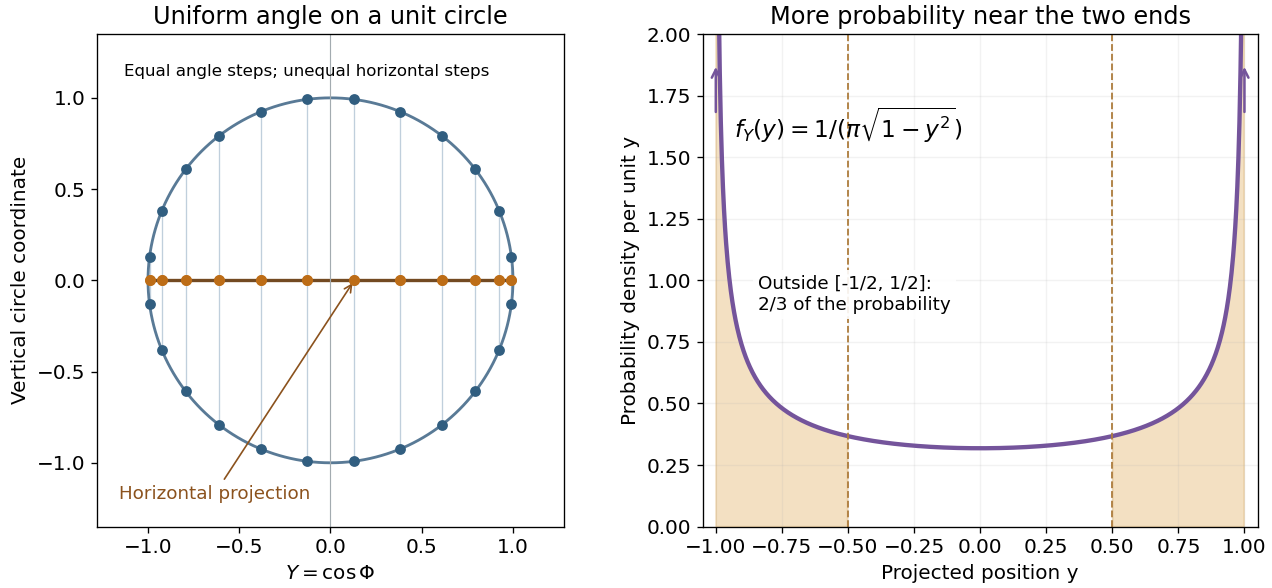

For an original comparison, take equal-length regions: the middle half , and the two outside quarters together. ThenA uniform distribution on instead assigns each region probability . Both distributions have mean ; the mean alone hides their different concentration.
Triangular distribution 2026-10-14
A triangular probability density function rises linearly from zero at to its mode , then falls linearly to zero at . Its peak is . Its inverse transform sampling rule is for , and otherwise.
Beta-prime distribution Created 2026-10-14 Updated 2026-11-05
For , this probability density function is obtained from a beta distribution variable by . Indeed and , and the change of variables formula gives the displayed density. In particular, the ratio of two independent equal-rate exponential distributions has , density and cumulative distribution function .
For two independent random variables taking values in a three-dimensional ball with constant volume probability density, the density of their distance is the displayed expression for , and zero otherwise. Both independence and the common radius are essential. To derive it, put , and integrate the product volume differential form over orientations. The law of cosines gives the angular Jacobian determinant , leaving over , . With , , the integrand becomes . Direct integration gives . An independent geometric derivation uses the overlap volume of two radius- balls displaced by , namely , multiplied by and divided by the square of . The density integrates to one and has mean .
Cantor distribution Created 2026-10-14 Updated 2026-10-25
The Cantor distribution is the law of a random variablewhere the are independent Bernoulli random variables taking values zero and one with equal probability. Its values lie in the Cantor set, and its cumulative distribution function is the Cantor function. Every individual value has probability zero, but the Cantor set has probability one despite having zero Lebesgue measure. A probability density function on that set would integrate to zero, so it cannot describe this law. The example motivates the distinction between a continuous probability distribution and an absolutely continuous probability distribution.
Scalar clipping Created 2026-10-14 Updated 2026-10-25
The continuous map projecting a real number onto the closed interval , with . It equals below the interval, equals the input inside it, and equals above it. It is nondecreasing and has Lipschitz constant one.
Strictly singular operator 2026-10-14
A bounded linear operator is strictly singular if it is bounded below on no infinite-dimensional subspace. Equivalently, every infinite-dimensional subspace contains unit vectors with arbitrarily small images. On a hereditarily indecomposable Banach space, an operator which is arbitrarily small on unit vectors in every finite-codimensional subspace is strictly singular: construct an infinite basic span on which its operator norm is small, then use the zero-angle property of hereditary indecomposability.
Absolutely p-summing operator 2026-10-14
For , a bounded linear operator between Banach spaces is absolutely p-summing if for every finite family. The least is its p-summing norm . Direct substitution gives the ideal inequality for compatible bounded linear operators.
Let be a bounded linear operator with a Banach space. If every has an approximate preimage with and , where , then every has an exact preimage with the displayed norm bound. Repeatedly correct the residual: the corrections have norms at most and form an absolutely convergent series; its image under equals . This proves surjectivity but does not provide a bounded linear right inverse.
Completely continuous operator Created 2026-10-14 Updated 2026-10-25
A bounded linear operator between Banach spaces is completely continuous when it maps weakly convergent sequences to norm-convergent sequences. Equivalently, it maps weakly compact sets to norm-compact sets: the Eberlein-Šmulian theorem gives the forward direction, while a weakly convergent sequence together with its limit is weakly compact and gives the reverse direction. The inclusion for finite Lebesgue measure is completely continuous by pointwise convergence, the Uniform boundedness principle and the dominated convergence theorem, but is not a compact operator because of the orthogonal Fourier modes.
Small norm residues from square-root continued fractions Created 2026-10-14 Updated 2026-11-05
For nonsquare , write the complete quotients after the initial term as . They exceed one, while their algebraic conjugates lie between minus one and zero. Thus . Comparing coefficients in gives , and the last determinant has absolute value one. These small residues are useful candidates for smooth numbers in congruence-of-squares factorization.
Barrier option 2026-10-14
A barrier option activates or expires according to whether the underlying price reaches a prescribed level during its lifetime. Its state must include whether the barrier has already been reached; the current price alone generally does not determine its remaining payoff.
There are unlisted articles, also show them or only show them.