
Angular-momentum estimate of a self-gravitating galactic disk Created 2026-10-06 Updated 2026-10-20
Let a disk contain fraction of its host mass and let its edge specific angular momentum be . With halo relation and disk geometry coefficient , combining centrifugal balance and the edge angular momentum gives the displayed estimates. The coefficient records the radial mass profile and thickness: enclosed mass does not determine a disc rotation curve. Treating as a monopole estimate must not be mistaken for an exact thin-disk theorem.
Starburst galaxy Created 2026-10-06 Updated 2026-10-14
A starburst galaxy undergoes an episode of rapid star formation. An instantaneous-burst idealization places all newly formed stars at one stellar age, so their present evolutionary-state fractions follow from the initial mass function at that fixed age rather than from an average over formation times.
Galactic tide 2026-10-06
The differential Newtonian gravitational field of a galaxy across a smaller bound system. Its tidal tensor can slowly change the angular momentum of distant comets, changing their periapses and their access to planetary encounters.
Cusped logarithmic spherical galaxy model 2026-10-06
This spherical gravitational potential, with , has density and circular speed . It combines a central density cusp with an outer flat galaxy rotation curve, but its total mass is infinite. It differs from a logarithmic potential with a constant-density core.
Oort constants 2026-10-06
The Oort constants describe local differential galactic rotation: and . Thus , the radial epicyclic frequency obeys , and the epicyclic ellipse has axis ratio .
Violent relaxation Created 2026-10-06 Updated 2026-10-14
Violent relaxation is rapid redistribution of the orbital energies of collisionless matter in a time-dependent collective gravitational potential. It can occur during collapse or a major galaxy merger. It differs from collisional two-body relaxation and from phase mixing in a stationary potential; it does not imply perfect final thermal equilibrium.
Translation of a function 2026-10-06
Translation shifts the argument without changing the shape of a function. On the real line, the displayed convention shifts a graph to the right by . Lebesgue measure invariance preserves every finite Lp norm; its Fourier transform is multiplied by .
Fiber of a function Created 2026-10-06 Updated 2026-10-14
For a function and , its fiber of a function over is the set of all inputs producing that one output:Here is shorthand for a preimage of a singleton set, rather than a claim that an inverse function exists. A fiber can contain several inputs or be empty. It describes exactly which distinctions the function forgets.
For the finite function under image and preimage of a function, the fibers over are , , and the empty set, respectively. The nonempty fibers form a partition of a set: they are disjoint sets whose union is the domain of a function. Every input belongs to the fiber over its unique output, and two fibers with distinct output labels cannot share an input. A function is injective exactly when every fiber has at most one member; it is surjective exactly when every member of its specified codomain has a nonempty fiber.
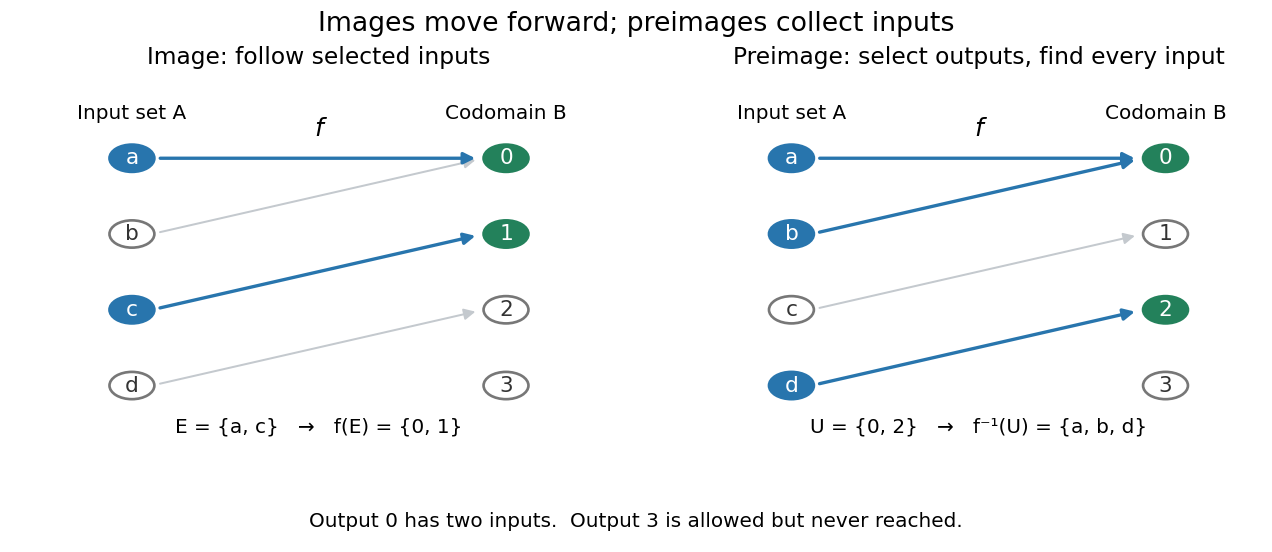

More generally, is the union of the fibers over all . The relation defined by is an equivalence relation, and its equivalence classes are precisely the nonempty fibers. The resulting quotient set is naturally in bijection with the image of a function. This links an input partition to the output values actually reached, without choosing one representative from each class.
Fibers are useful when an output is known but the input is not uniquely determined. A solution set is one fiber, and factorization through a surjection explains when another function depends only on the retained output. Quantum hidden subgroup problem algorithms use functions whose fibers are cosets, giving the same idea a structured form in group theory.
Function collision Created 2026-10-06 Updated 2026-10-14
A function collision is a pair of distinct inputs with . An injective function has no collisions. For a two-to-one function every nonempty fiber has two elements and hence one unordered collision pair. Finding such a pair through an oracle is the task of quantum collision finding.
In the finite example under image and preimage of a function, the pair is a function collision: both inputs give zero. The function retains their shared output but loses the distinction between them. If a finite set has more inputs than the number of available outputs, the pigeonhole principle forces a function collision. Equal source and target cardinalities alone do not prevent one.
For a finite function, let be the cardinality of its fiber of a function over . The number of unordered function collisions is , because each pair must lie in one common fiber. The example's nonempty fiber sizes are , giving exactly one collision pair.
Set function 2026-10-06
Vector-valued function Created 2026-10-06 Updated 2026-10-07
A vector-valued function is a function with values in a vector space. For finite-dimensional real or complex target spaces, choosing a basis represents it by scalar coordinate functions; continuity and differentiability can then be checked coordinatewise.
Accessory parameter 2026-10-06
An accessory parameter is a coefficient not determined by the singular points and their indicial exponents. A second-order Fuchsian differential equation with exactly three regular singular points has no such independent parameter.
For integrable weak velocity derivatives on a unit-period spatial circle, the Fourier transform of a derivative gives for . Summing these modes uses . The resulting absolute Fourier summability gives the displayed uniform bound for the continuous representative of the density. For the same summation diverges, so this argument needs additional input.
Free basis of a group Created 2026-10-06 Updated 2026-10-14
A subset is a free basis of a group when the natural map from the free group on to is an isomorphism. Equivalently, generates and no nonempty freely reduced word in equals the identity. A generating set is not automatically a free basis.
Rotational deflection of a falling body Created 2026-10-06 Updated 2026-10-14
In an Earth-fixed rotating reference frame, the horizontal displacement of a freely falling body receives contributions from Coriolis acceleration and centrifugal acceleration. A short-fall approximation substitutes the unperturbed downward velocity into the Coriolis term and the Earth's surface position into the centrifugal term. If gravitational acceleration excludes centrifugal acceleration, both contributions must be included explicitly.
Free-energy functional Created 2026-10-06 Updated 2026-10-14
A free-energy functional assigns a free energy to an entire spatial order parameter configuration rather than only to one uniform value. In Landau-Ginzburg theory, a local derivative expansion gives , with appropriate boundary terms and regular backgrounds. The Landau approximation minimizes this functional; a fluctuating statistical field theory instead integrates its Boltzmann weight over configurations. These procedures need not give identical critical exponents.
Primitive lattice element Created 2026-10-06 Updated 2026-10-14
A nonzero element of a free abelian group is primitive when it is part of an integral basis, equivalently when some homomorphism to takes it to one. Its coordinates have greatest common divisor one. This lattice meaning differs from a primitive homology class in the coalgebra sense.
Principal fractional ideal Created 2026-10-06 Updated 2026-10-14
A principal fractional ideal of an integral domain with fraction field is for a nonzero . Its generators differ by a unit in a ring in . For a number field, taking and quotienting nonzero fractional ideals by principal fractional ideals gives the ideal class group; requiring congruences and signs of the generators instead gives a ray class group.
Self-dual Haar measure 2026-10-06
Relative to a nontrivial additive character, the self-dual additive Haar measure makes the twice-applied Fourier transform over a local field equal to reflection. If the annihilator of the valuation ring is and its residue field has elements, the normalization is . Volumes of a compact open subgroup and its character annihilator then multiply to one.
For a compact open additive subgroup of a local field, translation and additive character orthogonality give the displayed transform of a coset indicator. With the self-dual Haar measure, transforming again gives . Every Schwartz-Bruhat function is a finite linear combination of these indicators.
There are unlisted articles, also show them or only show them.