
Past exam of the mathematics course of the University of Cambridge 2013 ia Paper 4 6E i Solution Created 2026-09-24 Updated 2026-10-07
Use a stars and bars bijection. For a tuple, place stars in consecutive blocks of lengths , separated by bars. The bar positions form an -element subset of . Explicitly,They satisfy . Conversely, such a subset determinesThese numbers are nonnegative and sum to , proving that the two constructions are inverse. HenceZero-length blocks are permitted, so the bijection also covers .
Past exam of the mathematics course of the University of Cambridge 2013 ia Paper 4 5E iii Solution Created 2026-09-24 Updated 2026-10-07
The universal property of Cartesian products constructs the desired map pointwise:Its coordinate projection maps are and . Any other map with those projection maps must have the same two coordinates at every , and hence must equal . This also covers .
For joint injectivity of a pair of functions, equality means equality of both coordinate images. If either coordinate function is injective, it follows that , so is injective. The converse fails: take and map these points to in . The paired map is injective, but the first coordinate identifies and the second identifies .
There is an empty-factor defect in the printed surjectivity implication. If both and are nonempty and is surjective, every element of either factor can be completed to a pair and then lifted through . Hence both are surjective. If both factors are empty, existence of the forces to be empty and both coordinate maps are again surjective. But takeThen is surjective, while is not. Without a nonempty-factor assumption, the printed implication is false. This is exactly the exception found for the projection maps in part (ii).
Even when both factors are nonempty, the reverse implication fails. For , let . Both coordinate maps are surjective, but misses and . Thus coordinate surjectivity does not guarantee that every pair is attained.
Past exam of the mathematics course of the University of Cambridge 2013 ia Paper 4 5E ii Solution Created 2026-09-24 Updated 2026-10-07
The empty-set cases for Cartesian projections matter here. For , write for the other factor. If is nonempty, any can be paired with an element of , so is surjective. If is empty, the Cartesian product is empty and its image is empty. ConsequentlyThe possibility is included because the empty function onto the empty set is surjective.
If is empty, has empty domain and is injective. If has at most one element, an ordered pair is determined by its th coordinate, so is also injective. Conversely, when is nonempty and contains two different elements, pairing those two elements with one fixed gives distinct ordered pairs with the same projection map. Therefore
Past exam of the mathematics course of the University of Cambridge 2013 ia Paper 4 5E i Solution Created 2026-09-24 Updated 2026-10-07
A function is injective when implies . It is surjective when every element of its codomain equals for at least one element of its domain.
If is injective, then implieshence . Thus injectivity of the composition implies injectivity of the first map.
If is surjective, then for every there is an with . Taking proves that lies in the image of . Thus surjectivity of the composition implies surjectivity of the second map. The arguments include empty domains and codomains whenever the specified functions exist.
Past exam of the mathematics course of the University of Cambridge 2013 ia Paper 4 12B b Solution Created 2026-09-24 Updated 2026-10-07
The total relativistic energy and momentum in the original frame areA Lorentz boost of signed velocity makes the total spatial momentum . Setting it to zero gives the centre-of-momentum frame velocityIt is a positive-weighted average of subluminal velocities, so .
In the rest mass of a coalescing relativistic collision, four-momentum conservation gives provided no energy or momentum escapes in additional radiation. For the single outgoing particle, , so its speed in the original frame is . Its rest mass is the invariant norm of the total four-momentum:Expanding and using givesThe positive square root is taken for . The factor multiplying is the relative Lorentz factor, at least one. Therefore , with equality when ; otherwise the initial relative kinetic energy becomes internal rest energy.
Past exam of the mathematics course of the University of Cambridge 2013 ia Paper 4 12B a Solution Created 2026-09-24 Updated 2026-10-07
Use four-momentum with components , suppressing the identically zero third spatial component. The photon in the primed frame hasIts energy is and its spatial momentum has magnitude . Apply the same Lorentz transformation as for the spacetime coordinates. With ,The time component gives the relativistic Doppler effectThe aberration of light follows by dividing spatial components by :In particularwhere the tangent expression is understood only when its denominators exist. The sine and cosine equations determine the correct quadrant and also cover directions where the tangent/secant expression is undefined.
For the photon-number half-cone under relativistic aberration, the forward half of the primed emission angles is . The aberration of light is monotone on this interval, and its endpoints have . Thus exactly half of a uniform angular photon distribution lies within the lab-frame coneAs , , so the cone becomes narrow. Here “half” counts emitted photons or ray directions; it is not a claim that half of the observed energy or power lies there, since the relativistic Doppler effect changes the photon energies with angle.
Past exam of the mathematics course of the University of Cambridge 2013 ia Paper 4 11B ii Solution Created 2026-09-24 Updated 2026-10-14
The PDF gives initial position and initial rotating-frame velocity zero. Use those values; the TeX erroneously places dots over the position coordinates.
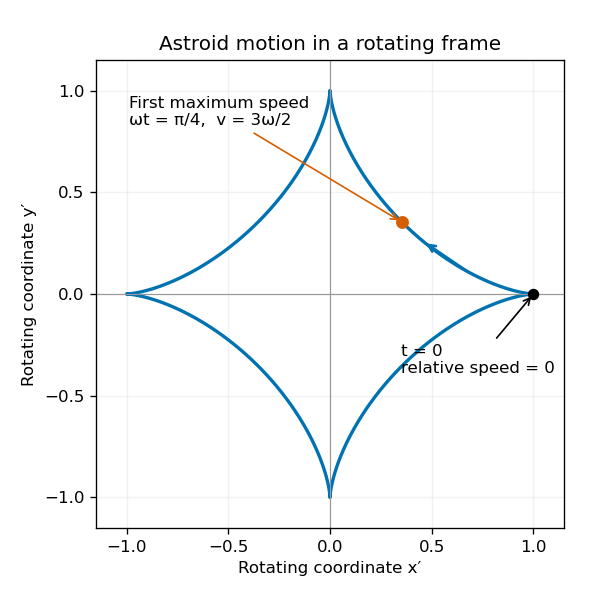
For rotation about the third axis, the supplied acceleration relation and Newton's second law give the equations of motion in a rotating frameThus . Set to combine the planar equations:The two characteristic roots are and . From and ,The triple-angle formulas therefore give the particularly simple astroid motion of a harmonic oscillator in a rotating frameThe orbit satisfies ; the zero speed at each cusp is consistent with the smooth time-parametrized motion.
Its rotating-frame speed isHence, for , the first maximum occurs at , andThe maximum repeats periodically. For a signed negative angular frequency, use and ; at the particle remains at rest.
Past exam of the mathematics course of the University of Cambridge 2013 ia Paper 4 11B i Solution Created 2026-09-24 Updated 2026-10-07
Write the position in the rotating basis as . Differentiating with respect to time in the inertial frame,Here is the relative velocity measured in the rotating reference frame. ConsequentlyThis is the vector differentiation rule for a rotating reference frame with a common origin: the extra term accounts for the changing basis, not a translational motion of that origin.
Past exam of the mathematics course of the University of Cambridge 2013 ia Paper 4 10B b Solution Created 2026-09-24 Updated 2026-10-14
Use the arch geometry of two hinged rods sliding on a floor, with and on the other side of . As long as remains in contact with the floor,The centres of mass of the two rods are and . Their squared speeds are respectively and . Each uniform rod has moment of inertia about its midpoint, and their angular velocities are and . Applying the kinetic energy decomposition about the center of mass to each rod givesThe gravitational potential energy is . The fixed pivot does no work; neither does the frictionless floor reaction while slides horizontally. Conservation of energy from rest therefore givesOn the falling branch is the negative square root. Just before the hinge reaches the floor, , and its speed is . Thus, under the maintained-contact interpretation,
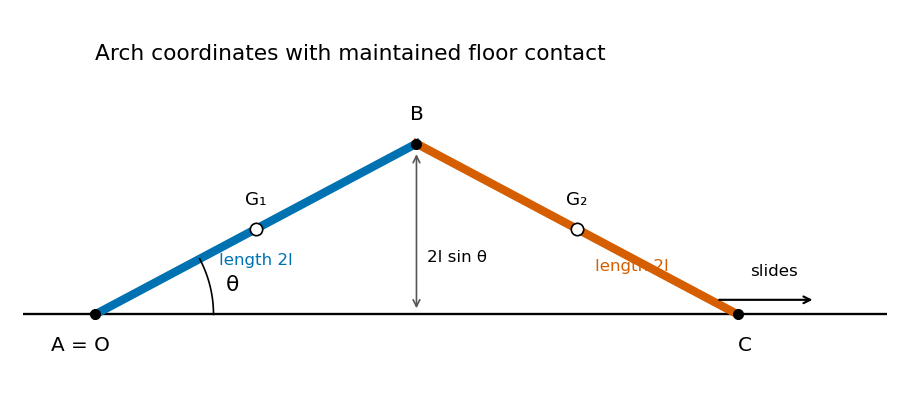


There is a contact hypothesis behind this calculation. A floor can push upward but cannot pull downward. For and , the required normal reaction at , found from the second rod's linear and angular equations, isFor the usual acute arch, this stays nonnegative throughout exactly when . Indeed, for , its nonnegativity is , whose minimum is at . For larger initial angles, the endpoint lifts before the hinge hits the floor, and the one-coordinate formula no longer governs the whole motion. The displayed impact speed is the intended floor-constrained answer; for unrestricted initial angles, maintained contact is an additional assumption. Subsequent free motion and possible reimpact would require a different model and contact/impact conditions.
Past exam of the mathematics course of the University of Cambridge 2013 ia Paper 4 10B a Solution Created 2026-09-24 Updated 2026-10-07
Let and introduce positions relative to the centre of mass, . The definition gives , and differentiation gives . Expand the total kinetic energy:The cross term vanishes. This proves the kinetic energy decomposition about the center of mass:The decomposition itself holds without rigidity.
For a rigid body rotating about its centre of mass, . With unit axis vector , the moment of inertia about that axis iswhere is the perpendicular distance from the axis. Therefore
Past exam of the mathematics course of the University of Cambridge 2013 ia Paper 3 7D b ii Created 2026-09-24 Updated 2026-09-24
Past exam of the mathematics course of the University of Cambridge 2013 ia Paper 3 7D b i Created 2026-09-24 Updated 2026-09-24
Past exam of the mathematics course of the University of Cambridge 2013 ia Paper 3 7D a Solution Created 2026-09-24 Updated 2026-10-07
Use the dihedral group presentation . Every element is or . A nonidentity rotation has order two only when its exponent is , while for every . Thus the complete list isThe half-turn is central, so its conjugacy class is the singleton and its normal closure is .
For reflections, and . Hence the conjugacy class is exactly the reflections whose exponents have the same parity as :The subgroup generated by this class contains , as the product of two consecutive listed reflections, and contains . Conversely those two generators contain every listed reflection. Their subgroup is invariant under conjugation by both and , so the smallest normal subgroup containing isof order and index two. This involutions in an even dihedral group classification distinguishes the two reflection classes from the central half-turn.
Past exam of the mathematics course of the University of Cambridge 2013 ia Paper 3 6D b Solution Created 2026-09-24 Updated 2026-10-07
Write the matrix as . Direct multiplication and inversion giveThe identity is and all determinants are one, so these formulas verify the subgroup criterion inside . This is the real Heisenberg group.
The map is a surjective group homomorphism to the additive group of real numbers; its kernel is exactly . Hence is normal and the first isomorphism theorem givesTwo matrices commute exactly when . Requiring that relation for every forces , while is unrestricted. ThereforeFinally is a surjective group homomorphism to the additive group with precisely this kernel of a group homomorphism, giving . The central coordinate records noncommutativity: the group commutator is .
Past exam of the mathematics course of the University of Cambridge 2013 ia Paper 3 6D a ii Created 2026-09-24 Updated 2026-09-24
Past exam of the mathematics course of the University of Cambridge 2013 ia Paper 3 6D a i Created 2026-09-24 Updated 2026-09-24
Past exam of the mathematics course of the University of Cambridge 2013 ia Paper 3 5D b Solution Created 2026-09-24 Updated 2026-10-07
Place the cube's vertices at . Its full symmetry group of a cube consists of signed permutation matrices. To see completeness, a cube symmetry fixes its center of a group and permutes the six face normals, so it sends coordinate axes to signed coordinate axes; conversely every such matrix preserves the cube. Coordinate permutations and sign changes take any edge to any other edge, so this is a transitive group action on edges.
Choose the edge . A symmetry stabilizing it must preserve its axis direction and its midpoint . It can swap the first two coordinates and independently reverse the third coordinate, but cannot change the signs of the two fixed coordinates. HenceThere are twelve edges and four elements of the stabilizer subgroup. The orbit-stabiliser theorem therefore gives , including orientation-reversing symmetries, not just the twenty-four rotations.
The action defines a group homomorphism . If an element fixes every edge as a set, it fixes every vertex, since each vertex is the unique common point of its three incident edges. A cube isometry fixing all vertices is the identity. Thus this is a faithful group action, and the cube symmetry action on edges embeds as a subgroup withIt is not a normal subgroup. Central inversion belongs to and swaps the twelve edges in six opposite pairs. In , all permutations of cycle type are conjugate, and their number isIf were a normal subgroup, it would contain this entire conjugacy class, impossible for a group of order forty-eight. This avoids relying on a classification of normal subgroups of the symmetric group.
Past exam of the mathematics course of the University of Cambridge 2013 ia Paper 3 5D a Solution Created 2026-09-24 Updated 2026-10-07
Take and let act by left multiplication . Each is a permutation, with inverse . Associativity gives , so is a group homomorphism into . If is the identity permutation, evaluating it at the identity element gives . ThusThis is the Cayley theorem, realized by the left regular action, which is a faithful group action.
Past exam of the mathematics course of the University of Cambridge 2013 ia Paper 3 3C ii Solution Created 2026-09-24 Updated 2026-10-07
Use the arc length coordinate oriented in the direction of increasing : , with . Also , giving and . The Lagrange identity for the cross product yieldsThe curvature of a space curve is thereforeFor the forward portion , this has ordinary nonnegative arc length . If instead nonnegative distance is measured backwards from , put for ; that branch has , . Choosing orientation avoids confusing the two points at the same unoriented distance.
Past exam of the mathematics course of the University of Cambridge 2013 ia Paper 3 3C i Solution Created 2026-09-24 Updated 2026-10-07
Differentiation gives . The squared speed is , so the arc length isThe speed never vanishes, so this is a regular curve throughout its parameter range.
There are unlisted articles, also show them or only show them.