
Locally convex space Created 2026-09-24 Updated 2026-10-14
A locally convex space is a topological vector space with a neighbourhood basis at zero consisting of convex sets. Equivalently, its topology is a seminorm topology generated by some family of seminorms. We allow non-Hausdorff spaces here; a separating family of seminorms gives precisely the Hausdorff case. Every normed vector space is locally convex, but smooth convergence generally requires a whole family of measurements.
The geometric and measurement descriptions fit together: seminorm sublevel sets are convex, while the Minkowski functional of an open, convex zero neighbourhood invariant under all scalar multiplications with is a continuous seminorm. Such neighbourhoods can be chosen as a neighbourhood basis. [ref]
https://www.math.lmu.de/~philip/publications/lectureNotes/philipPeter_FunctionalAnalysis.pdf. Peter Philip, Functional Analysis, Theorem 1.40, equivalence of local convexity and seminorm topologies
.Local convexity makes Hahn-Banach theorem and separation of a point and an open convex set available. It turns geometric distinctions into continuous linear functionals, connecting convex sets to the continuous dual space. For a seminorm topology generated by , a linear functional is continuous exactly when there are and withThus one continuous linear functional needs only finitely many of the available measurements. For example, point evaluation of a derivative on the space of smooth functions on a compact interval is controlled by a suitable derivative seminorm.
Finite-dimensional vector-space topology Created 2026-09-24 Updated 2026-09-28
Every finite-dimensional real vector space has a unique Hausdorff topology making it a topological vector space. Choosing a basis identifies it with ordinary Euclidean space; every linear map between such spaces is continuous.
Double cone singularity Created 2026-09-24 Updated 2026-09-24
Klein bottle Created 2026-09-24 Updated 2026-10-14
The Klein bottle is obtained from a square by identifying one pair of opposite sides with matching direction and the other pair with reversed direction.
Möbius band Created 2026-09-24 Updated 2026-10-14
The Möbius band is the topological surface obtained by gluing the ends of a rectangle with a half-turn. Precisely, it is the quotient spaceThe twist identifies the two apparent long edges into one boundary circle. Following the core circle of a Möbius band reverses local handedness, so this surface is not orientable. An untwisted untwisted band has two boundary circles and is orientable: the distinction survives stretching and bending because orientability is a topological invariant.
To explore the construction with paper, mark the two long edges in different colours, join the short ends after a half-turn, and trace an edge. The trace passes from one marked edge to the other without ever leaving the boundary. Separately, trace the centre line and track a local transverse arrow: it comes back reversed after one circuit. The boundary closes after twice the travel around the centre, while the transverse arrow needs two circuits to return to its original direction.
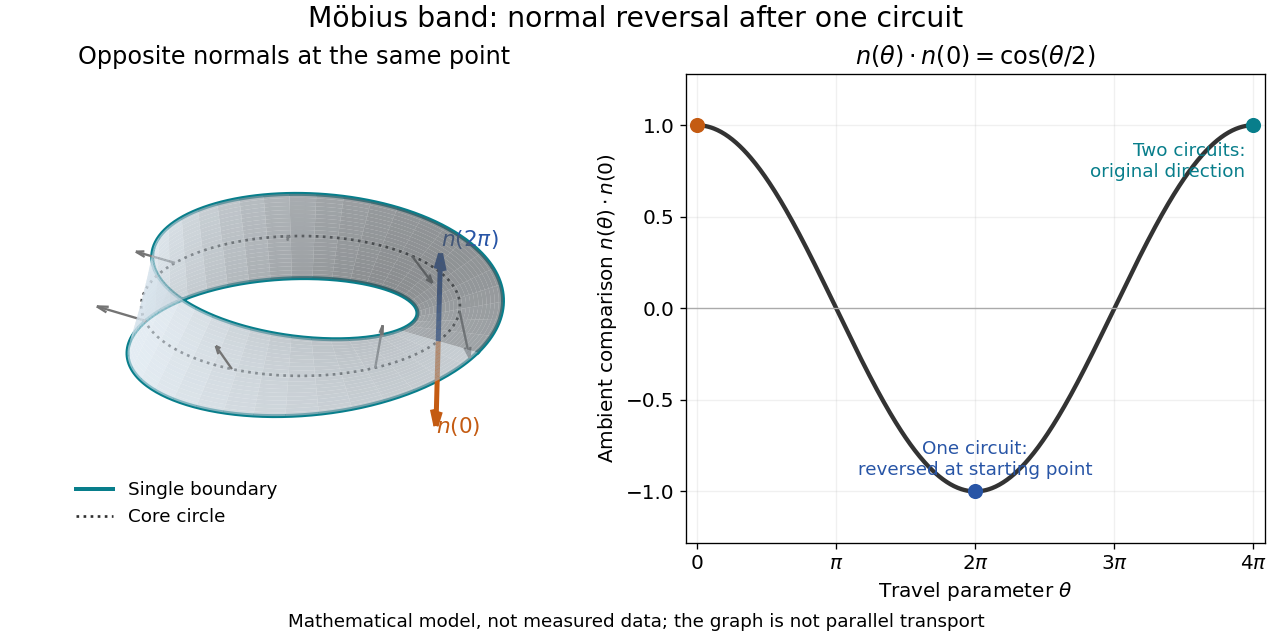

This original mathematical model has central radius and half-width :Its seam obeys . The dotted circle is the core circle of a Möbius band; the teal curve follows the single boundary through . At the same point on the core, the arrows for and are opposite. The graph compares a continuously followed unit normal with its starting value in the ambient space; the endpoint reversal, rather than any intermediate zero of the graph, establishes the obstruction. It is not a statement about parallel transport.
The Möbius band has the homotopy type of a circle: a deformation retraction shrinks each width coordinate to zero. Nevertheless its boundary represents twice a generator of its fundamental group. The boundary of a Möbius band winds twice around its core, so with compatible generator choices the boundary generator maps to in .
The historical account by Julyan H. E. Cartwright and Diego L. González places the mathematical discovery by August Möbius and Johann Listing in 1858, while investigating representations of twisted bands predating that work. A familiar-looking picture and a recognition of the underlying topological invariant are different kinds of evidence. [ref]
https://arxiv.org/abs/1609.07779. Cartwright and González, Möbius strips before Möbius, 2016
Torus Created 2026-09-24 Updated 2026-10-06
Polygonal schema Created 2026-09-24 Updated 2026-09-29
Jordan curve theorem Created 2026-09-24 Updated 2026-09-29
Every simple closed curve on the sphere separates it into two connected components, each having the curve as its boundary.
Surface quotient by a free finite action Created 2026-09-24 Updated 2026-09-28
A free action of a finite group on a topological surface has a surface quotient: sufficiently small coordinate discs have disjoint translates and descend homeomorphically to quotient neighbourhoods.
Kitaev chain Created 2026-09-24 Updated 2026-09-28
The Kitaev chain is a one-dimensional spinless p-wave superconductor. Its topological phase has a Majorana zero mode at each end of an open chain.
Quadratic fermion Hamiltonian Created 2026-09-24 Updated 2026-09-24
Open cover Created 2026-09-24 Updated 2026-10-03
Sierpiński space Created 2026-09-24 Updated 2026-10-14
The Sierpiński space is with open sets , , and . Continuous maps are in bijection with open subsets of through .
Topology axiom Created 2026-09-24 Updated 2026-09-29
Circle Created 2026-09-24 Updated 2026-10-14
Unitary group Created 2026-09-24 Updated 2026-10-14
Fundamental group of a topological group Created 2026-09-24 Updated 2026-09-28
For loops based at the identity of a topological group, pointwise multiplication and concatenation obey the interchange law and have the same identity. The Eckmann-Hilton argument therefore makes the fundamental group abelian.
Winding number of a one-dimensional Bogoliubov--de Gennes Hamiltonian Created 2026-09-24 Updated 2026-09-24
For a two-component gapped BdG Hamiltonian constrained to a plane, the winding number counts how many times its coefficient vector encircles the origin as crystal momentum traverses the Brillouin zone.
Reactive acoustic energy flux Created 2026-09-24 Updated 2026-09-24
When pressure and velocity are in quadrature, their instantaneous energy flux oscillates but its period average vanishes.
Finite periodic tight-binding ring Created 2026-09-24 Updated 2026-10-14
For identical sites of spacing with periodic boundary conditions, translation eigenstates have coefficientsThus modulo the reciprocal-lattice period .
There are unlisted articles, also show them or only show them.