
Virial theorem Created 2026-09-24 Updated 2026-10-13
The virial theorem relates the average value of a function along a trajectory to the forces that bind it. For an isolated system of particles interacting through Newtonian gravitational potential energy, it gives : the average kinetic energy is half the magnitude of the average negative potential energy. An eccentric Kepler orbit makes the distinction vivid: kinetic energy and potential energy vary throughout the orbit, although their sum is constant. The relation concerns their time averages, rather than their values at every instant. It underlies the virial mass estimate and the negative heat capacity of a virialized gravitational system.
Use constant positive particle masses , positions , mechanical momenta , and total kinetic energy . The auxiliary quantity is a sum of dot products, not the gravitational constant, which we denote here by :This finite- identity is exact wherever Newton's second law holds along a regular trajectory; must include every force. The endpoint term is what a finite observation window leaves behind. For the infinite-time theorem, suppose the averages on the left exist and . A sufficient condition is uniformly bounded positions and velocities for finitely many particles. More generally suffices, even without those individual bounds. Bounded positions alone do not supply a bound on momenta, especially near a singular potential energy; nor does a small endpoint term prove thermodynamic equilibrium. Periodic motion with gives the identity without an endpoint term at that finite . For an isolated system, use an inertial centre of mass frame so translational drift does not contribute bulk kinetic energy.[ref]
1 The Expanding Universe. Cosmology by David Tong, §1.4.3, “The Virial Theorem and Galaxy Clusters”: bounded positions and velocities, existence of averages, equation (1.74) and endpoint limit
For a differentiable potential energy that is a homogeneous function of degree , choose its additive constant so that the scaling law really holds. With conservative forces, the Euler theorem for homogeneous functions givesThus a harmonic oscillator has and . An isolated system with Newtonian gravitational potential energy hasEach interacting pair occurs once, and at infinite separation. Here the total energy is conserved. An external field or a mixture of different scaling powers requires its own force term; one cannot assign the whole potential energy a single degree . The virial theorem for a homogeneous pair potential states the corresponding general energy relation.
Hamiltonian of a charged particle Created 2026-09-24 Updated 2026-09-24
For , and .
Legendre transform in mechanics Created 2026-09-24 Updated 2026-10-03
Angular momentum about the centre of mass Created 2026-09-24 Updated 2026-09-24
The derivative of angular momentum about the moving centre of mass equals the total external torque about that centre, because total relative momentum vanishes and internal central torques cancel.
Rolling acceleration with rotational inertia Created 2026-09-24 Updated 2026-09-24
Mass Created 2026-09-24 Updated 2026-10-13
Displacement Created 2026-09-24 Updated 2026-09-24
Displacement is the change in position between two points.
Inverse-square force Created 2026-09-24 Updated 2026-10-03
An inverse-square central force has magnitude proportional to the reciprocal square of the separation.
Circular motion Created 2026-09-24 Updated 2026-10-03
Uniform circular motion of radius and angular frequency has centripetal acceleration of magnitude toward the centre.
Force Created 2026-09-24 Updated 2026-09-24
Period of an oscillation Created 2026-09-24 Updated 2026-10-14
Energy Created 2026-09-24 Updated 2026-10-14
Momentum Created 2026-09-24 Updated 2026-10-14
For a nonrelativistic point mass of fixed mass , measured in an inertial frame, its momentum isMomentum is a vector pointing along the velocity, with International System of Units unit . Doubling either mass or velocity doubles momentum. In one dimension, a chosen positive direction makes a signed quantity: a body moving right at has ; moving left at the same speed gives . [ref]
For a collection, total momentum is the vector sum . Two equal masses moving with opposite velocities can have zero total momentum while both have positive kinetic energy. Direction is therefore essential when using momentum conservation; adding speeds instead of signed velocities gives the wrong balance.
Newton's second law connects the net force on one fixed-mass point mass to its momentum through . Integrating that change gives impulse. Here denotes mechanical momentum; when canonical momentum differs from mass times velocity, the distinction in mechanical momentum below applies. The nonrelativistic formula also has a limited regime: special relativity is needed at speeds comparable with the speed of light.
Position Created 2026-09-24 Updated 2026-10-13
Degree of freedom Created 2026-09-24 Updated 2026-10-13
A degree of freedom is an independent coordinate needed to specify a mechanical configuration after all mechanical constraints have been imposed.
Newtonian gravitational field Created 2026-09-24 Updated 2026-10-14
The Newtonian gravitational field is the gravitational force per unit mass of a test particle. For a point mass at the origin,The test particle's mass cancels: different small masses have the same gravitational acceleration at the same position. In SI, the Newtonian gravitational field has units . The same exterior expression holds for a spherically symmetric source, by the spherical shell theorem.
Choose a reference radius , set , and use nondimensionalization with . Then : at , the magnitudes are . This makes the spatial variation visible without specifying a planet. [ref]
https://openstax.org/books/university-physics-volume-1/pages/13-1-newtons-law-of-universal-gravitation. OpenStax: inverse-square attraction and spherical sources
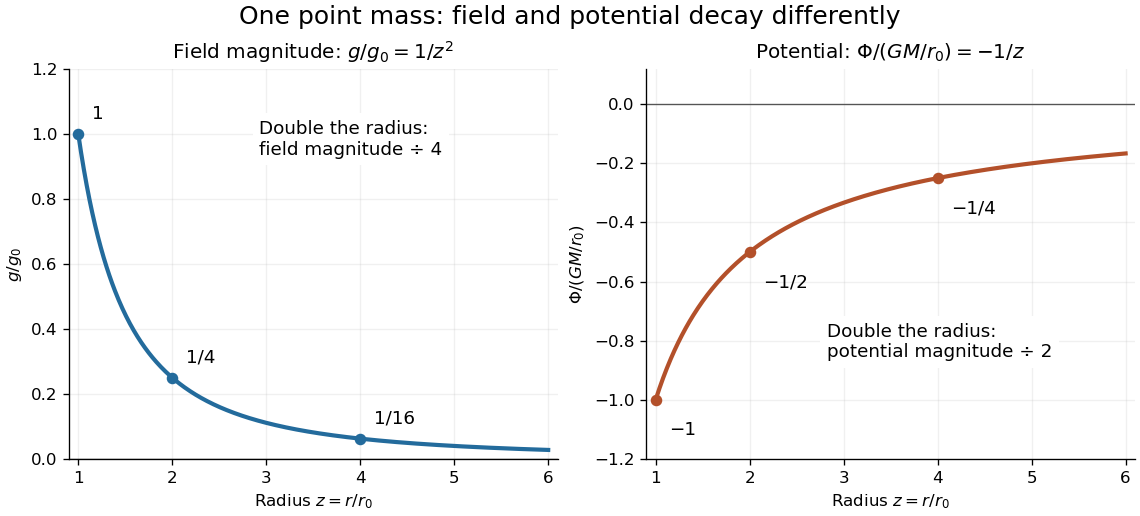
Normalized Newtonian gravitational field and point-mass potential
. Doubling the radius quarters the magnitude of the Newtonian gravitational field, but halves the magnitude of the negative Newtonian gravitational potential. Both curves approach zero as radius increases; the inward gravitational acceleration is minus the gradient of the Newtonian gravitational potential. Details.
Multiplicative order under the Chinese remainder theorem Created 2026-09-24 Updated 2026-09-24
The order of a unit modulo a product of coprime moduli is the least common multiple of the orders of its components.
Astrophysical black hole Created 2026-09-24 Updated 2026-09-24
An astrophysical black hole is a black hole studied through its formation, accretion, mergers, dynamical environment, and electromagnetic or gravitational-wave signatures.
Galaxy Created 2026-09-24 Updated 2026-09-24
Astrophysical disk Created 2026-09-24 Updated 2026-10-03
An astrophysical disk is a flattened rotating distribution of gas, dust, stars, or other matter whose orbital motion strongly influences its structure and evolution.
There are unlisted articles, also show them or only show them.