
Suppose for a linear operator , and Bézout's identity for polynomials gives . The kernel decomposition for coprime polynomials is . The displayed operators are the corresponding projection operators: is the identity on and zero on , while has the opposite action. Thus , , and . These actions also prove independence from the choice of Bézout coefficients. Every summand is an invariant subspace of , since the projections are polynomials in and commute with it.
For with and a polynomial , the binomial formula gives . Hence its module on the two-dimensional space is indecomposable exactly when : in that case the nonzero nilpotent part is one Jordan block; otherwise the operator is scalar and every line is a submodule. For over a field of characteristic different from two, the criterion is .
For continuous , a scalar second variation is strictly positive on nonzero fixed-endpoint Lipschitz variations if and only if every regularized form for has no conjugate point in , and the original weak Jacobi boundary problem has no nonzero Lipschitz solution. The Jacobi positivity criterion applies to each regularized coefficient . Letting decrease to zero gives . For a nonnegative quadratic form, forces its mixed bilinear form with every test function to vanish, by considering for both signs of . This is the weak Jacobi equation, so the kernel condition gives strict positivity. Necessity follows by the same argument in reverse. It distinguishes strict positivity from a uniform coercive estimate when the derivative coefficient degenerates.
For a plate occupying , the boundary part of the first variation of its isotropic thin-plate bending energy is, up to an overall nonzero sign,At a free edge the variation and its normal derivative can be prescribed independently. Their coefficients must therefore vanish, giving the two displayed natural boundary conditions: zero bending moment and zero effective transverse shear. The mixed-derivative coefficient includes the derivative along the edge of the twisting moment; keeping only the normal derivative of would miss that contribution.
Suppose the rational canonical form of is , with monic nonconstant invariant factors of a linear operator satisfying . Each block has minimal polynomial and characteristic polynomial , because a cyclic operator has equal minimal and characteristic polynomials. The determinant of a block diagonal matrix is the product of block determinants, giving . A polynomial kills the direct sum exactly when it kills each block, equivalently when every divides it. Thus is their least common multiple, which the divisibility chain reduces to . On the zero vector space both polynomials are conventionally one.
A Newton-Cotes quadrature is an interpolatory quadrature rule whose quadrature nodes are equally spaced. Integrating the Lagrange interpolation polynomial gives quadrature weights . A Newton-Cotes closed quadrature includes both endpoints; an open rule uses interior quadrature nodes. Simpson's rule is the closed rule with three quadrature nodes. Its quadrature weights are .
A compatible transfinite family of bijections can enumerate the square of an ordinal by adjoining a new row and then the remaining new column. Starting with , extend at a successor by for and for . Thus . At limits take compatible unions. The two new domain pieces are disjoint; the column is empty at the initial step . Each step enumerates consecutive ordinal intervals, proving bijectivity by transfinite induction. Finite stages have . Successor and limit cardinality arguments then give the square equality for well-orderable infinite cardinals without using that equality to justify the construction.
For two equal-mass particles with orthonormal coordinates confined to , the Hamiltonian is the sum of two width- infinite square well Hamiltonians. Exchange preserves and reverses . The relative-coordinate box mode is even for odd index and odd for even index . Pure spatial bosonic exchange symmetry therefore allows odd , while pure spatial fermionic exchange symmetry allows even .
The bosonic ground mode is , while its first excited mode is degenerate in energy with the fermionic ground mode . Angular spin degrees of freedom, if present, must be included in the full exchange symmetry rather than assigned the spatial rule automatically. The mean relative distance is in the lowest even mode and in the lowest odd mode, obtained by integrating the normalized squared cosine and sine. Multiplication by gives the particle separation.
Let be finite and let have index , the smallest prime divisor of . The group action on left cosets gives , with . The image order divides both and . By the choice of , the only possible nontrivial prime factor common to these orders is , and contains only one factor of . Thus the image order is or . The action is transitive on cosets, so its image is nontrivial and has order . The first isomorphism theorem gives , hence . A kernel of a group homomorphism is a normal subgroup, proving the claim. For example, every subgroup of order in a group of order is normal.
The usual associative, identity, two-sided inverse and commutativity axioms form an independent axiom set. A three-element commutative unital operation with self-inverses can fail associativity; a constant-zero operation can satisfy the other three axioms while failing the identity condition; natural-number addition fails the inverse condition; and a noncommutative group fails commutativity. Each example must be checked against all three retained axioms.
An improper integral whose absolute-value integral is finite. The triangle inequality for an integral bounds each truncated tail by the corresponding tail of , so the Cauchy criterion for an improper integral gives ordinary convergence. Absolute convergence is stronger than a Cauchy principal value, which may exist only because two divergent sides cancel. The continuous sine-product integrand has a removable value at zero and an integrable tail; its auxiliary complex contour integrand can nevertheless require a principal value.
For a locally integrable real or complex function, the displayed tail condition is equivalent to ordinary convergence of its improper integral at infinity. Apply the Cauchy criterion for a function limit to its truncated integrals, using completeness of the real or complex numbers. The necessity follows by subtracting two nearby-to-limit truncations; sufficiency follows by first taking a convergent sequence of truncations and then bounding all other late truncations against it. The analogous criterion applies at a finite singular endpoint. Bounding the modulus of every tail by its absolute-value integral proves that an absolutely convergent improper integral converges ordinarily.
For , the function is Lebesgue integrable on exactly when . Near zero, , so absolute integrability is equivalent to that of , which requires . At infinity, gives the upper bound . For , on each interval ,and the corresponding P-series diverges.
The signed improper integral nevertheless converges for every : near zero the same local comparison applies, and at infinity the Dirichlet test for improper integrals uses the bounded antiderivative of sine and the decreasing factor . Thus gives conditional convergence, while gives absolute integrability. In particular, substituting turns into the divergent tail .
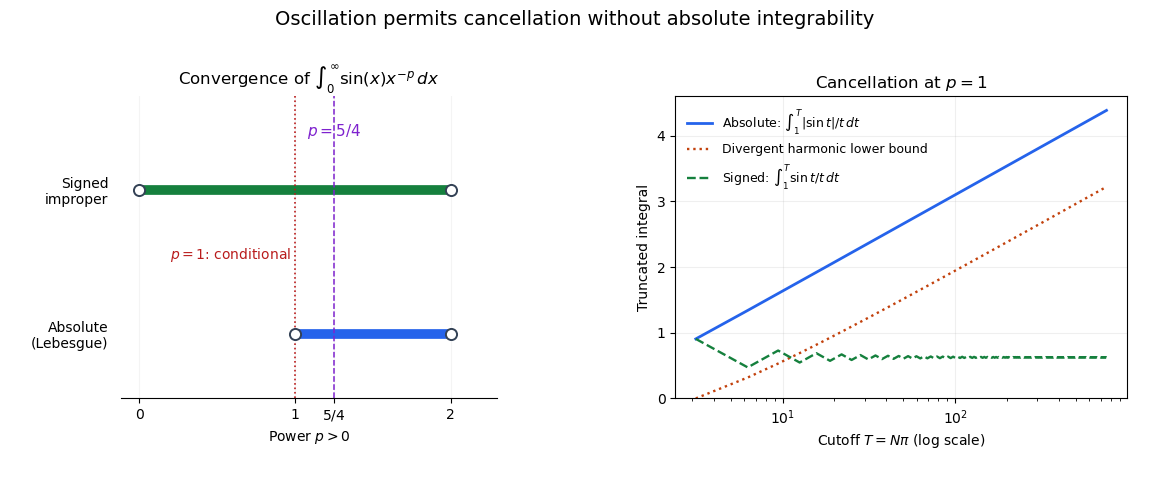

Let be measurable, integrable over a positive period , and have mean zero there. Its positive and negative parts have equal integrals . On the -th period the signed integral of has absolute value at mostThis follows by bounding the positive and negative weighted integrals between and . The bounds are summable, so the integrals at period endpoints converge. A leftover partial period has absolute integral at most , tending to zero, which proves convergence for arbitrary upper endpoints too.
In contrast, each full-period integral of is at least . It diverges in total unless , equivalently almost everywhere. Thus a nonzero mean-zero periodic function gives a convergent improper integral here but no Lebesgue integrability.
In the half-plane with an impermeable wall, place a point vortex of circulation in the background velocity , where . The image vortex at a plane wall has circulation at the reflected location and contributes horizontal velocity . Excluding the vortex's own singular velocity gives the displayed motion equations.
Put . Their first integral is , since its time derivative is . The explicit trajectory is and . These formulas show how image-induced drift changes the hyperbolic trajectories of the background flow while preserving a modified stream-function-type invariant.
For the Euler-type operator , set on either half-plane . The chain rule gives and . The operator becomes . Its characteristic coordinates , reduce it further to . Thus the constant-forcing equation has solutions , with arbitrary sufficiently differentiable functions . The logarithmic change of variables cannot by itself describe smooth passage across .
On , the linear partial differential equation has characteristic curves . The change of variables , has Jacobian determinant . The chain rule givesThus its canonical form of a second-order partial differential equation is , and its general twice differentiable solution is . The first derivative term exactly cancels the derivatives of the coordinate coefficients.
More generally, for positive differentiable , choose with . Then the same cancellation givesThe characteristic coordinates are . The quadratic example is , , with both coordinates multiplied by two.
This partial differential equation has discriminant , so it is a hyperbolic partial differential equation above and an elliptic partial differential equation below it. In its hyperbolic region the displayed characteristic coordinates have Jacobian determinant . The chain rule givesThe first derivative terms arise from differentiating the coordinate coefficients and cannot be discarded. The coordinate change degenerates at the line where the two characteristic directions merge.
There are unlisted articles, also show them or only show them.