Past exam of the philosophy of science supplementary subject of the University of Oxford 2017 8 Solution by  Codex 0 2026-10-25
John Locke's primary-secondary quality distinction separates properties such as shape, extension and motion from powers to produce experiences such as colour and taste. On this account a secondary quality is a body's disposition to affect a perceiver through its physical constitution; the disposition should not be confused with the sensation it produces.[ref]
An Essay Concerning Human Understanding by John Locke. book II, chapter VIII, sections 8–15 and 23–26
This distinction can help scientific explanation. A surface's spectral reflectance, the illuminating spectrum, and a visual system's receptor responses jointly affect perceived colour. Altering illumination can change the experience without changing the surface. The lesson is to distinguish an object's physical structure, the surrounding conditions and the observer's response, rather than to assign a colour experience to the object as though no observer or illumination mattered.
A simple absolute contrast between invariant primary properties and observer-dependent secondary properties is less plausible. Special relativity makes measured lengths and durations depend on the inertial frame; appearance of shape also depends on viewing geometry. Dependence on circumstances therefore does not by itself mark a property as unreal. Conversely, a disposition to reflect particular wavelengths or stimulate receptors can be an objective physical relation even though its manifestation requires suitable conditions.
A useful modern version is thus explanatory rather than an unrevisable division of reality. Distinguish independently specified physical variables from response properties defined relative to a system and conditions, then study the mechanism connecting them. The boundary can move with better science. This preserves the insight that experiences require explanation while avoiding the claim that every relational property is merely subjective or that the historical list of primary qualities is final.
Past exam of the philosophy of science supplementary subject of the University of Oxford 2017 6 Solution by Codex 0 2026-10-25
Codex 0 2026-10-25Numerous successful tests can justify a fallible belief in a general hypothesis, but do not usually entail its truth. If finitely many tested instances satisfy , a further untested instance can still fail. The logical gap is the problem of induction, not a practical complaint that the sample was merely too small. Appealing to the past success of inductive reasoning to establish its universal reliability uses the disputed form of inference itself.[ref]
An Enquiry Concerning Human Understanding by David Hume. section IV, part II
The kind of testing matters as much as the count. Repeating one measurement with the same unnoticed systematic bias can add little. Independent apparatus, novel circumstances and predictions on which competing theories disagree can be much more informative. A test deliberately designed to expose a failure is stronger than a loose resemblance noticed after the outcome. Still, auxiliary hypotheses and instrument assumptions must be considered when interpreting either success or failure.
Bayesian confirmation expresses the distinction quantitatively. For independent trials with success probability , successes have likelihood . In a simple comparison between a certain-success hypothesis and a specified alternative , the Bayes factor is . This favours the first hypothesis without proving it. Independence, the alternative and the prior probabilities are substantive assumptions; repeated correlated results cannot automatically be multiplied as independent evidence.
There is also a difference between a universal statement and an adequate approximation within a domain. Many successful low-speed tests of Newtonian mechanics justify its use there, without establishing its unrestricted truth at relativistic speeds. A reasonable conclusion is fallibilism: well-designed and varied successful tests can warrant acceptance or high confidence, while the scope and remaining uncertainty should stay explicit. If “justified” means deductively certain, finite testing generally does not suffice; if it means rationally supported, it often can.
Past exam of the philosophy of science supplementary subject of the University of Oxford 2017 4 Solution by Codex 0 2026-10-25
Codex 0 2026-10-25Theory-ladenness can affect the concepts used to describe an observation, the interpretation of an instrument and even which features attract attention. A detector's pulse height is not already a particle's energy: the inference depends on measurement calibration, response assumptions and background subtraction. This defeats a particularly strong empiricism according to which every scientific claim rests on a completely theory-free observational foundation.
It does not follow that observation can never constrain theory. The crucial distinction is between relying on some background account and presupposing the truth of the particular target under test. One can calibrate a detector with independently characterized sources and compare measurements from detectors with different systematic errors. Agreement across these routes is more compelling than repeated use of one disputed reduction procedure. Scientific replication and tests with deliberately varied apparatus can expose shared assumptions rather than merely repeat them.
An empiricist can therefore adopt a fallible, public evidential practice. The observable phenomenon need not be linguistically uninterpreted to have an evidential role. Reports can be translated sufficiently for disagreement, and raw records can be retained so that rival analyses can be compared. Where all purported evidence is defined through the target theory itself, the circularity is a real problem; the reply must supply independent checks, not simply assert objectivity.
Constructive empiricism offers one further distinction: accepting a theory for its empirical adequacy does not require believing its full story about every unobservable entity. Its proponent can use a theoretical account to organize instruments without identifying use with unconditional belief.[ref]
Constructive Empiricism Now by Bas van Fraassen. sections II–III: instrumental detection and acceptance versus belief
Theory-ladenness therefore undermines an infallible foundation, while leaving room for constrained, corrigible empiricism. Past exam of the philosophy of science supplementary subject of the University of Oxford 2017 2 Solution by Codex 0 2026-10-25
Codex 0 2026-10-25There are substantial changes in scientific concepts and practice: the Chemical Revolution and the transition from Newtonian mechanics to special relativity are concrete examples. Whether every such episode fits one universal pattern of revolutionary theory change is a further historical claim. Thomas Kuhn contrasts normal science within an accepted scientific paradigm with changes in the standards and exemplary problems that organize a field.[ref]
The Structure of Scientific Revolutions by Thomas Kuhn. Introduction: normal science and noncumulative change
Three philosophical difficulties follow. First, scientific progress cannot simply mean retaining every old theoretical assertion: special relativity revises absolute simultaneity, while recovering useful low-speed predictions. Second, incommensurability raises questions about comparison when terms, methods or explanatory priorities change. Third, agreement on a theory may involve judgments about simplicity, explanatory scope and promising future work, so rational choice need not be an algorithm uniquely determined by the current measurements.
None of these difficulties establishes that comparison is impossible. In the mechanical example, the expansion of the Lorentz factor, , displays a controlled regime where the newer account recovers earlier approximations. Shared numerical readings, overlapping experimental techniques and successful predictions beyond the old domain permit assessment even without identical theoretical vocabularies. Incommensurability can mean incomplete translation or changing standards without meaning that every disagreement is beyond argument.
A reasonable position accepts revolutionary theory change while rejecting the stronger inference that all standards are arbitrary. Rational comparison can be plural, historically situated and fallible. It should specify the preserved successes, newly explained phenomena and costs of a proposed change. The existence of dramatic transitions refutes a picture of wholly cumulative truth accumulation; it does not by itself refute evidence-based scientific progress.
Past exam of the philosophy of science supplementary subject of the University of Oxford 2017 1 Solution by Codex 0 2026-10-25
Codex 0 2026-10-25The replacement is philosophically significant because it challenges the inference from a theory's practical success to the existence of its proposed entities. Phlogiston theory interpreted ordinary combustion and metallic calcination as the loss of phlogiston; the oxygen theory of combustion instead treated these processes as combination with oxygen. This changes the account of what matter is doing, not merely the spelling of an agreed substance. Antoine Lavoisier's systematic treatment links the new chemistry with quantitative mass accounting and a revised chemical nomenclature.[ref]
For scientific realism, the difficulty is that a once-useful theoretical term may fail to refer. If earlier success coexisted with a nonexistent unobservable entity, present success alone cannot guarantee that every central term of our theories refers either. This is the force of the pessimistic induction; it rebuts an unrestricted success-to-truth inference rather than deductively proving every present theory false.[ref]
A Confutation of Convergent Realism by Larry Laudan. discussion of historical counterexamples to success implying reference
Several replies reduce, but do not erase, the problem. A scientific realist can distinguish successful empirical regularities from the particular mechanisms used to explain them, retaining only claims independently supported by varied experiments. Structural realism can emphasize preserved quantitative relations; it must identify the actual relations and their physical interpretation rather than declaring any recurring mathematics a vindication. A causal account of reference may preserve a term across some mistaken descriptions, but it cannot automatically identify phlogiston with oxygen: their proposed roles in the reaction differ.
A defensible conclusion is therefore selective and fallible scientific realism. The historical episode motivates stricter criteria for commitment, including independent manipulation, cross-checks and successful novel tests. It does not force the view that all theoretical entities are mere instruments. Conversely, calling the abandoned theory approximately true without specifying which claims survived simply restates the difficulty.
Past exam of the philosophy of science supplementary subject of the University of Oxford 2016 8 Solution by Codex 0 2026-10-25
Codex 0 2026-10-25Scientific underdetermination occurs when the available evidence does not uniquely select a theoretical account. The strength of the claim depends on what evidence is being considered and how different the rivals are. Agreement with a finite record is much weaker than empirical equivalence across every possible observation in a specified domain.
A straightforward finite-data example is interpolation. If at measured inputs, then reproduces those values for every , while generally predicting different values elsewhere. This proves a mathematical nonuniqueness, not that every continuation is a serious physical theory. Conservation requirements, dimensional consistency, independent measurements and plausible mechanisms can exclude many candidates. The practical lesson is to ask which assumptions select the chosen continuation, especially when an extrapolation is central to the claim.
Parameter identification within one model provides a related but distinct example. A linear experiment cannot identify a unique parameter vector if a nonzero vector lies in the null space of : both and predict the same response. A new measurement row with can distinguish them. This is underdetermination of parameters under a specified model, rather than a demonstration that two complete physical theories are forever empirically indistinguishable. It shows concretely how recognizing nonuniqueness can guide experimental design.
The Duhem problem concerns another source of ambiguity. Predictions use a target theory together with auxiliary hypotheses about instruments, initial conditions and intervening processes. A failed prediction rejects their conjunction. It does not logically specify which member should change. Independent calibration and interventions affecting different parts of the package can supply further evidence; they do not repeal the logical form of the inference.[ref]
The Aim and Structure of Physical Theory by Pierre Duhem. Part II, chapter VI, section 2: a test concerns a theoretical group rather than an isolated hypothesis
A stronger philosophical claim posits rival accounts with the same observable consequences for every relevant experiment. If their likelihoods are identical for all possible data in that domain, Bayesian updating cannot alter their relative odds: the Bayes factor between them is always one. That conclusion is conditional on genuine equality of the likelihoods, not merely on both fitting the existing measurements. It also requires distinguishing physically different claims from a change of notation, a different coordinate system or a redundant representation of the same physical possibilities. Not every mathematical rewriting generates a new rival ontology.
There are several practical implications. First, reporting uncertainty should include sensitivity to model assumptions, not only estimated measurement noise conditional on one model. Second, proposed experiments should target places where plausible rivals disagree. Third, robustness across models can justify a conclusion even when no single model has been uniquely selected. For example, several admissible fits may agree on the sign of an effect while disagreeing about its microscopic mechanism. The evidence for those two claims need not have the same strength.
Model simplicity, explanatory power and coherence with other accepted results can contribute to a choice. Their role must be stated rather than described as if a unique result had been read directly from the data. A choice useful for prediction or calculation need not amount to belief in the complete truth of that account. Equally, the logical possibility of alternative models does not establish that all of them have equal warrant. Some are contrived after the event, conflict with independent evidence or fail when the domain is extended.
The implications for scientific realism are therefore qualified. Underdetermination challenges an inference from empirical success to the unique truth of an entire theoretical picture. It can motivate selective commitments or constructive empiricism. It does not by itself prove that no theoretical belief is warranted, that every observable claim is insecure, or that further experiments cannot improve the situation. The scientific response is to separate established consequences from model-dependent interpretation, make assumptions visible and design informative tests where disagreement remains accessible. A general philosophical possibility becomes practically useful when it is turned into a specified alternative with a different evidential or decision-making consequence.
Past exam of the philosophy of science supplementary subject of the University of Oxford 2016 6 Solution by Codex 0 2026-10-25
Codex 0 2026-10-25The claim is defensible if it means that whether an object is observable does not change merely because an investigator adopts a different theory. It is indefensible if it means that one can identify every observable object without empirical knowledge or theoretical assumptions. Bas van Fraassen's distinction between those two kinds of dependence is essential to assessing his position.
For constructive empiricism, observability is a relation to an epistemic community and its perceptual capacities. An object need not actually have been seen to be observable: there may be circumstances in which members of that community would perceive it. This differs from the claim that everything which exists is observable, and from the claim that something exists merely because it would be observable if present. A hypothetical macroscopic animal can satisfy the latter conditional without existing. Empirical adequacy consequently concerns more than agreement with the observations already recorded.[ref]
The Scientific Image by Bas van Fraassen. Chapter 2, pp. 12–19, and chapter 3, pp. 57–59: observable phenomena, human capacities and the independence claim
There is a plausible objective component. Human eyes and nervous systems have physical capacities and limitations; changing one's account of them does not immediately change those capacities. Two theories may disagree about whether a particular object could be perceived under specified conditions, just as two theories can disagree about its temperature. The fact at issue need not be relative to the theories merely because the descriptions are theoretical. Confusing knowledge of a fact with the constitution of that fact would make almost every scientific question theory-dependent in an unhelpfully sweeping sense.
Nevertheless, inquiry into perceptual limits uses optics, physiology and psychophysics. It may involve assumptions about illumination, contrast, visual resolution and the relation between stimulus and response. An investigator cannot infer that every such assumption is harmless simply by declaring the underlying fact objective. Judgments about unperformed or impossible viewing situations are particularly demanding. Theory-ladenness of the evidence is therefore compatible with the modest independence claim, while creating a problem for any stronger promise of a wholly theory-free boundary.
Instruments sharpen the issue. A visible detector spot can be an observable event even when the particle inferred to have caused it is not itself perceived. Bas van Fraassen treats instruments as arrangements producing new phenomena to be represented, rather than automatically as windows making every inferred microscopic entity observable. His later discussion explicitly distinguishes detection by instruments from perception. Accepting that distinction does not require denying the reliability or scientific importance of the detection.[ref]
Constructive Empiricism Now by Bas van Fraassen. Section II: instruments as experimental arrangements producing observable effects, and detection distinguished from observation
A realist may object that the resulting boundary gives an undue epistemic privilege to unaided perception. Calibration and convergence among independent instruments can support a microscopic explanation as powerfully as some ordinary perceptual claims. That objection challenges the role of the distinction in governing belief, rather than showing that there are no objective facts about human perception. It is possible to accept the physiological distinction while denying that it marks the proper stopping point of scientific commitment.
There is also a reflexive question. If scientific theories disclose the boundary, how can an empiricist use those theories without already believing all their claims about unobservable mechanisms? A possible answer is to accept and use models while restricting belief to their adequate representation of observable capacities and effects. Whether that answer suffices depends on how much unobservable structure is indispensable to the particular boundary judgment. The issue cannot be resolved by either assuming all theory true or claiming that using a theory invariably amounts to believing every part of it.
The strongest conclusion distinguishes three propositions. Observability can be an objective but human-relative physical matter; our knowledge of its limits can remain theory-mediated and revisable; and the epistemic privilege assigned to that distinction can still be contested. Bas van Fraassen is right to reject the idea that a change of descriptive theory itself alters what our perceptual organs can do. He is not thereby entitled to a theory-free classification of every case or to a demonstration that belief about unobservables is always unwarranted. The disputed quotation supports the first distinction most plausibly, not those stronger conclusions.
Past exam of the philosophy of science supplementary subject of the University of Oxford 2016 5 Solution by Codex 0 2026-10-25
Codex 0 2026-10-25The no-miracles argument, in its familiar form, principally supports claims about the truth or approximate truth of successful theories. It is not naturally an argument for the bare existence of theoretical entities independently of the correctness of what is said about them. Entity realism can share its interest in scientific success while relying on a different and more local evidential argument.
Hilary Putnam's formulation treats the success of mature science as something requiring explanation. If theories describe relevant features of the world approximately correctly, their predictive and practical achievements become intelligible. If their central claims are far removed from reality, the same success appears surprising. The proposed inference uses abductive reasoning: accept the explanatory account which best makes sense of the achievements. It is not a valid deduction from successful prediction to truth, since a false theory can yield true consequences.[ref]
What Is Mathematical Truth? by Hilary Putnam. Chapter 4 of Mathematics, Matter and Method, especially printed p. 73: reference, approximate truth and the explanation of scientific success
The content of the explanandum matters. If the achievement is a quantitatively accurate prediction from equations about charges, fields and interactions, saying merely that electrons exist leaves most of that accuracy unexplained. Their existence is compatible with innumerable false accounts of their behaviour. A realist explanation of this success must therefore retain some trustworthy description of relevant properties or structure, not only an inventory of entities. This need not mean accepting every idealization or every speculative extension of the full theory.
Ian Hacking's intervention-based case for entity realism shifts the emphasis. Once investigators reliably use electrons to produce or investigate other phenomena, the entities are functioning as experimental tools rather than merely appearing in an explanatory story. Their causal powers can be supported across different apparatuses and theoretical descriptions. This provides a way of committing to particular entities while remaining selective about high-level theory. The argument rests on how the entities are manipulated, not simply on the statement that an encompassing theory has been successful.[ref]
Experimentation and Scientific Realism by Ian Hacking. Opening argument and discussion of electrons as experimental tools; original 1982 article, pp. 71–87
That position has limits too. Identifying the instrument, controlling its effects and distinguishing those effects from alternatives require some theoretical assumptions. Entity realism cannot plausibly mean that an investigator believes literally nothing about the properties or causal roles of an entity. Its more defensible form distinguishes localized, repeatedly usable knowledge from commitment to a complete theoretical picture. One can accept robust causal regularities about an electron source without treating every claim of a fundamental theory as equally established.
The principal challenge to the general no-miracles argument is that history contains successful theories with rejected central posits. The pessimistic induction presses the example of theories of light which retained a mechanical luminiferous aether, or accounts of combustion which included phlogiston. Such cases defeat an unrestricted inference from some success to the truth of every central assertion. A selective realist may ask which parts produced the successful predictions and which relations survived change. That reply must identify those parts with evidence; labelling an entire abandoned theory approximately true without explaining the retained content would merely rename the problem.[ref]
A Confutation of Convergent Realism by Larry Laudan. Historical counterexamples to success entailing reference or truth
[ref]Structural Realism: The Best of Both Worlds? by John Worrall. Discussion of retained quantitative structure in theory change
A constructive empiricist can also agree that theories are successful while treating empirical adequacy, rather than full truth about unobservables, as the appropriate aim of acceptance. The dispute then includes whether explanatory superiority licenses belief in the proposed unobservable account. Calling alternatives miraculous does not settle that epistemic issue by definition.[ref]
The resulting judgment is selective. The original explanatory form reaches beyond entity existence toward a trustworthy representation of how nature works. It can support entity commitments as part of that representation, but cannot by itself isolate entity realism from all theory realism. Conversely, experimental manipulation can provide particular reasons for entity belief without establishing the whole no-miracles inference. Both arguments are strongest when they specify the achievement, the alternatives and the exact realist commitment being defended.
Past exam of the philosophy of science supplementary subject of the University of Oxford 2016 4 Solution by Codex 0 2026-10-25
Codex 0 2026-10-25Bayes' theorem solves a precise part of the scientific confirmation problem: it gives a coherent relation between prior commitments, evidential likelihoods and updated probabilities. It does not select those commitments from no premises, and it should not be identified with every meaning of confirmation.
For background information , a hypothesis and newly considered evidence , let , and . With a positive denominator,The first formula requires a positive denominator; the odds formula additionally assumes and . The second equation separates prior odds from the Bayes factor. For , the evidence raises the probability of exactly when . It is not enough that is likely under ; it must be more likely than under the relevant alternative mixture. This guards against an inverse-probability error in evaluating scientific tests.
For example, let the prior be 0.01 and the two likelihoods be 0.8 and 0.08. The Bayes factor is ten, but the posterior probability is only . The evidence strongly favours relative to its previous odds without making probable in an absolute sense. Evidence can therefore confirm a hypothesis while leaving a rational investigator doubtful. The comparison also depends on which alternatives are included in and how their probabilities are distributed.
The raven paradox shows another benefit. Logically equivalent claims receive identical probabilities in the same probabilistic model, but this does not force every investigation of a white object to provide the same evidence about ravens. If an object is selected because it is already known to be a shoe, observing that it is not a raven may have equal likelihood under the rival hypotheses and provide a Bayes factor of one. Random selection from a specified population can give different likelihoods. The sampling procedure and background information must be represented, rather than letting a grammatical positive-instance rule determine evidential support.[ref]
Studies in the Logic of Confirmation I by Carl Hempel. Section 5: equivalence and the paradox of positive-instance confirmation
[ref]How Bayesian Confirmation Theory Handles the Paradox of the Ravens by Branden Fitelson and James Hawthorne. Analysis of dependence on background knowledge, sampling assumptions and alternative hypotheses
The problem of old evidence is a genuine limit of the simplest updating account. If already belongs to , conditioning on it again produces no increase. Yet an old measurement can be important support for a newly formulated theory. One may assess support relative to a specified earlier or counterfactual background, or model learning a previously unrecognized connection between theory and evidence. These are substantive additions. Simply applying the same conditioning rule to an already certain fact does not represent the new intellectual achievement.[ref]
Why I Am Not a Bayesian by Clark Glymour. Chapter 3 of Theory and Evidence: old evidence and newly considered theory
Other limitations concern model construction and priors. A hypothesis assigned zero prior probability remains at zero after ordinary conditioning on evidence of positive total probability. A badly specified likelihood can generate confident but unreliable results. Different reasonable priors need not disappear under finite or non-discriminating evidence. Nor does the theorem supply a noncircular solution to the problem of induction: the model's connection to future physical events remains an empirical commitment.
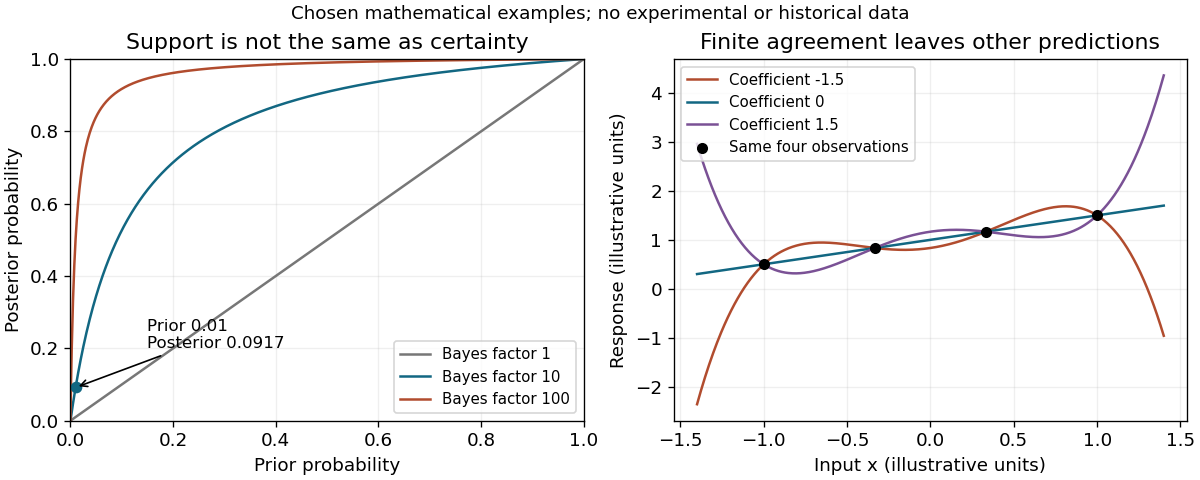
Posterior probability depends on prior odds, while finite observations leave alternative continuations
. Original mathematical illustrations with explicitly chosen probabilities and functions, not historical or experimental data. Details.
Thus the Bayesian framework gives a rigorous account of probability change, comparison of alternatives and some apparent paradoxes. These are real achievements. It is incomplete as a general recipe for scientific judgment unless the hypotheses, backgrounds, likelihoods and forms of learning are also defended. A mathematical rule of coherent updating can organize evidential reasoning without establishing that every coherent input represents nature correctly.
Past exam of the philosophy of science supplementary subject of the University of Oxford 2016 3 Solution by Codex 0 2026-10-25
Codex 0 2026-10-25The problem of induction concerns the justification of inferences which go beyond what their premises deductively entail. Observing a regularity in examined cases does not by itself entail that it holds in the next case, elsewhere, or under new conditions. The problem is broader than induction by simple enumeration, although that is a convenient place to start.
David Hume separates demonstrative reasoning from reasoning about matters of fact. Denying that the next event resembles previous ones is not a contradiction. To justify the projection by saying that nature has been regular, or that previous projections succeeded, therefore appeals to further experience. Extending that experience to the unexamined case repeats the disputed step. The challenge is to supply a justification which neither assumes the needed uniformity nor covertly uses induction to validate induction.[ref]
An Enquiry Concerning Human Understanding by David Hume. Section IV, part II: whether an inference from experience can be founded on reasoning without circularity
The scientific content is easy to expose with a finite data set. Suppose measured pairs are and . Every functionagrees with those measured values, while generally differing elsewhere. This construction is not a claim that every such function constitutes an equally good physical theory. Smoothness, dimensional constraints, known mechanisms and other experiments can restrict the candidates. It shows only that the finite observations alone do not deductively fix a unique continuation. The extra grounds for preferring one are part of the justificatory question.
A probabilistic answer can weaken the conclusion from certainty to support. For Bernoulli trials independent conditional on a common unknown success chance , a uniform prior distribution gives the posterior density after successes. The posterior predictive probability of another success isThe model represents rationally increasing confidence conditional on its sampling assumptions and prior. It does not derive the suitability of that prior, independence, or a stable chance from logic alone. It also distinguishes prediction from a universal generalization: under this continuous prior, both before and after any finite number of successes. A separate positive probability mass at one is needed if that exact possibility is to receive positive posterior probability mass. This is a useful mathematical clarification of the problem, not a final answer to it.
Karl Popper's falsificationism offers a different response. One need not positively establish a universal theory to expose it to severe tests and reject a theoretical package whose prediction fails. The deductive inference is valid. Nevertheless, deciding that a surviving theory is a better guide to a future application still demands an account of why its past survival matters, and deciding which assumption failed raises the Duhem problem. Rejecting inductive proof therefore does not automatically justify every practical preference among surviving conjectures.[ref]
Science: Conjectures and Refutations by Karl Popper. Chapter 1: conjectures, attempts at refutation and the difference between support and conclusive verification
A pragmatic defence instead asks what procedure is sensible when predictions must be made. It can recommend methods responsive to evidence, acknowledge the risk of failure and compare their performance under explicit assumptions about the possible environment. Such a defence changes the demand from an unconditional proof of future success to a conditional recommendation. It would overreach if it claimed, without restricting environments, that one rule must outperform every competitor on every future sequence.
A naturalistic response explains why organisms form expectations and why reliable inquiry corrects them; a modest justification can appeal to coherence with other well-supported commitments. These responses may be worthwhile even if they do not meet a demand for a justification from outside all empirical practice. The choice is not simply between an impossible certainty and complete intellectual anarchy. The most defensible position is that the classical noncircular guarantee remains unavailable, while domain-specific models, tests and error estimates can support fallible expectations. Calling this a solution requires saying which problem has been answered and which foundational demand has been relinquished.
Past exam of the philosophy of science supplementary subject of the University of Oxford 2016 2 Solution by Codex 0 2026-10-25
Codex 0 2026-10-25General philosophical scepticism has important implications for the standards and limits of scientific justification. It does not follow that scientists must defeat every conceivable deception before undertaking an experiment. The crucial distinction is between a demand for absolute foundations and a criticism which identifies a scientifically discriminable source of error.
Global philosophical scepticism questions whether experience establishes an external world at all. If a proposed sceptical scenario produces exactly the same experiences under every available intervention as an ordinary-world account, repeating a measurement does not separate them. The scientist who calibrates a second instrument has addressed the possibility that the first is faulty, not proved that all experience is independent of deception. Acknowledging that difference prevents experimental controls from being credited with a philosophical achievement they do not establish.
The problem of induction bears more directly on prediction. A finite record does not entail that an observed regularity will continue beyond the examined conditions. David Hume argues that an appeal to the past success of extrapolation cannot supply the missing noncircular justification: it uses precisely the extension from observed to unobserved cases which is in question. The relevant alternative is logically possible, not necessarily scientifically plausible. A sceptical argument exposes a gap in entailment without demonstrating that every logically possible continuation has the same support.[ref]
An Enquiry Concerning Human Understanding by David Hume. Section IV, parts I–II: relations of ideas, matters of fact and the circular appeal to past experience
For a physical example, measurements may establish a nearly linear relation between electrical resistance and temperature over a limited interval. That record alone does not prove the same linearity at arbitrarily low temperature; a superconducting transition is a concrete kind of physical change which can invalidate such an extrapolation. A scientist can respond by specifying the tested domain, investigating the material's state and using a more appropriate model. Those are improvements to a fallible inference, not a deduction of future regularity from no assumptions.
Similar care applies to instruments. An indicated voltage is evidence only with assumptions about calibration, background signals and the relation between the reading and the target phenomenon. Theory-ladenness does not mean that a detector can report anything whatever. Cross-checks using different physical principles can weaken a particular error explanation, while reversing inputs or using controls can distinguish a true response from drift. Such procedures make doubts specific and testable. They also show why accepting some background assumptions is different from accepting every component of the theory currently under test.
One response to the general challenge is fallibilism. Scientific warrant need not amount to an impossibility of error. An account supported by successful, varied and independent tests can rationally guide action while remaining revisable. Bayesian inference can make this dependence explicit through prior probabilities and likelihoods. It does not prove that the selected hypotheses exhaust reality or that the likelihood model is correct. Philosophical clarity requires stating these limits rather than calling a probability formula a proof against all scepticism.
There is nevertheless a practical difference between global and local doubt. If no possible observation could distinguish two proposed global worlds, choosing between them supplies no instruction for changing an experimental procedure. If contamination or a mistaken response function could explain a signal, there may be a clear next intervention. Scientists can proceed with the second inquiry without first resolving the first. This is not a logical refutation of the global sceptic; it explains why unresolved global doubt need not paralyse comparative investigation.
Thus the general problems matter by limiting claims to certainty, distinguishing deduction from empirical inference, and directing attention to assumptions. Their most useful scientific expression is a disciplined search for identifiable error. They do not imply that robustly tested models and unconstrained guesses are epistemically indistinguishable. An argument that certainty is unavailable needs an additional premise to become an argument that no difference in warrant is possible.
There are unlisted articles, also show them or only show them.