Past exam of the philosophy of science supplementary subject of the University of Oxford 2016 1 Solution by  Codex 0 2026-10-25
A useful response to the demarcation problem should identify practices which make claims answerable to evidence without equating scientific status with either truth or prestige. There is a defensible case for demanding testability, serious engagement with contrary results and the possibility of correction. There is a much weaker case for one simple criterion which assigns every past and present activity unambiguously to science or pseudoscience.
Karl Popper's falsifiability criterion makes an important distinction. A claim has empirical content when some possible outcomes would count against it under specified assumptions. A system which can accommodate every conceivable result without changing its commitments lacks that vulnerability. The strength of a risky prediction is precisely that an investigator cannot claim success whichever outcome occurs. This is a methodological criticism of immunizing a claim against testing, not a rule that a false claim must be unscientific.[ref]
Science: Conjectures and Refutations by Karl Popper. Chapter 1: risky predictions, falsifiability and conventionalist strategies for avoiding refutation
A simple counterexample shows why falsifiability alone cannot settle the whole question. A highly specific astrological prediction can be empirically testable and fail its test. Its logical form does not explain why a community continues presenting it as reliable after repeated failures. Conversely, a promising new physical conjecture may have no practicable decisive test yet, although it belongs to a programme seeking one. Testability in principle, present experimental access and responsible response to evidence are three different matters. Describing an isolated sentence is not always enough to characterize an activity.
Nor does a failed prediction logically identify its culprit. If a theory and an auxiliary hypothesis imply an outcome , a contrary outcome establishes , not uniquely . A damaged detector or an incorrect initial condition may deserve investigation before the target theory is abandoned. The Duhem problem therefore rules out the naive demand to discard a theory after every anomalous reading. It does not license endless rescue: independent calibration, further predictions and interventions can distinguish a justified repair from an ad hoc hypothesis introduced only to evade a result.[ref]
The Aim and Structure of Physical Theory by Pierre Duhem. Part II, chapter VI, section 2: experimental testing concerns a group of theoretical assumptions
Imre Lakatos accordingly evaluates a scientific research programme through its development. Alterations which lead to independently corroborated new predictions can be progressive; changes which merely accommodate difficulties without new success are less impressive. The relevant contrast concerns a pattern of inquiry over time. This explains why one temporary anomaly or an initially unsuccessful idea does not determine the status of a whole field. The difficulty is that the judgment may be retrospective, and there is no automatic deadline after which every stalled programme must be rejected.[ref]
Science and Pseudoscience by Imre Lakatos. Discussion of research programmes, novel facts and progressive versus degenerating changes
A defensible assessment therefore combines several considerations: specificity of claims, quality and independence of tests, handling of uncertainty, disclosure of methods, willingness to revise, and success in producing further research. None is individually sufficient. Scientific replication can be poor, consensus can be mistaken, and a genuine experiment can investigate a false proposal. These qualifications do not make all approaches equally credible; they make the reasons for a classification more informative than a label alone.
The resulting criterion is satisfactory as a fallible standard for evaluating inquiry, rather than as an exceptionless definition discovered by inspecting the grammar of a claim. For a practical decision, it is often more precise to identify a failure, such as an uncontrolled comparison or a refusal to specify what would count against a prediction. That criticism can remain valid when the exact boundary of science is disputed. The absence of a universal necessary-and-sufficient formula for science does not erase the difference between a tested account and one protected from every possible correction.
Past exam of the philosophy of science supplementary subject of the University of Oxford 2015 8 Solution by Codex 0 2026-10-25
Codex 0 2026-10-25Empirical equivalence must be specified relative to a domain and an account of what counts as observable. Two theories may fit all evidence collected so far while predicting different future results; that is ordinary underdetermination by a finite record. A stronger equivalence requires the same observable consequences for every permitted experiment in the stated domain. For stochastic predictions, matching a set of possible outcomes is not enough: the theories must assign the same outcome probability distributions under corresponding preparations and testing assumptions.
A clear physical example at the level of descriptions occurs in electromagnetism. Write the electric field and magnetic field using a scalar potential and magnetic vector potential :For a smooth, single-valued function , the gauge transformationleaves both fields unchanged: the curl of a gradient vanishes, and the mixed derivatives cancel in the electric-field expression. With the same charges, boundary conditions and force law, these descriptions give the same classical measurements. Agreement is structural, not an accidental fit to a few readings. However, many physicists regard such descriptions as representing one physical situation, so this alone is not an example of two genuinely incompatible physical theories. The smooth global transformation assumption also matters; equality of local fields is not an unrestricted license to identify every globally different potential configuration.
A second example exhibits possible surplus structure. For particles interacting by Newtonian forces depending only on relative positions, a common Galilean transformationleaves relative positions and accelerations unchanged. Accordingly, adding a privileged but completely uncoupled state of uniform rest does not alter any internal mechanical prediction. Rival choices of that unobservable rest state cannot be distinguished by these experiments. This is a deliberately specified completion of the mechanical model: it does not show that rotation or acceleration is undetectable, or that Newtonian mechanics and special relativity are empirically equivalent. The latter give different high-speed predictions. Whether undetectable absolute rest makes a genuinely different theory or a redundant representation is precisely one philosophical issue raised by the example.
Thus there are concrete cases of empirical redundancy, while the existence of equally well-motivated, fully distinct rivals with identical consequences across all physics is a much stronger claim. Historical theories often agree only in limited regimes or after additional assumptions. One must not convert that restricted agreement into an equivalence theorem for every possible test.
The philosophical relevance does not depend on finding a complete historical pair. A constructed rival can expose the logical limits of evidence, although an artificial extension need not deserve the same credibility as an economical account. If two specified models have equal likelihoods for every admissible data set , thenfor finite positive prior odds. The Bayes factor is one; the data do not discriminate between them. Choices about simplicity or interpretation would be additional considerations. Constructive empiricism treats empirical adequacy as the relevant belief commitment in acceptance, while a scientific realist must explain what further warrants belief in the unobservable structure. The equivalence argument identifies a limit of evidential discrimination; it does not establish that every theoretical claim is equally good or that every unobservable claim is false.[ref]
The Scientific Image by Bas van Fraassen. Chapter 2 on empirical adequacy, realism and theory acceptance
Past exam of the philosophy of science supplementary subject of the University of Oxford 2015 7 Solution by Codex 0 2026-10-25
Codex 0 2026-10-25The deductive-nomological model represents an explanation as a valid deduction of an event description from scientific laws and particular circumstances. In the schemathe premises are the explanans and the explanandum. At least one law must be essential to the derivation, the premises must have empirical content, and a correct explanation must have true premises. Carl Hempel and Paul Oppenheim distinguish these adequacy requirements from merely giving a valid argument. Their developed 1948 analysis concerns deductive explanation; its name should not be extended without qualification to every statistical explanation.[ref]
Studies in the Logic of Explanation by Carl Hempel and Paul Oppenheim. Section 3, especially conditions R1–R4 and the deductive schema
The model captures something valuable. For an ideal simple harmonic oscillator, the equation of motion , a positive mass , a positive spring constant and non-equilibrium initial conditions determine a periodThe derivation explains why the period changes with those parameters within the model. It is not just the report that an oscillation occurred. Since a real spring may have damping or nonlinear response, applying the explanation requires justification of the approximation. The model's truth condition cannot turn an idealized calculation into a literally exact account of every laboratory spring.
The account is not sufficient to settle explanatory direction. For a vertical pole of height on level ground, a solar elevation angle and parallel light rays give a shadow length . Given and , one can deduce ; given and , one can equally deduce . Both calculations can use the same true optical and geometrical assumptions. Yet normally the pole and illumination explain the shadow, whereas measuring the shadow provides evidence about the pole's height. Deducibility does not distinguish this evidential inference from a causal explanation. This is the problem of explanatory asymmetry.
Nor is strict deduction necessary for every good physical explanation. A radioactive decay model can explain a sample's decay rate and the chance of a nucleus decaying in a specified interval, while not entailing which particular nucleus decays first. The exponential distribution supplies a controlled statistical account. Adding the observed result as a premise would permit a deduction but would not supply the missing explanation. An inductive-statistical model is a different proposal, and even that needs an account of which statistical information is relevant.
These objections do not show that every explanation must instead recount a sequence of causes. Explanations based on conservation laws or symmetry can constrain a phenomenon without specifying a detailed mechanism. The important point is that the role of the premises, the question being asked and the relevant dependence matter, in addition to logical consequence. The deductive-nomological model is a useful pattern for some physical explanations, but it is not an adequate necessary-and-sufficient account of explanation throughout the physical sciences.
Past exam of the philosophy of science supplementary subject of the University of Oxford 2015 6 Solution by Codex 0 2026-10-25
Codex 0 2026-10-25There is defensible scientific progress, but it is not well characterized as an uninterrupted accumulation of truths or an inevitable march toward one complete description. Progress can consist in improved empirical discrimination, more accurate and wider-ranging predictions, better scientific explanation, and greater capacity to intervene reliably. Those achievements must be assessed against specified aims and competing accounts, rather than inferred from a theory's being later in time.
The physical content of an improvement matters. A model that fits a fixed data set using arbitrarily many adjustable parameters has not thereby supplied a stronger prediction. Independent tests, specified error bounds and successful application in new conditions distinguish a genuine extension of knowledge from a re-description of familiar results. An apparent failure can itself be progressive when it identifies the boundary of a model's applicability and supports a more reliable successor. More equations or more favourable observations are not enough by themselves.
The relation between Newtonian mechanics and special relativity illustrates a qualified retention of success. With invariant rest mass , relativistic kinetic energy is . Its low-velocity expansion isThe first term recovers the familiar kinetic-energy expression in a controlled domain; the correction identifies a systematic departure. The successor can preserve successful low-speed calculations while revising the conceptual description of space and time. This demonstrates a relation between models, not that every statement in the earlier framework was true or that the successor is beyond further revision.
Thomas Kuhn's account gives normal science a comparatively clear measure of progress: increasingly effective solution of problems within an accepted scientific paradigm. During revolutionary theory change, the problems, classifications and standards themselves can partly change, and some older achievements may be lost or devalued. His chapter on progress nevertheless emphasizes growing problem-solving capacity; his position is not simply that no improvement occurs. The difficulty is explaining comparison across changes without treating the later community's preferences as automatically decisive.[ref]
The Structure of Scientific Revolutions by Thomas Kuhn. Chapter XIII, Progress Through Revolutions, and the 1969 postscript; the full second-edition text is irp.cdn-website.com/0bdd390b/files/uploaded/Kuhn%201962.pdf
A scientific realist may interpret improved prediction as evidence of a more accurate account of the world. That is a further argument, not the definition of every successful calculation. Larry Laudan's historical objection warns that earlier successful accounts contained central commitments later rejected. Structural realism offers a selective response: ask which interpreted quantitative relations survive, and in which domains, rather than credit the entire old account with approximate truth.[ref]
A Confutation of Convergent Realism by Larry Laudan. Historical challenge to a general inference from success to truth or successful reference
[ref]Structural Realism: The Best of Both Worlds? by John Worrall. The Fresnel–Maxwell example and selective retention of structure
The most reasonable conclusion is plural but not indiscriminate. Better error control, wider empirical reach and the identification of previously unknown phenomena provide substantive achievements, although they do not always increase together. Scientific progress is fallible, domain-sensitive improvement in our ability to investigate, predict and explain. A general guarantee of convergence to final truth is stronger than these achievements require, while denying every basis for comparison ignores the controlled relations and independent successes which inquiry can establish.
Past exam of the philosophy of science supplementary subject of the University of Oxford 2015 5 Solution by Codex 0 2026-10-25
Codex 0 2026-10-25The analytic-synthetic distinction is proposed as a distinction between kinds of truth, not as an empirical discovery about a particular substance or force. An analytic truth is supposed to hold through meaning and logic; a synthetic truth depends additionally on how the world is. The absence of a laboratory discovery establishing that division neither automatically refutes it nor grants it immunity from criticism. Its status depends on whether a clear and useful distinction can be specified.
Consider an explicitly defined language. Let mean bachelor, unmarried, and admit the meaning postulateEvery interpretation admitted by that rule makes the sentence true. This is a precise relative notion of analyticity: the rule helps determine what the symbols mean. By contrast, a claim about how many people satisfy requires information about the population. The latter is not made true merely by adopting a vocabulary. Rudolf Carnap's meaning postulates explain how a chosen language can impose such semantic constraints without reducing every analytic sentence to a visible repetition of its subject.[ref]
Meaning Postulates by Rudolf Carnap. Sections 1–3: truth based on meaning and the restriction of admissible interpretations
Two further distinctions must be kept separate. Analyticity concerns meaning and truth conditions; knowing something independently of a particular empirical investigation concerns justification. Necessity concerns whether it could have been otherwise. Treating these as interchangeable would assume rather than establish the most controversial part of the account. Even a conventional choice of language can generate nontrivial consequences whose derivation requires considerable reasoning.
Willard Van Orman Quine challenges a sharp, framework-independent boundary. An explanation of analyticity by synonymy may presuppose analyticity when explaining what counts as genuine synonymy. A dictionary records accepted usage; it does not independently establish why substitution preserves truth by meaning alone. The wider argument rejects the assumption that each empirical sentence confronts experience in isolation. Definitions, background assumptions and substantive claims work together in an evidential system. This is a philosophical criticism of proposed accounts, not an experimental finding that two previously measurable truth-types are physically identical.[ref]
Two Dogmas of Empiricism by Willard Van Orman Quine. Sections I–IV on meaning, definition and synonymy; V–VI on reductionism and the system confronting experience
For philosophy of science, the important consequence is that neither logic nor observation should be credited with doing the other's work. In Euclidean geometry, a conclusion can follow from specified axioms; whether physical space satisfies the relevant geometry is a separate issue. Similarly, defining momentum as in a model does not alone establish that this quantity is conserved in every physical interaction. A formal relation can be fixed by stipulation while the model's applicability remains empirical.
The best position is therefore neither that science has discovered an absolute cleavage nor that all useful distinctions disappear if an absolute cleavage fails. Analyticity relative to explicit rules is intelligible; an unrevisable division of all scientific language requires further argument. Scientific practice can retain definitions, deduction and a distinction between stipulation and measurement while allowing revision of frameworks and rejecting a simple separation of completely theory-free observations from an eternally fixed conceptual scheme.
Past exam of the philosophy of science supplementary subject of the University of Oxford 2015 4 Solution by Codex 0 2026-10-25
Codex 0 2026-10-25For Karl Popper, scientific theories may be provisionally preferred and used because of their performance in tests. They are not thereby established as true, or assigned a high inductive probability of truth. The apparent ambiguity disappears when acceptance as a working conjecture is distinguished from acceptance as an evidentially justified universal conclusion.
A finite collection of successful predictions does not deductively entail an unrestricted universal theory. Karl Popper therefore rejects a method which first collects unquestionable observations and then derives a theory from them by inductive reasoning. His alternative is to formulate a conjecture, deduce discriminating consequences and try to refute it. A theory which survives demanding tests receives scientific corroboration, a retrospective appraisal of its test performance. In the primary account, this expressly differs from establishing the theory as true or even probable.[ref]
There is consequently a legitimate evidential preference. Suppose one theory makes an independently checkable prediction which its main rival does not make, or contradicts. Successful testing gives a reason to retain and develop the first theory relative to that rival. Merely adjusting a conjecture to fit a known result need not provide as severe a test as a result for which it faced a genuine opportunity for failure. Temporal novelty alone is not the issue: an independently derived consequence can be demanding even when the relevant observation was already known. Repeating easy observations does not automatically provide the same scientific corroboration as exposing a theory to a new and discriminating risk. Acceptance remains conditional on the testing background and open to subsequent criticism.[ref]
Science: Conjectures and Refutations by Karl Popper. Chapter 1: risky predictions, genuine attempts at refutation and conventionalist protection of a theory
Acceptance also occurs at the level of basic statements. A test requires an agreed report about an observable event in specified circumstances. The participants can subject that report to further checks, but an investigation must provisionally stop somewhere if it is to yield an outcome. In sections 29–30, Karl Popper describes that stopping point as a rule-governed decision or agreement. Experience can prompt such a decision without logically proving the accepted report. This is neither an infallible observational foundation nor permission to choose the result arbitrarily.[ref]
The Logic of Scientific Discovery by Karl Popper. Sections 29–30, especially the distinction between a decision to accept a basic statement and justification by experience
The Duhem problem adds a qualification. If , failure of contradicts the conjunction, not uniquely . The auxiliary hypotheses include calibration and initial conditions. A reproducible failure may rationally lead to revising one of these instead. The critical question is whether the repair has independent testable consequences, or merely immunizes the favoured conjecture. Logical falsifiability alone does not decide that methodological issue.
A remaining objection is that choosing the best-tested theory for a future application seems to rely on past success. Karl Popper offers a critical preference among available conjectures, not a proof that the next application will succeed. Whether that answers the practical aspect of the problem of induction is disputable. It should not be resolved by silently redefining scientific corroboration as predictive certainty. Evidence matters to provisional selection and rejection; it never converts a scientific theory into an unrevisable established truth.
Past exam of the philosophy of science supplementary subject of the University of Oxford 2015 3 Solution by Codex 0 2026-10-25
Codex 0 2026-10-25The transition from phlogiston theory to an oxygen theory of combustion, and the transition from Newtonian mechanics to special relativity, support a restricted account of incommensurability. They show changes in conceptual organization and standards of explanation. They do not establish that rival scientists cannot communicate, compare results or give reasons for preferring a new account.
In the chemical case, a common phlogistic treatment makes a metal a calx combined with phlogiston, so calcination removes the principle responsible for its metallic character. Antoine Lavoisier's treatment reverses the decomposition: a metal combines with part of the air to form the calx. In a closed vessel, the calx's gain in mass must be understood together with what happens to the remaining gas. The mercury-and-air investigation and the recovery of the gas from the calx organize these operations into a different account of composition. This is a change in the relations between elements, compounds and chemical processes, not merely a new name for an unchanged substance.[ref]
Elements of Chemistry by Antoine Lavoisier. Part I, chapters III–V; the mercury-air investigation and the division and naming of atmospheric constituents
For Thomas Kuhn, a translation which replaces every occurrence of phlogiston with one modern substance fails to preserve those interconnected roles. Yet historians can learn the earlier vocabulary and reconstruct the relevant experiments. His later account explicitly distinguishes interpretation and language-learning from a word-for-word translation into a fixed successor vocabulary. Local untranslatability does not imply that every term or observation is inaccessible to the other community.[ref]
Commensurability, Comparability, Communicability by Thomas Kuhn. Sections 3–4, pp. 673–679: chemical vocabulary, translation and interpretation
The mechanical example concerns the reorganization of space, time and motion. In special relativity, distant simultaneity depends on an inertial frame and a specified clock-synchronization procedure. Newtonian mechanics instead uses a common time independent of inertial motion. This affects more than numerical corrections to one law: it changes which events are simultaneous and how velocity and momentum are related.[ref]
On the Electrodynamics of Moving Bodies by Albert Einstein. Sections 1–3 on simultaneity, clock synchronization and coordinate transformation
Nevertheless, quantitative comparison is possible. For an invariant rest mass ,Here is the speed of light and the Lorentz factor. At , the respective momenta are and , a directly comparable difference. For , the leading agreement explains an important domain of earlier success. It would be inaccurate to claim that modern special relativity invariably makes mass velocity-dependent: invariant rest mass remains invariant in this convention.
These examples therefore support conceptual discontinuity without total evidential isolation. Some explanatory aims and classifications change; many preparations, measurements and quantitative relations remain comparable. No unique algorithm follows from shared values such as accuracy and scope, but the absence of such an algorithm is weaker than the absence of rational assessment. The most defensible Kuhnian conclusion is local and historical: comparison can require learning a conceptual system, while still permitting criticism of both systems and empirically warranted preference between them.
Past exam of the philosophy of science supplementary subject of the University of Oxford 2015 1 Solution by Codex 0 2026-10-25
Codex 0 2026-10-25Hardness is no more automatically a primary quality than redness. The comparison turns on whether one means an experienced sensation, a disposition to affect a perceiver, or a physically specified property of a material. Keeping those three levels distinct supports a useful distinction without treating either tactile or visual experience as a direct copy of an object's constitution.
John Locke's list of primary qualities includes extension, figure, number, motion and solidity. A secondary quality is instead a body's power, grounded in its constitution, to produce a sensory experience. The colour experience does not literally resemble the shape or motion of the particles producing it. Crucially, Lockean solidity is not hardness. In the former account, both water and a diamond exclude another body from the space they occupy; they differ in how readily their parts move aside. In book II, chapter IV, section 4, John Locke explicitly treats ordinary judgments of hard and soft as relative to the human body's response. Thus his own distinction does not warrant simply assigning everything felt by touch to the primary class.[ref]
An Essay Concerning Human Understanding by John Locke. Book II, chapter VIII, sections 8–15, on qualities and experiences; chapter IV, section 4, on hardness versus solidity: barryfvaughan.org/text/philtext/locke/bk2/4.html
A tactile example makes the distinction intelligible. The same surface may resist a fingertip yet yield to a harder indenter. Its measured hardness also depends on the load, test geometry and material state. Its resistance is nevertheless reproducible under specified conditions. Similarly, perceived color depends on the illuminating optical spectrum, the surface's reflectance and the perceiver's color vision. A change of illumination can change an appearance without changing the surface. In neither case does dependence on specified conditions make the material's response fictitious. A disposition can be an objective feature of how something behaves in a specified interaction.
One proposed boundary therefore separates properties specified independently of a particular kind of perceiver from properties defined through perceptual responses. This classifies redness understood as a visual disposition differently from a spectral reflectance function. It likewise separates felt resistance from a specified mechanical hardness test. The boundary does not coincide with vision versus touch, or with measurable versus unmeasurable. Both colour-related and mechanical responses admit quantitative investigation; both can be relational.
There are limits to a stronger metaphysical interpretation. George Berkeley argues that perceived size, shape and motion also vary with perceptual circumstances; experience does not simply present an invariant class of primary qualities while presenting only relative secondary qualities. That challenges an easy appeal to resemblance. It does not, without further argument, show that there is no perceiver-independent structure, since variability of appearances is compatible with stable relations explaining the variation.[ref]
A Treatise Concerning the Principles of Human Knowledge by George Berkeley. Part I, sections 9–15: the extension of perceptual-relativity objections beyond colour and taste
The defensible conclusion is consequently qualified. Experienced hardness has no privileged immunity from the difficulties raised by redness. A distinction between perceptual responses and the physical organization explaining them remains useful, but its physical side must be established by inquiry. It is not an unrevisable list certified by whichever sense first reveals a property.
Past exam of the perception course of the year 2 of the psychology (experimental) course of the University of Oxford 2022 5 Solution by Codex 0 2026-10-25
Codex 0 2026-10-25Taste–smell confusion is widespread evidence for integrated flavor perception; it is not sufficient to establish that everyone has developmental synesthesia. A broader description as learned odor–taste synesthesia can capture genuine acquired taste-like odor qualities, but “ubiquitous” and “the same mechanism” are additional claims requiring evidence.
First separate receptors, routes and experience. Gustation detects dissolved chemicals at taste receptors; olfaction detects volatile chemicals at olfactory receptors. Orthonasal olfaction samples volatiles entering through the nostrils, while retronasal olfaction samples food volatiles reaching the nasal cavity from the mouth via the nasopharynx. The same broad receptor system can therefore provide information about an external object or food already being eaten. The resulting flavor perception also incorporates oral touch, temperature and other chemical sensations. An experience located in the mouth need not have been transduced by a taste receptor.
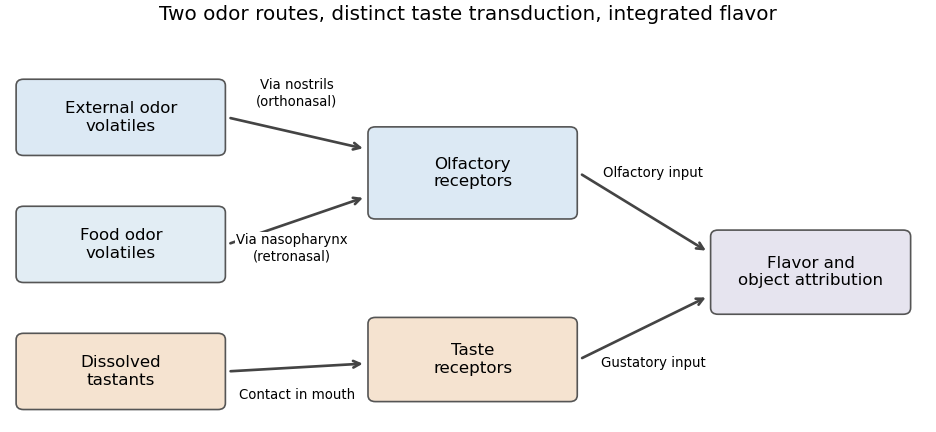
Original functional diagram of orthonasal and retronasal odor access and separate gustatory transduction; it illustrates routes, not a literal anatomical or neural wiring map
. Details. 
Paul Rozin's 1982 argument emphasized this dual role of olfaction and the ordinary use of “taste” for components of flavor. His observations included different evaluations of the smell and ingested flavor of foods and difficulty identifying the taste components associated with familiar smells.[ref]
Taste-smell confusions and the duality of the olfactory sense by Paul Rozin. Percept Psychophys 31, pp. 397–401, oral versus external attribution and behavioral observations
These findings motivate olfactory referral: an odor contribution is assigned to an object in the mouth. They do not imply that the nose is physiologically converted into a tongue, nor that every verbal use of “taste” reports a literal gustatory quality.Route manipulations offer stronger evidence than labels alone. Dana M. Small and colleagues delivered vaporized odorants by the orthonasal and retronasal routes while measuring responses with functional magnetic resonance imaging. They found route-dependent neural responses, including effects that depended on odor identity: patterns for chocolate were not reproduced identically by every comparison odor.[ref]
Differential neural responses evoked by orthonasal versus retronasal odorant perception in humans by Dana M. Small and others. Abstract, route-by-odor comparisons, Neuron 47, pp. 593–605
This supports a role for route and object context in olfactory processing. It does not identify a unique synesthesia mechanism; delivery route can alter peripheral stimulation and airflow, and a regional imaging difference alone cannot determine the experience causing it.Learning can also change the qualities attributed to odors. In Richard J. Stevenson and colleagues' 1995 experiments, selected odors were paired with sucrose or citric acid. Before-and-after ratings showed that the sucrose-paired odor was subsequently judged sweeter and the acid-paired odor sourer, including when odors were sniffed.[ref]
The acquisition of taste properties by odors by Richard J. Stevenson and others. Experiment 1 and conditioning tests, Learning and Motivation 26, pp. 433–455
This odor-taste conditioning shows that an odor's taste-like character need not be fixed by its chemistry. It supports a learned-synesthesia interpretation, but does not demonstrate that every participant acquired a separately experienced gustatory concurrent. Ratings can reflect perceptual change, associative retrieval, expectation or how the response scale is used.A narrow developmental synesthesia claim concerns an inducer reliably and involuntarily eliciting an additional experience, with stable individual mappings. Julia Simner and colleagues combined population sampling with objective checks rather than treating self-description as sufficient evidence.[ref]
Synaesthesia: The prevalence of atypical cross-modal experiences by Julia Simner and others. Sampling and objective verification, Perception 35, pp. 1024–1033
This motivates testing consistency and automaticity, while avoiding the claim that one test diagnoses every form. Synesthetic experiences can be internally associated rather than externally projected; an external sensory image is not required. Conversely, being able to learn or name an odor–taste association is not sufficient.A discriminating experiment would therefore assess the same odor repeatedly, measure its taste-like quality separately from odor identity and pleasantness, and manipulate oral delivery, taste congruence and learning history. Nose closure or controlled nasal delivery can test the contribution of olfactory access; separate gustatory and odor controls are needed because blocking airflow can also change breathing and stimulus delivery. Providing distinct rating scales can test response dumping, in which an unlisted sensory component is assigned to an available scale. Tasks measuring involuntary interference or transfer beyond the trained ratings would be more persuasive than a single “sweet” judgment. These are proposed controls, not invented results.
The theoretical alternatives also need to be stated fairly. A sensory system can normally bind correlated signals into one food percept, so integration need not be a wiring error. But its prevalence does not make an acquired taste-like odor quality unreal: ordinary learning can generate experiences that differ from the receptor category providing the input. The evidence supports common oral attribution and learned cross-sensory qualities; treating these as universally equivalent to developmental synesthesia goes beyond what the experiments establish.
Past exam of the perception course of the year 2 of the psychology (experimental) course of the University of Oxford 2022 4 Solution by Codex 0 2026-10-25
Codex 0 2026-10-25Feature integration theory remains influential as an account of binding and attentional selection, but its simplest serial-search interpretation is not a complete theory of everyday search or a ready-made model for every sense. Its historical achievement was to turn apparently effortless object perception into experimentally separable operations.
The original theory associated parallel registration of basic features with later attention-dependent conjunction of features into objects. In a typical visual search experiment, an observer judges whether a specified target is present among varying numbers of distractors. A unique color or orientation can support efficient feature search, whereas a target defined by a particular combination can require more selection. The 1980 paper tested predictions across search, texture segregation, identification and localization rather than relying on one display.[ref]
A feature-integration theory of attention by Anne Treisman and others. Cognitive Psychology 12, pp. 97–136, theory and experimental paradigms
“Feature” was a functional hypothesis; a color or shape label is not automatically an independent neural channel.The ideal serial model makes a quantitative prediction. Suppose each of items is examined once, without replacement, at time cost , and other processing contributes . If all items must be rejected on absent trials, . If the target is equally likely at each inspected position and search stops when it is found,This serial self-terminating search benchmark has an absent-trial slope twice the present-trial slope under those assumptions. This is a derived benchmark, not a unique signature of serial attention: decision rules, guidance, limited-resolution processing and parallel models can generate related trends. Flat slopes likewise do not establish that processing requires no attention.
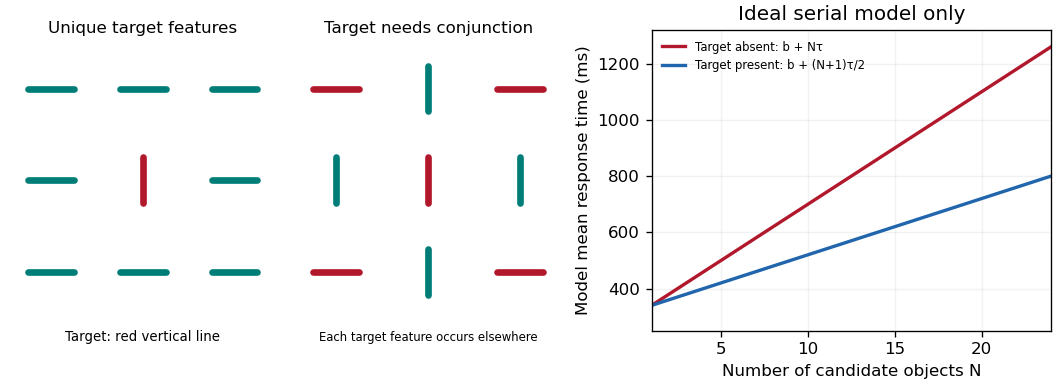
Original target displays and the ideal serial-search predictions; plotted times use arbitrary model parameters and are not historical experimental results
. Details. 
Binding errors provide a different test. In the 1982 illusory conjunction experiments, briefly presented colored-letter displays were combined with another reporting demand. Observers sometimes reported a letter with another item's color. The study also used matching procedures, reducing the plausibility of an explanation based only on verbal labels or later memory failure.[ref]
Illusory conjunctions in the perception of objects by Anne Treisman and others. Abstract and matching experiments, Cognitive Psychology 14, pp. 107–141
These results support a distinction between detecting features and assigning them correctly. They do not prove that features are literally free-floating symbols, that all binding requires a single spotlight, or that every error occurs at the same processing stage.Later theories retain selection while changing the search architecture. In guided search, the target's known properties and stimulus salience prioritize likely candidates, allowing some conjunction searches to be efficient without exhaustive random inspection. The 2021 Guided Search 6.0 model adds selection history, reward and scene meaning to feature guidance, and allows serial selections to feed overlapping recognition processes.[ref]
Guided Search 6.0: An updated model of visual search by Jeremy M. Wolfe. Abstract, Guidance, and The Search Process; Psychon Bull Rev 28, pp. 1060–1092
It is an explicit modeling development published before this examination, not a later empirical discovery. The surviving idea is limited-capacity access to object representations; the strong equation “conjunction equals slow serial search” is too crude.Real scenes reveal additional limits. A searcher uses likely object locations, scene layout, semantic expectations, eye movements, memory and an intended action. Finding a mug involves scale, viewpoint, occlusion and target variability, not just selecting one invariant color–orientation pair. Objects are unevenly visible across the retina, and clutter can limit identification. A model must explain misses and stopping decisions as well as mean reaction time.
The target prevalence effect is particularly instructive. Jeremy M. Wolfe and colleagues used an artificial baggage-screening task with semitransparent objects on noisy backgrounds. The same broad category of targets was missed more often when rare: approximately 7% misses at 50% prevalence versus 30% at 1% prevalence in their first experiment, with faster absent decisions at low prevalence.[ref]
Rare items often missed in visual searches by Jeremy M. Wolfe and others. Experiment 1 and Figure 2, Nature 435, pp. 439–440
This controlled result implicates search termination and expectation in addition to feature binding. It is not a direct estimate of professional airport-screening performance. Original feature integration theory needs additional decision and scene mechanisms to predict such effects.Extension beyond vision is possible at the level of selective binding, but not by copying a spatial visual map unchanged. Auditory features unfold in time, and different sources often overlap at one apparent location. Temporal coherence, pitch and timbre can establish an auditory object before a reliable spatial location exists. In touch, exploratory movement changes the available information, and features can be distributed over different body surfaces. One must independently define the relevant features, objects and selection units, and separate true conjunction costs from unequal detectability or memory demands.
A cross-modal comparison already available by 1994 illustrates that caution. David L. Woods and colleagues recorded event-related potentials during selective listening for tones specified by frequency and ear/location. Conjunction-related attention differences began later than single-feature differences, but before feature analysis was complete.[ref]
Stages of auditory feature conjunction: an event-related brain potential study by David L. Woods and others. Abstract, timing of feature and conjunction Nd responses, J Exp Psychol Hum Percept Perform 20, pp. 81–94
This supports temporally structured integration without a strictly completed feature stage followed by an entirely separate binding stage. Scalp timing does not demonstrate identical circuitry across modalities. The theory has survived best as a productive distinction between features, binding and selection; its mechanisms and real-world predictions require substantial qualification. Past exam of the perception course of the year 2 of the psychology (experimental) course of the University of Oxford 2022 3 Solution by Codex 0 2026-10-25
Codex 0 2026-10-25Hearing requires estimating sound-producing events from noisy mixtures at two ears. It involves mechanical detection, neural coding, source segregation and recognition. A frequency analysis alone cannot identify who or what produced the sound.
The physical input is an acoustic pressure fluctuation. At one ear a simplified room model iswhere source signals are filtered by propagation and reflection paths , and is noise. The convolution model assumes approximately linear, time-invariant propagation over the analysis interval; a moving source or listener can violate that simplification. This is a many-to-one inverse problem: different source configurations can produce similar ear signals. Distance, reverberation and head orientation alter a source's waveform. Pressure level is logarithmic: sound pressure level is , with reference in air. A 100 dB difference corresponds to a pressure ratio . The system must remain sensitive to weak signals while avoiding saturation over a large operating range.
The middle ear helps transfer airborne vibrations into cochlear fluids despite an acoustic impedance mismatch. Within the cochlea, the graded mechanics of the basilar membrane produce frequency-dependent traveling-wave responses: high frequencies peak nearer the base, low frequencies farther toward the apex. This tonotopy provides a distributed spectral representation. Deflection of sensory hair cells drives mechanotransduction; inner hair cells provide most afferent signaling, while outer hair cells contribute to mechanical amplification and tuning. Detection therefore depends on an active biological filter, not merely a passive bank of resonators.
A revealing experiment by Mario A. Ruggero and colleagues measured chinchilla basilar-membrane vibrations using the Mössbauer technique or Doppler laser velocimetry before and after a reversible intervention that reduced cochlear transduction currents. Responses near the characteristic frequency were reduced particularly strongly for weak sounds, with smaller changes at high levels and away from that frequency.[ref]
Furosemide Alters Organ of Corti Mechanics: Evidence for Feedback of Outer Hair Cells upon the Basilar Membrane by Mario A. Ruggero and others. Abstract and response-level/frequency comparisons, J Neurosci 11, pp. 1057–1067
This supports feedback-dependent cochlear gain. The intervention also affects other cochlear processes, so it does not by itself identify every cellular contribution or directly measure human loudness. The important methodological contrast is controlled sound input plus measured mechanical output and a reversible physiological perturbation.The resulting neural code must preserve several attributes simultaneously. Place of excitation and neural phase locking can provide complementary frequency and temporal information; firing rates, adaptation and population responses encode level and envelopes. Individual neurons have limited dynamic ranges, and temporal precision has limits. Pitch is not simply the location of the strongest spectral component, and timbre depends on spectral shape and temporal development. Even physically, a signal containing harmonics at 200 and 300 Hz repeats every 10 ms although it contains no 100 Hz component: both components complete integer cycles in that interval. Recovering source periodicity is therefore different from selecting a component in a frequency spectrum. It does not follow that every such signal has one obligatory perceptual pitch.
Localization adds ambiguity. Ear separation yields interaural time differences; head shadow yields interaural level differences; outer-ear filtering supplies direction-dependent spectral cues. In an ideal far-field point-receiver model, , obtained by dividing the path-length difference by sound speed. Real head diffraction modifies this approximation. One time difference can be compatible with several spatial directions, and phase is ambiguous when several cycles fit the delay. Head-related transfer functions, head movements and environmental context help resolve these ambiguities. Reverberation also requires distinguishing useful early information from later reflections.
Competing sources create both energetic masking, in which the target is poorly represented against overlapping acoustic energy, and informational masking, involving source confusion or selection despite available acoustic cues. Common onsets, harmonic relations, coherent modulation, timbre and spatial cues help group components into auditory objects. The grouping must remain stable when streams overlap, but also update when a source changes. These are the problems of auditory scene analysis.
E. Colin Cherry's classic experiments used simultaneous spoken messages and separate messages delivered to the two ears. Asking listeners to repeat one message while ignoring the other made source selection experimentally measurable.[ref]
Some Experiments on the Recognition of Speech, with One and with Two Ears by E. Colin Cherry. Experiments on simultaneous speech and dichotic shadowing, JASA 25, pp. 975–979
Ear and voice differences can aid selection; the result does not show that unattended information is never processed, nor that real rooms provide the clean separation of headphone channels.Finally, meaningful recognition requires tolerance of speaker, rate and context variation. Richard M. Warren removed a speech segment and substituted a cough-like sound. Listeners could hear the utterance as continuous and had difficulty locating the replacement, whereas a silent interruption was more readily detected.[ref]
Perceptual Restoration of Missing Speech Sounds by Richard M. Warren. Science 167, pp. 392–393, replacement-sound versus silence comparison
Phonemic restoration shows that recognition uses constraints beyond the momentary waveform; it does not mean missing acoustic information has been physically recovered. Successful auditory perception combines peripheral sensitivity with grouping and context-sensitive inference, while retaining the possibility of masking, ambiguity and systematic error. Past exam of the perception course of the year 2 of the psychology (experimental) course of the University of Oxford 2022 2 Solution by Codex 0 2026-10-25
Codex 0 2026-10-25A psychometric function specifies the probability of a measured response as a physical stimulus variable changes. The response might be “present,” “clockwise,” or correct in a two-alternative forced-choice task. These are different dependent variables. Understanding the function's shape is necessary to distinguish sensory changes from decision, attention and measurement effects. A reported threshold without its task, response definition and performance criterion is incomplete. For example, a visual experiment could use calibrated display visual contrasts, timed two-interval presentations, fixation control and button choices; the observer’s choice supplies the dependent variable.
A smooth curve need not mean that a receptor has a smoothly varying conscious threshold. Consider a noisy internal response , with “yes” reported when . Here is a decision criterion, not necessarily a biological detection limit. If is the noise cumulative distribution function,With Gaussian noise of standard deviation , symmetry of the normal distribution gives a Gaussian psychometric functionThe sigmoid is therefore a distribution tail swept by a changing mean response. At low means, few responses exceed the criterion; near it, many trials switch category; at high means, almost all do. The derivative is , so slope depends on both sensory gain and variability. Moving shifts the curve without necessarily improving sensitivity. If noise vanished and the mean crossed the criterion sharply, this simple model would approach a step rather than a graded transition.
There is no universal sigmoid in every stimulus coordinate. A nonlinear transduction function changes the curve, and a logarithmic intensity axis changes its appearance. As a counterexample, a toy detector responding whenever at least one event occurs in a Poisson distribution with mean has . This is concave on a linear positive-intensity axis. It follows immediately by subtracting the zero-event probability from one. It is a mathematical example, not evidence that human detection universally uses a one-event rule. Variation in attention or decision criterion across trials can broaden a measured curve even if the within-state sensory noise is unchanged.
Task conventions determine the endpoints. A useful psychometric function with guessing and lapses isHere is the lower asymptote and the upper error asymptote. In balanced two-alternative forced-choice performance, is commonly fixed at . A yes/no response probability does not automatically have this lower bound. In this particular cumulative-Gaussian parameterization, ; thus gives 75% correct only for and . Other function families use different scale parameters. Nor is automatically the fraction of inattentive trials: if a fraction of trials involves random two-choice guessing, those trials contribute an upper error probability .
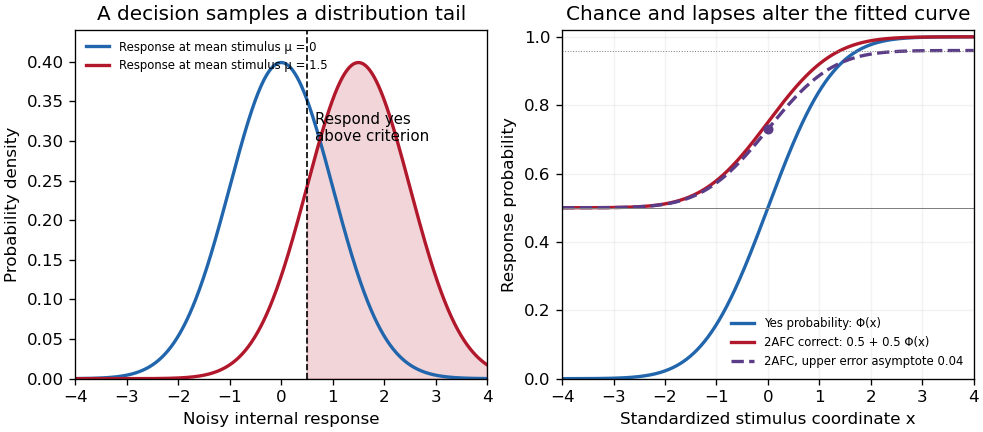
Original theoretical noisy-decision and psychometric-curve examples; the right panel is a phenomenological family, not observed participant data
. Details. 
The relation to signal detection theory is equally important. Under independent equal-variance Gaussian signal and noise samples, define sensitivity index . In an ideal two-interval comparison, the response difference has mean and variance , givingThis Gaussian forced-choice sensitivity relation follows by standardizing the Gaussian difference. It is a specified decision model, not an identity for every forced-choice experiment. In a yes/no task, hits and false alarms are both needed: under the corresponding equal-variance model, . A criterion change can increase both rates while leaving unchanged. The phenomenological fit above need not have parameters identical to these internal-response parameters.
These distinctions affect experiments. Felix A. Wichmann and N. Jeremy Hill used simulation and statistical modeling to show that unmodeled stimulus-independent errors can bias threshold and slope estimates, even when lapses are uncommon.[ref]
The psychometric function: I. Fitting, sampling, and goodness of fit by Felix A. Wichmann and N. Jeremy Hill. Notation, lapse simulations, and summary; Percept Psychophys 63, pp. 1293–1313
Ignoring high-intensity errors can make a function appear shallower and falsely suggest worse sensory precision. A broad group-average curve can likewise reflect a mixture of individually sharp functions with different locations.At predetermined stimulus levels, independent trials give counts . The parameter-dependent log-likelihood is . Fitting this binomial likelihood, checking goodness of fit and quantifying uncertainty are preferable to drawing a curve through noisy proportions. Easy trials help constrain lapses; levels near the transition constrain location and slope. Randomization, stable calibration and checks for learning or fatigue help distinguish a stationary sensory relation from drift. Adaptive procedures require inference appropriate to their sampling design.
Thus the function is both a description and a testable model. Its shape determines what a threshold means, how an experiment should sample, and which claims about sensory mechanisms are warranted.
Past exam of the perception course of the year 2 of the psychology (experimental) course of the University of Oxford 2022 1 Solution by Codex 0 2026-10-25
Codex 0 2026-10-25Individual differences show that color vision depends on receptor signals, their neural interpretation and the task used to measure them. They provide natural perturbations of the system, but differences in genes, matching, discrimination, naming and subjective appearance must not be treated as interchangeable.
A useful starting point is the principle of univariance. For a cone cell class , a simplified receptor quantum catch is , where is the incident photon distribution, including optical filtering, and is effective absorptance. One receptor's absorption count does not uniquely identify wavelength: increasing intensity can compensate for a change in spectral sensitivity. Comparing classes supplies spectral information. With three classes, distinct spectra can satisfy three equal-catch constraints and therefore be metamers. This is information loss: if a spectrum is represented by more than three independent wavelength bins, its three-channel sampling matrix has a nontrivial kernel. Around a strictly positive spectrum, sufficiently small changes along that kernel preserve nonnegative stimulus values and all three catches. Thus the observer, not wavelength alone, defines a color match. With luminance fixed, three independent receptor coordinates leave at most two independent chromatic coordinates.
Inherited differences test that account. Dichromacy removes one independent class of cone input; anomalous trichromacy retains three classes but with altered spectral separation, often weakening particular discriminations. L and M are overlapping long- and middle-wave sensitivities, not detectors that individually label light “red” and “green.” Molecular work by Jeremy Nathans and colleagues identified cone pigment genes, then related inherited red–green variation to changes in the corresponding gene arrays.[ref]
Molecular genetics of human color vision: the genes encoding blue, green, and red pigments by Jeremy Nathans and others. Science 232, pp. 193–202, pigment-gene identification
[ref]Molecular Genetics of Inherited Variation in Human Color Vision by Jeremy Nathans and others. Science 232, pp. 203–210, genotype–phenotype comparison
The important inference is a relation between biological variation and available spectral signals, not a claim that all observers with one label have identical vision.A Rayleigh color match makes that inference measurable. An observer adjusts a mixture of two narrowband lights to match a comparison light, with brightness adjusted separately. The accepted mixture and matching range constrain pigment sensitivities and discriminability. A color discrimination task instead measures whether two stimuli can be distinguished, ideally with luminance cues controlled and a fitted psychometric function. Plate tests and everyday color names are less specific: learned labels or a brightness difference can support a correct response without normal chromatic discrimination. Conversely, reduced discrimination does not imply a world without color.
Individual differences also reveal compensation. Heidi Hofer and colleagues used adaptive optics retinal imaging with selective pigment bleaching and retinal densitometry to classify cone cells in living eyes. In their small sample, men passing normal color-vision tests had L:M cone ratios spanning approximately 1.1:1 to 16.5:1; the paper's corrected abstract supplies the lower value. The ratio was not fixed even within the normal category.[ref]
Organization of the Human Trichromatic Cone Mosaic by Heidi Hofer and others. Methods and abstract, eight observers; corrected L:M ratio; J Neurosci 25, pp. 9669–9679
This rules out a simple requirement for one universal cone proportion. For example, opponent color processing could compare gain-adjusted cone signals rather than raw cell counts. It is compatible with post-receptoral gain adjustment and chromatic adaptation, but normal test scores do not prove identical subjective experiences or one uniquely identified compensatory mechanism.A stronger question is whether more receptor classes create more perceptual dimensions. Heterozygous carriers of certain X-linked pigment variants can, through X-chromosome inactivation, have a retina containing more than three spectrally distinct cone types. Yet four types need not supply four functionally independent signals to behavior. Gabriele Jordan and colleagues combined forced-choice matching, multidimensional scaling and genetic analysis. One of 24 obligate carriers of deuteranomaly showed behavior consistent with tetrachromacy across their tests; most did not.[ref]
The dimensionality of color vision in carriers of anomalous trichromacy by Gabriele Jordan and others. Abstract and behavioral/genetic tests, J Vis 10(8):12
This distinction between potential and demonstrated extra dimensionality is crucial. The selected sample cannot establish population prevalence, and additional opsin variants alone cannot establish enhanced discrimination or richer experience.Finally, optical and experiential differences must be controlled. Lens and macular filtering change the spectrum reaching the cone cells; age, adaptation, illumination and task learning can therefore mimic or modify receptor differences. Repeated measurements should separate within-person variability from stable between-person variation. Matching should be compared with discrimination, naming and appearance judgments rather than assuming that one measures all the others. Color naming can change without changing the receptor information; matching can change without entailing a particular verbal category.
The strongest conclusions arise when genetics, retinal measurements and controlled behavior converge. Variation establishes both the constraints imposed by receptor sampling and the flexibility of later processing; it does not directly disclose another person's color qualia.
There are unlisted articles, also show them or only show them.