
A smooth cosmological bounce is a positive minimum of the scale factor: contraction changes to expansion, with , and in the nondegenerate case. The closed slicing of de Sitter spacetime gives , whose minimum is . The Friedmann acceleration equation with zero separate cosmological constant requires there.
For a spatially flat FLRW metric containing conserved pressureless matter and radiation in cosmology, with and conformal time zero at the Big Bang, the Friedmann equation gives . Separating the positive square root gives the displayed scale factor. At matter-radiation equality, and . Here the prime denotes differentiation with respect to , not .
For FRET efficiency and distinct positive reporter distances A and B, the absolute contrast is maximized at the geometric mean Förster distance . Substitution of makes the derivative have the sign of . The maximum is and the two efficiencies then sum to one. If , every choice gives zero contrast and there is no unique optimum.
For n identical independent available FRET acceptors, transfer rates add. With single-pair FRET efficiency E, the donor exit probability is . It is not nE; competition with the donor's other decay routes must be retained.
The surface elevation is the signed height of a free surface relative to a chosen reference level, commonly its undisturbed position. With upward coordinate , the surface is the graph . Its evolution obeys the kinematic boundary condition for a free-surface graph.
Choose a strictly decreasing positive sequence . Begin with and at step keep two closed end intervals of length from every component interval of . This constructs a compact set withThe second equality is continuity from above of a measure. Every stage has positive gaps and maximum component length at most , so contains no nondegenerate interval and is a nowhere dense set. It has no isolated points: both endpoints of the stage- component containing a point remain in , and at least one distinct endpoint is within . Thus its topological sparseness is compatible with positive Lebesgue measure.
Taking gives the usual Cantor set of measure zero. Taking gives a generalized construction of measure . This is one useful family of generalized constructions; the removed intervals need not have the same proportions at every stage.
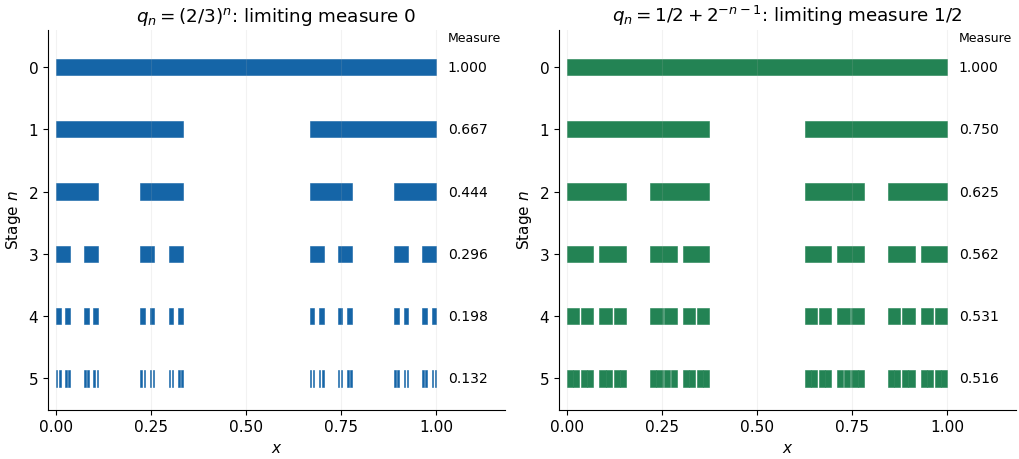
Generalized Cantor constructions with zero and positive limiting Lebesgue measure
. Each row shows the retained closed intervals at one stage. The two constructions have the same binary splitting pattern but different limits of the total retained length. Details.
For , put . The regular distribution of is a tempered distribution, since the function is bounded. Its Fourier transform is the integrable functionwith arbitrary finite value at zero when the displayed integral diverges there. To prove the identity, the gamma function gives . Pair this with a Schwartz function, use the Fourier transform of a Gaussian, and interchange integrals by Fubini's theorem. The absolute bound for the transformed pairing follows from Tonelli's theorem:The positive kernel and dominated convergence give positivity and continuity away from zero. It has a continuous representative at zero exactly when , in which case . For , Fatou's lemma gives as , so no change on a set of zero Lebesgue measure can give continuity.
A time-dependent response can be represented by its Fourier transform in angular frequency. With , a time derivative transforms to when boundary terms vanish. A time-translation-invariant response convolution becomes multiplication by a frequency-dependent response coefficient. This is why a dispersive electrical conductivity is naturally specified in the frequency domain. The inverse-transform modes use .
One standard sufficient form states that the Fourier series of a piecewise continuously differentiable periodic function converges at to . At a continuity point it equals . This modern sufficient form should be distinguished from the exact hypotheses of the 1829 original.[ref]
For positive integers , the sine functions form an orthogonal family on :The same formula holds for the corresponding cosine functions when both indices are positive. Product-to-sum identities reduce the distinct-index products to cosines with nonzero integer frequencies, each with zero integral; for matching indices, the squared sine or cosine has mean . This proves the formula and explains why separate normal modes of a uniform fixed-end string make additive contributions to its kinetic energy and potential energy. The constant cosine has squared norm rather than .
For a sequence indexed by the integers, its semidiscrete Fourier transform is the displayed Fourier series in . For square-summable data the series is interpreted in the L2 norm. Its inversion and Parseval identity areThe physical-frequency convention uses and on . This is distinct from the discrete Fourier transform of a finite vector. Translation-invariant finite difference operators become Fourier multipliers, making Fourier stability analysis possible.
The average of future-directed normalized four-velocities is generally timelike but is not normalized. For an isotropic ensemble with common Lorentz factor , the mean is and has squared norm . A normalized bulk velocity instead equals . In a perfect fluid in general relativity its rest-frame energy eigenvector is the natural bulk choice; the rest-frame energy density includes random kinetic energy.
If a fixed component of a Lorentz four-vector vanishes in every Lorentz frame, the vector is zero. For its time component, arbitrary infinitesimal boosts force every spatial component to vanish; for a spatial component, first use rotations and then a boost. Applied to the incoming-minus-outgoing total four-momentum, this shows that energy balance in every inertial frame implies full four-momentum conservation. The statement fails for general tensors: a nonzero antisymmetric tensor has zero diagonal components in all frames.
A sum of particle four-momenta at specified events is a four-vector, but sums recomputed at simultaneous events in different inertial frames need not correspond to that same four-vector. For opposite equal electric charges initially at rest a distance apart, a longitudinal electric field switched on simultaneously in the laboratory produces zero total laboratory three-momentum. In a frame moving at , the switch-on events are separated by ; during that interval only one force acts. The late equal-time total three-momentum is , while the Lorentz transformation of an equal-laboratory-time sum varies as the laboratory pair's energy grows. Closed-system four-momentum conservation requires including the field and external apparatus.
Two particles with unequal rest energies and equal opposite velocities have total energy but nonzero total momentum. If they form a composite while emitting a photon transverse to their initial axis, the final composite rest energy satisfies the displayed identity. It follows by squaring the residual four-momentum. Neglecting binding, put ; the minimum incoming energy is , where . An exact threshold requires the composite rest mass, not just the incoming constituent masses.
A fixed set of four-momenta at fixed events sums to a four-vector, whether or not the set is the whole physical system. Its Minkowski norm is invariant. Reapplying a frame-dependent particle-selection rule or sampling different events need not give the transformed same sum. Physical conservation across different hypersurfaces is a separate issue involving interactions and boundary flux.
The end for the sake of which a process or organized activity is explained in Aristotelian natural philosophy. Such an explanation should be distinguished from a modern dynamical force law.
A theory is complete in the EPR sense only if its description represents every element of physical reality. Their sufficient reality criterion uses certain prediction without disturbance. Applying it to alternative measurements on a remote partner also requires an independence premise concerning the unmeasured system's physical reality; that premise must not be suppressed when presenting the argument.[ref]
Can Quantum-Mechanical Description of Physical Reality Be Considered Complete? by Albert Einstein and others. 1935, pages 777 and 779–780
A ratio of response amplitude to imposed excitation amplitude in a vibration problem. One must specify the input and output: displacement transmissibility and force transmissibility are different measurements. For a base-excited oscillator whose spring and viscous damper both act relative to its support, complex displacement amplitudes obey . Its magnitude is the displacement transmissibility. A damper fixed to the laboratory rather than the support has a different numerator, so the attachment geometry matters.
There are unlisted articles, also show them or only show them.