Past exam of the relativistic Astrophysics and Cosmology course of the University of Cambridge 2012 Paper 1 2 Solution by  Codex 0 2026-10-20
Here is the cosmological scale factor, is cosmic time and is the Hubble parameter. With a length, labels positively curved, flat and negatively curved spatial sections. This is unrelated to Question 1's specific orbital energy. The density is mass-equivalent energy density: has energy-per-volume units. In the displayed Friedmann equation has units ; the geometric cosmological constant is . For a separately conserved fluid of constant equation of state , the cosmological perfect-fluid continuity equation gives , so : zero for pressureless matter and one for radiation. With several fluids, sum their densities in the expansion equation and evolve each separately.
Setting cosmological spatial curvature and the cosmological constant to zero gives the mass-equivalent cosmological critical density,Its energy-density version is ; keeping this distinction is necessary when dividing a radiation energy density by below.
In an Einstein-de Sitter universe, integrates to and . With ,Here are the two epoch redshifts relative to today. This is elapsed cosmic time, not comoving distance divided by .
For collisionless preservation of a Planck spectrum, use frequency redshift as well as photon-number conservation. Let , so a frequency bin now corresponds to and initially. Collisionless propagation conserves photon number in the corresponding comoving bin:For an initial blackbody spectrum, insert its Planck distribution to obtainThe factors from the numerator cancel the spectral dilution factor, while the exponent changes only the temperature. Integrating gives photon number density proportional to and radiation energy density proportional to . Conservation of total photon number alone would not guarantee a blackbody spectrum shape; the frequency-bin mapping and absence of injection or spectral redistribution are essential.
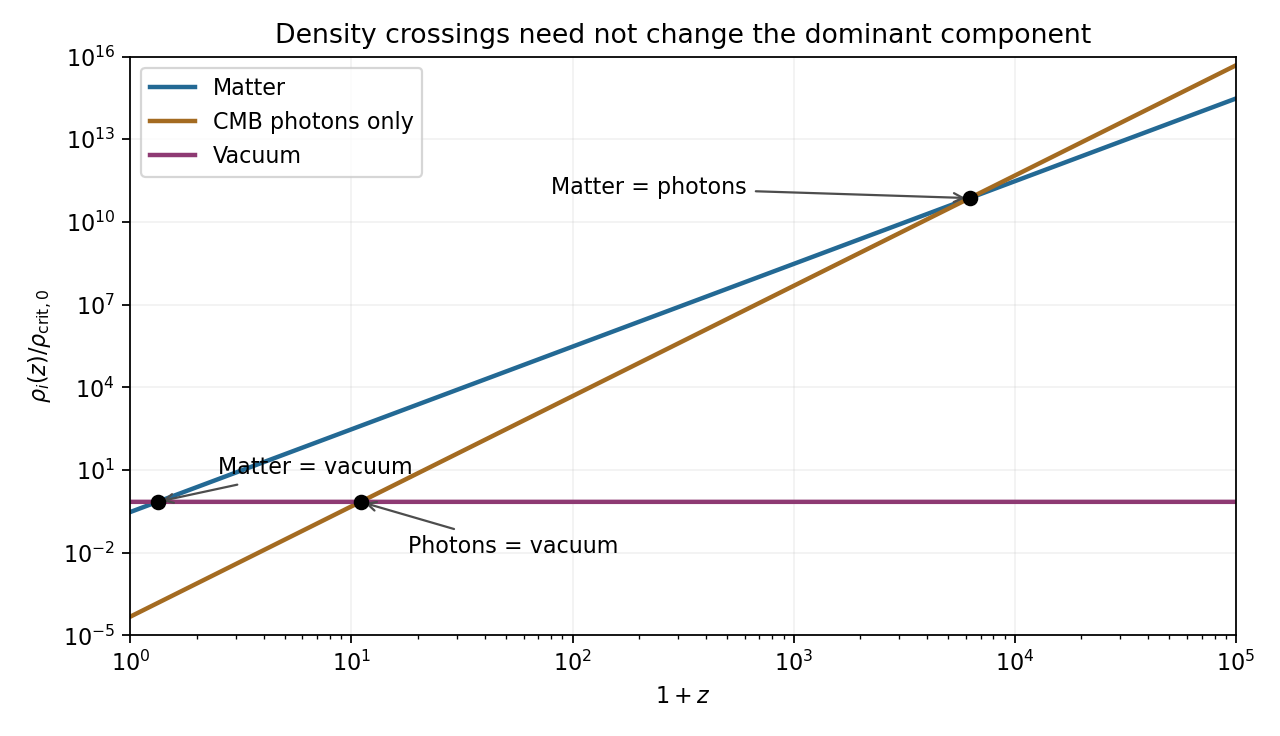
For the numerical density comparisons, the supplied Hubble constant is . Taking and givesThe radiation specified here is cosmic microwave background photons only. Adding a relic neutrino density would change the photon-only matter-radiation equality result. The rounded present matter and vacuum fractions sum to one without this small photon contribution; the requested pairwise density comparisons do not require silently renormalizing them.
For the final unlabelled flight-time request, insert the case-(c) value into the stipulated Einstein-de Sitter formula:The two model ages are approximately and years. This uses exactly the instructed matter-only model with the same . It is not an exact age difference in the matter-plus-vacuum cosmology; a high-redshift matter-era normalization using would be a different approximation.

Past exam of the relativistic Astrophysics and Cosmology course of the University of Cambridge 2012 Paper 1 1 Solution by Codex 0 2026-10-20
Codex 0 2026-10-20Take overdots in this question to mean differentiation with respect to the orbiting particle's proper time . Write , and , with the specific angular momentum. Then the dimensionless timelike effective potential isThe last term is the relativistic correction to the Newtonian centrifugal-plus-gravitational potential. At large the two agree. Newtonian angular momentum gives an infinite inner centrifugal barrier for nonzero ; the relativistic correction lowers that barrier and permits plunge. The exterior problem starts at , where ; extrapolating the potential towards is not a static exterior description.
Circular orbits obeyThere are two extrema when : an inner maximum representing an unstable circular orbit and an outer minimum representing a stable one. At equality they merge at ; below it neither exists. More explicitly, evaluate the curvature at a circular orbit:Timelike circular orbits require . They are radially stable for , so the marginally stable inner limit is . The Newtonian potential instead has one stable minimum at , without an innermost stable circular orbit.
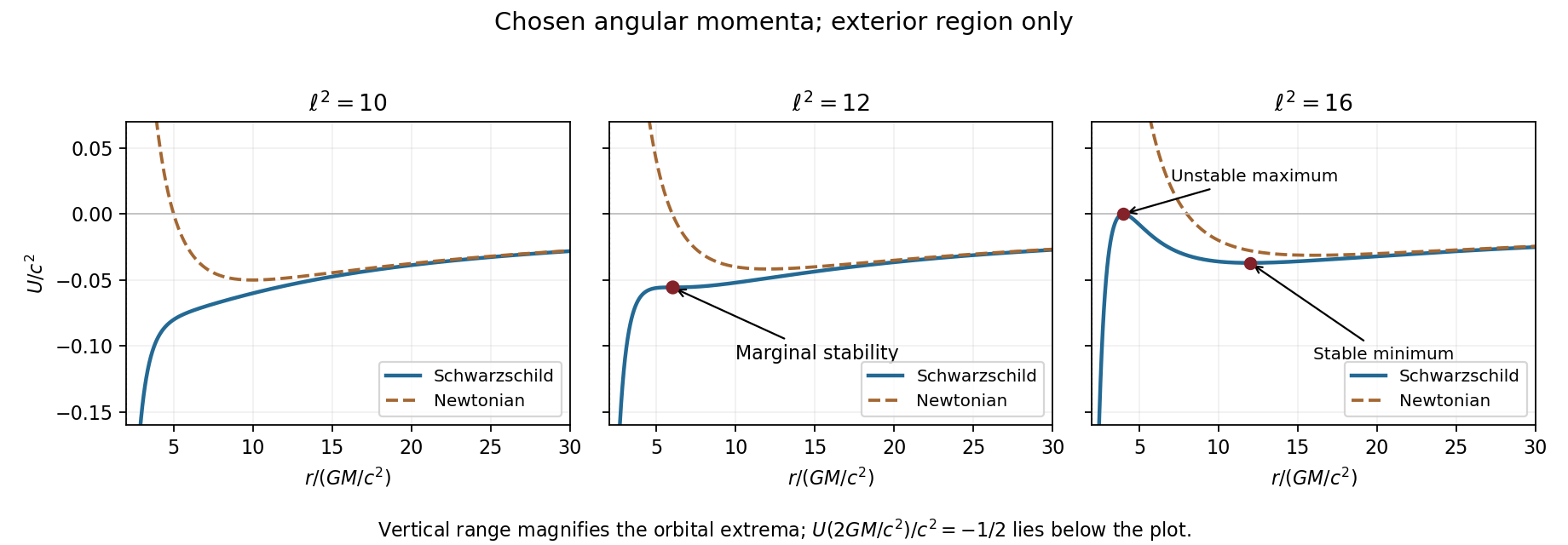
Schwarzschild and Newtonian potentials
. Details. 
For the Schwarzschild circular-orbit local speed in the question, is the Lorentz factor relative to a local Schwarzschild static observer, not . That observer's clock obeys . Since the particle passes with local speed , . Circular normalization givesThus at the innermost stable circular orbit. Using Schwarzschild time in place of the local clock would give a different speed.
For the conserved particle energy measured at infinity, substitute in the circular energy equation. Setting givesTake the positive root for a future-directed exterior orbit. It approaches at large radius. The marginally bound circular Schwarzschild orbit solves , giving and hence at finite radius. It is unstable; strictly bound circular orbits have , with . The phrase smallest bound orbit here denotes this marginal circular limit, not a prohibition on a bound-energy trajectory plunging below it.
At the innermost stable circular orbit,A radiatively efficient thin disc with a zero-torque inner boundary condition can therefore release about 5.7% of the accreted rest energy before the plunge. energy advection, stress at the inner edge and photon capture can alter the escaping luminosity, so this is a model efficiency rather than a universal emitted fraction.
For the Kerr ISCO spin limits of an equatorial prograde disc around a rapidly rotating Kerr black hole, the innermost stable circular orbit moves inward and its specific energy decreases. In the ideal extremal limit its Boyer-Lindquist radius tends to , , and the corresponding binding-energy efficiency tends to 42.3%. Retrograde rotation has the opposite trend: the extremal limit is , , giving about 3.8%. The prograde limiting coordinate radius does not identify a massive orbit with the null horizon generator.[ref]
Rotating Black Holes: Locally Nonrotating Frames, Energy Extraction, and Scalar Synchrotron Radiation by James M. Bardeen and others. §II, Eqs. 2.20–2.23 and Fig. 1, pp. 351–353
Finally . Dividing by this givesIts algebraic form is exactly Newtonian, but is the Schwarzschild spacetime areal radius and Schwarzschild time, normalized at infinity. Local clock rates, orbit stability and binding energy remain relativistic. With ,The marginally bound circular-orbit frequency is about . These Schwarzschild ISCO orbital frequencies and marginally bound frequencies are rotation frequencies per distant stationary observer's time, as intended by using . A static observer at finite radius instead divides both frequencies by , leaving their ratio unchanged. Identifying an observed quasi-periodic oscillation with the innermost stable circular orbit orbital frequency is an additional astrophysical assumption.
There are unlisted articles, also show them or only show them.