Past exam of the medical physics course of the University of Cambridge 2012 Paper 1 3 b Solution by  Codex 0 2026-10-20
 Past exam of the medical physics course of the University of Cambridge 2012 Paper 1 3 a Solution by Codex 0 2026-10-20
Codex 0 2026-10-20TODO: Biology deferred at the user's request: clinical registration applications and their validation requirements.
Generic image registration estimates a coordinate transformation aligning corresponding features in two images. A rigid transform permits translation and rotation, an affine transform additionally permits linear deformation, and a nonrigid model permits spatially varying displacement. The transformation class expresses assumptions about what changes between the acquisitions.
One can minimize a discrepancy between and , using interpolated image values and an explicit optimization procedure. Squared intensity differences suit some comparable acquisitions; mutual information can compare statistical dependence when image contrasts differ. Landmarks, feature descriptors or additional geometric constraints provide other information. Smoothness or other regularization controls overly flexible transformations. A favorable objective value does not by itself prove correct feature correspondence.
Past exam of the frontiers of Observational Astrophysics course of the University of Cambridge 2012 Paper 1 3 d Solution by Codex 0 2026-10-20
Codex 0 2026-10-20Atmospheric refractive-index fluctuations distort the incoming wavefront. In a Kolmogorov model, the long-exposure seeing width is approximately , where the Fried parameter scales as . High-quality sites and longer wavelengths can improve the observing conditions, but do not eliminate the distorted phase. Short coherence times also require rapid correction or exposure.
Adaptive optics uses a guide source, wavefront sensor, deformable mirror and fast feedback loop. Tip-tilt correction removes image wander; higher-order actuators correct finer spatial distortions. Finite actuator spacing, sensor noise, delay and changing turbulence leave residual errors. A nearby natural guide star limits sky coverage, while a laser beacon supplies higher-order reference information over more directions. Conventional laser-guide-star systems still need independent image-motion information, commonly from a natural star.[ref]
Laser Guide Star for Adaptive Optics by European Southern Observatory. ESO, tip-tilt information and sky-coverage limitation
Anisoplanatism limits the corrected field; laser finite-altitude sampling and variable PSFs need their own calibration.Lucky imaging selects favorable short exposures and aligns them, trading exposure efficiency and photon statistics for reduced blur. Speckle interferometry uses short-exposure spatial-frequency information and suitable phase/statistical reconstruction instead of simply averaging away the speckles. Both need adequate time resolution, detector performance and calibration; selection cannot restore information never recorded. Interferometric methods can also recover fine structure with phase control or closure information. These approaches correct or infer wavefront effects; they do not make clouds, absorption or every atmospheric amplitude fluctuation disappear.[ref]
Adaptive Optics by European Southern Observatory. wavefront sensing, deformable-mirror correction and atmospheric limitations
Past exam of the frontiers of Observational Astrophysics course of the University of Cambridge 2012 Paper 1 3 c Solution by Codex 0 2026-10-20
Codex 0 2026-10-20A charge-coupled device converts absorbed photons into stored charge in semiconductor potential wells. An exposure accumulates a pixelated image; clocked electrodes transfer rows toward a serial register and output amplifier. Quantum efficiency, pixel sampling and optical throughput connect collected photons to the expected signal. In ordinary optical imaging it primarily counts photoelectrons rather than independently measuring every photon's energy.
The CCD noise budget combines source and sky shot noise, dark-current fluctuations and read noise. For an aperture containing pixels, known background expectation , total dark expectation , source expectation and per-pixel read noise ,Estimating the background from a finite separate region adds its own uncertainty. Cooling reduces dark current; longer integration reduces the relative importance of one read but can encounter saturation, cosmic rays or changing conditions. Full well capacity, amplifier gain, linearity, blooming and charge-transfer efficiency limit useful detector dynamic range.
Bias frames establish the electronic offset; matched dark frames characterize time- and temperature-dependent dark signal. Flat fields calibrate pixel-to-pixel response and illumination, with appropriate attention to wavelength. Bad-pixel masks, repeated exposures and dithering help reject defects and cosmic rays. A calibrated PSF and astrometric solution are needed for reliable photometry and positions. High quantum efficiency and stable linear integration are advantages, but an uncalibrated count array is not yet an astronomical flux map.
Past exam of the frontiers of Observational Astrophysics course of the University of Cambridge 2012 Paper 1 3 b Solution by Codex 0 2026-10-20
Codex 0 2026-10-20The radial-velocity method measures repeated Doppler shifts of stellar spectral lines as a star responds to an orbiting companion. A stable high-resolution spectrograph and wavelength reference distinguish stellar motion from instrumental drift; many lines or a spectral template improve precision. A Keplerian fit yields period, eccentricity, phase and velocity semi-amplitude. For a companion mass , stellar mass and inclination ,With a stellar-mass estimate and , this measures approximately , a minimum mass unless the inclination is independently constrained. A nearly face-on orbit can hide a massive companion. The method preferentially detects larger masses, shorter periods and favorable inclinations.
Starspots, activity, pulsations, rotation, blended spectra and sampling aliases can imitate or distort a periodic signal. Line-shape diagnostics, activity indicators, repeated observations and independent constraints help test a planetary explanation. Photon noise and spectral line width constrain precision even for a perfectly calibrated spectrograph. Multiple planets or incomplete orbital coverage require an adequate model and longer monitoring; a periodic centroid shift alone is not a proof of a particular planetary system.
Past exam of the frontiers of Observational Astrophysics course of the University of Cambridge 2012 Paper 1 3 a Solution by Codex 0 2026-10-20
Codex 0 2026-10-20Thermal bremsstrahlung arises from electron acceleration in ion Coulomb fields. For a thermal plasma its optically thin spectral emissivity has the dependenceThe exponential high-energy slope helps constrain temperature in X-ray spectra, with composition, absorption and other emission components included. At radio frequencies with , the thin spectrum is much flatter and does not alone determine a unique temperature; the Gaunt factor supplies a weak frequency dependence.
For an approximately isothermal layer, radiative transfer gives . Radio free-free opacity scales approximately as , where the hydrogen-plasma emission measure is . A resolved optically thick brightness temperature approaches ; an unresolved filling factor lowers the observed value. The turnover between thin and thick regimes helps constrain emission measure.
An angular extent and distance give a physical size, and an assumed geometry supplies a line-of-sight depth. Combining that depth with emission measure estimates an rms density, . Clumping, filling factor, composition and unknown depth preserve a density-depth degeneracy of free-free radiation. These measurements constrain different combinations of temperature, density and size rather than independently fixing all three without assumptions.
Past exam of the frontiers of Observational Astrophysics course of the University of Cambridge 2012 Paper 1 1 c Solution by Codex 0 2026-10-20
Codex 0 2026-10-20The wavelength corresponds to about , in the low-frequency decrement part of the thermal Sunyaev-Zeldovich effect. Hot cluster electrons inverse-Compton scatter CMB photons. In the Rayleigh-Jeans limit,The signal probes integrated electron pressure. Short baselines give sensitivity to extended arcminute-scale cluster structure, while the primary field covers the cluster and surrounding sky. The array's several-arcminute resolution suits many such structures; it is not equally well matched to every cluster size.
Simultaneous cross-correlations reject uncorrelated receiver noise and provide spatial information; compact radio sources can be constrained with the relatively longer baselines and separated from extended structure. Broad frequency coverage helps sensitivity provided channel smearing is controlled. Correlated atmospheric emission, calibration error, primordial CMB fluctuations and radio-source contamination remain relevant. The lack of zero and very short spacings also means that total integrated cluster flux requires a model or complementary data. An interferometer is therefore useful for the spatially resolved decrement, rather than automatically measuring every cluster's full pressure integral.
Past exam of the frontiers of Observational Astrophysics course of the University of Cambridge 2012 Paper 1 1 b Solution by Codex 0 2026-10-20
Codex 0 2026-10-20Use the projected baseline along the source offset, , and . The first bandwidth null occurs at . A worst-case gives . That is a zero of the response, not a good usable bandwidth. A quantitative maximum needs an allowed attenuation.
For example, requiring a response of at least gives at . Hencefor that worst projection. A strictly east-west offset in a sides-aligned square instead samples at most , giving a first null and a ten-percent-loss bandwidth. The original two-antenna geometry supplies an additional projection; these examples use its maximum magnitude. Thus a bandwidth of order is a reasonable conservative estimate with a stated small-loss criterion, rather than a unique geometry-free limit.
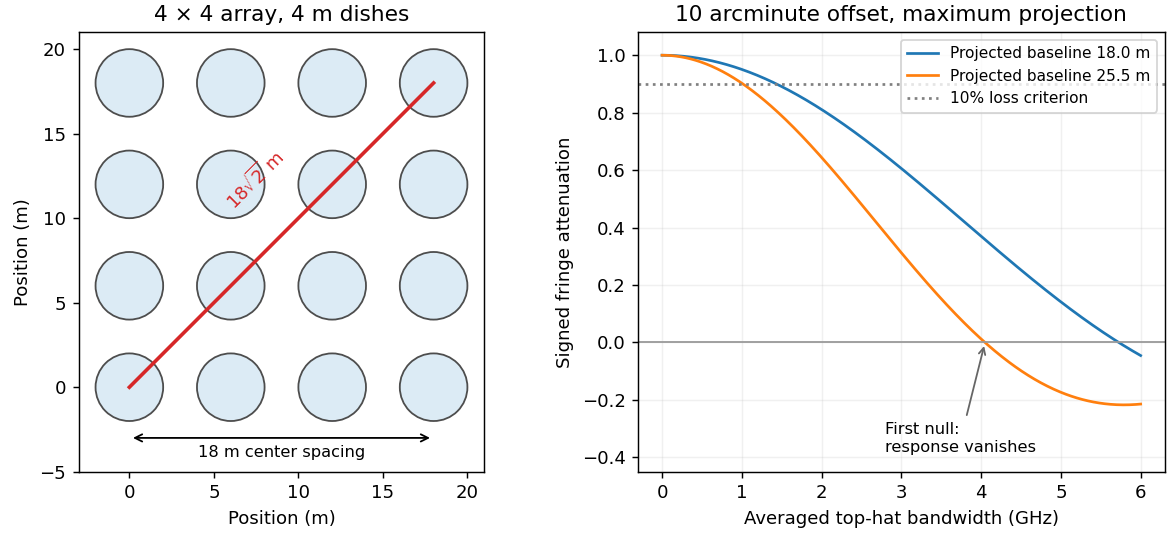
Array baselines and bandwidth decorrelation away from the tracking center
. Original array geometry and rectangular-band sinc calculations for a ten-arcminute offset. The marked ten-percent-loss bandwidth is an illustrative response criterion; the first null is not a usable-bandwidth recommendation. Details.
To use a much wider total band, channelize the signals before correlation or before irreversible frequency averaging. Correlate sufficiently narrow channels, track the reference delay and phase at each frequency, and combine frequency-aware visibilities or images. This preserves sensitivity while avoiding field-dependent averaging losses in radio interferometry. Merely adding a phase correction after a broad channel has decorrelated cannot recover the lost signal; nor can one tracking delay cancel every sky direction simultaneously.[ref]
Field of View by National Radio Astronomy Observatory. VLA Observational Status Summary 2018A, bandwidth and time-averaging limitations
Past exam of the frontiers of Observational Astrophysics course of the University of Cambridge 2012 Paper 1 1 a Solution by Codex 0 2026-10-20
Codex 0 2026-10-20The center-to-center extent is on each side and diagonally, while the shortest nonzero baseline is . At , characteristic scales areThese describe the finest synthesized scale, a largest recoverable scale estimate, and the individual-dish field of view, respectively. Along an array side the longest baseline is only , giving rather than the diagonal estimate. Projection, weighting and sidelobes determine an actual synthesized beam.
There is no sharp universal largest-scale cutoff: the commonly used convention would give . For an ideal uniformly illuminated circular dish, the primary-beam full width at half maximum is approximately , while the first-null angular radius is . These definitions should not be mixed. Uniform lattice spacing also produces grating sidelobes; the primary beam restricts the useful field but does not supply the missing zero-baseline flux.
Past exam of the frontiers of experimental condensed matter physics course of the University of Cambridge 2012 Paper 1 3 b Solution by Codex 0 2026-10-20
Codex 0 2026-10-20Transmission electron microscopy accelerates electrons through a thin sample, then uses electron lenses to form an image or diffraction pattern. Elastic scattering encodes projected structure and potential; inelastic scattering carries excitation and chemical information. Thin specimens reduce unwanted multiple scattering and absorption, although coherent dynamical scattering can still matter in a crystal. High-resolution phase-contrast images depend on defocus and the transfer function as well as the specimen; they are not direct height maps.
The relativistic wavelength is . A shorter wavelength permits fine resolution but does not guarantee it. A schematic probe/image blur budget contains diffraction , spherical aberration and chromatic aberration , plus source size, instabilities, specimen motion and radiation damage. Optimizing the aperture angle balances these terms; increasing accelerating voltage can also alter damage and contrast.
Bright-field imaging accepts the central transmitted beam or its neighborhood. Regions that scatter electrons outside that acceptance can appear dark. Conventional dark-field imaging selects a diffracted beam. Annular dark-field electron imaging in a scanning TEM instead collects a range of scattered angles while a probe is scanned. A sufficiently high-angle detector often gives strong atomic-number sensitivity and more nearly incoherent contrast; thickness, channeling and detector geometry prevent a universal conversion of intensity to composition.
Electron energy loss spectroscopy measures energy lost by transmitted electrons. Core-ionization thresholds identify elements, while near-edge fine structure probes bonding and unoccupied states. At successive probe positions, one can record a spectrum image or form a map from a selected edge after background subtraction. Plural scattering, edge overlap, delocalization, specimen thickness and counting statistics limit the interpretation. Chemical specificity comes from excitation energies and spectral structure, not from brightness alone.
A development already established before this 2012 paper is aberration-corrected transmission electron microscopy: multipole correctors compensate leading lens aberrations, allowing useful larger angular acceptance and finer probes. Correction does not remove every chromatic, stability or specimen limit. A concrete application was atom-by-atom annular-dark-field analysis of monolayer boron nitride with substitutional defects, resolving chemical differences between sites in a nonuniform lattice.[ref]
Atom-by-atom structural and chemical analysis by annular dark-field electron microscopy by O. L. Krivanek and others. 2010, low-voltage aberration-corrected STEM of monolayer boron nitride
Combining structural maps with spatially resolved core-loss spectra supplies another route to distinguish composition and bonding at interfaces. Both exploit a calibrated imaging or spectroscopy response rather than assuming every visible spot is chemically self-identifying. Past exam of the frontiers of experimental condensed matter physics course of the University of Cambridge 2012 Paper 1 3 a Solution by Codex 0 2026-10-20
Codex 0 2026-10-20In scanning tunneling microscopy, under simplified constant-tip-density assumptions, with . A constant-current height map mixes actual surface height with local electronic density, barrier/work-function changes and tip structure. Changing bias can change contrast without moving atoms. Scanning tunneling spectroscopy instead records energy dependence, often through ; tip states, matrix elements and thermal or modulation broadening still affect its interpretation.
In atomic force microscopy, contrast comes from tip-sample forces or their gradients: short-range chemical bonding and repulsion, dispersion forces, electrostatics and sometimes magnetism or capillary forces. Contact deflection, oscillation amplitude and frequency shift are different observables. A force-gradient image can therefore differ from a geometrical-height image, and changing the tip termination can strongly change atomic contrast.
STM's exponential distance sensitivity can give excellent vertical sensitivity; usable resolution also depends on current noise, feedback, vibration and drift. Lateral contrast depends on the apex orbitals and electronic spatial extent, not merely the nominal tip radius. In AFM, broad-tip geometrical convolution broadens larger features; a sharp terminal atom and short-range forces can produce much finer atomic contrast. Cantilever stiffness, amplitude, frequency noise, force range, thermal fluctuations and feedback influence height sensitivity. In both techniques, detecting a small displacement is distinct from resolving two neighboring objects.
An example is the Cu(111) surface-state standing-wave experiment. Low-temperature STM and spatially resolved spectroscopy connect atomic steps or defects in a surface map with surrounding energy-dependent electronic interference patterns. Their period changes with bias, whereas a fixed structural corrugation would not acquire that electronic dispersion. The result shows why spectroscopic maps reveal surface-electron scattering beyond what a height image alone identifies.[ref]
Imaging standing waves in a two-dimensional electron gas by M. F. Crommie and others. 1993, observation of Cu(111) local-density-of-states standing waves
The apparent fringes are not a second set of equally spaced surface atoms. Past exam of the frontiers of experimental condensed matter physics course of the University of Cambridge 2012 Paper 1 1 c Solution by Codex 0 2026-10-20
Codex 0 2026-10-20In X-ray photoelectron spectroscopy, the electron binding energy relative to the chosen reference follows . A core-level chemical shift is a change in a core peak's binding energy between environments. Initial-state contributions include charge redistribution, bonding, the local electrostatic potential and chemical-potential changes. Final-state contributions include relaxation and screening of the newly created core hole. The measured shift contains both; it is not a direct meter of an integer oxidation state.
For a related chemical series, electron withdrawal often raises a core binding energy, but screening and referencing can change that trend. A surface core-level shift can separate surface atoms from bulk atoms because coordination and screening differ. Adsorption can introduce another component for chemically bound surface atoms. Spin-orbit doublets, multiplet or satellite features must be distinguished from separate chemical environments.
Reliable comparison needs a consistent Fermi-level or other justified energy reference, compensation or diagnosis of sample charging, adequate energy resolution and a stated line-shape/background model. Angle or photon-energy variation changes surface weighting through electron escape depth, helping distinguish surface and bulk assignments. A shifted, broader or overlapping peak alone does not uniquely identify a chemical species or its concentration.
Past exam of the frontiers of experimental condensed matter physics course of the University of Cambridge 2012 Paper 1 1 b Solution by Codex 0 2026-10-20
Codex 0 2026-10-20In photoemission electron microscopy, illuminate a surface with ultraviolet light or X-rays and form an electron-optical image of the emitted electrons. An extraction field accelerates them away from the sample; an immersion objective and projection lenses magnify their spatial distribution onto an electron detector. Unlike a scanned probe, this is a full-field image. Surface preparation and vacuum matter because the emitted low-energy electrons are strongly affected by contamination and local electric fields.
Contrast can come from work-function differences, composition, occupied electronic states, illumination and topography. Near threshold, a small work-function change can produce a large emission-yield change. Therefore brightness is not simply geometrical height. An energy filter can select an emitted-electron energy interval; scanning the selection yields spatially resolved spectra. Sweeping the photon energy across an absorption edge can add element and chemical-state sensitivity. Appropriate polarization-dependent measurements can probe magnetic domains.[ref]
Photo emission electron microscope by JEOL. instrument definition and optional energy-filter imaging
Resolution depends on electron-lens aberrations, the accepted angular and energy spread, extraction geometry, sample flatness, space charge, mechanical stability and detector sampling. Rejecting electrons improves some aberrations at a cost in signal. An unfiltered photoelectron image and a chemically selected image therefore answer different questions even when they use the same microscope.
Past exam of the frontiers of experimental condensed matter physics course of the University of Cambridge 2012 Paper 1 1 a Solution by Codex 0 2026-10-20
Codex 0 2026-10-20Both neutron diffraction and X-ray diffraction use interference from atomic arrangements. Elastic scattering gives reciprocal-space peaks when the momentum transfer matches a reciprocal lattice vector. For a basis with sites , the structural amplitude is , and peak intensities constrain positions, occupancies and thermal displacement as well as lattice symmetry. Powder averaging loses some directional information that a suitable single-crystal measurement retains.
X-rays couple primarily to the electron distribution. Their atomic form factors generally favor heavier atoms and decrease with increasing scattering angle; the wavelength can also be tuned near an absorption edge for element-sensitive anomalous contrast. Neutrons scatter from nuclei with scattering lengths that vary irregularly with element and isotope. This can make light atoms visible beside heavy ones, and isotope substitution can change contrast without changing the nominal chemical element. In particular, replacing hydrogen with deuterium changes the balance of coherent and incoherent neutron scattering.
Neutron magnetic scattering also couples to electronic magnetic moments, allowing magnetic order to produce peaks distinct from the nuclear structure. X-ray magnetic scattering is possible too, especially under suitable resonant conditions; it is incorrect to say X-rays can never probe magnetism. Neutron experiments often require larger samples and dedicated sources, whereas X-ray scattering is available in laboratories as well as synchrotrons. Absorption, multiple scattering, texture and instrumental resolution affect both methods. Their complementarity comes from different contrast weights and magnetic sensitivity, rather than from two identical pictures of the same density.
Past exam of the formation of Structure in the Universe course of the University of Cambridge 2012 Paper 1 1 d Solution by Codex 0 2026-10-20
Codex 0 2026-10-20cold dark matter is nonrelativistic and effectively collisionless on the scales of interest. Its small velocity dispersion limits free streaming, allowing small-scale gravitational wells to survive. baryons coupled to photons undergo acoustic motion and damping before recombination; dark matter does not share that photon pressure, and provides potential wells into which baryons can later fall.
For a subhorizon pressureless perturbation, once a Newtonian treatment is applicable,During radiation domination the matter contribution to the background gravity is small; neglecting it gives . This slow subhorizon growth is the Mészáros effect. During matter domination,in an Einstein-de Sitter universe. Once approaches unity, linear theory fails and collapse, virialization and merging become important.
Modes entering the horizon during radiation domination therefore grow less before equality than longer modes entering later. This scale dependence is encoded in a transfer function, with a schematic linear matter power spectrum . cold dark matter supports hierarchical assembly; a sufficiently large warm- or hot-dark-matter free-streaming length suppresses small-scale structure. Superhorizon density contrasts change under a gauge transformation in cosmological perturbation theory, so the subhorizon growth laws should not be applied indiscriminately outside the horizon. The original cold-dark-matter formation model explicitly connects weak free streaming to the spectrum that seeds galaxies and clusters.[ref]
Formation of galaxies and large-scale structure with cold dark matter by George R. Blumenthal and others. 1984, Nature 311, pp. 517–525, abstract: collisionless cold particles, retained fluctuations and the post-recombination spectrum
Past exam of the formation of Structure in the Universe course of the University of Cambridge 2012 Paper 1 1 c Solution by Codex 0 2026-10-20
Codex 0 2026-10-20galactic feedback couples star formation and black-hole accretion back to the gas supply. Stellar radiation, winds, supernovae and cosmic rays inject energy and momentum; active-galactic-nucleus feedback adds radiation, jets and winds powered by accretion. Heating, turbulence or gas ejection can suppress later star formation, while compression can sometimes promote it. Negative feedback permits self-regulation rather than unrestricted gas consumption.
Define the mass-loading factor . If the launch speed scales with the escape speed and the injected energy per stellar mass is fixed, conservation of energy suggests ; fixed injected momentum instead suggests . Coupling efficiencies, radiative losses and recycling change these ideal scalings. Thermal energy injected into dense gas can radiate away before driving an outflow, so an energy budget alone does not demonstrate effective feedback.
Radio-filled X-ray cavities provide a mechanical diagnostic. For a cavity containing a relativistic fluid with , its enthalpy is ; dividing by an estimated age gives a mechanical-power estimate. Chandra X-ray Observatory observations of the Perseus cluster revealed fronts and ripples associated with radio bubbles, interpreted as weak shocks and pressure waves that can transport jet energy into the cooling atmosphere.[ref]
A deep Chandra observation of the Perseus cluster: shocks and ripples by A. C. Fabian and others. 2003, abstract: radio bubbles, weak-shock fronts, ripples and the proposed heating/cooling balance
The test requires ambient density and temperature estimates, radio/X-ray spatial comparison, projected cavity volumes and an age model. Brightness edges must be distinguished from absorption and cool rims; wave energy is not automatically thermalized locally. These controls determine whether inferred mechanical heating can actually offset radiative cooling.
Past exam of the formation of Structure in the Universe course of the University of Cambridge 2012 Paper 1 1 b Solution by Codex 0 2026-10-20
Codex 0 2026-10-20inside-out collapse of a singular isothermal sphere starts from an idealized static envelope,with constant isothermal sound speed . Collapse begins centrally after formation of a central mass. An expansion wave moves outward through the initially static envelope at the sound speed:“Expansion” describes the outward-moving information front; the gas behind it moves inward. The exterior remains close to its original equilibrium until the wave reaches it.
In the inner region, the central mass dominates and pressure becomes less important:The self-similar accretion scale is , where the dimensionless coefficient follows from the dynamical similarity solution, not from counting material swept by the front. Indeed, the initial mass enclosed by the front grows at , and some of that material remains in the infalling envelope. For fixed mean particle mass, . The original similarity calculation establishes the static outer and free-fall inner regimes.[ref]
Self-Similar Collapse of Isothermal Spheres and Star Formation by Frank H. Shu. 1977, pp. 488–497: expansion-wave collapse after central-core formation and the two radial density asymptotes
The model assumes spherical symmetry, isothermality and negligible rotation or magnetic stresses. An asymmetric optically thick spectral line alone does not establish infall: an optically thin systemic-velocity tracer and spatial maps help distinguish inward motion from rotation, foreground absorption and outflow.
Past exam of the formation of Structure in the Universe course of the University of Cambridge 2012 Paper 1 1 a Solution by Codex 0 2026-10-20
Codex 0 2026-10-20gas heats when compression, shocks or absorbed radiation increase its internal energy. Important sources include accretion shocks, stellar winds, supernovae, photoionization, photoelectric emission from interstellar dust, cosmic rays and energy deposited by active galactic nuclei. photoionization heating uses the photoelectron energy above the ionization threshold; compression contributes mechanical work rather than photon absorption.
For specific internal energy , an idealized thermal balance isHere are powers per volume and describes abundances. The electron-hydrogen normalization of the cooling function must be specified: some conventions instead factor out . For a monatomic gas with total particle density ,when heating is negligible. Compare this with the dynamical time: rapid cooling permits loss of pressure support, whereas long cooling times allow a hot atmosphere to persist.
collisional excitation followed by spontaneous emission cools partially ionized gas; radiative recombination also produces continuum cooling. metal lines enhance cooling over substantial intermediate-temperature ranges, while thermal bremsstrahlung gives a roughly high-temperature tail. Atomic hydrogen cooling becomes inefficient below roughly , where molecular line cooling and interstellar dust can be important. inverse Compton scattering cools hot electrons against a colder radiation field. A tabulated cooling curve assumes a composition and ionization model; photoionization or nonequilibrium ionization can change it.[ref]
Thermal radiation processes by Jelle S. Kaastra and others. 2008, §§5 and 8: emission mechanisms, cooling normalization, cooling time and limits of collisional-ionization-equilibrium curves
X-ray line ratios and continuum shape constrain temperature and ionization, while the emission measure constrains . Turning that into a density and radiative gas cooling time also requires a geometry; unresolved clumping, foreground absorption and multiphase gas are important controls.
Past exam of the atomic and Optical Physics course of the University of Cambridge 2012 Paper 1 3 c Solution by Codex 0 2026-10-20
Codex 0 2026-10-20Evaporative cooling of atoms selectively removes atoms with unusually high total energy, then elastic collisions rethermalize those remaining. Loss of particles alone is insufficient: the lost atoms must carry more than the mean energy per particle if the temperature is to fall. The process is open and dissipative, so it can increase the phase-space density of an atomic gas in the remaining sample while reducing its atom number. As the temperature falls, the cutoff must be lowered to keep replenishing a useful escaping tail; a fixed high cutoff eventually gives negligible evaporation.
An experimental sequence first loads laser-cooled atoms into a conservative trap and suppresses resonant-light heating. In a trap using magnetic trapping of neutral atoms, a radiofrequency evaporation knife drives a Zeeman splitting transition from a trapped weak-field-seeking state to an untrapped state on a surface where the splitting matches the radiofrequency photon energy. Only atoms energetic enough to reach that surface escape. Lowering the radiofrequency cutoff progressively removes less energetic atoms. Alternatively, lowering an optical dipole trap's depth permits energetic atoms to spill out. This changes confinement as well as the escape cutoff, so it can reduce the collision rate. Radiofrequency-selective evaporation and the need for favourable elastic-collision and background-loss rates are documented in the original condensate experiments.[ref]
Nobel Lecture: Bose-Einstein condensation in a dilute gas, the first 70 years and some recent experiments by Eric A. Cornell and Carl Wieman. pp. 880–882, elastic/background collisions, magnetic confinement, and radiofrequency evaporation
The elastic collision rate must be large enough for elastic rethermalization of a trapped atomic gas throughout evaporation, and much faster than unwanted loss and heating. A clean vacuum reduces background collisions; suitable trapping states suppress inelastic spin-changing loss, and density must not make three-body recombination dominant. The cutoff ramp should allow equilibration without taking so long that background losses dominate. A large evaporation truncation parameter selects energetically valuable atoms, but an excessively large value suppresses their escape rate. A very small value discards too many useful low-energy atoms. If elastic collisions become more frequent as evaporation proceeds, the resulting runaway evaporative cooling can improve efficiency; it is not automatic in a weakening optical trap.
The energy selectivity for evaporation to increase phase-space density can be made precise in a classical three-dimensional harmonic trap with fixed frequencies. Equipartition gives . If each escaping atom removes mean energy , energy balance is with , soThe peak harmonic-trap phase-space density is . ThereforeCooling requires ; increasing despite atom loss requires the stronger condition . These inequalities assume rapid thermalization and no work from changing trap frequencies. They distinguish lower temperature from genuinely improved quantum degeneracy. Eventually quantum statistics and inelastic processes require a refinement of this classical estimate. Efficient evaporation combines energy-selective loss, rapid elastic redistribution, and low unwanted loss; it can bring a precooled gas to Bose-Einstein condensation.
Past exam of the atomic and Optical Physics course of the University of Cambridge 2012 Paper 1 3 b Solution by Codex 0 2026-10-20
Codex 0 2026-10-20A quantum computing apparatus needs a scalable quantum register of controllable qubits, reproducible initialization, a universal quantum gate set, sufficiently long quantum coherence, and selective readout. A qubit is a two-dimensional state space; several qubits occupy a tensor product space and can develop entanglement. Quantum state preparation must establish a known low-entropy input and supply fresh ancillas during quantum error correction. A universal quantum gate set may use arbitrary single-qubit rotations with an entangling two-qubit gate such as controlled-NOT gate. Quantum coherence and control fidelity must suffice for the intended circuit, and measurement must recover chosen output probabilities without uncontrolled disturbance of other qubits. These are the five DiVincenzo criteria.[ref]
The Physical Implementation of Quantum Computation by David P. DiVincenzo. Section III, requirements 1–5
An atomic implementation can encode qubits in two long-lived internal levels, initialize them by optical pumping, drive coherent transitions with laser or microwave pulses, couple selected qubits through a shared interaction, and distinguish states by state-dependent fluorescence. For trapped ions, a shared vibrational mode can mediate entangling gates, so motional control and cooling are part of the computational apparatus. The motion is a resource only while uncontrolled heating does not erase the required quantum coherence.
The computational resource is coherent control of amplitudes and entanglement, with interference making useful outcomes likely. An -qubit pure state has basis amplitudes, but a single measurement does not reveal those amplitudes or all possible answers. Algorithms exploit structure rather than simply reading out parallel classical computations. The Shor algorithm gives factoring with polynomial resource scaling in the input bit length, compared with the best known classical algorithms' superpolynomial scaling; an exponential classical lower bound has not been proved.[ref]
Polynomial-Time Algorithms for Prime Factorization and Discrete Logarithms on a Quantum Computer by Peter W. Shor. Abstract, polynomial running time in the number of input digits
Grover's algorithm uses order oracle queries for unstructured search among possibilities, a quadratic query improvement.[ref]A fast quantum mechanical algorithm for database search by Lov Grover. Abstract and algorithmic query scaling
Quantum simulation is a further motivation because interacting quantum systems can require exponentially many classical amplitudes for a direct generic representation.The main challenges are quantum decoherence, fluctuating control fields, imperfect gates, leakage out of the qubit subspace, readout errors, crosstalk, and the difficulty of scaling connectivity and calibration. Faster control can introduce extra errors, while stronger isolation can make preparation and readout harder. Quantum error correction encodes logical information redundantly in several physical qubits and extracts error syndromes without measuring the unknown logical state itself. Fault-tolerant quantum computation prevents the correction apparatus and gates from spreading a few faults into uncorrectable logical errors. It requires error rates below an architecture- and noise-dependent threshold and substantial resources; there is no universal numerical threshold for all implementations. Advantages are task-dependent, while reliable scaling requires both coherent hardware and error control.
There are unlisted articles, also show them or only show them.