Past exam of the thermal and statistical physics course of the University of Cambridge 2012 Paper 1 4 Solution by  Codex 0 2026-10-20
For two localized energy levels with degeneracies , let . Canonical equilibrium givesHere is the total upper-level occupation probability and are per unit. For nondegenerate levels the entropy rises from zero to , while the heat capacity vanishes at both low and high temperatures and has a Schottky maximum near . A spin one-half in a field, or a localized defect with two configurations, supplies an example. Higher levels must be thermally inaccessible; unequal degeneracies change the populations and peak. Distinguishable localized units have total partition function , unlike a gas of indistinguishable particles sharing just two orbitals.
For the magnetic atom, choose level labels with , . Put . Its partition function and exact entropy of a finite magnetic multiplet areThe ratio form has removable limit . Since is a function of only, it depends on field and temperature solely through . For fixed at small , symmetry removes the odd powers and the supplied sum of givesFor large , the expansion requires , not merely .
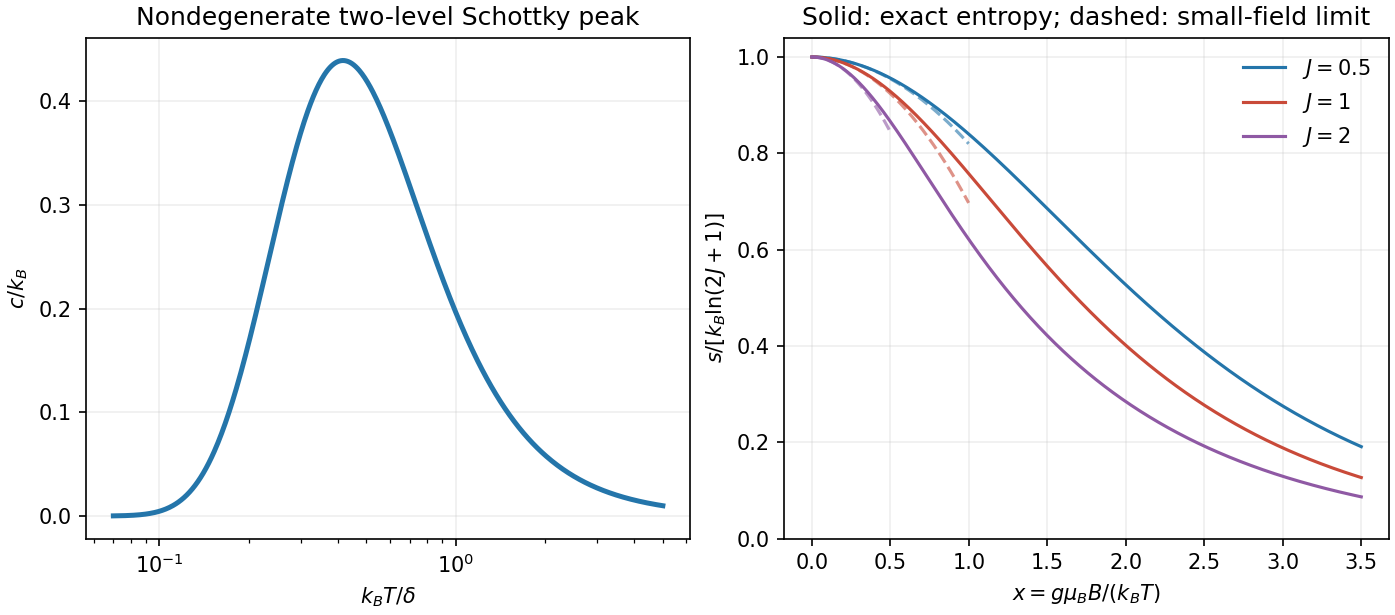
Two-level heat and magnetic entropy
. Original Schottky heat-capacity curve and exact finite-spin entropies show the entropy deficit removed by isothermal magnetization. Quadratic high-temperature expansions are shown only over a limited small-field interval. Details.For demagnetization with a linear-heat-capacity load, integrate its specified :Isothermal magnetization at removes spin entropy; the bath receives the corresponding heat. During the following reversible, thermally isolated demagnetization, it is the combined entropy of spins and load that stays constant. At the minimum-field endpoint , the ideal independent spins reach . ThereforeThe bracket is the initial magnetic entropy deficit. The PDF's intermediate equality uses the initial entropy itself instead; with its preceding definition of , that equality omits the maximum-entropy term. The corrected balance recovers its final temperature formula:Without the small-field expansion, the exact independent-spin prediction is . As a check, zero initial field gives zero entropy deficit and no cooling. The incorrectly printed intermediate balance would fail this check.
The result requires the load law throughout the temperature interval, hence ; a small initial Zeeman splitting, quantitatively ; positive final temperature; negligible additional heat capacities and heat leaks; thermal equilibration between subsystems; and a reversible sweep slow enough to maintain equilibrium. A negative extrapolated temperature is a breakdown of this approximation, not a cooling prediction. Spins alone would keep fixed, but the attached load changes that adiabat by transferring entropy to them as it cools.
Interactions invalidate the product of independent one-site partition functions. The entropy must be computed from the many-body energy spectrum or a justified interacting approximation. Correlations and possible magnetic ordering introduce an interaction scale and can remove the independent-spin entropy available for cooling near zero field. Internal fields and ordering commonly limit practical demagnetization. The detailed correction and any residual entropy depend on the interaction Hamiltonian, dimensionality and frustration; neither a universal ordering temperature nor a numerical final-temperature correction is specified here.
Past exam of the thermal and statistical physics course of the University of Cambridge 2012 Paper 1 3 Solution by Codex 0 2026-10-20
Codex 0 2026-10-20Let . Each independent fermion orbital is either empty or occupied once, so its grand partition factor is . Multiplying factors and taking the logarithm givesSince , this is the requested form. Spin or other orbital degeneracy is already included in .
For the Fermi-window convolution of the grand potential, defineDirect differentiation gives . The supplied PDF hint has the opposite sign; using that sign would contradict its grand-potential formula. Integrating twice with and vanishing upper boundary terms,At zero temperature , confirming .
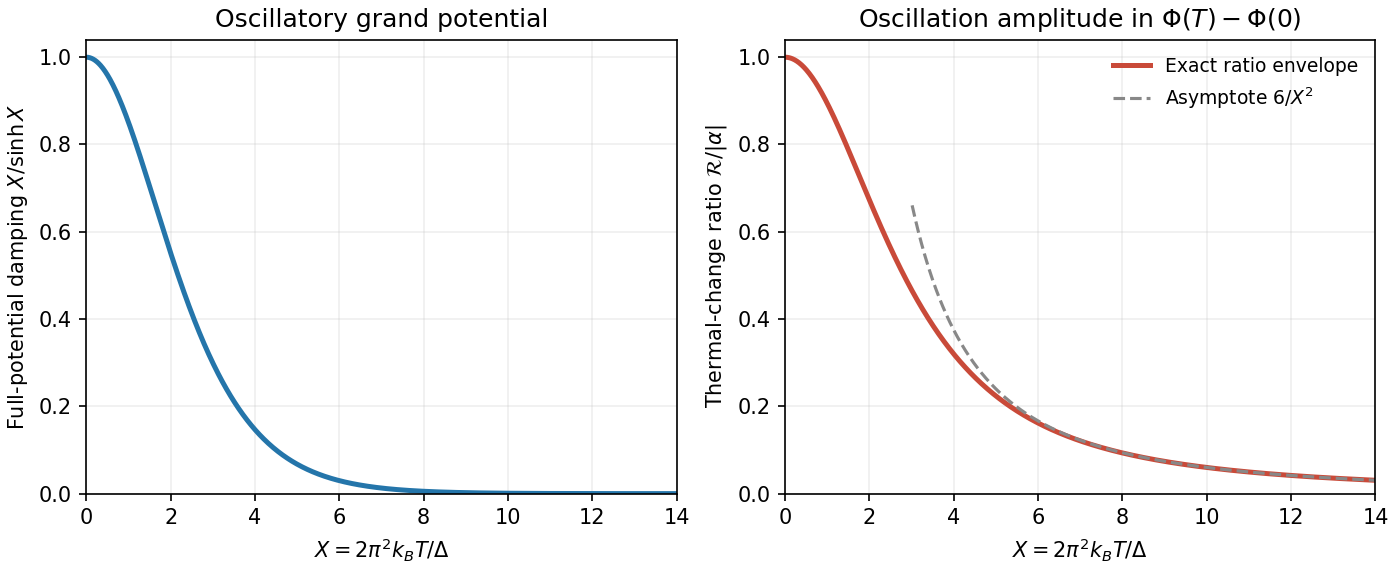
Use the source's implicit unit normalization of the constant density of states; restoring a constant baseline multiplies the following potentials by . For the sinusoidal density of states, direct integration givesPhysical nonnegative density of states requires . Write and . The Fermi windowis even, with full-line moments , and . The last integral follows, for example, by expanding on into its alternating exponential series. When , extending the lower integration limit to introduces only exponentially small band-edge corrections. The supplied Fourier transform givesThe odd sine term vanishes. Substitution provesThe thermal damping of a sinusoidal density of states is therefore in the full oscillatory potential. The requested ratio instead concerns the thermal change . Its oscillatory thermal-change amplitude ratio isFor positive it decreases smoothly from the limit to zero:At exactly both thermal changes vanish; the quoted value is their limiting ratio. The amplitude is the envelope in chemical potential. At a particular fixed , the signed contribution ratio has in place of ; at an oscillation node the actual oscillatory contribution is zero. The large- behaviour still requires , so the useful range is .


There are unlisted articles, also show them or only show them.