Past exam of the physics course of the year 4 of the natural sciences course of the University of Cambridge 2012 Paper 1 Section B B1 Solution by  Codex 0 2026-10-20
A normal mode is a small motion in which all coordinates oscillate at one common angular frequency with fixed relative amplitudes. For conservative linearized motion, these are eigenvectors of the mass-weighted stiffness matrix.
All three springs are initially stretched from to , giving equal tension and zero resultant force on each mass. This prestress is essential for the transverse modes found below.
For the final mixed-axis trajectory of a prestressed spring pair, the initial displacements excite only the symmetric mode in each direction. Therefore, to first order in ,The second mass has the same displacements about . Over the first transverse period , write :The trajectory is not closed after , because the frequency ratio is . It ends at approximately in these scaled coordinates rather than .
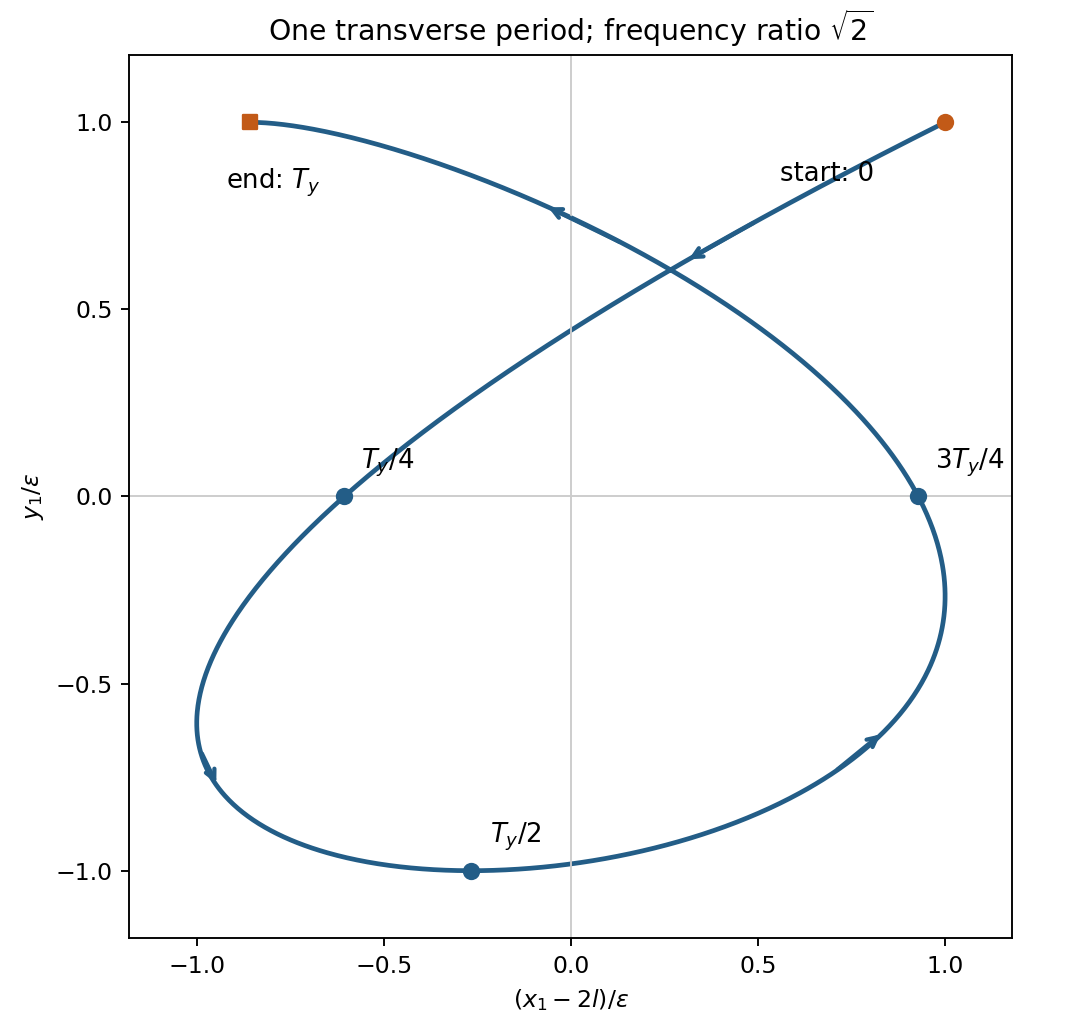
Prestressed spring trajectory
. Original first-transverse-period trajectory of the first mass. Markers distinguish initial and final points and intermediate quarter-period positions; both normal-coordinate amplitudes equal the release displacement. Details.
Past exam of the physics course of the year 4 of the natural sciences course of the University of Cambridge 2012 Paper 1 Section A A9 Solution by Codex 0 2026-10-20
Codex 0 2026-10-20The vacuum wave equation gives . The cutoff frequency is . In a lossless empty guide, energy travels at group velocity,The larger phase velocity is not the speed of energy transport.
Past exam of the physics course of the year 4 of the natural sciences course of the University of Cambridge 2012 Paper 1 Section A A8 Solution by Codex 0 2026-10-20
Codex 0 2026-10-20Prefer molecular rotational spectroscopy or rovibrational spectroscopy, because nuclear masses enter their reduced mass directly. For an isotopologue with nuclear reduced mass ,Isotope substitution therefore produces appreciable shifts and distinct sets of lines, assuming the same electronic potential and approximately unchanged bond length and force constant. A suitable heteronuclear molecule can provide electric-dipole rotational/vibrational spectra; other molecules may require Raman spectroscopy.
Atomic electronic energies instead depend on the electron-nucleus reduced mass , whose fractional change is suppressed by . High-resolution atomic spectroscopy can still detect isotope shifts, including nuclear-size and many-electron mass effects; it is not intrinsically incapable of identifying isotopes. Molecular spectra generally offer the stronger mass sensitivity for this purpose.
Past exam of the physics course of the year 4 of the natural sciences course of the University of Cambridge 2012 Paper 1 Section A A7 Solution by Codex 0 2026-10-20
Codex 0 2026-10-20For the usual nonrelativistic dispersion, the three-dimensional density of states is . Filling all states through the Fermi energy givesDegeneracy factors cancel. More generally gives ; an ultrarelativistic gas would give . The nonrelativistic result is the standard massive ideal-gas interpretation.
Past exam of the physics course of the year 4 of the natural sciences course of the University of Cambridge 2012 Paper 1 Section A A6 Solution by Codex 0 2026-10-20
Codex 0 2026-10-20For a reversible refrigerator, zero net entropy production gives . ThusThe necessary work is . Irreversibility increases the heat dumped to the surroundings; is the minimum work, not the requested rejected heat.
Past exam of the physics course of the year 4 of the natural sciences course of the University of Cambridge 2012 Paper 1 Section A A5 Solution by Codex 0 2026-10-20
Codex 0 2026-10-20The geostationary gravitational clock gain uses only the potential contribution, as requested. In the weak field, and . The geostationary radius follows from . Taking with , and sidereal day gives .The satellite clock gains time because it is at higher gravitational potential. This is not the combined gravitational-plus-kinematic correction; the orbital and surface rotational velocities are deliberately outside the requested potential contribution.
Past exam of the physics course of the year 4 of the natural sciences course of the University of Cambridge 2012 Paper 1 Section A A4 Solution by Codex 0 2026-10-20
Codex 0 2026-10-20The photon wavelength is . The exact half-period zone radii for incident plane waves are chosen so that the path to the axial focus increases by per zone:Transmit alternate zones and block the others, with . For , . The number of zones is a design choice: 100 zones give outer radius and outermost width about . Adjacent open zones then arrive in phase at the principal focus.
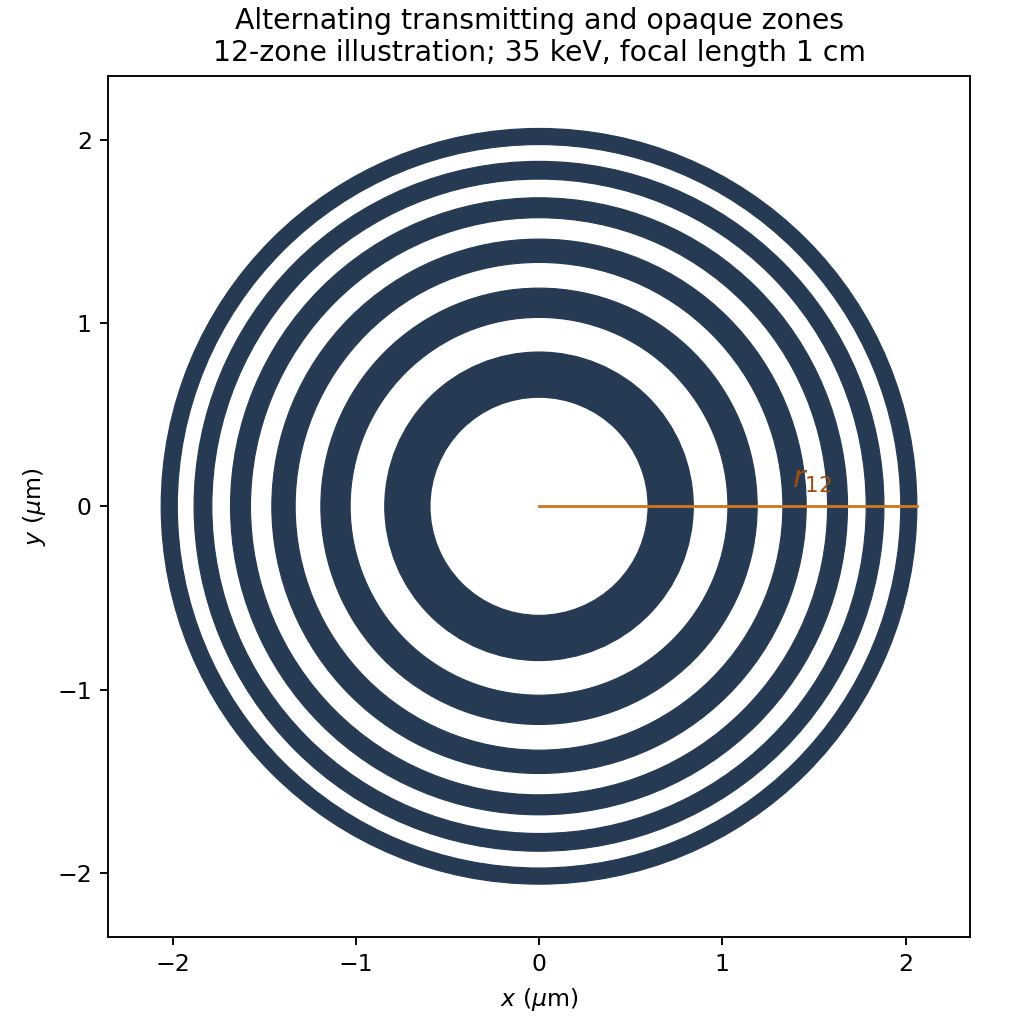

The blocking material must be sufficiently opaque at 35 keV; no attenuation coefficient or fabrication thickness is specified. A binary amplitude plate also has zero-order transmission and other odd-order foci, so an aperture/order stop may be needed. The principal focal length is chromatic, varying as for fixed radii.
Past exam of the physics course of the year 4 of the natural sciences course of the University of Cambridge 2012 Paper 1 Section A A3 Solution by Codex 0 2026-10-20
Codex 0 2026-10-20Treat the repeated angles as independent measurements of one fixed angle. Their sample mean, sample standard deviation and standard error of the mean areFor , uncorrelated standard uncertainties giveInterpreting the stated 1% amplitude accuracy as a standard uncertainty,Use radians in the derivative. This is uncertainty in the result using the mean angle, not the spread of individual angle measurements; the latter convention would use and give about . An accuracy bound or systematic angular calibration error would require a different uncertainty model.
Past exam of the physics course of the year 4 of the natural sciences course of the University of Cambridge 2012 Paper 1 Section A A2 Solution by Codex 0 2026-10-20
Codex 0 2026-10-20For an elastic eccentric impact of a thin disc, take upward velocity as positive and let be the short upward impulse. The disc's moment of inertia about a horizontal diameter is . With impact offset ,The contact point has upward velocity . Unit restitution against the fixed post requires that velocity to be , soSince , and the centre's instantaneous speed is zero. The disc rotates with ; its rotational kinetic energy equals the entire initial energy. Gravity's impulse during the impact is neglected. Using the polar-axis moment of inertia would describe the wrong rotation axis.
Past exam of the physics course of the year 4 of the natural sciences course of the University of Cambridge 2012 Paper 1 Section A A10 Solution by Codex 0 2026-10-20
Codex 0 2026-10-20For a cylinder of radius in unbounded two-dimensional incompressible potential flow, a velocity potential is . It givesOn the surface . The points nearest the banks are the sides perpendicular to the stream, , hence the speed is at each. This is the inviscid outer-flow speed; a real no-slip boundary layer has zero velocity at the material surface. The small-radius/wide-river assumption neglects bank effects.
Past exam of the physics course of the year 1 of the natural sciences course of the University of Cambridge 2011 Paper 1 Section E E15 Solution by Codex 0 2026-10-20
Codex 0 2026-10-20Treat Earth as a stationary spherical source, with , and neglect drag and other bodies. The conserved quantities are total mechanical energy and the angular momentum vector, implying a fixed orbital plane and constant areal velocity. The Kepler problem additionally conserves the Laplace-Runge-Lenz vector. The orbiting object's linear momentum is not constant because gravity exerts a force.
For a circular orbit, , so . HenceAt the closest approach of a noncircular orbit, the velocity is tangential and . Its energy and specific angular momentum areThe pericentre-speed qualification of Kepler orbit classes requires when is genuinely the closest approach. For an ellipse, conservation of h gives . Equating energies at the two turning points and writing givesThe distinct apocentre root is thereforeFor an unbound orbit, decreases toward infinity. The asymptotic minimum speed of an unbound Kepler orbit isIt is the limiting infimum, reached only asymptotically: positive for a hyperbola and zero for a parabola. The turning-point interpretation of is essential; if , the same instantaneous energy describes a bound orbit whose is the apocentre instead. [ref]
University Physics Volume 1 by William Moebs and others. Chapter13, gravitational energy, escape and Kepler orbits
There are unlisted articles, also show them or only show them.