Past exam of the physics course of the year 1 of the natural sciences course of the University of Cambridge 2011 Paper 1 Section D D13 Solution by  Codex 0 2026-10-20
In the time-independent Schrödinger equation, is the kinetic-energy operator acting on the state, its potential-energy contribution and the energy-eigenvalue term. The complex wave function is a probability amplitude: the Born rule assigns density for a normalized single-particle state. A plane-wave beam uses an incident-amplitude or flux normalization instead of a unit-integral wavefunction.
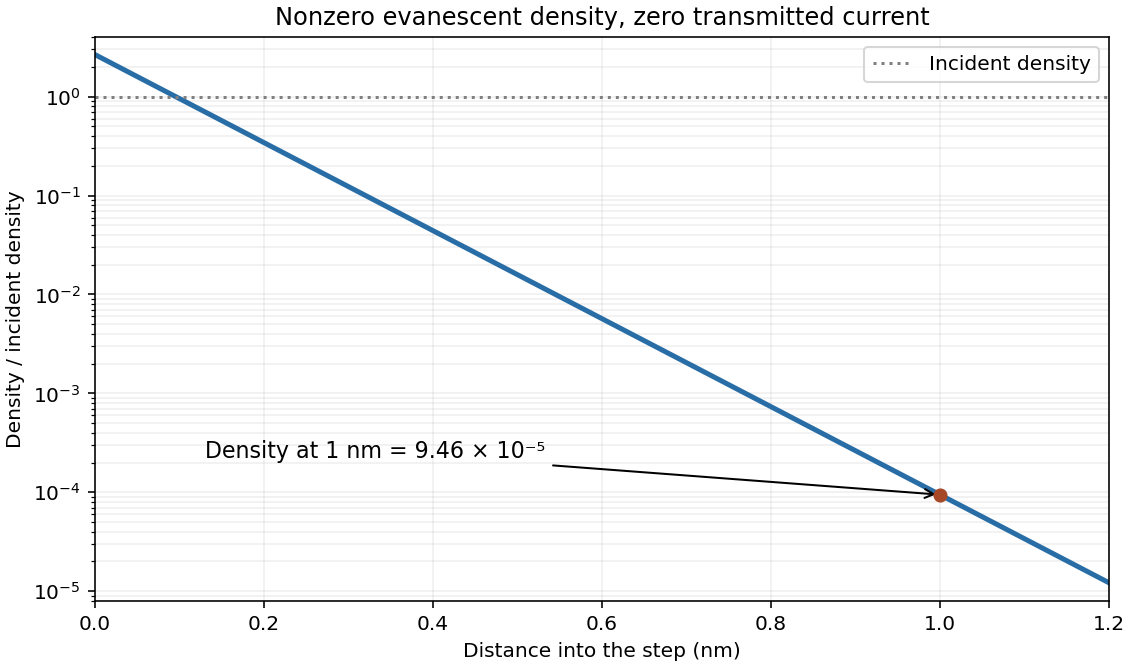
For a free plane wave, , so and its time factor obeys . Above the upward potential step, the bounded subthreshold solution has decay constantFor the PDF's unit incident amplitude, write on the left and on the right, omitting their common time phase. Continuity of both and at this finite step givesConsequentlyThe evanescent amplitude versus transmitted current distinction matters: the second quantity is a squared amplitude, not a transmitted-flux probability. The decaying tail has zero probability current, despite nonzero density and the possible value .
Using and the electron mass and elementary charge specified above, the energy difference1eV gives . Thus at the stated positionThis is relative to the unit incident density in the source figure, not an absolute normalized probability per metre. [ref]
Past exam of the physics course of the year 1 of the natural sciences course of the University of Cambridge 2011 Paper 1 Section D D12 Solution by Codex 0 2026-10-20
Codex 0 2026-10-20For a small-slope string element, the transverse net tension is . Its mass is , so Newton's second law givesIts extra length is . Work against the approximately constant tension gives the elastic energy of a small-slope string, while transverse motion gives its kinetic energy:For a single travelling wave , , so pointwise to this order. A standing wave need not have pointwise or instantaneous kinetic–potential equality.
For a fixed-end string of length L, taking the stated note to be its fundamental gives . HenceIf98Hz were instead the nth harmonic, the required tension would be ; the usual fundamental interpretation is explicit.
For the specified standing wave, . Every allowed nonzero fixed-end mode has , yieldingAt this instant the ideal mode's elastic energy is zero; at maximum displacement all its energy is elastic. [ref]
University Physics Volume 1 by William Moebs and others. Chapter16, transverse-string wave speed, wave energy and fixed-end normal modes
Past exam of the physics course of the year 1 of the natural sciences course of the University of Cambridge 2011 Paper 1 Section C C10 Solution by Codex 0 2026-10-20
Codex 0 2026-10-20For sinusoidal steady state with the convention, complex impedance is the phasor ratio , encoding both amplitude ratio and phase. From , an ideal inductor has ; from , a capacitor has .
The original diagram has in series, and in parallel. ThusWith the right supply node as the reference, the two unloaded voltage divider outputs are and . Subtracting givesThe series-RL parallel-RC bridge balance is . Equating its real and imaginary coefficients givesThese ideal components balance the bridge at any frequency, not just the test frequency.
At , the current amplitude through is . Using peak rather than RMS supply amplitude,In the DC steady state the inductor is a short and the capacitor is open. Both dividers have equal resistors, so each midpoint is at2.5V and the bridge stays balanced. The upper-branch current is0.100A, giving .
For the high-input-resistance voltmeter, hold the other components fixed. At the DC balance,The DC bridge resistance resolution is a local readout resolution, or0.08% of , not a total uncertainty allowing for supply, component calibration or voltmeter loading. [ref]
Past exam of the physics course of the year 1 of the natural sciences course of the University of Cambridge 2011 Paper 1 Section B B9 Solution by Codex 0 2026-10-20
Codex 0 2026-10-20For the stated standard configuration, the Lorentz transformation isDifferentiate along the moving object's worldline and divide by to obtain the velocity-addition formula:For a receding source, two emissions separated by proper time occur apart in S. The second signal travels an additional distance , so its reception interval is . Hence the longitudinal relativistic Doppler effect isThe inverse velocity transformation for the forward throw givesThe ball approaches the stationary receiver, so its forward light is blueshifted. The received wavelength is , in the ultraviolet. The stated monochromatic emission is outside the visible band. Other reflected or emitted frequencies have not been specified. [ref]
University Physics Volume 3 by Samuel J. Ling and others. §5.7, longitudinal light Doppler shift and approach/recession signs
Past exam of the physics course of the year 1 of the natural sciences course of the University of Cambridge 2011 Paper 1 Section B B8 Solution by Codex 0 2026-10-20
Codex 0 2026-10-20The moment of inertia about an axis is . The parallel axis theorem states , where a is the perpendicular separation from a parallel axis through the centre of mass, and M is total mass.
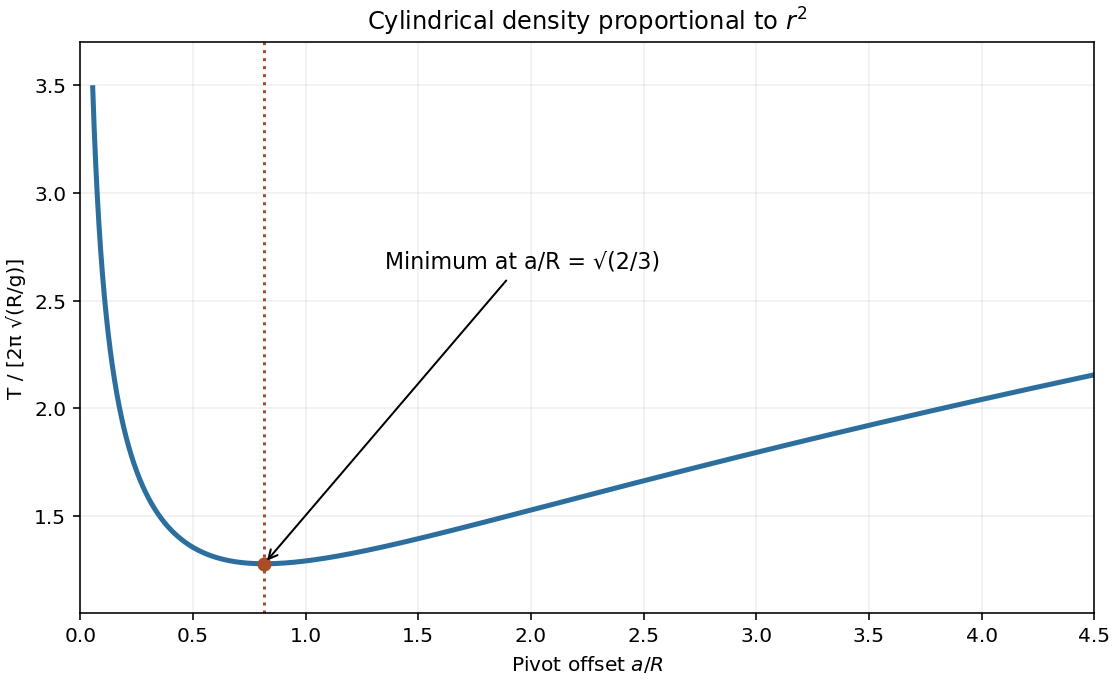
Since , the density coefficient has units . The density-power cylindrical moment of inertia follows from cylindrical shells:For an offset pivot, the physical pendulum equation is . At small amplitude,For the minimum-period offset of a physical pendulum, minimizing is equivalent to minimizing . Its derivative vanishes atThe second derivative is positive. The period diverges as near zero and grows as for large offset, giving one minimum. This assumes the stated ideal pivot can pass inside the body; an externally constrained pivot would restrict the allowable a. [ref]
Past exam of the physics course of the year 1 of the natural sciences course of the University of Cambridge 2011 Paper 1 Section B B7 Solution by Codex 0 2026-10-20
Codex 0 2026-10-20For a steady uniform jet, the mass flow rate is . The transported momentum flux and kinetic energy flux of a uniform jet areIncompressibility gives piston speed . Equating piston power to the jet's kinetic power givesThis ideal result neglects losses and the kinetic energy of fluid moving slowly inside the large cylinder. Retaining an inlet speed correction would multiply the pressure expression by .
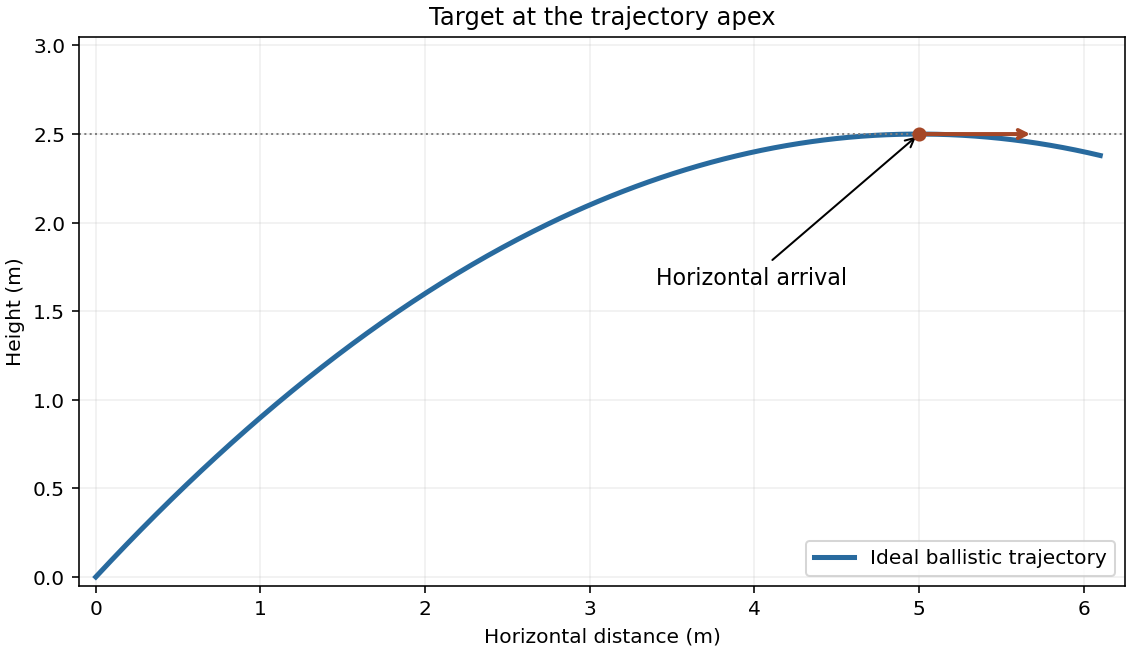
A horizontal impact occurs at the projectile apex. Write and . At its height h, and the flight time is , soHere and . The apex-target condition for a ballistic jet fixes both launch speed and angle.
If the target stops the horizontal momentum of the arriving water, the force isThis exceeds the limiting friction, so the target can be dislodged in the ideal stopping-impact model. The jet-area adjustment during ballistic slowing matters: the nozzle area sets ; replacing u by in that mass-flow factor would incorrectly assume unchanged jet area during deceleration. Reflection or a specified deflection would change the transferred momentum. Air drag, breakup and splash losses are excluded from the ballistic estimate.


Past exam of the physics course of the year 1 of the natural sciences course of the University of Cambridge 2011 Paper 1 Section A A6 Solution by Codex 0 2026-10-20
Codex 0 2026-10-20The central estimate is . With independent input standard errors, the ratio-minus-one uncertainty from first-order uncertainty propagation isThe four independent reported results cluster near1.21, within about one quoted standard error of this estimate, so they are consistent at this precision. Their tight clustering is not evidence that this measurement has the same precision. If the measurements of a and b were correlated, a covariance term would be needed. [ref]
Past exam of the physics course of the year 1 of the natural sciences course of the University of Cambridge 2011 Paper 1 Section A A5 Solution by Codex 0 2026-10-20
Codex 0 2026-10-20For the double-slit experiment with oblique incidence, the optical path difference has an unknown incident contribution plus in the outgoing direction. It cancels between adjacent angular features. From a minimum to the next maximum, the path difference changes by :This incidence-independent adjacent-fringe wavelength uses the statement that intensity rises directly from the stated zero to the following peak. No absolute interference order or incidence angle is needed; nonadjacent extrema would require the number of intervening fringes.
Past exam of the physics course of the year 1 of the natural sciences course of the University of Cambridge 2011 Paper 1 Section A A4 Solution by Codex 0 2026-10-20
Codex 0 2026-10-20The PDF's apex angle is , so each contacted face makes with the vertical. Let N be the inward normal force per face. Its vertical component is downward, ; limiting upward static friction contributes . Symmetric contacts cancel horizontal forces and torque. Incipient lift consequently requiresThis is the usual normal gripping force convention, using . Friction can lift the prism only if , which is satisfied here.
If “force applied” means the magnitude of the entire finger-contact resultant, including its tangential component, the normal versus resultant force in a frictional pinch givesThe optimal resultant lies at the limiting friction angle from the inward normal. Stating which force is being measured avoids confusing these two legitimate quantities.
Past exam of the physics course of the year 1 of the natural sciences course of the University of Cambridge 2011 Paper 1 Section A A3 Solution by Codex 0 2026-10-20
Codex 0 2026-10-20In the initial centre-of-mass frame, equal fragments acquire opposite velocities by conservation of momentum. The released energy isThe equal-mass fragmentation energy budget needs merely to match the other ship, costing . To close an existing gap requires a little more than this. Using the full reserve givesThe reserve is sufficient to overtake. The rear half moves at , preserving momentum. The kinetic-energy increase is the same in any inertial frame because total momentum is unchanged. Subsequent capture or braking would require additional interaction details; no target mass is needed for the interception test.
Past exam of the physics course of the year 1 of the natural sciences course of the University of Cambridge 2011 Paper 1 Section A A2 Solution by Codex 0 2026-10-20
Codex 0 2026-10-20By symmetry, the two grounded plates take equal induced surface charge and the electric field has magnitude between either plate and the sheet. The grounded-plate potential of a central charged sheet is thereforeAn electron released at zero potential gains kinetic energy . ThusThe planar infinite-sheet approximation neglects edge effects. Here denotes charge magnitude; the electron's negative charge makes it accelerate toward the positive sheet. Relativistic corrections are below0.1%. Numerical constants use rounded CODATA values, not a claim about the historical handbook: , and . [ref]
Past exam of the physics course of the year 1 of the natural sciences course of the University of Cambridge 2011 Paper 1 Section A A1 Solution by Codex 0 2026-10-20
Codex 0 2026-10-20For the gravitational-electrostatic balance of equal charged spheres, the shell theorem and Coulomb's law give and for well-separated spherical particles. Their separation cancels at balance. Since ,The two charges have the same sign, so electrostatic repulsion opposes gravitational attraction. A zero charge gives no nontrivial force balance. Spherical symmetry of the external charge distribution, or the leading far-field monopole approximation, is understood.
Past exam of the physics course of the year 1 of the natural sciences course of the University of Cambridge 2010 Paper 1 Section E E15 Solution by Codex 0 2026-10-20
Codex 0 2026-10-20For point masses, Newton's force is attractive along their separation with magnitude . Treat the narrow rod as uniform, with linear mass density ; a mass profile would otherwise be needed beyond total mass and length.
For axial and transverse gravity of a uniform rod, on the axis at , integrating the element force givesdirected toward the rod. On the perpendicular bisector, axial components cancel and transverse components add:At ,Both approach the point-mass force, but , so the axial attraction is slightly larger.
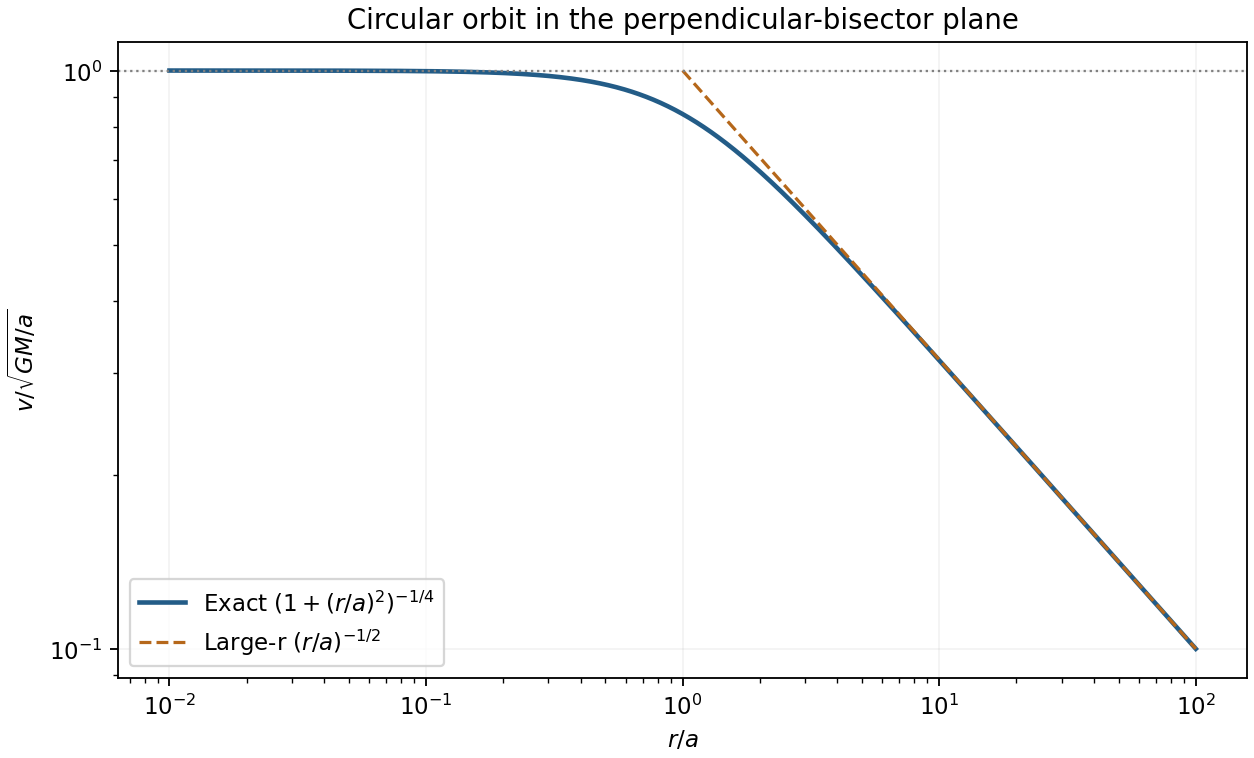
For a circular orbit perpendicular to a uniform rod, rotational symmetry about the rod makes a centred circular orbit possible in its perpendicular-bisector plane. With , centrifugal balance givesFor , it is Keplerian, . For rod thickness , the force approximates that of an infinite line and , a flat speed limit rather than a divergence.
Circular speed around a uniform rod
. Original orbital speed normalized by sqrt(GM/a), against perpendicular orbit radius divided by the rod half-length. The small-radius plateau and large-radius Kepler asymptote are marked; the zero-thickness rod approximation requires orbit radius larger than the physical rod thickness. Details.
Past exam of the physics course of the year 1 of the natural sciences course of the University of Cambridge 2010 Paper 1 Section E E14 Solution by Codex 0 2026-10-20
Codex 0 2026-10-20The closed surface integral sums the outward electric flux: is the electric field, its outward vector area, the total enclosed charge and the vacuum permittivity. Gauss's law relates that flux to enclosed charge for any closed surface. High symmetry can make the field's magnitude constant on a suitable Gaussian surface and fix its direction; without symmetry, flux alone does not determine the local field.
For an isolated conducting sphere, charges reside at its surface and the exterior field is radial. ThusThe conductor has zero interior field. Integrating exterior field energy givesLet the initial charge per drop be . After disconnecting the charging supply, charge is conserved. Volume conservation gives final radius , total charge andInitial mutual energy is negligible at the stipulated large separation. HenceThe electrostatic energy increase on equal-drop coalescence is positive. It can be supplied by the decrease in surface energy during coalescence and/or by external mechanical work bringing like charges together. Remaining energy can become motion and heat. If the charge is too large, surface-energy release alone need not suffice to make merging spontaneous; conservation does not assert that it will. Keeping the drops connected to a voltage supply would instead be a different charge-balance problem.
There are unlisted articles, also show them or only show them.