Past exam of the superconductivity and Quantum Coherence course of the University of Cambridge 2012 Paper 1 3 Solution by  Codex 0 2026-10-20
Ginzburg-Landau theory of superconductivity describes the superconducting phase by a complex order parameter and a gauge-invariant free-energy functional. A common normalization iswith , pair charge and . In zero field the uniform minimum has below . Variation gives the order-parameter equation and supercurrent. The characteristic lengths areThe Meissner response screens static magnetic fields over . In the simple isotropic theory, gives type-I behavior; allows type-II vortices and a mixed state between lower and upper critical fields. Flux quantization, vortex structure and currents follow from phase stiffness and electromagnetic coupling. This is a phenomenological expansion most directly controlled near ; static coefficients alone do not determine every dynamical mode or dissipation rate.
BCS theory supplies a microscopic pairing description. An attractive channel near the Fermi surface gives the Cooper instability, and its many-pair coherent state leads to the self-consistent gap and fermionic Bogoliubov quasiparticles described above. For an isotropic weak-coupling model with constant single-spin density of states , attraction and cutoff ,It predicts in that specified model. A full gap suppresses low-temperature quasiparticles exponentially, whereas nodes permit power laws such as the heat capacity derived above. The weak-coupling ratio is not a universal value for all superconductors. Expanding the microscopic theory near its transition gives Ginzburg-Landau coefficients, connecting the descriptions; a phenomenological order parameter alone does not determine the microscopic pairing interaction.
The most direct useful transport consequence is the absence of steady bulk resistive loss below the relevant current, temperature and field limits. Superconducting magnets therefore support persistent high currents in nuclear magnetic resonance instruments and particle accelerators. Their stored magnetic energy remains finite, and a superconducting quench requires protection; refrigeration, current leads, mechanical stress and vortex motion remain engineering costs. Zero dc resistance does not eliminate all ac loss or justify unlimited current.
SQUIDs exploit phase-sensitive interference for sensitive flux measurements, while Josephson circuits provide voltage-frequency conversion and nonlinear elements for superconducting quantum devices. These applications use coherence, not just low resistance. Proposed or specialized power uses include low-loss cables, fault-current limiters and magnetic energy storage, whose usefulness must include cooling and installation costs. Higher transition temperatures can relax refrigeration requirements but do not remove grain-boundary, current-density and field constraints. Neither BCS nor Ginzburg-Landau theory alone supplies a complete device design or guarantees that a particular material is economical.
Past exam of the superconductivity and Quantum Coherence course of the University of Cambridge 2012 Paper 1 2 Solution by Codex 0 2026-10-20
Codex 0 2026-10-20Momentum-resolved photoemission and directional tunneling can map the magnitude and nodes of the cuprate gap. Low-temperature heat capacity, thermal transport and penetration-depth measurements constrain the low-energy quasiparticle spectrum. These probes do not all determine the relative sign of the gap. A phase-sensitive test of d-wave pairing uses Josephson interference between differently oriented crystal regions. In the tricrystal half-flux experiment, a superconducting film crosses three designed grain boundaries; a frustrated ring can produce a half-flux signal detected with a scanning SQUID. Unfrustrated geometries supply controls. This probes phase structure beyond merely finding a V-shaped tunneling spectrum.[ref]
Pairing symmetry and flux quantization in a tricrystal superconducting ring by C. C. Tsuei and others. 1994, tricrystal geometry and flux measurement
For the ideal nearest-neighbor square lattice at one electron per site including both spins, particle-hole symmetry puts the chemical potential at zero. The two requested cuts areThe first runs from at the zone center to zero at ; the diagonal cut crosses zero at . The Fermi surface obeys , giving the diamond in the first Brillouin zone.
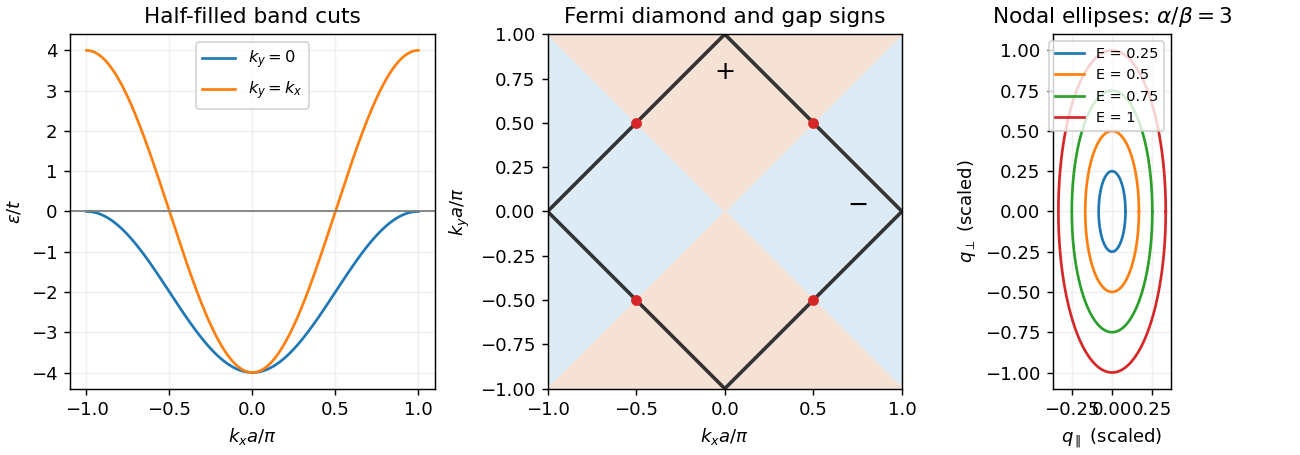
Half-filled square-lattice band cuts, diamond Fermi surface and anisotropic nodal quasiparticle contours
. Details. Near the specified node define andExpanding giveswhere and . ThereforeThere are four such nodes. An energy contour about one node encloses momentum area . Counting all four nodes and two independent spin quasiparticles, with one state per of momentum area per unit real-space area, gives the positive-excitation count and nodal quasiparticle density of states in a two-dimensional d-wave superconductorThis counts thermally excitable Bogoliubov modes, including particle-like and hole-like excitations, not the electron-addition spectral density alone. That distinction prevents a factor-of-two ambiguity. It is a per-layer result; dividing by the layer spacing gives the corresponding volume density in the independent-layer approximation.
The thermal energy density above its zero-temperature value follows from Fermi occupation:ThusThis clean nodal contribution assumes small compared with the scale over which linearization fails; impurity states and other excitations can add further terms.
In the vortex state, each flux quantum occupies area of order , so . Outside a core of radius , the phase flow has magnitude in the simple circular-cell estimate, with and condensed-pair mass . Its cell average isThe signed vector average can vanish around a vortex; the relevant quantity is a typical magnitude or Doppler shift, not a net transport velocity. Flow shifts nodal energies by order . Because the zero-field nodal density of states is linear in energy, averaging the magnitude of these shifts produces a residual density of states proportional to . The resulting Volovik effect givesThis is the clean semiclassical nodal regime, at temperatures below the field-induced Doppler scale and in an appropriate mixed-state field range. Core states, disorder, Zeeman splitting and screening can modify it. Its replacement by a square root of applied field additionally assumes the mean induction tracks that field away from the lower-critical-field onset; it is not an exact all-field law.
Past exam of the soft matter and biological physics course of the University of Cambridge 2012 Paper 1 2 Solution by Codex 0 2026-10-20
Codex 0 2026-10-20 Past exam of the soft matter and biological physics course of the University of Cambridge 2012 Paper 1 1 Solution by Codex 0 2026-10-20
Codex 0 2026-10-20resistive-pulse sensing detects the change in a conducting aperture's electric current as a particle crosses it. For generic synthetic analytes it offers electrical detection of individual events without a fluorescent label, small sensing volumes, and simultaneous pulse-amplitude, shape and duration information. Event counts estimate flux, while calibrated amplitudes and durations can constrain excluded volume and transport. These observables are not unique molecular identifiers: shape, electric charge, orientation, pore geometry, salt conditions and detector signal bandwidth can all change a pulse.
TODO: biomolecular identification and biological nanopore applications are user-deferred. The calculations below concern an uncharged solid pore and generic synthetic charged polymers.
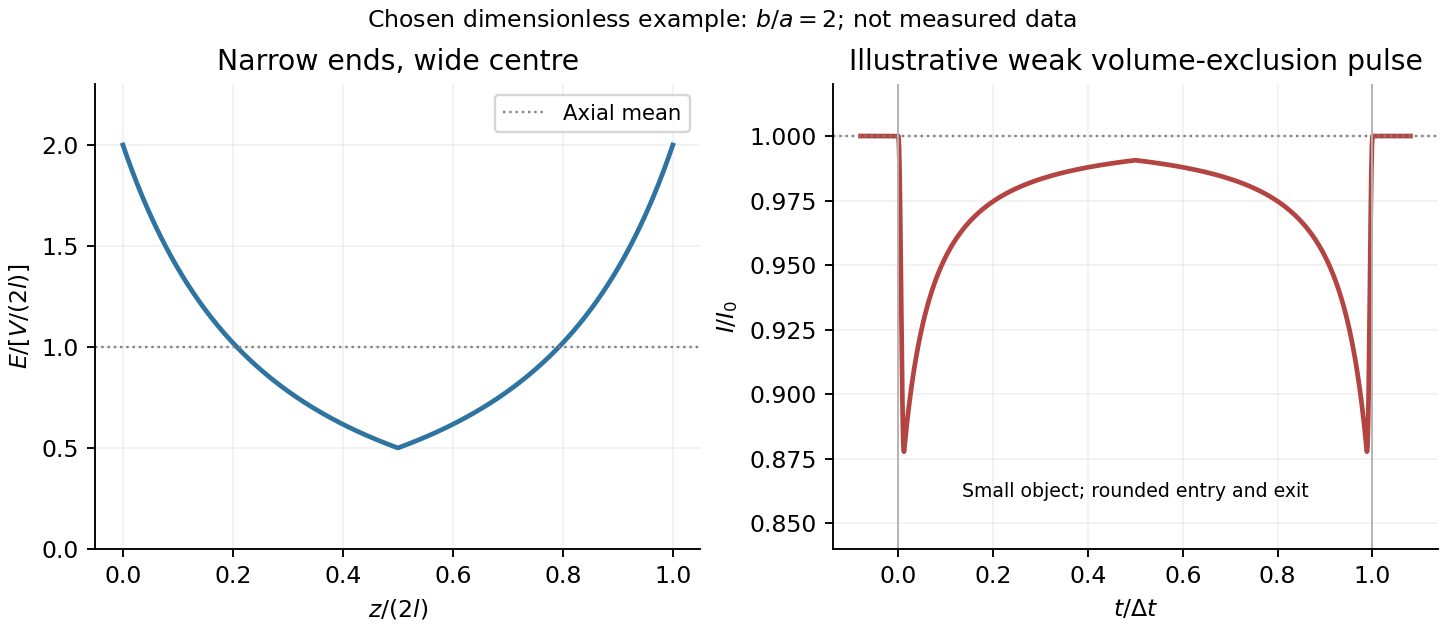
The original cross-section has radius at both ends and radius midway through. In the intended one-dimensional series-resistance approximation, put andFor constant ionic electrical resistivity , a slice contributes . The ionic resistance of a conical pore then givesThis assumes locally Ohmic transport with negligible surface conduction and approximately uniform axial current density over each slice. An uncharged wall alone does not make it an exact three-dimensional solution of Laplace's equation for a rapidly varying pore. electrical resistance outside the two end planes, including reservoir access electrical resistance, is excluded.
Take as the potential drop inside the pore, so positive electric current flows along . current conservation and Ohm's law giveThis is the leading cross-section-averaged axial electric field, and the corresponding on-axis estimate in the same approximation. It is largest at the two narrow ends and smallest at the wide centre:The graph is symmetric, falls on the first half and rises on the second, with a minimum at . The electric potential difference check is . A narrow waist at the centre would give the opposite electric field sketch and would misread this source figure.
Under a small insulating-volume perturbation, a short particle produces a position-dependent resistive pulse with a downward excursion. If its excluded volume is and small compared with the local sensing volume, a local volume-exclusion model gives . Thus is strongest near either narrow end. A sufficiently resolved event can show two deeper end features separated by a shallower middle depression, then return to baseline. Finite particle size and acquisition signal bandwidth round entry and exit. The original illustration below shows this conditional small-particle mechanism, not a fitted amplitude. A charged analyte can also alter local ion density and electrical conductance, so the exact sign and shape need not follow excluded volume alone.


For positive drift in this coordinate, require . The electrophoretic transit time in a conical pore is the integral of inverse local drift speed:ThereforeReverse the polarity or use when reporting a positive transit duration in the opposite direction. The limit is regular: , equal to length divided by uniform drift speed. Also , so nonuniform electric field makes this point-particle transit no faster than the uniform-field value at the same length and electric potential difference. The wide, weak-field interior dominates residence time.
The final length-dependent observations do not uniquely identify a microscopic mechanism. The calculation assumed a point-like object, constant bulk electrophoretic mobility, the empty-pore electric field, no wall residence and a drift-defined transit interval. An extended chain can sample entrance and reservoir fields simultaneously, alter its conformation and tension, and change the effective driving-to-friction ratio. These effects can make a bulk-mobility, local-field prediction underestimate the driving. For a small object, wall interactions, reversible trapping, or repeated entry excursions can add residence time that the deterministic formula omits. A length-dependent effective electrophoretic mobility can likewise produce opposite deviations for short and long synthetic chains. Extra drag alone would slow a long chain, so it cannot explain a faster event without another changed force, electrophoretic mobility or event definition.
Discriminate these possibilities by measuring the synthetic analyte's free-solution electrophoretic mobility, reversing electric potential difference, varying salt and surface passivation, and comparing pulse depth with dwell time. Resolved multiple occupancy or folds can alter amplitude as well as timing. Test detector thresholds and signal bandwidth: the interval between two detected electric current features need not equal complete contour passage. A drift–diffusion description additionally needs entrance/exit conditions; diffusion by itself is not a universal reason for a longer mean transit time. No unique anomalous-duration prediction follows from the provided parameters alone.
There are unlisted articles, also show them or only show them.