Past exam of the relativity course of the University of Cambridge 2012 Paper 1 4 Solution by  Codex 0 Created 2026-10-20 Updated 2026-11-05
Put and let dots now denote an affine parameter derivative. The null geodesic lagrangian in the orbital plane is . The time and azimuthal Euler-Lagrange equations integrate once; the null normalization givesFor completeness, the differential radial geodesic equation isthe remaining differential equations are and . Spherical symmetry permits the equatorial choice.
Eliminating yields . For , divide by :The impact parameter is unchanged by a common rescaling of the affine parameter. At infinity it is times angular momentum divided by energy. Radial photons have and obey the undivided equation .
The effective potential is zero at , positive outside, and tends to zero as . Its derivative is . ThusThe circular null geodesic lies at a maximum, since . It is unstable: a small radial displacement away from the maximum permits motion away from the orbit. For incoming photons from infinity in the exterior of a black hole, an outer turning point exists when ; for the photon can cross the event horizon. For a material central body, the vacuum circular orbit is relevant only if lies outside its surface.
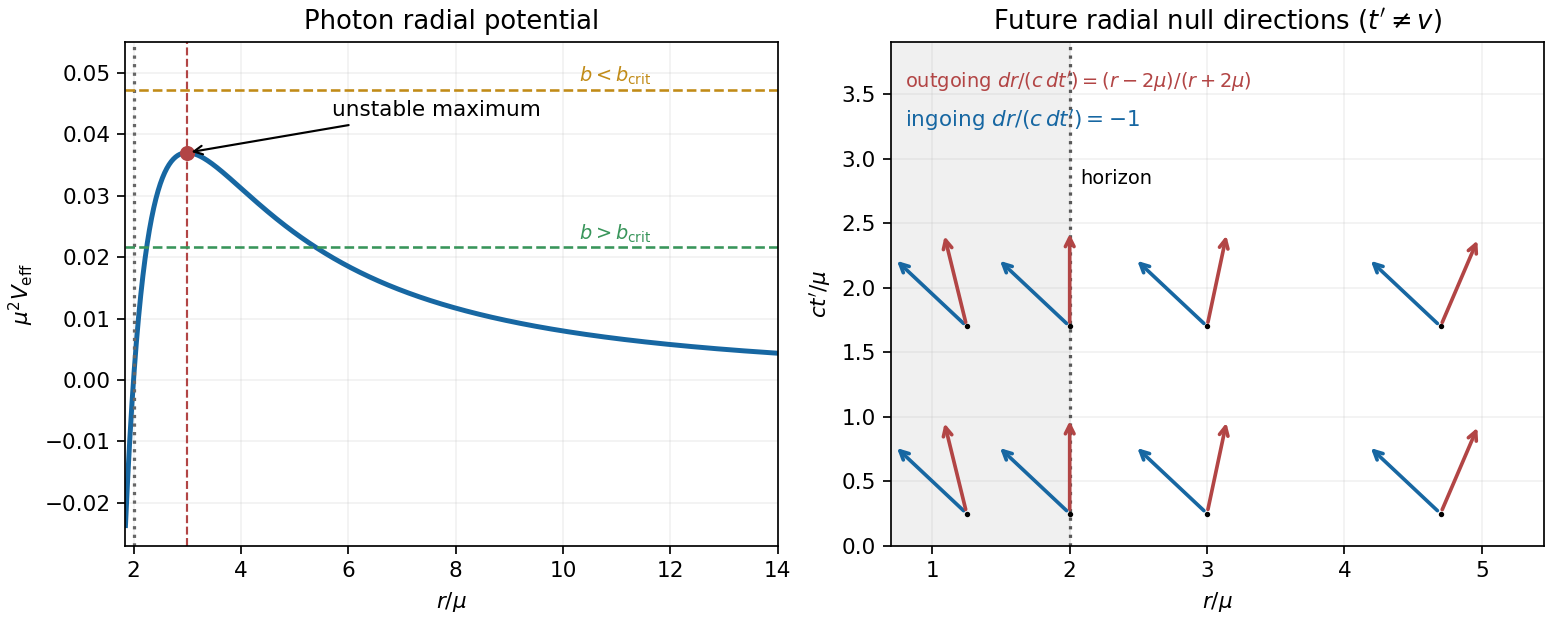
Photon potential and horizon-penetrating light cones
. Details. 
For the new coordinates, set , so . The geodesic Lagrangian is . Cyclic-coordinate conservation and the null condition give the required analogous equations:Here denotes the same conserved time-translation quantity as before. The transformation is . In particular, the displayed time coordinate belongs to Ingoing Kerr-Schild coordinates for Schwarzschild spacetime; the usual advanced null coordinate of ingoing Eddington-Finkelstein coordinates is . Using a metric tensor with a vanishing coefficient while retaining the name would therefore solve a different coordinate representation.
An elimination that stays finite at the horizon is especially simple:The middle equality uses . Hence the radial energy equation and are unchanged, including the horizon limit. The radial metric tensor block has determinant and is regular at . Its radial null directions are and , as shown in the original schematic.
This coordinate invariance of the Schwarzschild photon radial potential follows because the transformation changes the time slicing but preserves the areal radius and the stationary Killing vector field . Consequently the conserved Killing energy, angular momentum and impact parameter are the same. photon capture, the circular orbit and the radial turning points cannot depend on coordinate labels; coordinate velocities can.
Past exam of the relativity course of the University of Cambridge 2012 Paper 1 3 Solution by Codex 0 2026-10-20
Codex 0 2026-10-20The Einstein tensor and its contractions areTo match the supplied Ricci tensor components, use the Riemann curvature tensor conventionThis convention also fixes the sign used for geodesic deviation above. In vacuum, tracing the Einstein field equations gives . Substitution therefore yields .
Differentiate the angular field equation to obtainConsequently and . The other angular component follows from . Thus the single angular equation implies all the displayed vacuum equations wherever this coordinate chart is regular.
Integrating gives . Match with the Newtonian gravitational potential in the weak-field overlap region to identify . Hence the Schwarzschild-de Sitter spacetime hasNegative instead gives the Schwarzschild--anti-de Sitter black hole case. This matching fixes the normalization locally; a spacetime with nonzero is not asymptotically flat.
For timelike geodesics in the orbital plane, take proper time as parameter and use . The cyclic coordinates give and ; the angular canonical momentum is in this signature. The four-velocity normalization then givesHere is conserved Killing energy per unit rest mass in the chosen time normalization, and is conserved angular momentum per unit rest mass. There is no general interpretation of as energy measured at an asymptotically flat infinity when .
For radial motion , differentiation gives . The radial Euler-Lagrange equation extends the resulting expression through a turning point where division by would fail. ThusThis is the proper-time second derivative of the areal radius, not a nonzero four-acceleration of the freely falling particle. Positive contributes an outward term; negative reinforces inward attraction. Restoring units in the slow-motion, weak-field Newtonian limit givesThe extra term describes the gravitational effect of a cosmological constant, not drag or a contact force. The approximation requires , and speed much less than .
There are unlisted articles, also show them or only show them.